


Neath

Encyclopedia
Neath is a town and community
situated in the principal area of Neath Port Talbot
, Wales
, UK with a population of approximately 45,898 in 2001. The town is located on the river of the same name
, 7 miles (11.3 km) east northeast of Swansea
.
of the River Neath
and has existed as a settlement since the Romans
established the fort of Nido or Nidum
in the AD 70s. The Roman fort took its name from the River Nedd; the meaning is obscure but 'shining' or simply 'river' have been suggested. Neath is the Anglicised form. The Antonine Itinerary
(c. 2nd century) names only nine places in Roman Wales, one of them being Neath. There is evidence of undated prehistoric settlements on the hills surrounding the town, which were probably Celt
ic. The fort covered a large area which now lies under the playing fields of Dŵr-y-Felin Comprehensive School. In the late 1960s, there were reports in the local media of a massive Roman marching camp being found above Llantwit which would have accommodated many thousands of troops.
St Illtyd
visited the Neath area and established a settlement in what is now known as Llantwit on the northern edge of the town. The church of St. Illtyd was built at this settlement and was enlarged in Norman
times. The Norman
and pre Norman church structure remains intact and active to day within the Church in Wales
. The Welsh language
name for Neath is Castell-nedd, referring to the Norman Neath Castle, which is close to the shopping centre.
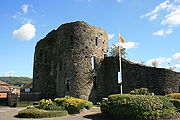 Neath was a market town
that expanded with the arrival of the Industrial Revolution
in the 18th century with new manufacturing industries of iron
, steel
and tinplate. The Mackworth family
, who owned the Gnoll Estate were prominent in the town's industrial development. Coal
was mined extensively in the surrounding valleys and the construction of canal
s and railways made Neath a major transportation centre and the Evans & Bevan families were major players in the local coal mining community as well as owning the Vale of Neath Brewery. Silica was mined in the Craig-y-Dinas area of Pontneddfechan, after Quaker entrepreneur William Weston Young
invented the blast furnace
silica firebrick, later moving brick production from the works at Pontwalby to the Green in Neath. The town continued as a market trading centre with a municipal cattle market run by W.B.Trick. Industrial development continued throughout the 20th century with the construction by British Petroleum of a new petroleum
refinery at Llandarcy
.
Admiral Lord Nelson
stayed at the Castle Hotel en route to Milford Haven
when the fleet was at anchor there. Lt. Lewis Roatley, the son of the landlord of the Castle Hotel, served as a Royal Marines
officer with Admiral Lord Nelson aboard in the Battle of Trafalgar
.
The River Neath
is a navigable estuary
and Neath was a river port until recent times. The heavy industries are no more with the town being a commercial and tourism centre. Attractions for visitors are the ruins of the Cistercian Neath Abbey
, the Gnoll Park and Neath Indoor Market
.
Neath hosted the National Eisteddfod of Wales
in 1918, 1934 and 1994.
Neath is also home to the Trade Centre Wales
, also the Bay Radio studios.
was formed at a meeting held at the Castle Hotel in 1881. Neath Rugby Football Club
, the famous and very successful "Welsh All Blacks", play at The Gnoll
who have managed to win 4 consecutive titles in the Semi Professional Principality Premiership and 3 Swalec Cup titles (Previously known as Schweppes and Konica Minolta Cups) and are now competing in a new competition The British and Irish Cup founded in 2009. Neath RFC still hold the World Records for most points scored in a season and most tries scored in a season which are unlikely to ever be beaten..
Motorcycle speedway
was staged at the Abbey Stadium in Neath in 1962. The Welsh Dragons, led by New Zealand
er Trevor Redmond
, raced with some success in the Provincial League
but, because of local problems, a number of the "home" fixtures were raced at St Austell
. The Dragons introduced the Australia
n rider Charlie Monk to British speedway. After a season at Long Eaton Archers
, Monk went on to have considerable success at Glasgow
. The team also featured South African Howdy Cornell. In the early 1960s there was also stock car racing held at Neath Abbey, opposite the monastery
Neath Athletic A.F.C.
is the town's largest football team
, playing at Neath RFC
's ground, the Gnoll
and play in the top-flight of Welsh football, the Welsh Premier League. In the 2006-07 season, Neath Athletic A.F.C. gained promotion from the Welsh Football League
First Division, and to the Welsh Premier League. Neath Athletic A.F.C. get on average, 300 supporters attending a domestic, Welsh Premier League game, which is normal with the rest of the Welsh Premier League.
South Wales Scorpions
are a newly formed rugby league
team who will play their games at the Gnoll
for the 2010 Championship 1
.
of Neath Port Talbot
on April 1, 1996. The town encompasses the electoral wards of Neath East
, Neath North
and Neath South
.
Neath and the surrounding area is represented at Westminster by Peter Hain
MP
(Labour
) and in the National Assembly for Wales
by Gwenda Thomas
AM
(Labour
).
and Wales, Neath experiences a maritime climate with cool summers and mild winters, often high winds, and low sunshine levels.
is situated in the outskirts of the town as is a campus of Neath Port Talbot College
(which was previously Neath College). There is also the Cefn Saeson Comprehensive School situated in the village of Cimla
near the Crynallt Primary School. Two other comprehensive schools serve the town, Llangatwg Comprehensive School in Cadoxton
and Cwrt Sart Comprehensive School in Briton Ferry
. Primary schools include Crynallt Primary School in Cimla, Alderman Davies Church in Wales Primary School in Neath, Gnoll Primary School in Neath, Melin Infant and Junior schools,Ysgol Gynradd Castell Nedd, Mynachlog Nedd Junior School in Skewen, Tonnau Primary School in Tonna, Tonmawr Primary School in Tonmawr, Catwg Primary School in Cadoxton, Wauncierch primary school situated in Wauncierch and Ynysmardey Primary School located in Briton Ferry. Also Neath College is located in the area of Neath (Opposite Dwr-Y-Felin). The college offers courses on a part-time or full-time basis.
at Neath railway station
, on Windsor Road, in the heart of the town. Services operate to Port Talbot
, Bridgend
, Cardiff Central
, Newport
, Bristol Parkway
and London Paddington
to the east and Swansea
, Carmarthen
and West Wales
to the west. Services also operate to Shrewsbury
and Manchester Piccadilly.
Neath bus station
is at Victoria Gardens, A five minute walk from the railway station. National Express
services call at Neath at the railway station.
From Victoria Gardens, First Cymru
provides direct inter-urban services to nearby Swansea
and Port Talbot
in addition to South Wales Transport who provide many similar local services. The A465
skirts the town to the north east and provides a link to the M4
.
in the near future. The site once occupied by the previous civic centre will be redeveloped as a new shopping centre. The Gwyn Hall
will be rebuilt after having been gutted by a fire. The area around the Milland Road Industrial Estate will be redeveloped along with the area around the Neath Canal. On 27 November 2008, proposals for an "iconic" golden rugby ball-shaped museum, a library, heritage centre and other new facilities were announced for consultation. The developer, Simons Estates, says that it plans to start construction when the economic climate improves.
In March 2008, the county's new radio station, Afan FM
, announced plans to turn on a new transmitter dedicated to the Neath area in the summer. This will transmit on 97.4 FM, and will give residents of Neath their first taste of the borough's new local radio station, which already transmits to the neighbouring area of Port Talbot
on 107.9 FM. The new transmitter for the Neath area was commissioned by Government regulator Ofcom
on Thursday 23 October 2008.
Community (Wales)
A community is a division of land in Wales that forms the lowest-tier of local government in Wales. Welsh communities are analogous to civil parishes in England....
situated in the principal area of Neath Port Talbot
Neath Port Talbot
Neath Port Talbot is a county borough and one of the unitary authority areas of Wales. Neath Port Talbot is the 8th most populous county in Wales and the third most populous county borough....
, Wales
Wales
Wales is a country that is part of the United Kingdom and the island of Great Britain, bordered by England to its east and the Atlantic Ocean and Irish Sea to its west. It has a population of three million, and a total area of 20,779 km²...
, UK with a population of approximately 45,898 in 2001. The town is located on the river of the same name
River Neath
River Neath is a river in south Wales running south west from its source in the Brecon Beacons National Park to its mouth at Baglan Bay below Briton Ferry on the east side of Swansea Bay.Several minor rivers rise on the southern slopes of Fforest Fawr...
, 7 miles (11.3 km) east northeast of Swansea
Swansea
Swansea is a coastal city and county in Wales. Swansea is in the historic county boundaries of Glamorgan. Situated on the sandy South West Wales coast, the county area includes the Gower Peninsula and the Lliw uplands...
.
History
Historically, Neath was the crossing placeFord (crossing)
A ford is a shallow place with good footing where a river or stream may be crossed by wading or in a vehicle. A ford is mostly a natural phenomenon, in contrast to a low water crossing, which is an artificial bridge that allows crossing a river or stream when water is low.The names of many towns...
of the River Neath
River Neath
River Neath is a river in south Wales running south west from its source in the Brecon Beacons National Park to its mouth at Baglan Bay below Briton Ferry on the east side of Swansea Bay.Several minor rivers rise on the southern slopes of Fforest Fawr...
and has existed as a settlement since the Romans
Roman Britain
Roman Britain was the part of the island of Great Britain controlled by the Roman Empire from AD 43 until ca. AD 410.The Romans referred to the imperial province as Britannia, which eventually comprised all of the island of Great Britain south of the fluid frontier with Caledonia...
established the fort of Nido or Nidum
Nidum
Nidum is a Roman fort found near the town of Neath, in Wales. Artifacts from the site are on permanent exhibition in the Neath Museum.-External links:*...
in the AD 70s. The Roman fort took its name from the River Nedd; the meaning is obscure but 'shining' or simply 'river' have been suggested. Neath is the Anglicised form. The Antonine Itinerary
Antonine Itinerary
The Antonine Itinerary is a register of the stations and distances along the various roads of the Roman empire, containing directions how to get from one Roman settlement to another...
(c. 2nd century) names only nine places in Roman Wales, one of them being Neath. There is evidence of undated prehistoric settlements on the hills surrounding the town, which were probably Celt
Celt
The Celts were a diverse group of tribal societies in Iron Age and Roman-era Europe who spoke Celtic languages.The earliest archaeological culture commonly accepted as Celtic, or rather Proto-Celtic, was the central European Hallstatt culture , named for the rich grave finds in Hallstatt, Austria....
ic. The fort covered a large area which now lies under the playing fields of Dŵr-y-Felin Comprehensive School. In the late 1960s, there were reports in the local media of a massive Roman marching camp being found above Llantwit which would have accommodated many thousands of troops.
St Illtyd
Illtud
Illtyd , was a Welsh saint, founder and abbot of Llanilltud Fawr in the Welsh county of Glamorgan...
visited the Neath area and established a settlement in what is now known as Llantwit on the northern edge of the town. The church of St. Illtyd was built at this settlement and was enlarged in Norman
Norman conquest of England
The Norman conquest of England began on 28 September 1066 with the invasion of England by William, Duke of Normandy. William became known as William the Conqueror after his victory at the Battle of Hastings on 14 October 1066, defeating King Harold II of England...
times. The Norman
Norman architecture
About|Romanesque architecture, primarily English|other buildings in Normandy|Architecture of Normandy.File:Durham Cathedral. Nave by James Valentine c.1890.jpg|thumb|200px|The nave of Durham Cathedral demonstrates the characteristic round arched style, though use of shallow pointed arches above the...
and pre Norman church structure remains intact and active to day within the Church in Wales
Church in Wales
The Church in Wales is the Anglican church in Wales, composed of six dioceses.As with the primus of the Scottish Episcopal Church, the Archbishop of Wales serves concurrently as one of the six diocesan bishops. The current archbishop is Barry Morgan, the Bishop of Llandaff.In contrast to the...
. The Welsh language
Welsh language
Welsh is a member of the Brythonic branch of the Celtic languages spoken natively in Wales, by some along the Welsh border in England, and in Y Wladfa...
name for Neath is Castell-nedd, referring to the Norman Neath Castle, which is close to the shopping centre.
Market town
Market town or market right is a legal term, originating in the medieval period, for a European settlement that has the right to host markets, distinguishing it from a village and city...
that expanded with the arrival of the Industrial Revolution
Industrial Revolution
The Industrial Revolution was a period from the 18th to the 19th century where major changes in agriculture, manufacturing, mining, transportation, and technology had a profound effect on the social, economic and cultural conditions of the times...
in the 18th century with new manufacturing industries of iron
Iron
Iron is a chemical element with the symbol Fe and atomic number 26. It is a metal in the first transition series. It is the most common element forming the planet Earth as a whole, forming much of Earth's outer and inner core. It is the fourth most common element in the Earth's crust...
, steel
Steel
Steel is an alloy that consists mostly of iron and has a carbon content between 0.2% and 2.1% by weight, depending on the grade. Carbon is the most common alloying material for iron, but various other alloying elements are used, such as manganese, chromium, vanadium, and tungsten...
and tinplate. The Mackworth family
Mackworth Baronets
There have been two Baronetcies created for persons with the surname Mackworth, one in the Baronetage of England and one in the Baronetage of Great Britain. One creation is extant as of 2008....
, who owned the Gnoll Estate were prominent in the town's industrial development. Coal
Coal
Coal is a combustible black or brownish-black sedimentary rock usually occurring in rock strata in layers or veins called coal beds or coal seams. The harder forms, such as anthracite coal, can be regarded as metamorphic rock because of later exposure to elevated temperature and pressure...
was mined extensively in the surrounding valleys and the construction of canal
Canal
Canals are man-made channels for water. There are two types of canal:#Waterways: navigable transportation canals used for carrying ships and boats shipping goods and conveying people, further subdivided into two kinds:...
s and railways made Neath a major transportation centre and the Evans & Bevan families were major players in the local coal mining community as well as owning the Vale of Neath Brewery. Silica was mined in the Craig-y-Dinas area of Pontneddfechan, after Quaker entrepreneur William Weston Young
William Weston Young
William Weston Young Quaker Entrepreneur of Bristol and Glamorganshire; artist, botanist, wreck-raiser, surveyor, potter, and inventor of the firebrick....
invented the blast furnace
Blast furnace
A blast furnace is a type of metallurgical furnace used for smelting to produce industrial metals, generally iron.In a blast furnace, fuel and ore and flux are continuously supplied through the top of the furnace, while air is blown into the bottom of the chamber, so that the chemical reactions...
silica firebrick, later moving brick production from the works at Pontwalby to the Green in Neath. The town continued as a market trading centre with a municipal cattle market run by W.B.Trick. Industrial development continued throughout the 20th century with the construction by British Petroleum of a new petroleum
Petroleum
Petroleum or crude oil is a naturally occurring, flammable liquid consisting of a complex mixture of hydrocarbons of various molecular weights and other liquid organic compounds, that are found in geologic formations beneath the Earth's surface. Petroleum is recovered mostly through oil drilling...
refinery at Llandarcy
Llandarcy
Llandarcy is a village near Neath in Neath Port Talbot county borough, southwest Wales, and formerly the site of the UK's first oil refinery. The village, which lies near the Junction 43 of the M4 Motorway, was originally designed as a garden village to house the workers for the refinery, built by...
.
Admiral Lord Nelson
Horatio Nelson, 1st Viscount Nelson
Horatio Nelson, 1st Viscount Nelson, 1st Duke of Bronté, KB was a flag officer famous for his service in the Royal Navy, particularly during the Napoleonic Wars. He was noted for his inspirational leadership and superb grasp of strategy and unconventional tactics, which resulted in a number of...
stayed at the Castle Hotel en route to Milford Haven
Milford Haven
Milford Haven is a town and community in Pembrokeshire, Wales. It is situated on the north side of the Milford Haven Waterway, a natural harbour used as a port since the Middle Ages. The town was founded in 1790 on the north side of the Waterway, from which it takes its name...
when the fleet was at anchor there. Lt. Lewis Roatley, the son of the landlord of the Castle Hotel, served as a Royal Marines
Royal Marines
The Corps of Her Majesty's Royal Marines, commonly just referred to as the Royal Marines , are the marine corps and amphibious infantry of the United Kingdom and, along with the Royal Navy and Royal Fleet Auxiliary, form the Naval Service...
officer with Admiral Lord Nelson aboard in the Battle of Trafalgar
Battle of Trafalgar
The Battle of Trafalgar was a sea battle fought between the British Royal Navy and the combined fleets of the French Navy and Spanish Navy, during the War of the Third Coalition of the Napoleonic Wars ....
.
The River Neath
River Neath
River Neath is a river in south Wales running south west from its source in the Brecon Beacons National Park to its mouth at Baglan Bay below Briton Ferry on the east side of Swansea Bay.Several minor rivers rise on the southern slopes of Fforest Fawr...
is a navigable estuary
Estuary
An estuary is a partly enclosed coastal body of water with one or more rivers or streams flowing into it, and with a free connection to the open sea....
and Neath was a river port until recent times. The heavy industries are no more with the town being a commercial and tourism centre. Attractions for visitors are the ruins of the Cistercian Neath Abbey
Neath Abbey
Neath Abbey was a Cistercian monastery, located near the present-day town of Neath in southern Wales, UK.It was once the largest abbey in Wales. Substantial ruins can still be seen, and are in the care of Cadw...
, the Gnoll Park and Neath Indoor Market
Neath Indoor Market
Neath Indoor Market is an indoor market located in the town centre of Neath, Wales.The market building dates back to 1837. It was renovated in 1904...
.
Neath hosted the National Eisteddfod of Wales
National Eisteddfod of Wales
The National Eisteddfod of Wales is the most important of several eisteddfodau that are held annually, mostly in Wales.- Organisation :...
in 1918, 1934 and 1994.
Neath is also home to the Trade Centre Wales
Trade Centre Wales
The Trade Centre Wales is a used car sales company located in Neath, Wales just off the M4. The claim that they are the suppliers of 'Probably the UKs Cheapest Cars'.-£5k Fine, Bald Tyre - Court Proceeding:...
, also the Bay Radio studios.
Notable people
- See :Category:People from Neath
- Samuel Charles Silkin, Baron Silkin of Dulwich (1918–1988), barrister and politician;
- Clayton BlackmoreClayton BlackmoreClayton Graham Blackmore is a former Welsh international footballer. He was a combative player known for his attacking free kicks and a utility player who excelled at full back and in central defence but could play equally well in midfield or as an emergency forward.-Career:Blackmore once had...
(1964- ), the former Manchester United and WalesWales national football teamThe Wales national football team represents Wales in international football. It is controlled by the Football Association of Wales , the governing body for football in Wales, and the third oldest national football association in the world. The team have only qualified for a major international...
international; - Michael BogdanovMichael BogdanovMichael Bogdanov , is a British theatre director known for his work with new plays, modern reinterpretations of Shakespeare, musicals and work for Young People.-Early years:...
(1938- ), international theatre director; - Mark Bowen (1963- , b. Briton Ferry), deputy manager of Fulham FC, and formerly a player with Spurs and Norwich City;
- Richard BurtonRichard BurtonRichard Burton, CBE was a Welsh actor. He was nominated seven times for an Academy Award, six of which were for Best Actor in a Leading Role , and was a recipient of BAFTA, Golden Globe and Tony Awards for Best Actor. Although never trained as an actor, Burton was, at one time, the highest-paid...
(1925–1984, b. PontrhydyfenPontrhydyfenPontrhydyfen is a small village in the Afan Valley, in Neath Port Talbot county borough in Wales.-Location:It is situated in the Afan Valley at , at the confluence of the River Afan and the smaller Afon Pelenna, 1.8 miles north of the larger village of Cwmafan and not far from the towns of Port...
), actor; - Hugh DaltonHugh DaltonEdward Hugh John Neale Dalton, Baron Dalton PC was a British Labour Party politician who served as Chancellor of the Exchequer from 1945 to 1947, when he was implicated in a political scandal involving budget leaks....
(1887–1962, b. Gnoll), LabourLabour Party (UK)The Labour Party is a centre-left democratic socialist party in the United Kingdom. It surpassed the Liberal Party in general elections during the early 1920s, forming minority governments under Ramsay MacDonald in 1924 and 1929-1931. The party was in a wartime coalition from 1940 to 1945, after...
politician, Chancellor of the ExchequerChancellor of the ExchequerThe Chancellor of the Exchequer is the title held by the British Cabinet minister who is responsible for all economic and financial matters. Often simply called the Chancellor, the office-holder controls HM Treasury and plays a role akin to the posts of Minister of Finance or Secretary of the...
from 1945-1947. - Sir Clifford Darby (1909–1992), geographer, ex-vice-president of the British Academy;
- David DaviesDavid Harris DaviesDavid Harris Davies was a Welsh international rugby union forward who played club rugby for Neath and county rugby for Glamorgan...
, famed chief test pilot of the UK's Civil Aviation Authority and author of classic book Handling the Big Jets; - Ivor EmmanuelIvor EmmanuelIvor Lewis Emmanuel was a Welsh musical theatre and television singer and actor. He led the rendition of "Men of Harlech" in the 1964 film Zulu.-Life and career:...
(1927–2007), singer and actor; - Craig EvansCraig Evans (Welsh cricketer)Craig Evans is a former Welsh cricketer. Evans was a right-handed batsman who bowled right-arm off break. He was born in Neath, Glamorgan....
(born 1971), cricketer; - Rebecca EvansRebecca EvansRebecca Evans is a Welsh operatic soprano.-Personal life:Born in the village of Pontrhydyfen near Neath, the same village as Hollywood actor Richard Burton....
(1963- , b. Pontrhydyfen), soprano; - Sir Samuel Thomas EvansSamuel Thomas EvansSir Samuel Thomas Evans GCB PC QC , was a Welsh barrister, judge and Liberal politician.-Background and education:...
(1859–1918, b. Skewen), politician and judge; - George Grant FrancisGeorge Grant Francis-Life:Francis was the eldest son of John Francis of Swansea, Glamorganshire, by his wife, Mary Grant, and was born there in January 1814. He was educated at the Swansea high school....
(1814–1822, b. Swansea) historian who wrote Original Charters and Materials for a History of Neath (1845); - Julie GardnerJulie GardnerJulie Gardner is a Welsh television producer. Her most prominent work has been serving as executive producer on the 2005 revival of Doctor Who and its spin-off shows Torchwood and The Sarah Jane Adventures...
(1969- ), television producer previously responsible for Doctor WhoDoctor WhoDoctor Who is a British science fiction television programme produced by the BBC. The programme depicts the adventures of a time-travelling humanoid alien known as the Doctor who explores the universe in a sentient time machine called the TARDIS that flies through time and space, whose exterior...
and its spin-off TorchwoodTorchwoodTorchwood is a British science fiction television programme created by Russell T Davies. The series is a spin-off from Davies's 2005 revival of the long-running science fiction programme Doctor Who. The show has shifted its broadcast channel each series to reflect its growing audience, moving from...
, now executive producer of scripted projects at BBC WorldwideBBC WorldwideBBC Worldwide Limited is the wholly owned commercial subsidiary of the British Broadcasting Corporation, formed out of a restructuring of its predecessor BBC Enterprises in 1995. In the year to 31 March 2010 it made a profit of £145m on a turnover of £1.074bn. The company had made a profit of £106m...
; - Richard GrantRichard Grant (cricketer)Richard Neil Grant is a former Welsh cricketer. Grant is a right-handed batsman who bowls right-arm medium pace. He was born at Neath, Glamorgan and was educated at Cefn Saeson Comprehensive and Neath Port Talbot College....
(born 1984), cricketer - Carl Harris (1956- ), the former Leeds United and Wales international;
- Sir Gilmour Jenkins (1894–1981), civil servant and amateur musician, ex-Vice President of the Royal Academy of MusicRoyal Academy of MusicThe Royal Academy of Music in London, England, is a conservatoire, Britain's oldest degree-granting music school and a constituent college of the University of London since 1999. The Academy was founded by Lord Burghersh in 1822 with the help and ideas of the French harpist and composer Nicolas...
; - Cecil GriffithsCecil GriffithsCecil Redvers Griffiths was a Welsh athlete.- Olympic Gold Medal 1920 :Cecil Griffiths was a winner of the Olympic Gold medal in 4 x 400m relay at the 1920 Summer Olympics....
(1901–1945), winner of an Olympic gold medal in the 4x400m relay at the 1920 Antwerp Olympics1920 Summer OlympicsThe 1920 Summer Olympics, officially known as the Games of the VII Olympiad, were an international multi-sport event in 1920 in Antwerp, Belgium....
; - Katherine JenkinsKatherine JenkinsKatherine Jenkins is a Welsh mezzo-soprano. She is a classical-popular crossover singer who performs across a spectrum of operatic arias, popular songs, musical theatre and hymns.-Early life and education:...
(1980- ), popular classical mezzo-soprano; - Della JonesDella JonesDella Jones , is a Welsh mezzo-soprano, particularly well-known for her interpretations of works by Handel, Mozart, Rossini, Donizetti, and Britten.-Life and career:Della Jones was born in Tonna, near Neath, Wales...
(1946, b. Tonna), mezzo-soprano; - Geraint F. LewisGeraint F. LewisGeraint F. Lewis is a Welsh-born astrophysicist , who is best known for his work on dark energy, gravitational lensing and galactic cannibalism. Lewis is a Professor of Astrophysics at the Sydney Institute for Astronomy, part of the University of Sydney's School of Physics...
(1969- ), leading astrophysicist; - Andy LeggAndy LeggAndrew "Andy" Legg is a Welsh footballer and Wales international who is currently player-manager of Welsh Premier League side Llanelli. He has previously played for Swansea City, Notts County, Birmingham City, Ipswich Town, Reading, Peterborough United, Cardiff City and Newport County...
(1966- ), former professional footballer and Wales international; - Jessie Penn-LewisJessie Penn-LewisJessie Penn-Lewis was a Welsh evangelical speaker and author of a number of Christian evangelical works.-Early life:Penn-Lewis was born in Victoria Terrace, Neath in 1861. Her father was a Methodist minister...
(1861–1927), missioner and revivalist; - Tony LewisTony LewisAnthony Robert Lewis CBE is a former Welsh cricketer, who went on to become the face of BBC Television cricket coverage in the 1990s, and become president of the MCC. Lewis attended Christ's College, Cambridge and played for Cambridge University. He also played county cricket for Glamorgan, and...
(1936- , b. Swansea), former England cricket captain, writer and broadcaster; - Thomas Leyson (1549-c. 1608), Latin and Welsh poet and physician;
- Andrew Matthews-OwenAndrew Matthews-OwenAndrew Matthews-Owen is a Welsh pianist and accompanist. He was born at Neath, Wales and now lives in LondonMatthews-Owen studied at the University of Wales, Cardiff and the Royal Academy of Music supported by scholarships from the Rayne Foundation and Sir Edward Heath...
, pianist; - Ray MillandRay MillandRay Milland was a Welsh actor and director. His screen career ran from 1929 to 1985, and he is best remembered for his Academy Award–winning portrayal of an alcoholic writer in The Lost Weekend , a sophisticated leading man opposite a corrupt John Wayne in Reap the Wild Wind , the murder-plotting...
(1907–1986), Oscar winning Hollywood actor; - David Watts MorganDavid Watts MorganDavid Watts Morgan CBE DSO JP was a Welsh trade unionist, a Labour politician, and a Member of Parliament from 1918 to 1933....
(1867–1933), miners' leader and politician; - Sir William NottWilliam NottSir William Nott GCB was a British military leader in British India.- Early life :Nott was born in 1782, near Neath in Wales, the second son of Charles Nott, a Herefordshire farmer, who in 1794 became an innkeeper of the Ivy Bush Inn at Carmarthen in Wales...
(1782–1845), British General in India; - Harry Parr-Davies, composer;
- Sir Arthur Pugh (1870–1955, b. RossRossRoss is a region of Scotland and a former mormaerdom, earldom, sheriffdom and county. The name Ross allegedly derives from a Gaelic word meaning a headland - perhaps a reference to the Black Isle. The Norse word for Orkney - Hrossay meaning horse island - is another possible origin. The area...
, HertfordshireHertfordshireHertfordshire is a ceremonial and non-metropolitan county in the East region of England. The county town is Hertford.The county is one of the Home Counties and lies inland, bordered by Greater London , Buckinghamshire , Bedfordshire , Cambridgeshire and...
), trade unionist, who moved to his father's birthplace, Neath, in 1894; - Henry Habberley Price (1899–1984), philosopher;
- Walter Enoch ReesWalter E. ReesCaptain Walter Enoch Rees was a Welsh rugby union administrator who was the longest serving secretary of the Welsh Rugby Union and joint manager of the 1910 British Lions tour of South Africa.-Career as rugby administrator:...
(1863–1949), rugby administrator; - Peter ShreevesPeter ShreevesPeter Shreeves is a Welsh former football player, manager and coach.-Career:Shreeves was born in Neath in South Wales where his mother had been evacuated to during the early stages of World War II, but was brought up in Islington, London. He began his career with non-league Finchley from where he...
(1940- ), former SpursTottenham Hotspur F.C.Tottenham Hotspur Football Club , commonly referred to as Spurs, is an English Premier League football club based in Tottenham, north London. The club's home stadium is White Hart Lane....
and Sheffield Wednesday manager; - William SquireWilliam SquireWilliam Squire was a Welsh actor of stage, film and television, born in Neath, South Wales.As a stage actor, Squire performed at Stratford-upon-Avon and at the Old Vic, and notably replaced his fellow-countryman Richard Burton as King Arthur in Camelot at the Majestic Theatre on Broadway.His...
(1916–1989), actor; - David ThaxtonDavid ThaxtonDavid Thaxton is a British musical theatre and opera performer. He recently starred in the Donmar Warehouse's Passion, for which he won the 2011 Olivier Award for Best Actor in a Musical. He previously appeared as Enjolras in the West End production of Les Misérables...
(1982- ), West End performer, currently principal EnjolrasEnjolrasEnjolras is the charismatic leader of the Friends of the ABC in the 1862 novel Les Misérables by Victor Hugo.- The Friends of the ABC :...
in Les MisérablesLes Misérables (musical)Les Misérables , colloquially known as Les Mis or Les Miz , is a musical by Claude-Michel Schönberg, based on the novel of the same name by Victor Hugo.... - Paul RhysPaul RhysPaul Rhys is a British television, film and theatre actor.Rhys was born in Wales and studied at RADA, leaving with the Bancroft Gold Medal in 1987. While there, he obtained his first major screen role, in Absolute Beginners . Since then he has seldom been off the stage and screen...
(1963- ), actor; - Bonnie TylerBonnie TylerBonnie Tyler is a Welsh singer, most notable for her hits in the 1970s and 1980s including "It's a Heartache", "Holding Out for a Hero" and "Total Eclipse of the Heart".-Early life:...
(1951- , b. Skewen), pop star; - Andrew VicariAndrew VicariAndrew Vicari is a Welsh painter working in France who has established a career painting portraits of the rich and famous. Despite being largely unknown in his own country, Vicari was Britain's richest living painter....
(1938- ), artist; - Ron WaldronRon WaldronRonald "Ron" Gwyn Waldron is a former Welsh rugby union international player. He later took up coaching and is best known as the former head coach of Neath RFC during the late 1980s when Neath dominated British rugby for a number of seasons. Waldron built a team of senior international players...
(1933- ) Welsh rugby coach; - Alfred Russel WallaceAlfred Russel WallaceAlfred Russel Wallace, OM, FRS was a British naturalist, explorer, geographer, anthropologist and biologist...
(1823, b. MonmouthshireMonmouthshireMonmouthshire is a county in south east Wales. The name derives from the historic county of Monmouthshire which covered a much larger area. The largest town is Abergavenny. There are many castles in Monmouthshire .-Historic county:...
), evolutionary theorist, lived in Neath during 1841/2 and attended lectures given by the area's scientific societies; - Cyril WaltersCyril WaltersCyril Frederick Walters was a Welsh cricketer who had most of his success after leaving Glamorgan to do duty as captain-secretary of Worcestershire. In this role he developed his batting to such an extent that for a brief period he became an England regular and even captained them in one match as...
(1905–1992), Glamorgan cricketer and Captain of the England cricket team; - Anna Letitia WaringAnna Laetitia WaringAnna Letitia Waring was a Welsh poet and hymn-writer.She was born at Plas-y-Felin, Neath, the daughter of Elijah Waring . Her family were Quakers, but she became an Anglican and was baptised into the Church of England in 1842, at Winchester...
(1823–1910), poet and hymn writer; - Elijah WaringElijah WaringElijah Waring , was an Anglo-Welsh writer.Born at Alton, Hampshire, Waring was the son of a Jeremiah Waring, and settled in South Wales in about 1810. He founded and English-language periodical, The Cambrian Visitor: a Monthly Miscellany, at Swansea in 1813, and moved to Neath in the following...
, writer; and, - Jane WilliamsMaria Jane WilliamsMaria Jane Williams was an 18th century Welsh musician and folklorist born at Aberpergwm House, Glynneath in Glamorgan, south Wales.-Life:Maria Jane Williams was born in 1794, or 1795, at Aberpergwm House, Glynneath...
[called Llinos] (1795–1873), singer and compiler of traditional Welsh music.
Sport
The Welsh Rugby UnionWelsh Rugby Union
The Welsh Rugby Union is the governing body of rugby union in Wales, recognised by the International Rugby Board.The union's patron is Queen Elizabeth II, and her grandson Prince William of Wales became the Vice Royal Patron of the Welsh Rugby Union as of February 2007.-History:The roots of the...
was formed at a meeting held at the Castle Hotel in 1881. Neath Rugby Football Club
Neath RFC
Neath Rugby Football Club is a Welsh rugby union club which plays in the Welsh Premier Division. The club's home ground is The Gnoll, Neath. The first team is known as the Welsh All Blacks because of the team colours: black with only a white cross pattée as an emblem...
, the famous and very successful "Welsh All Blacks", play at The Gnoll
The Gnoll
The Gnoll in Neath, Wales is a sports ground, with a capacity of 5,000.In July 2009, Neath RFC presented plans for the redevelopment of the Gnoll, including building a community centre on the site, which were criticised as "too woolly".-Rugby union:...
who have managed to win 4 consecutive titles in the Semi Professional Principality Premiership and 3 Swalec Cup titles (Previously known as Schweppes and Konica Minolta Cups) and are now competing in a new competition The British and Irish Cup founded in 2009. Neath RFC still hold the World Records for most points scored in a season and most tries scored in a season which are unlikely to ever be beaten..
Motorcycle speedway
Motorcycle speedway
Motorcycle speedway, usually referred to as speedway, is a motorcycle sport involving four and sometimes up to six riders competing over four anti-clockwise laps of an oval circuit. Speedway motorcycles use only one gear and have no brakes and racing takes place on a flat oval track usually...
was staged at the Abbey Stadium in Neath in 1962. The Welsh Dragons, led by New Zealand
New Zealand
New Zealand is an island country in the south-western Pacific Ocean comprising two main landmasses and numerous smaller islands. The country is situated some east of Australia across the Tasman Sea, and roughly south of the Pacific island nations of New Caledonia, Fiji, and Tonga...
er Trevor Redmond
Trevor Redmond
Trevor Redmond - died 1997) was a speedway rider who mainly rode for the Aldershot Shots, and the Wembley Lions. Redmond also opened a speedway track in Neath, Wales in 1962.-Rider:...
, raced with some success in the Provincial League
Speedway Provincial League
The Provincial League was a league competition for speedway teams in the United Kingdom which operated alongside the National League for five years between 1960 and 1964.-History:The Provincial League was formed in the winter of 1959/60...
but, because of local problems, a number of the "home" fixtures were raced at St Austell
St Austell
St Austell is a civil parish and a major town in Cornwall, England, United Kingdom. It is situated on the south coast approximately ten miles south of Bodmin and 30 miles west of the border with Devon at Saltash...
. The Dragons introduced the Australia
Australia
Australia , officially the Commonwealth of Australia, is a country in the Southern Hemisphere comprising the mainland of the Australian continent, the island of Tasmania, and numerous smaller islands in the Indian and Pacific Oceans. It is the world's sixth-largest country by total area...
n rider Charlie Monk to British speedway. After a season at Long Eaton Archers
Long Eaton Invaders
Several motorcycle speedway teams operated from 1950 until 1997 in Long Eaton, England. Teams have raced at the Station Road Stadium as the Long Eaton Archers, Long Eaton Rangers, Nottingham Outlaws and the Long Eaton Invaders...
, Monk went on to have considerable success at Glasgow
Glasgow Tigers (speedway)
The Glasgow Tigers are a motorcycle speedway team from Glasgow, Scotland. Formed in 1928, the club adopted the Tigers nickname in 1946 and compete in the British Premier League...
. The team also featured South African Howdy Cornell. In the early 1960s there was also stock car racing held at Neath Abbey, opposite the monastery
Neath Athletic A.F.C.
Neath Athletic A.F.C.
Neath Football Club are a Welsh professional association football club based in Neath, Neath Port Talbot and are currently playing in the Welsh Premier League.The club was formed in 2005 following the merger between Neath and Skewen Athletic...
is the town's largest football team
Football team
A football team is the collective name given to a group of players selected together in the various team sports known as football.Such teams could be selected to play in an against an opposing team, to represent a football club, group, state or nation, an All-star team or even selected as a...
, playing at Neath RFC
Neath RFC
Neath Rugby Football Club is a Welsh rugby union club which plays in the Welsh Premier Division. The club's home ground is The Gnoll, Neath. The first team is known as the Welsh All Blacks because of the team colours: black with only a white cross pattée as an emblem...
's ground, the Gnoll
The Gnoll
The Gnoll in Neath, Wales is a sports ground, with a capacity of 5,000.In July 2009, Neath RFC presented plans for the redevelopment of the Gnoll, including building a community centre on the site, which were criticised as "too woolly".-Rugby union:...
and play in the top-flight of Welsh football, the Welsh Premier League. In the 2006-07 season, Neath Athletic A.F.C. gained promotion from the Welsh Football League
Welsh Football League
The Welsh Football League is a club football league in Wales. Division One of the Welsh Football League is at Level 2 of the Welsh football league system, immediately below the national Welsh Premier League.The Welsh Football League's history stretches back to 1904 when the competition was first...
First Division, and to the Welsh Premier League. Neath Athletic A.F.C. get on average, 300 supporters attending a domestic, Welsh Premier League game, which is normal with the rest of the Welsh Premier League.
South Wales Scorpions
South Wales Scorpions
South Wales Scorpions Rugby League Football Club is a professional rugby league club formed in 2009, based in Neath, Wales. They are owned by a consortium of South Wales businessmen, led by Phil Davies...
are a newly formed rugby league
Rugby league
Rugby league football, usually called rugby league, is a full contact sport played by two teams of thirteen players on a rectangular grass field. One of the two codes of rugby football, it originated in England in 1895 by a split from Rugby Football Union over paying players...
team who will play their games at the Gnoll
The Gnoll
The Gnoll in Neath, Wales is a sports ground, with a capacity of 5,000.In July 2009, Neath RFC presented plans for the redevelopment of the Gnoll, including building a community centre on the site, which were criticised as "too woolly".-Rugby union:...
for the 2010 Championship 1
2010 Championship 1
The 2010 Championship 1 was a semi-professional rugby league football competition played in the United Kingdom, the third tier of the sport in the country. The winner of this league, Hunslet Hawks, were promoted to the Co-operative Championship along with play-off winners, York City Knights...
.
Administration
The previous borough council was absorbed into the larger unitary authorityUnitary authority
A unitary authority is a type of local authority that has a single tier and is responsible for all local government functions within its area or performs additional functions which elsewhere in the relevant country are usually performed by national government or a higher level of sub-national...
of Neath Port Talbot
Neath Port Talbot
Neath Port Talbot is a county borough and one of the unitary authority areas of Wales. Neath Port Talbot is the 8th most populous county in Wales and the third most populous county borough....
on April 1, 1996. The town encompasses the electoral wards of Neath East
Neath East
Neath East is an electoral ward of Neath Port Talbot county borough, Wales. Neath East falls within the community of Neath.Neath East includes some or all of the neighbourhoods of Melincryddan, Pencaerau, Penrhiwtyn in the parliamentary constituency of Neath...
, Neath North
Neath North
Neath North is an electoral ward of Neath Port Talbot county borough, Wales falling within the community of Neath.Neath North includes some or all of the neighbourhoods of Llantwit and Neath town centre in the parliamentary constituency of Neath...
and Neath South
Neath South
Neath South is an electoral ward of Neath Port Talbot county borough, Wales falling in the community of Neath.Neath South consists of some or all of the settlements of Cimla and Mount Pleasant in the parliamentary constituency of Neath...
.
Neath and the surrounding area is represented at Westminster by Peter Hain
Peter Hain
Peter Gerald Hain is a British Labour Party politician, who has been the Member of Parliament for the Welsh constituency of Neath since 1991, and has served in the Cabinets of both Tony Blair and Gordon Brown, firstly as Leader of the House of Commons under Blair and both Secretary of State for...
MP
Member of Parliament
A Member of Parliament is a representative of the voters to a :parliament. In many countries with bicameral parliaments, the term applies specifically to members of the lower house, as upper houses often have a different title, such as senate, and thus also have different titles for its members,...
(Labour
Labour Party (UK)
The Labour Party is a centre-left democratic socialist party in the United Kingdom. It surpassed the Liberal Party in general elections during the early 1920s, forming minority governments under Ramsay MacDonald in 1924 and 1929-1931. The party was in a wartime coalition from 1940 to 1945, after...
) and in the National Assembly for Wales
National Assembly for Wales
The National Assembly for Wales is a devolved assembly with power to make legislation in Wales. The Assembly comprises 60 members, who are known as Assembly Members, or AMs...
by Gwenda Thomas
Gwenda Thomas
Gwenda Thomas AM is the Labour Assembly Member for Neath. Mrs Thomas was first elected to the National Assembly for Wales in 1999 and re-elected in 2003, having almost doubled her majority. She is a fluent Welsh speaker...
AM
National Assembly for Wales
The National Assembly for Wales is a devolved assembly with power to make legislation in Wales. The Assembly comprises 60 members, who are known as Assembly Members, or AMs...
(Labour
Labour Party (UK)
The Labour Party is a centre-left democratic socialist party in the United Kingdom. It surpassed the Liberal Party in general elections during the early 1920s, forming minority governments under Ramsay MacDonald in 1924 and 1929-1931. The party was in a wartime coalition from 1940 to 1945, after...
).
Climate
As with the rest of the British IslesBritish Isles
The British Isles are a group of islands off the northwest coast of continental Europe that include the islands of Great Britain and Ireland and over six thousand smaller isles. There are two sovereign states located on the islands: the United Kingdom of Great Britain and Northern Ireland and...
and Wales, Neath experiences a maritime climate with cool summers and mild winters, often high winds, and low sunshine levels.
Education
Dwr-y-Felin Comprehensive SchoolDwr-y-Felin Comprehensive School
Dwr-y-Felin Comprehensive School is a comprehensive school in the town of Neath in South Wales.-Admissions:...
is situated in the outskirts of the town as is a campus of Neath Port Talbot College
Neath Port Talbot College
Neath Port Talbot College is a further education institution established as two campuses in Port Talbot and Neath in Wales, United Kingdom....
(which was previously Neath College). There is also the Cefn Saeson Comprehensive School situated in the village of Cimla
Cimla
Cimla is a suburb of the town of Neath in the county borough of Neath Port Talbot, Wales. It is set high up on a hill. It is pronounced Kim-la. The Welsh language spelling is Cymla, pronounced the same way....
near the Crynallt Primary School. Two other comprehensive schools serve the town, Llangatwg Comprehensive School in Cadoxton
Cadoxton, Neath Port Talbot
Cadoxton , is a village situated in Neath Port Talbot county borough, Wales. Cadoxton is located just outside the town of Neath and borders the villages of Cilfrew and Bryncoch. The village is home to just over 1,500 people and is located in the Cadoxton ward...
and Cwrt Sart Comprehensive School in Briton Ferry
Briton Ferry
Briton Ferry is a town and community in the county borough of Neath Port Talbot, Wales. The town encompasses the electoral wards of Briton Ferry East and Briton Ferry West....
. Primary schools include Crynallt Primary School in Cimla, Alderman Davies Church in Wales Primary School in Neath, Gnoll Primary School in Neath, Melin Infant and Junior schools,Ysgol Gynradd Castell Nedd, Mynachlog Nedd Junior School in Skewen, Tonnau Primary School in Tonna, Tonmawr Primary School in Tonmawr, Catwg Primary School in Cadoxton, Wauncierch primary school situated in Wauncierch and Ynysmardey Primary School located in Briton Ferry. Also Neath College is located in the area of Neath (Opposite Dwr-Y-Felin). The college offers courses on a part-time or full-time basis.
Transport
Neath is served by the South Wales Main LineSouth Wales Main Line
The South Wales Main Line , originally known as the London, Bristol and South Wales Direct Railway or simply as the Bristol and South Wales Direct Railway, is a branch of the Great Western Main Line in Great Britain...
at Neath railway station
Neath railway station
Neath railway station is a mainline railway station, serving Neath, Wales. The station is located at street level on Windsor Road in Neath town centre...
, on Windsor Road, in the heart of the town. Services operate to Port Talbot
Port Talbot
Port Talbot is a town in Neath Port Talbot, Wales. It had a population of 35,633 in 2001.-History:Port Talbot grew out of the original small port and market town of Aberafan , which belonged to the medieval Lords of Afan. The area of the parish of Margam lying on the west bank of the lower Afan...
, Bridgend
Bridgend
Bridgend is a town in the Bridgend County Borough in Wales, west of the capital, Cardiff. The river crossed by the original bridge, which gave the town its name, is the River Ogmore but the River Ewenny also passes to the south of the town...
, Cardiff Central
Cardiff
Cardiff is the capital, largest city and most populous county of Wales and the 10th largest city in the United Kingdom. The city is Wales' chief commercial centre, the base for most national cultural and sporting institutions, the Welsh national media, and the seat of the National Assembly for...
, Newport
Newport
Newport is a city and unitary authority area in Wales. Standing on the banks of the River Usk, it is located about east of Cardiff and is the largest urban area within the historic county boundaries of Monmouthshire and the preserved county of Gwent...
, Bristol Parkway
Bristol
Bristol is a city, unitary authority area and ceremonial county in South West England, with an estimated population of 433,100 for the unitary authority in 2009, and a surrounding Larger Urban Zone with an estimated 1,070,000 residents in 2007...
and London Paddington
London
London is the capital city of :England and the :United Kingdom, the largest metropolitan area in the United Kingdom, and the largest urban zone in the European Union by most measures. Located on the River Thames, London has been a major settlement for two millennia, its history going back to its...
to the east and Swansea
Swansea
Swansea is a coastal city and county in Wales. Swansea is in the historic county boundaries of Glamorgan. Situated on the sandy South West Wales coast, the county area includes the Gower Peninsula and the Lliw uplands...
, Carmarthen
Carmarthen
Carmarthen is a community in, and the county town of, Carmarthenshire, Wales. It is sited on the River Towy north of its mouth at Carmarthen Bay. In 2001, the population was 14,648....
and West Wales
West Wales
West Wales is the western area of Wales.Some definitions of West Wales include only Pembrokeshire, Ceredigion and Carmarthenshire, an area which historically comprised the Welsh principality of Deheubarth., an area called "South West Wales" in the Nomenclature of Territorial Units for Statistics....
to the west. Services also operate to Shrewsbury
Shrewsbury railway station
Shrewsbury railway station is the railway station serving Shrewsbury, county town of Shropshire, England. It is the only remaining railway station in the town; Shrewsbury Abbey, as well as other small stations around the town, having long closed. The station was built in 1848 and has been extended...
and Manchester Piccadilly.
Neath bus station
Bus station
A bus station is a structure where city or intercity buses stop to pick up and drop off passengers. It is larger than a bus stop, which is usually simply a place on the roadside, where buses can stop...
is at Victoria Gardens, A five minute walk from the railway station. National Express
National Express
National Express Coaches, more commonly known as National Express, is a brand and company, owned by the National Express Group, under which the majority of long distance bus and coach services in Great Britain are operated,...
services call at Neath at the railway station.
From Victoria Gardens, First Cymru
First Cymru
First Cymru Buses Ltd. is a provider of public transport bus services in South Wales. First Cymru was formed from a number of privatised former bus companies, including South Wales Transport. Its headquarters are in Penlan, Swansea...
provides direct inter-urban services to nearby Swansea
Swansea
Swansea is a coastal city and county in Wales. Swansea is in the historic county boundaries of Glamorgan. Situated on the sandy South West Wales coast, the county area includes the Gower Peninsula and the Lliw uplands...
and Port Talbot
Port Talbot
Port Talbot is a town in Neath Port Talbot, Wales. It had a population of 35,633 in 2001.-History:Port Talbot grew out of the original small port and market town of Aberafan , which belonged to the medieval Lords of Afan. The area of the parish of Margam lying on the west bank of the lower Afan...
in addition to South Wales Transport who provide many similar local services. The A465
A465 road
The A465 is a major road in south Wales. It is more commonly known as the Heads of the Valleys Road because it joins together the north ends of the South Wales Valleys...
skirts the town to the north east and provides a link to the M4
M4 motorway
The M4 motorway links London with South Wales. It is part of the unsigned European route E30. Other major places directly accessible from M4 junctions are Reading, Swindon, Bristol, Newport, Cardiff and Swansea...
.
Plans
There are plans to regenerate around 1000 acres (4 km²) of land in and around Neath town centreTown centre
The town centre is the term used to refer to the commercial or geographical centre or core area of a town.Town centres are traditionally associated with shopping or retail. They are also the centre of communications with major public transport hubs such as train or bus stations...
in the near future. The site once occupied by the previous civic centre will be redeveloped as a new shopping centre. The Gwyn Hall
Gwyn Hall
The Gwyn Hall was previously a four-storey Victorian theatre in the town centre of Neath, Wales, UK, and is currently being reconstructed.-Original Construction:The Gwyn Hall was originally built in 1887 on land given by Howel Gwyn...
will be rebuilt after having been gutted by a fire. The area around the Milland Road Industrial Estate will be redeveloped along with the area around the Neath Canal. On 27 November 2008, proposals for an "iconic" golden rugby ball-shaped museum, a library, heritage centre and other new facilities were announced for consultation. The developer, Simons Estates, says that it plans to start construction when the economic climate improves.
In March 2008, the county's new radio station, Afan FM
Afan FM
XS is a community radio station serving the Neath Port Talbot county borough. The station is owned and operated by Neath Port Talbot Broadcasting CIC and provides a range of dance and alternative music together with information services, primarily for 11-25 year-olds, from studios in the Water...
, announced plans to turn on a new transmitter dedicated to the Neath area in the summer. This will transmit on 97.4 FM, and will give residents of Neath their first taste of the borough's new local radio station, which already transmits to the neighbouring area of Port Talbot
Port Talbot
Port Talbot is a town in Neath Port Talbot, Wales. It had a population of 35,633 in 2001.-History:Port Talbot grew out of the original small port and market town of Aberafan , which belonged to the medieval Lords of Afan. The area of the parish of Margam lying on the west bank of the lower Afan...
on 107.9 FM. The new transmitter for the Neath area was commissioned by Government regulator Ofcom
Ofcom
Ofcom is the government-approved regulatory authority for the broadcasting and telecommunications industries in the United Kingdom. Ofcom was initially established by the Office of Communications Act 2002. It received its full authority from the Communications Act 2003...
on Thursday 23 October 2008.