


Neath Abbey

Encyclopedia
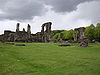
Neath Abbey was a Cistercian monastery
, located near the present-day town of Neath
in southern Wales
, UK
.
It was once the largest abbey
in Wales
. Substantial ruins can still be seen, and are in the care of Cadw
. Tudor
historian John Leland called Neath Abbey "the fairest abbey of all Wales."
s (32 km²) of his estate in Glamorgan
, Wales
to Savigniac monk
s from western Normandy
. The first monks arrived in 1130. Following the assumption of the Savigniac order into the Cistercian order in 1147, Neath Abbey also became a Cistercian house. The abbey was ravaged by the Welsh uprisings of the 13th century, and eventually dissolved
by King Henry VIII of England
in 1539. At this time, the abbey was turned into a large estate. Sir Philip Hobby was the last occupant of the estate.
By 1730, some of the buildings were being used for copper
smelting
, and the rest were abandoned. In the late 18th century, an Iron
Foundry
was opened near the Abbey ruins by a company owned by the Price, Fox
and Tregelles families.
The archaeology
of the abbey was eventually excavated between 1924 and 1935.
Monastery
Monastery denotes the building, or complex of buildings, that houses a room reserved for prayer as well as the domestic quarters and workplace of monastics, whether monks or nuns, and whether living in community or alone .Monasteries may vary greatly in size – a small dwelling accommodating only...
, located near the present-day town of Neath
Neath
Neath is a town and community situated in the principal area of Neath Port Talbot, Wales, UK with a population of approximately 45,898 in 2001...
in southern Wales
Wales
Wales is a country that is part of the United Kingdom and the island of Great Britain, bordered by England to its east and the Atlantic Ocean and Irish Sea to its west. It has a population of three million, and a total area of 20,779 km²...
, UK
United Kingdom
The United Kingdom of Great Britain and Northern IrelandIn the United Kingdom and Dependencies, other languages have been officially recognised as legitimate autochthonous languages under the European Charter for Regional or Minority Languages...
.
It was once the largest abbey
Abbey
An abbey is a Catholic monastery or convent, under the authority of an Abbot or an Abbess, who serves as the spiritual father or mother of the community.The term can also refer to an establishment which has long ceased to function as an abbey,...
in Wales
Wales
Wales is a country that is part of the United Kingdom and the island of Great Britain, bordered by England to its east and the Atlantic Ocean and Irish Sea to its west. It has a population of three million, and a total area of 20,779 km²...
. Substantial ruins can still be seen, and are in the care of Cadw
Cadw
-Conservation and Protection:Many of Wales's great castles and other monuments, such as bishop's palaces, historic houses, and ruined abbeys, are now in Cadw's care. Cadw does not own them but is responsible for their upkeep and for making them accessible to the public...
. Tudor
Tudor period
The Tudor period usually refers to the period between 1485 and 1603, specifically in relation to the history of England. This coincides with the rule of the Tudor dynasty in England whose first monarch was Henry VII...
historian John Leland called Neath Abbey "the fairest abbey of all Wales."
History
Neath Abbey was established in 1129 AD when Sir Richard de Granville gave 8,000 acreAcre
The acre is a unit of area in a number of different systems, including the imperial and U.S. customary systems. The most commonly used acres today are the international acre and, in the United States, the survey acre. The most common use of the acre is to measure tracts of land.The acre is related...
s (32 km²) of his estate in Glamorgan
Glamorgan
Glamorgan or Glamorganshire is one of the thirteen historic counties and a former administrative county of Wales. It was originally an early medieval kingdom of varying boundaries known as Glywysing until taken over by the Normans as a lordship. Glamorgan is latterly represented by the three...
, Wales
Wales
Wales is a country that is part of the United Kingdom and the island of Great Britain, bordered by England to its east and the Atlantic Ocean and Irish Sea to its west. It has a population of three million, and a total area of 20,779 km²...
to Savigniac monk
Monk
A monk is a person who practices religious asceticism, living either alone or with any number of monks, while always maintaining some degree of physical separation from those not sharing the same purpose...
s from western Normandy
Normandy
Normandy is a geographical region corresponding to the former Duchy of Normandy. It is in France.The continental territory covers 30,627 km² and forms the preponderant part of Normandy and roughly 5% of the territory of France. It is divided for administrative purposes into two régions:...
. The first monks arrived in 1130. Following the assumption of the Savigniac order into the Cistercian order in 1147, Neath Abbey also became a Cistercian house. The abbey was ravaged by the Welsh uprisings of the 13th century, and eventually dissolved
Dissolution of the Monasteries
The Dissolution of the Monasteries, sometimes referred to as the Suppression of the Monasteries, was the set of administrative and legal processes between 1536 and 1541 by which Henry VIII disbanded monasteries, priories, convents and friaries in England, Wales and Ireland; appropriated their...
by King Henry VIII of England
Henry VIII of England
Henry VIII was King of England from 21 April 1509 until his death. He was Lord, and later King, of Ireland, as well as continuing the nominal claim by the English monarchs to the Kingdom of France...
in 1539. At this time, the abbey was turned into a large estate. Sir Philip Hobby was the last occupant of the estate.
By 1730, some of the buildings were being used for copper
Copper
Copper is a chemical element with the symbol Cu and atomic number 29. It is a ductile metal with very high thermal and electrical conductivity. Pure copper is soft and malleable; an exposed surface has a reddish-orange tarnish...
smelting
Smelting
Smelting is a form of extractive metallurgy; its main use is to produce a metal from its ore. This includes iron extraction from iron ore, and copper extraction and other base metals from their ores...
, and the rest were abandoned. In the late 18th century, an Iron
Iron
Iron is a chemical element with the symbol Fe and atomic number 26. It is a metal in the first transition series. It is the most common element forming the planet Earth as a whole, forming much of Earth's outer and inner core. It is the fourth most common element in the Earth's crust...
Foundry
Foundry
A foundry is a factory that produces metal castings. Metals are cast into shapes by melting them into a liquid, pouring the metal in a mold, and removing the mold material or casting after the metal has solidified as it cools. The most common metals processed are aluminum and cast iron...
was opened near the Abbey ruins by a company owned by the Price, Fox
Fox family of Falmouth
The Fox family of Falmouth, Cornwall, UK were very influential in the development of the town of Falmouth in the 19th century and of the Cornish Industrial Revolution...
and Tregelles families.
The archaeology
Archaeology
Archaeology, or archeology , is the study of human society, primarily through the recovery and analysis of the material culture and environmental data that they have left behind, which includes artifacts, architecture, biofacts and cultural landscapes...
of the abbey was eventually excavated between 1924 and 1935.
See also
- Neath (UK Parliament constituency)Neath (UK Parliament constituency)Neath is a constituency represented in the House of Commons of the Parliament of the United Kingdom. It elects one Member of Parliament by the first past the post system of election and one Assembly Member by the first past the post system of election.- The Constituency of Neath :The constituency...
- Neath Abbey Castle Class steam locomotiveGWR 4073 ClassThe GWR 4073 Class or Castle class locomotives are a group of 4-6-0 steam locomotives of the Great Western Railway. They were originally designed by the railway's Chief Mechanical Engineer, Charles Collett, for working the company's express passenger trains.-History:A development of the earlier...
External links
- www.EventPicture.co.uk : FREE pictures of Neath Abbey
- www.geograph.co.uk : photos of Neath Abbey
- Neath Abbey article from a website on Cistercian abbeys
- Castle Wales website with good illustrations
- Gathering the Jewels website on Welsh Cultural History - includes aerial photograph of the Abbey site
- Neath Abbey Ironworks
- Cistercian Way website - article on the Iron Works
- West Glamorgan Archives service- records relating to Neath Abbey