

Rhizaria

Encyclopedia
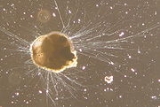
The Rhizaria are a species-rich supergroup of unicellular eukaryote
s. This supergroup was proposed by Cavalier-Smith in 2002. They vary considerably in form, but for the most part they are amoeboid
s with filose, reticulose, or microtubule-supported pseudopod
s. Many produce shells or skeletons, which may be quite complex in structure, and these make up the vast majority of protozoan fossils. Nearly all have mitochondria
with tubular cristae.
A few other groups may be included in the Cercozoa, but on some trees appear closer to the Foraminifera. These are the Phytomyxea
and Ascetosporea
, parasites of plants and animals respectively, and the peculiar amoeba Gromia
. The different groups of Rhizaria are considered close relatives based mainly on genetic similarities, and have been regarded as an extension of the Cercozoa. The name Rhizaria for the expanded group was introduced by Cavalier-Smith
in 2002, who also included the centrohelid
s and Apusozoa
.
clade
, which also comprises the Archaeplastida
, the Chromalveolata, the Excavata, and some smaller, unresolved groups such as the Apusozoa
and the Centrohelid
a. As bikonts, they all descend from a heterotroph
ic eukaryote with two flagella.
Historically, many rhizarians were considered animal
s, with their motility and heterotrophy as justification. However, when the five-kingdom system took prevalence over the animal-plant dichotomy, the rhizarians were put into the kingdom Protista. Then, after Woese published his three-domain system, because of the paraphyly of the kingdom Monera
, taxonomists turned their attention to the eukaryote domain, and the inherent paraphyly of Protista. After much debate, which continues to this day, Rhizaria emerged as a monophyletic group.
Eukaryote
A eukaryote is an organism whose cells contain complex structures enclosed within membranes. Eukaryotes may more formally be referred to as the taxon Eukarya or Eukaryota. The defining membrane-bound structure that sets eukaryotic cells apart from prokaryotic cells is the nucleus, or nuclear...
s. This supergroup was proposed by Cavalier-Smith in 2002. They vary considerably in form, but for the most part they are amoeboid
Amoeboid
Amoeboids are single-celled life-forms characterized by an irregular shape."Amoeboid" and "amœba" are often used interchangeably even by biologists, and especially refer to a creature moving by using pseudopodia. Most references to "amoebas" or "amoebae" are to amoeboids in general rather than to...
s with filose, reticulose, or microtubule-supported pseudopod
Pseudopod
Pseudopods or pseudopodia are temporary projections of eukaryotic cells. Cells that possess this faculty are generally referred to as amoeboids. Pseudopodia extend and contract by the reversible assembly of actin subunits into microfilaments...
s. Many produce shells or skeletons, which may be quite complex in structure, and these make up the vast majority of protozoan fossils. Nearly all have mitochondria
Mitochondrion
In cell biology, a mitochondrion is a membrane-enclosed organelle found in most eukaryotic cells. These organelles range from 0.5 to 1.0 micrometers in diameter...
with tubular cristae.
Groups
There are three main groups of Rhizaria:- CercozoaCercozoaThe Cercozoa are a group of protists. They are sometimes described as a kingdom.-Characteristics:The group includes most amoeboids and flagellates that feed by means of filose pseudopods. These may be restricted to part of the cell surface, but there is never a true cytostome or mouth as found in...
- Various amoebae and flagellates, usually with filose pseudopodsFilopodiaFilopodia are slender cytoplasmic projections that extend beyond the leading edge of lamellipodia in migrating cells. They contain actin filaments cross-linked into bundles by actin-binding proteins, e.g. fascin and fimbrin. Filopodia form focal adhesions with the substratum, linking it to the...
and common in soil
- ForaminiferaForaminiferaThe Foraminifera , or forams for short, are a large group of amoeboid protists which are among the commonest plankton species. They have reticulating pseudopods, fine strands of cytoplasm that branch and merge to form a dynamic net...
- Amoeboids with reticulose pseudopods, common as marine benthosBenthosBenthos is the community of organisms which live on, in, or near the seabed, also known as the benthic zone. This community lives in or near marine sedimentary environments, from tidal pools along the foreshore, out to the continental shelf, and then down to the abyssal depths.Many organisms...
- Radiolaria - Amoeboids with axopods, common as marine planktonPlanktonPlankton are any drifting organisms that inhabit the pelagic zone of oceans, seas, or bodies of fresh water. That is, plankton are defined by their ecological niche rather than phylogenetic or taxonomic classification...
A few other groups may be included in the Cercozoa, but on some trees appear closer to the Foraminifera. These are the Phytomyxea
Phytomyxea
The Phytomyxea are a group of protists that are parasites of plants. A more common name for them is the plasmodiophorids, but this does not always include Phagomyxa. They typically develop within plant cells, causing the infected tissue to grow into a gall or scab...
and Ascetosporea
Ascetosporea
The Ascetosporea are a group of protists that are parasites of animals, especially marine invertebrates. There are two groups, the haplosporids and paramyxids, which are not particularly similar morphologically but consistently group together on molecular trees, which place them near the base of...
, parasites of plants and animals respectively, and the peculiar amoeba Gromia
Gromia
Gromia is a widespread genus of marine and freshwater amoeboids, closely resembling some foraminiferans. It produces an organic test, which is ovoid or lobed and may exceed one millimetre in size; this resembles a small grape, in that its centre is fluid-filled but lacks organic matter, which is...
. The different groups of Rhizaria are considered close relatives based mainly on genetic similarities, and have been regarded as an extension of the Cercozoa. The name Rhizaria for the expanded group was introduced by Cavalier-Smith
Thomas Cavalier-Smith
Professor Thomas Cavalier-Smith , FRS, FRSC, NERC Professorial Fellow, is a Professor of Evolutionary Biology in the Department of Zoology, at the University of Oxford...
in 2002, who also included the centrohelid
Centrohelid
The centrohelids or centroheliozoa are a large group of heliozoan protists. They include both mobile and sessile forms, found in freshwater and marine environments, especially at some depth.-Characteristics:...
s and Apusozoa
Apusozoa
The Apusozoa are a phylum comprising several genera of flagellate protozoa. They are usually around 5-20 μm in size, and occur in soils and aquatic habitats, where they feed on bacteria...
.
Evolutionary relationship
Rhizaria is part of the bikontBikont
A Bikont is a eukaryotic cell with two flagella, as its name suggests. It is a division of eukaryotes.-Enzymes:Another shared trait of bikonts is the fusion of two genes into a single unit: the genes for thymidylate synthase and dihydrofolate reductase encode a singleprotein with two...
clade
Clade
A clade is a group consisting of a species and all its descendants. In the terms of biological systematics, a clade is a single "branch" on the "tree of life". The idea that such a "natural group" of organisms should be grouped together and given a taxonomic name is central to biological...
, which also comprises the Archaeplastida
Archaeplastida
The Archaeplastida are a major group of eukaryotes, comprising the red and green algae and the land plants, together with a small group called the glaucophytes. The plastids of all of these organisms are surrounded by two membranes, suggesting they developed directly from endosymbiotic...
, the Chromalveolata, the Excavata, and some smaller, unresolved groups such as the Apusozoa
Apusozoa
The Apusozoa are a phylum comprising several genera of flagellate protozoa. They are usually around 5-20 μm in size, and occur in soils and aquatic habitats, where they feed on bacteria...
and the Centrohelid
Centrohelid
The centrohelids or centroheliozoa are a large group of heliozoan protists. They include both mobile and sessile forms, found in freshwater and marine environments, especially at some depth.-Characteristics:...
a. As bikonts, they all descend from a heterotroph
Heterotroph
A heterotroph is an organism that cannot fix carbon and uses organic carbon for growth. This contrasts with autotrophs, such as plants and algae, which can use energy from sunlight or inorganic compounds to produce organic compounds such as carbohydrates, fats, and proteins from inorganic carbon...
ic eukaryote with two flagella.
Historically, many rhizarians were considered animal
Animal
Animals are a major group of multicellular, eukaryotic organisms of the kingdom Animalia or Metazoa. Their body plan eventually becomes fixed as they develop, although some undergo a process of metamorphosis later on in their life. Most animals are motile, meaning they can move spontaneously and...
s, with their motility and heterotrophy as justification. However, when the five-kingdom system took prevalence over the animal-plant dichotomy, the rhizarians were put into the kingdom Protista. Then, after Woese published his three-domain system, because of the paraphyly of the kingdom Monera
Monera
Monera is a superseded kingdom that contains unicellular organisms without a nucleus , such as bacteria....
, taxonomists turned their attention to the eukaryote domain, and the inherent paraphyly of Protista. After much debate, which continues to this day, Rhizaria emerged as a monophyletic group.