


Amoeboid

Encyclopedia
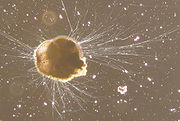
"Amoeboid" and "amœba" are often used interchangeably even by biologists, and especially refer to a creature moving by using pseudopod
Pseudopod
Pseudopods or pseudopodia are temporary projections of eukaryotic cells. Cells that possess this faculty are generally referred to as amoeboids. Pseudopodia extend and contract by the reversible assembly of actin subunits into microfilaments...
ia. Most references to "amoebas" or "amoebae" are to amoeboids in general rather than to the specific genus Amoeba
Amoeba
Amoeba is a genus of Protozoa.History=The amoeba was first discovered by August Johann Rösel von Rosenhof in 1757. Early naturalists referred to Amoeba as the Proteus animalcule after the Greek god Proteus, who could change his shape...
. The genus Amoeba and amoeboids in general both derive their names from the ancient Greek word for change.
Structure
Amoeboids move using pseudopodiaAmoeboid movement
Amoeboid movement is a crawling-like type of movement accomplished by protrusion of cytoplasm of the cell involving the formation of pseudopodia. The cytoplasm slides and forms a pseudopodium in front to move the cell forward. This type of movement has been linked to changes in action potential;...
, which are bulges of cytoplasm
Cytoplasm
The cytoplasm is a small gel-like substance residing between the cell membrane holding all the cell's internal sub-structures , except for the nucleus. All the contents of the cells of prokaryote organisms are contained within the cytoplasm...
.
Amoebas breathe using their entire cell membrane
Cell membrane
The cell membrane or plasma membrane is a biological membrane that separates the interior of all cells from the outside environment. The cell membrane is selectively permeable to ions and organic molecules and controls the movement of substances in and out of cells. It basically protects the cell...
that is constantly immersed in water. Excess water can cross into the cytosol
Cytosol
The cytosol or intracellular fluid is the liquid found inside cells, that is separated into compartments by membranes. For example, the mitochondrial matrix separates the mitochondrion into compartments....
. Amoebas have a contractile vacuole
Vacuole
A vacuole is a membrane-bound organelle which is present in all plant and fungal cells and some protist, animal and bacterial cells. Vacuoles are essentially enclosed compartments which are filled with water containing inorganic and organic molecules including enzymes in solution, though in certain...
to expel excess water.
Food sources vary in amoeboids. They may consume bacteria
Bacteria
Bacteria are a large domain of prokaryotic microorganisms. Typically a few micrometres in length, bacteria have a wide range of shapes, ranging from spheres to rods and spirals...
or other protist
Protist
Protists are a diverse group of eukaryotic microorganisms. Historically, protists were treated as the kingdom Protista, which includes mostly unicellular organisms that do not fit into the other kingdoms, but this group is contested in modern taxonomy...
s. Some are detritivore
Detritivore
Detritivores, also known as detritophages or detritus feeders or detritus eaters or saprophages, are heterotrophs that obtain nutrients by consuming detritus . By doing so, they contribute to decomposition and the nutrient cycles...
s and eat dead organic material. They extend a pair of pseudopodia around food. They fuse to make a food vacuole which then fuses with a lysosome
Lysosome
thumb|350px|Schematic of typical animal cell, showing subcellular components. [[Organelle]]s: [[nucleoli]] [[cell nucleus|nucleus]] [[ribosomes]] [[vesicle |vesicle]] rough [[endoplasmic reticulum]]...
to add digestive chemicals. Undigested food is expelled at the cell membrane.
Amoebas use pseudopodia to move and feed. They are powered by flexible microfilament
Microfilament
Microfilaments are the thinnest filaments of the cytoskeleton, a structure found in the cytoplasm of all eukaryotic cells. These linear polymers of actin subunits are flexible and relatively strong, resisting buckling by multi-piconewton compressive forces and filament fracture by nanonewton...
s near the membrane. Microfilaments are at least 50% of the cytoskeleton
Cytoskeleton
The cytoskeleton is a cellular "scaffolding" or "skeleton" contained within a cell's cytoplasm and is made out of protein. The cytoskeleton is present in all cells; it was once thought to be unique to eukaryotes, but recent research has identified the prokaryotic cytoskeleton...
. The other parts are more stiff and are composed of intermediate filament
Intermediate filament
Intermediate filaments are a family of related proteins that share common structural and sequence features. Intermediate filaments have an average diameter of 10 nanometers, which is between that of 7 nm actin , and that of 25 nm microtubules, although they were initially designated...
s and microtubule
Microtubule
Microtubules are a component of the cytoskeleton. These rope-like polymers of tubulin can grow as long as 25 micrometers and are highly dynamic. The outer diameter of microtubule is about 25 nm. Microtubules are important for maintaining cell structure, providing platforms for intracellular...
s. These are not used in amoeboid movement, but are stiff skeletons on which organelles are supported or can move on.
The shells of amoebas are often composed of calcium
Calcium
Calcium is the chemical element with the symbol Ca and atomic number 20. It has an atomic mass of 40.078 amu. Calcium is a soft gray alkaline earth metal, and is the fifth-most-abundant element by mass in the Earth's crust...
. The proteins or materials are synthesised in the cell and exported just outside the cell membrane.
Amoebas seem to have connections with two phyla composed of multicellular organism
Multicellular organism
Multicellular organisms are organisms that consist of more than one cell, in contrast to single-celled organisms. Most life that can be seen with the the naked eye is multicellular, as are all animals and land plants.-Evolutionary history:Multicellularity has evolved independently dozens of times...
s of the lineage of fungus-like protists. The two phyla are Myxomycota (plasmodial slime molds), and Acrasiomycota
Acrasiomycota
Acrasidae is a family of slime molds which belongs to the protist group Percolozoa. The name acrasio- comes from the Greek Akrasia, meaning "acting against one's judgement." This group consists of cellular slime molds....
(cellular slime molds). These two phyla use amoeboid movement in their feeding stage. The former is basically a giant multinucleate amoeba, while the latter lives solitary until food runs out; in which a colony of these functions as a unit. Myxomycetes use amoeboid gametes, as well.
Diversity
They have appeared in a number of different groups. Some cells in multicellular animals may be amoeboid, for instance human white blood cellWhite blood cell
White blood cells, or leukocytes , are cells of the immune system involved in defending the body against both infectious disease and foreign materials. Five different and diverse types of leukocytes exist, but they are all produced and derived from a multipotent cell in the bone marrow known as a...
s, which consume pathogens. Many protist
Protist
Protists are a diverse group of eukaryotic microorganisms. Historically, protists were treated as the kingdom Protista, which includes mostly unicellular organisms that do not fit into the other kingdoms, but this group is contested in modern taxonomy...
s also exist as individual amoeboid cells, or take such a form at some point in their life-cycle. The most famous such organism is Amoeba proteus
Amoeba
Amoeba is a genus of Protozoa.History=The amoeba was first discovered by August Johann Rösel von Rosenhof in 1757. Early naturalists referred to Amoeba as the Proteus animalcule after the Greek god Proteus, who could change his shape...
; the name amoeba is variously used to describe its close relatives, other organisms similar to it, or the amoeboids in general.
Classification
As amoebas themselves are polyphyletic and subject to some imprecision in definition, the term "amoeboid" does not provide identification of an organism, and is better understood as description of locomotion.When used in the broader sense, the term can include many different groups. One source includes 97 different genera. Others include far fewer.
Older classification
In older classification systems, amoeboids, under the taxon name Sarcodina, had been divided into several morphological categories based on the form and structure of their pseudopodPseudopod
Pseudopods or pseudopodia are temporary projections of eukaryotic cells. Cells that possess this faculty are generally referred to as amoeboids. Pseudopodia extend and contract by the reversible assembly of actin subunits into microfilaments...
s.
Amoeboids with pseudopods supported by regular arrays of microtubule
Microtubule
Microtubules are a component of the cytoskeleton. These rope-like polymers of tubulin can grow as long as 25 micrometers and are highly dynamic. The outer diameter of microtubule is about 25 nm. Microtubules are important for maintaining cell structure, providing platforms for intracellular...
s were called actinopods, whereas those that weren't were called rhizopods, which were further subdivided into lobose, filose, and reticulose amoebae. In contrast to "rhizopods", where most of their morphologies can be mapped to modern classification systems, "actinopods" appear to be extensively polyphyletic. Actinopods are divided into radiolaria and heliozoa
Heliozoa
Heliozoa are phagotrophs. They are roughly spherical amoeboids with many stiff, microtubule-supported projections called axopods radiating outward from the cell surface. These give them the characteristic sun-like appearance for which they are named, and are variously used for capturing food,...
(itself a polyphyletic grouping).
Finally, there was also a strange group of giant marine amoeboids, the xenophyophore
Xenophyophore
Xenophyophores are marine protozoa, giant single-celled organisms found throughout the world's oceans, at depths of up to 10,641 meters . Xenophyophores are found in the greatest numbers on the abyssal plains of the deep ocean. They were first described as sponges in 1889, then as testate...
s, that did not fall into any of these categories.
Modern classification
More modern classifications are based upon cladisticsCladistics
Cladistics is a method of classifying species of organisms into groups called clades, which consist of an ancestor organism and all its descendants . For example, birds, dinosaurs, crocodiles, and all descendants of their most recent common ancestor form a clade...
. It has been stated that most amoeboid are now grouped in Amoebozoa
Amoebozoa
The Amoebozoa are a major group of amoeboid protozoa, including the majority that move by means ofinternal cytoplasmic flow. Their pseudopodia are characteristically blunt and finger-like,...
or Rhizaria
Rhizaria
The Rhizaria are a species-rich supergroup of unicellular eukaryotes. This supergroup was proposed by Cavalier-Smith in 2002. They vary considerably in form, but for the most part they are amoeboids with filose, reticulose, or microtubule-supported pseudopods...
. However, in contexts where "amoeboid" is defined more loosely, there are many amoeboid species that are in the Excavata clade.
Phylogenetic analyses place these genera into the following groups (not all of these are considered amoeboid (or "amoebas") by all sources):
| Grouping | Genera | Morphology |
|---|---|---|
| Amoebozoa Amoebozoa The Amoebozoa are a major group of amoeboid protozoa, including the majority that move by means ofinternal cytoplasmic flow. Their pseudopodia are characteristically blunt and finger-like,... |
|
Lobosea Lobosea is a group of Amoebozoa. An example is Arcellinida.Sensu strico, it can refer to Tubulinea. However, sensu lato, it can also refer more generally to a paraphyletic group of lobose Amoebozoa. Formal classification of lobose amoebae remains speculative, and the older, less specific terms... ): Lobose pseudopods are blunt, and there may be one or several on a cell, which is usually divided into a layer of clear ectoplasm surrounding more granular endoplasm. |
| Rhizaria Rhizaria The Rhizaria are a species-rich supergroup of unicellular eukaryotes. This supergroup was proposed by Cavalier-Smith in 2002. They vary considerably in form, but for the most part they are amoeboids with filose, reticulose, or microtubule-supported pseudopods... |
Cercozoa The Cercozoa are a group of protists. They are sometimes described as a kingdom.-Characteristics:The group includes most amoeboids and flagellates that feed by means of filose pseudopods. These may be restricted to part of the cell surface, but there is never a true cytostome or mouth as found in... :
|
Cercozoa The Cercozoa are a group of protists. They are sometimes described as a kingdom.-Characteristics:The group includes most amoeboids and flagellates that feed by means of filose pseudopods. These may be restricted to part of the cell surface, but there is never a true cytostome or mouth as found in... together with various flagellates that tend to have amoeboid forms. The naked filose amoebae also includes vampyrellid Vampyrellid The Vampyrellidae are a group of cercozoans with filose pseudopods and lacking shells. Vampyrella is typical of the group, which also contains genera such as Platyreta and Arachnula.The term "Aconchulinida" is sometimes used for vampyrellid... s.
|
| Excavata Excavate The excavates are a major kingdom of unicellular eukaryotes, often known as Excavata. The phylogenetic category Excavata, proposed by Cavalier-Smith in 2002, contains a variety of free-living and symbiotic forms, and also includes some important parasites of humans.-Characteristics:Many excavates... |
|
Flagellate Flagellates are organisms with one or more whip-like organelles called flagella. Some cells in animals may be flagellate, for instance the spermatozoa of most phyla. Flowering plants do not produce flagellate cells, but ferns, mosses, green algae, some gymnosperms and other closely related plants... forms. |
| Chromalveolate Chromalveolate Chromalveolata is a eukaryote supergroup first proposed by Thomas Cavalier-Smith as a refinement of his kingdom Chromista, which was first put forward in 1981. Chromalveolata was proposed to represent the result of a single secondary endosymbiosis between a line descending from a bikont and a red... |
Heterokont Heterokont The heterokonts or stramenopiles are a major line of eukaryotes currently containing more than 100,000 known species. Most are algae, ranging from the giant multicellular kelp to the unicellular diatoms, which are a primary component of plankton... : Hyalodiscus Hyalodiscus Hyalodiscus is an extant genus of diatom known also from the fossil record.... , Labyrinthula Labyrinthula Labyrinthula is a genus of heterokont, comprising ten species.... Alveolata Alveolate The alveolates are a major line of protists.-Phyla:There are four phyla, which are very divergent in form, but are now known to be close relatives based on various ultrastructural and genetic similarities:... : Pfiesteria Pfiesteria Pfiesteria is a genus of heterotrophic dinoflagellates that has been associated with harmful algal blooms and fish kills. Pfiesteria complex organisms were claimed to be responsible for large fish kills in the 1980s and 1990s on the coast of North Carolina and in tributaries of the Chesapeake Bay... |
Hyalodiscus Hyalodiscus is an extant genus of diatom known also from the fossil record.... and Pfiesteria Pfiesteria Pfiesteria is a genus of heterotrophic dinoflagellates that has been associated with harmful algal blooms and fish kills. Pfiesteria complex organisms were claimed to be responsible for large fish kills in the 1980s and 1990s on the coast of North Carolina and in tributaries of the Chesapeake Bay... are sometimes considered to have amoeboid characteristics. |
| Nucleariid Nucleariid The nucleariids are a group of amoebae with filose pseudopods, known mostly from soils and freshwater. They are distinguished from the similar vampyrellids mainly by having mitochondria with discoid cristae.-Classification:... |
Micronuclearia Micronuclearia Micronuclearia is a Nucleariid genus.It includes the species Micronuclearia podoventralis.... , Nuclearia Nuclearia Nuclearia is a nucleariid genus.Species include:* Nuclearia delicatula* Nuclearia moebiusi* Nuclearia pattersoni Dyková, Veverková, Fiala, Macháčková & Pecková, 2003* Nuclearia simplex* Nuclearia thermophila... |
Nucleariid The nucleariids are a group of amoebae with filose pseudopods, known mostly from soils and freshwater. They are distinguished from the similar vampyrellids mainly by having mitochondria with discoid cristae.-Classification:... s appear to be close relatives of animal Animal Animals are a major group of multicellular, eukaryotic organisms of the kingdom Animalia or Metazoa. Their body plan eventually becomes fixed as they develop, although some undergo a process of metamorphosis later on in their life. Most animals are motile, meaning they can move spontaneously and... s and fungi Fungus A fungus is a member of a large group of eukaryotic organisms that includes microorganisms such as yeasts and molds , as well as the more familiar mushrooms. These organisms are classified as a kingdom, Fungi, which is separate from plants, animals, and bacteria... . |
| Ungrouped/ unknown |
Adelphamoeba, Astramoeba, Cashia, Dactylamoeba, Dinamoeba, Flagellipodium, Flamella, Gibbodiscus, Gocevia, Gruberella, Hollandella, Iodamoeba, Malamoeba, Nollandia, Oscillosignum, Paragocevia, Parvamoeba, Pernina, Pontifex, Protonaegleria, Pseudomastigamoeba, Plaesiobystra, Rugipes, Striamoeba, Striolatus, Subulamoeba, Theratromyxa, Trienamoeba, Trimastigamoeba, Vampyrellium |
Pathogenic interactions with other organisms
Some amoeboids can infect other organisms pathogenPathogen
A pathogen gignomai "I give birth to") or infectious agent — colloquially, a germ — is a microbe or microorganism such as a virus, bacterium, prion, or fungus that causes disease in its animal or plant host...
ically (causing disease):
- Entamoeba histolyticaEntamoeba histolyticaEntamoeba histolytica is an anaerobic parasitic protozoan, part of the genus Entamoeba. Predominantly infecting humans and other primates, E. histolytica is estimated to infect about 50 million people worldwide...
is the cause of amoebiasisAmoebiasisEntamebiasis is a term for the infection more commonly known as amoebiasis.It became the preferred term in MeSH in 1991, but the term amoebiasis is used by the World Health Organization and by those working in the field of amoebiasis research....
, or amoebic dysentery. - Naegleria fowleriNaegleria fowleriNaegleria fowleri is a free-living excavate form of protist typically found in warm bodies of fresh water, such as ponds, lakes, rivers, and hot springs. It is also found in soil, near warm-water discharges of industrial plants, and unchlorinated swimming pools in an amoeboid or temporary...
(the "brain-eating amoeba") is a fresh-water-native species that can be fatal to humans if introduced through the nose. - AcanthamoebaAcanthamoebaAcanthamoeba is a genus of amoebae, one of the most common protozoa in soil, and also frequently found in fresh water and other habitats. The cells are small, usually 15 to 35 μm in length and oval to triangular in shape when moving. The pseudopods form a clear hemispherical lobe at the anterior,...
can cause amoebic keratitisKeratitisKeratitis is a condition in which the eye's cornea, the front part of the eye, becomes inflamed. The condition is often marked by moderate to intense pain and usually involves impaired eyesight.-Types:...
and encephalitisEncephalitisEncephalitis is an acute inflammation of the brain. Encephalitis with meningitis is known as meningoencephalitis. Symptoms include headache, fever, confusion, drowsiness, and fatigue...
in humans. - Balamuthia mandrillarisBalamuthia mandrillarisBalamuthia mandrillaris is a free-living leptomyxid amoeba which is known to cause amoebiasis in humans, especially the deadly neurological condition known as granulomatous amoebic encephalitis . Balamuthia has not been definitively isolated in nature, but it is believed to be distributed...
is the cause of (often fatal) granulomatous amoebic meningoencephalitis
External links
- The Amoebae website brings together information from published sources.
- Amoebas are more than just blobs
- Sun Animacules and Amoebas
- Molecular Expressions Digital Video Gallery: Pond Life - Amoeba (Protozoa) Some good, informative Amoeba videos.
- Amoebae: Protists Which Move and Feed Using Pseudopodia at the Tree of Life web project