


Rheinwiesenlager

Encyclopedia
| Prisoner of War Temporary Enclosures (PWTE) | |
|---|---|
| "Rheinwiesenlager" | |
| World War II World War II World War II, or the Second World War , was a global conflict lasting from 1939 to 1945, involving most of the world's nations—including all of the great powers—eventually forming two opposing military alliances: the Allies and the Axis... |
|
| prisoner-of-war camp Prisoner-of-war camp A prisoner-of-war camp is a site for the containment of combatants captured by their enemy in time of war, and is similar to an internment camp which is used for civilian populations. A prisoner of war is generally a soldier, sailor, or airman who is imprisoned by an enemy power during or... |
|
| Operator: | Occupant: |
 |
 |
| April - September 1945 | |
| location: | Germany |
| number of camps: | 19 |
| prisoners: | 1,000,000 ~ 1,900,000 estimated |
| deaths: | Most estimates 3,000 - 10,000 |
The Rheinwiesenlager (Rhine meadow camps), official name Prisoner of War Temporary Enclosures (PWTE), were a group of about 19 transit camps for holding about one million German
Germany
Germany , officially the Federal Republic of Germany , is a federal parliamentary republic in Europe. The country consists of 16 states while the capital and largest city is Berlin. Germany covers an area of 357,021 km2 and has a largely temperate seasonal climate...
POW
Prisoner of war
A prisoner of war or enemy prisoner of war is a person, whether civilian or combatant, who is held in custody by an enemy power during or immediately after an armed conflict...
s after World War II
World War II
World War II, or the Second World War , was a global conflict lasting from 1939 to 1945, involving most of the world's nations—including all of the great powers—eventually forming two opposing military alliances: the Allies and the Axis...
from spring until late summer 1945. Credible sources for German POW deaths in these camps range from about 3,000 to 10,000, in most part occurring from starvation, dehydration and exposure to the weather elements. Most of these deaths were attributed to an unexpectedly large number of POWs which accumulated during the end of WWII, and the subsequent inability to provide adequate necessities for them.
List of Rheinwiesenlager
listing from north to south with official number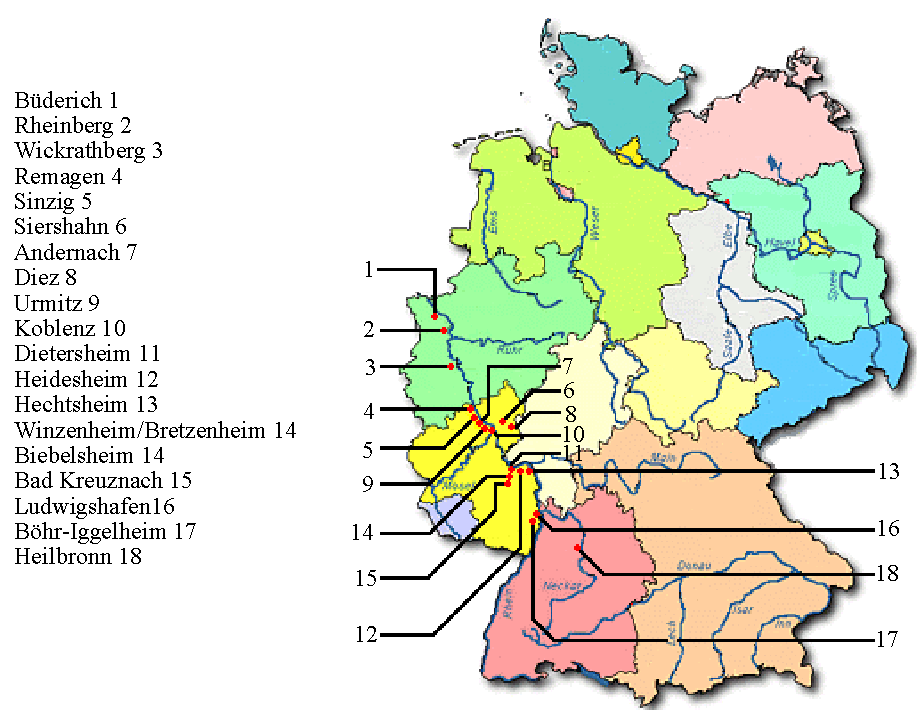
- A4 Büderich
- A1 RheinbergRheinbergRheinberg is a town in the district of Wesel, in North Rhine-Westphalia, Germany. It is situated on the left bank of the Rhine, approx. north of Moers and south of Wesel....
- A9 Wickrathberg
- A2 RemagenRemagenRemagen is a town in Germany in Rhineland-Palatinate, in the district of Ahrweiler. It is about a one hour drive from Cologne , just south of Bonn, the former West German capital. It is situated on the River Rhine. There is a ferry across the Rhine from Remagen every 10–15 minutes in the summer...
- A5 SinzigSinzigSinzig is a town in the district of Ahrweiler, in Rhineland-Palatinate, Germany. It is situated on the river Rhine, approx. 5 km south-east of Remagen and 25 km south-east of Bonn, and it has approximately 20,000 inhabitants .-History:...
- SiershahnSiershahnSiershahn is an Ortsgemeinde – a community belonging to a Verbandsgemeinde – in the Westerwaldkreis in Rhineland-Palatinate, Germany.-History:Clay finds from La Tène times have been unearthed here...
- A11 A14 AndernachAndernachAndernach is a town in the district of Mayen-Koblenz, in Rhineland-Palatinate, Germany, of currently about 30,000 inhabitants. It is situated towards the end of the Neuwied basin on the left bank of the Rhine between the former tiny fishing village of Fornich in the north and the mouth of the...
- Diez
- A13 UrmitzUrmitzUrmitz is a municipality in the district of Mayen-Koblenz in Rhineland-Palatinate, western Germany....
- A10 KoblenzKoblenzKoblenz is a German city situated on both banks of the Rhine at its confluence with the Moselle, where the Deutsches Eck and its monument are situated.As Koblenz was one of the military posts established by Drusus about 8 BC, the...
- A8 DietersheimDietersheimDietersheim is a municipality in the district of Neustadt -Bad Windsheim in Bavaria in Germany....
- A12Heidesheim
- A6 Winzenheim/BretzenheimBretzenheimBretzenheim was a minor Principality in pre-Napoleonic Germany. It was created in 1790 for Charles Augustus of the line of Wittelsbach-Bretzenheim. Its territory in central Germany was mediatised to Hesse-Darmstadt in 1803, and its territory north of Lake Constance was mediatised to Austria in...
- A16 A17Hechtsheim
- A7 A15 BiebelsheimBiebelsheimBiebelsheim is a municipality in the district of Bad Kreuznach in Rhineland-Palatinate, in western Germany....
- A3 Bad KreuznachBad KreuznachBad Kreuznach is the capital of the district of Bad Kreuznach, Rhineland-Palatinate, Germany. It is located on the Nahe river, a tributary of the Rhine...
- C1 Ludwigshafen
- C2 Böhl-IggelheimBöhl-IggelheimBöhl-Iggelheim is a municipality in the Rhein-Pfalz-Kreis, in Rhineland-Palatinate, Germany. It has about 8.200 inhabitants and is situated approx. 15 km southwest of Ludwigshafen, and 10 km northwest of Speyer.-Geography:...
- C3 C4HeilbronnHeilbronnHeilbronn is a city in northern Baden-Württemberg, Germany. It is completely surrounded by Heilbronn County and with approximately 123.000 residents, it is the sixth-largest city in the state....
Most of the camps were established on the western side of the Rhine to prevent the imprisoned soldiers from returning to the German armies on the right side of the river.
Historical situation
By March 1943, the general staff of the commander in chief Dwight D. EisenhowerDwight D. Eisenhower
Dwight David "Ike" Eisenhower was the 34th President of the United States, from 1953 until 1961. He was a five-star general in the United States Army...
realized that after the victory over Germany, they would not to be able to feed the German military prisoners. Rather than adhere to the Geneva Convention of 1929, it was decided to treat the prisoners as "Disarmed Enemy Forces
Disarmed Enemy Forces
Disarmed Enemy Forces , and—less commonly—Surrendered Enemy Forces, was a U.S. designation, both for soldiers who surrendered to an adversary after hostilities ended, and for those previously surrendered POWs who were held in camps in occupied German territory at that time. It is mainly referenced...
(DEF)". As captured former soldiers of a state that no longer existed, they could be denied the rights of prisoners of war
Prisoner of war
A prisoner of war or enemy prisoner of war is a person, whether civilian or combatant, who is held in custody by an enemy power during or immediately after an armed conflict...
guaranteed by the Geneva Convention. The German Wehrmacht employed a similar strategy in referring to imprisoned Italian soldiers as "Militärinternierter" in order to justify their use as forced labour.
Half of the German prisoners of war in the West were imprisoned by the US forces, half of them by the British. When the Allied forces crossed the Rhine, the quantity of prisoners of war reached such numbers that the British could not accept any more prisoners in their camps. The US forces, forced to deal with the situation on their own, established the Rheinwiesenlager.
Germany surrendered in May 1945, but the Allied leadership was worried the Germans would conduct an effective guerrilla warfare against their occupation. According to Perry Biddiscombe the decision to keep these hundreds of thousands of Germans in the poor conditions of Rheinwiesenlager camps for months (despite the war being over) was "mainly to prevent Werwolf
Werwolf
Werwolf was the name given to a Nazi plan, which began development in 1944, to create a commando force which would operate behind enemy lines as the Allies advanced through Germany itself. Werwolf remained entirely ineffectual as a combat force, however, and in practical terms, its value as...
activity".
The construction of the camps
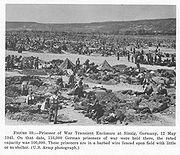
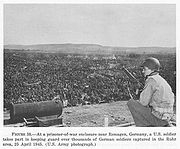
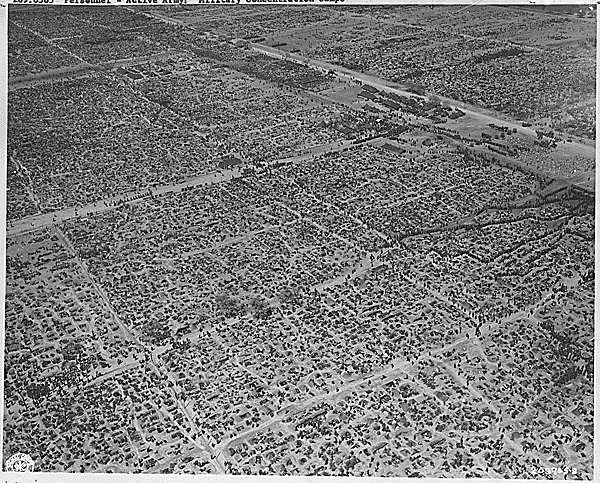
The camps were founded in April 1945 and remained in existence until September. There was a similar plan for the construction of all the camps. Open farmland close to a village with a railroad line was enclosed with barbed wire and divided into 10 - 20 camps each housing 5,000 to 10,000 men. Existing field paths were used as streets of the camp and surrounding buildings as the administration, kitchen and hospital. The prisoners of war, forced to surrender their equipment, had to dig holes in the earth by hand in which to sleep.
Soon the camps were totally overcrowded. Camp Remagen, intended for 100,000, grew to 184,000 prisoners.
"Some of the enclosures resembled Andersonville Prison
Andersonville prison
The Andersonville prison, officially known as Camp Sumter, served as a Confederate Prisoner-of-war camp during the American Civil War. The site of the prison is now Andersonville National Historic Site in Andersonville, Georgia. Most of the site actually lies in extreme southwestern Macon County,...
in 1864".
The "disarmed enemy forces"
To circumvent international regulations that dealt with the handling of POWs, the surrendered forces were termed "Disarmed Enemy ForcesDisarmed Enemy Forces
Disarmed Enemy Forces , and—less commonly—Surrendered Enemy Forces, was a U.S. designation, both for soldiers who surrendered to an adversary after hostilities ended, and for those previously surrendered POWs who were held in camps in occupied German territory at that time. It is mainly referenced...
" (DEF) and the term "Prisoners of war (POW)" was not applied. The Americans transferred the interior administration of the camps to German prisoners. Internal administration, police, doctors, cooks and work forces were all German prisoners of war. After some weeks those who were regarded as harmless were released: Hitlerjugend and women. Later those professional groups, which were important for reconstruction, were released: farmers, drivers and miners. At the end of June 1945 the first camps in Remagen, Böhl-Ingelheim and Büderich were dissolved. This first wave of release stopped again. The SHAEF
Supreme Headquarters Allied Expeditionary Force
Supreme Headquarters Allied Expeditionary Force , was the headquarters of the Commander of Allied forces in north west Europe, from late 1943 until the end of World War II. U.S. General Dwight D. Eisenhower was in command of SHAEF throughout its existence...
offered the French, who wanted 1.75 million prisoners of war for forced labour, to take over the camps. On 10 July 1945 Sinzig, Andernach, Siershahn, Bretzenheim, Dietersheim, Koblenz, Hechtzheim and Dietz, at the time containing in total roughly 182,400 prisoners, were given to France. In the British Zone the British took over on 12 June 1945. Those prisoners of war who were able to work were transferred to France, the rest released. At the end of September 1945 all the camps were dissolved. Only the camp Bretzenheim
Bretzenheim
Bretzenheim was a minor Principality in pre-Napoleonic Germany. It was created in 1790 for Charles Augustus of the line of Wittelsbach-Bretzenheim. Its territory in central Germany was mediatised to Hesse-Darmstadt in 1803, and its territory north of Lake Constance was mediatised to Austria in...
near Bad Kreuznach
Bad Kreuznach
Bad Kreuznach is the capital of the district of Bad Kreuznach, Rhineland-Palatinate, Germany. It is located on the Nahe river, a tributary of the Rhine...
served until 1948 as a transit camp for prisoners of war coming home from France.
Conditions and deaths
United States
The United States of America is a federal constitutional republic comprising fifty states and a federal district...
statistics were just over 3,000 deaths while the German villages nearby reported 4,537. R. J. Rummel
R. J. Rummel
Rudolph Joseph Rummel is professor emeritus of political science at the University of Hawaii. He has spent his career assembling data on collective violence and war with a view toward helping their resolution or elimination...
calculates a most probable figure of 6,000. Extremely high figures of up to a million are sometimes quoted by James Bacque
James Bacque
James Bacque is a Canadian novelist, publisher and book editor. He was born in Toronto, Ontario.-Early life:Bacque was educated at Upper Canada College in Toronto and then the University of Toronto, where he studied history and philosophy graduating in 1952 with a Bachelor of Art degree...
but there has been no corroboration. The official German inquiry into the numbers of deaths was published by the Maschke committee (named after its head, Erich Maschke) which, on behalf of the German Federal Ministry of Displaced persons, Refugees, and War Victims (Bundesministerium für Vertriebene, Flüchtlinge und Kriegsgeschädigte) researched the history of German prisoners of war on a scientific level. According to their results camps with the highest mortality were:
- Bad KreuznachBad KreuznachBad Kreuznach is the capital of the district of Bad Kreuznach, Rhineland-Palatinate, Germany. It is located on the Nahe river, a tributary of the Rhine...
(Lager Galgenberg und Bretzenheim) - SinzigSinzigSinzig is a town in the district of Ahrweiler, in Rhineland-Palatinate, Germany. It is situated on the river Rhine, approx. 5 km south-east of Remagen and 25 km south-east of Bonn, and it has approximately 20,000 inhabitants .-History:...
near Remagen - RheinbergRheinbergRheinberg is a town in the district of Wesel, in North Rhine-Westphalia, Germany. It is situated on the left bank of the Rhine, approx. north of Moers and south of Wesel....
- Heidesheim
- Wickrathberg
- Büderich
In these camps 5,000 of 500,000 inmates died. An analysis of the documents of the local administrations around the camps of Remagen yields similar results. Projected to a total of about 1,000,000 prisoners in all the camps there would have been at the most, 10,000 deaths and probably many less.
In total, the number of American-held German POWs that died could not have exceeded 1% (56,000). The death rates for German POWs held by Americans were among the lowest experienced by surrendered combatants during and after the war. The death rates for POWs in World War II were as follows:
| Percentage of POWs who died |
|
|---|---|
| Italian POWs held by Soviets | 84.5% |
| Russian POWs held by Germans | 57.5% |
| German POWs held by Soviets | 35.8% |
| American POWs held by Japanese | 33.0% |
| German POWs held by Eastern Europeans | 32.9% |
| British POWs held by Japanese | 24.8% |
| British POWs held by Germans | 3.5% |
| German POWs held by French | 2.58% |
| German POWs held by Americans | 0.15% |
| German POWs held by British | 0.03% |
In 1969, Lieutenant General Leonard D. Heaton
Leonard D. Heaton
Leonard Dudley Heaton was Surgeon General of the United States Army from 1959 to 1969.- Youth and education :...
prepared and published a report for the United States Army Medical Department, that examined preventive medicine and the problems associated with housing a large number German POWs after World War II. The report found a number of problems, including:
- The army had lost track of some of the locations where POWs were held.
- The number of prisoners greatly exceeded expectations.
- Organization of the camps was left to prisoners.
- Food and water supplies were insufficient during April and May 1945, though they later improved.
- The 1200 to 1500 calories ration that the Disarmed Enemy Forces were receiving in August 1945 was inadequate.
- The lack of food led in some cases to "extensive malnutrition."
In one chapter in a multi-author book published in 2003, Richard Dominic Wiggers argued that the Allies violated international law regarding the feeding of enemy civilians, they both directly and indirectly caused the unnecessary suffering and death of large numbers of civilians and POWs in occupied Germany, guided partly by a spirit of postwar vengeance when creating the circumstances that contributed to their deaths. and by strict orders to U.S. military personnel and their wives to destroy or otherwise render inedible their own leftover surplus so as to ensure it could not be eaten by German civilians. The Americans also prevented locals from bringing prisoners food under threat of being shot
The International Red Cross was prevented from visiting prisoners. Only in the autumn of 1945 - a time when most camps had closed or where closing - the Red Cross was granted permission to send delegations to visit camps in the French and UK occupation zones
Allied Occupation Zones in Germany
The Allied powers who defeated Nazi Germany in World War II divided the country west of the Oder-Neisse line into four occupation zones for administrative purposes during 1945–49. In the closing weeks of fighting in Europe, US forces had pushed beyond the previously agreed boundaries for the...
, and to provide - very small - amounts of relief. On February 4, 1946 the Red Cross was allowed to send relief also to those in the U.S. run occupation zone. The International Red Cross reports "The quantities received by the ICRC for these captives remained very small, however. During their visits, the delegates observed that German prisoners of war were often detained in appalling conditions. They drew the attention of the authorities to this fact, and gradually succeeded in getting some improvements made."
Some of the 740,000 German prisoners transferred by the U.S. for forced labor in France
Forced labor of Germans after World War II
Forced labour of Germans after World War II refers to the Allied use of German civilians and captured soldiers for forced labor in years following World War II ....
came from these camps, these forced laborers were already very weak, many weighing barely 50 kilos.
Further reading
- Rüdiger Overmans: Die Rheinwiesenlager 1945. In: Hans-Erich Volkmann (Hrsg.): Ende des Dritten Reiches – Ende des Zweiten Weltkrieges. Eine perspektivische Rückschau. herausgegeben im Auftrag des Militärgeschichtlichen Forschungsamtes, München 1995, ISBN 3-492-12056-3.
- Brigitte Bailer-Galanda: Eisenhower und die deutschen Kriegsgefangenen. Jahrbuch 1997. Dokumentationsarchiv des österreichischen Widerstandes, Wien 1997