


Rehe

Encyclopedia
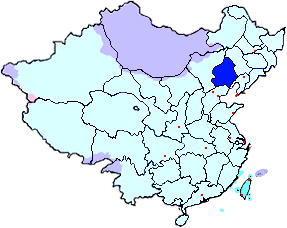 |
|
| Capital | Chengteh Chengde Chengde , previously known as Jehol or Re He , is a prefecture-level city in Hebei province, People's Republic of China, situated northeast of Beijing. It is best known as the site of the Mountain Resort, a vast imperial garden and palace formerly used by the Qing emperors as summer residence... |
Rehe , also known as Jehol, is a defunct Chinese
China
Chinese civilization may refer to:* China for more general discussion of the country.* Chinese culture* Greater China, the transnational community of ethnic Chinese.* History of China* Sinosphere, the area historically affected by Chinese culture...
Special administrative district
Special administrative region (Republic of China)
In the subdivision of the Republic of China , "special administrative regions" were historically used to designate special areas, most of which were eventually converted into provinces...
and later province.
Administration
Rehe was located north of the Great Wall, west of ManchuriaManchuria
Manchuria is a historical name given to a large geographic region in northeast Asia. Depending on the definition of its extent, Manchuria usually falls entirely within the People's Republic of China, or is sometimes divided between China and Russia. The region is commonly referred to as Northeast...
, and east of Mongolia
Mongolia
Mongolia is a landlocked country in East and Central Asia. It is bordered by Russia to the north and China to the south, east and west. Although Mongolia does not share a border with Kazakhstan, its western-most point is only from Kazakhstan's eastern tip. Ulan Bator, the capital and largest...
. The capital of Rehe was the city of Chengde
Chengde
Chengde , previously known as Jehol or Re He , is a prefecture-level city in Hebei province, People's Republic of China, situated northeast of Beijing. It is best known as the site of the Mountain Resort, a vast imperial garden and palace formerly used by the Qing emperors as summer residence...
. The second largest city in the province was Chaoyang, followed by Chifeng
Chifeng
Chifeng , also known as Ulanhad, is a prefecture-level city in southeastern Inner Mongolia, People's Republic of China. It borders Xilin Gol to the north and west, Tongliao to the northeast, Chaoyang prefecture of Liaoning province to the southeast, and Chengde prefecture of Hebei province to the...
. The province covered an area of 114,000 square kilometers.
History
Once the seat of the KhitanKhitan people
thumb|250px|Khitans [[Eagle hunting|using eagles to hunt]], painted during the Chinese [[Song Dynasty]].The Khitan people , or Khitai, Kitan, or Kidan, were a nomadic Mongolic people, originally located at Mongolia and Manchuria from the 4th century...
-led Liao Dynasty, Rehe was conquered by the Manchu
Manchu
The Manchu people or Man are an ethnic minority of China who originated in Manchuria . During their rise in the 17th century, with the help of the Ming dynasty rebels , they came to power in China and founded the Qing Dynasty, which ruled China until the Xinhai Revolution of 1911, which...
in the 17th century and was reserved as imperial pastureland with settlement forbidden to Han Chinese
Han Chinese
Han Chinese are an ethnic group native to China and are the largest single ethnic group in the world.Han Chinese constitute about 92% of the population of the People's Republic of China , 98% of the population of the Republic of China , 78% of the population of Singapore, and about 20% of the...
in the early part of the Qing dynasty. Over time, many Han Chinese settled in Rehe anyway. In the early Republic of China, the area was organized as the Rehe Special Autonomous Mongol Territory in 1914. It was declared the Province of Jehol of the Republic of China in 1923.
Jehol was seized by the Imperial Japanese Army
Imperial Japanese Army
-Foundation:During the Meiji Restoration, the military forces loyal to the Emperor were samurai drawn primarily from the loyalist feudal domains of Satsuma and Chōshū...
to form a buffer zone
Buffer zone
A buffer zone is generally a zonal area that lies between two or more other areas , but depending on the type of buffer zone, the reason for it may be to segregate regions or to conjoin them....
between China proper and Japanese-controlled Manchukuo
Manchukuo
Manchukuo or Manshū-koku was a puppet state in Manchuria and eastern Inner Mongolia, governed under a form of constitutional monarchy. The region was the historical homeland of the Manchus, who founded the Qing Empire in China...
in Operation Nekka beginning on January 21, 1933. It was subsequently annexed to the Empire of Manchukuo, forming the anto
Anto
An anto was an ancient Manchu political administrative term referring to provinces or prefectures. The term was used during the Japanese occupation of Manchuria to name in local terms the provinces of the Manchukuo empire....
(province) of Rehe.
The seizure of Jehol was one of the most important of many incidents in the 1930s that poisoned relations between Japan and China, leading to the Second Sino-Japanese War
Second Sino-Japanese War
The Second Sino-Japanese War was a military conflict fought primarily between the Republic of China and the Empire of Japan. From 1937 to 1941, China fought Japan with some economic help from Germany , the Soviet Union and the United States...
.
After the annexation of Manchukuo by the Republic of China
Republic of China
The Republic of China , commonly known as Taiwan , is a unitary sovereign state located in East Asia. Originally based in mainland China, the Republic of China currently governs the island of Taiwan , which forms over 99% of its current territory, as well as Penghu, Kinmen, Matsu and other minor...
after the end of World War II
World War II
World War II, or the Second World War , was a global conflict lasting from 1939 to 1945, involving most of the world's nations—including all of the great powers—eventually forming two opposing military alliances: the Allies and the Axis...
, the Kuomintang
Kuomintang
The Kuomintang of China , sometimes romanized as Guomindang via the Pinyin transcription system or GMD for short, and translated as the Chinese Nationalist Party is a founding and ruling political party of the Republic of China . Its guiding ideology is the Three Principles of the People, espoused...
continued to recognize the area as a separate province, reverting its name to Jehol Province, with the capital in Hailar. However, under the administration of the People's Republic of China
People's Republic of China
China , officially the People's Republic of China , is the most populous country in the world, with over 1.3 billion citizens. Located in East Asia, the country covers approximately 9.6 million square kilometres...
, in 1955, the area was divided between Hebei
Hebei
' is a province of the People's Republic of China in the North China region. Its one-character abbreviation is "" , named after Ji Province, a Han Dynasty province that included what is now southern Hebei...
province, Liaoning
Liaoning
' is a province of the People's Republic of China, located in the northeast of the country. Its one-character abbreviation is "辽" , a name taken from the Liao River that flows through the province. "Níng" means "peace"...
Province and the Inner Mongolia Autonomous Region
Inner Mongolia
Inner Mongolia is an autonomous region of the People's Republic of China, located in the northern region of the country. Inner Mongolia shares an international border with the countries of Mongolia and the Russian Federation...
.