


Refreshable Braille display

Encyclopedia
Braille
The Braille system is a method that is widely used by blind people to read and write, and was the first digital form of writing.Braille was devised in 1825 by Louis Braille, a blind Frenchman. Each Braille character, or cell, is made up of six dot positions, arranged in a rectangle containing two...
characters, usually by means of raising dots through holes in a flat surface. Blind
Blindness
Blindness is the condition of lacking visual perception due to physiological or neurological factors.Various scales have been developed to describe the extent of vision loss and define blindness...
computer
Computer
A computer is a programmable machine designed to sequentially and automatically carry out a sequence of arithmetic or logical operations. The particular sequence of operations can be changed readily, allowing the computer to solve more than one kind of problem...
users, who cannot use a normal computer monitor
Computer display
A monitor or display is an electronic visual display for computers. The monitor comprises the display device, circuitry, and an enclosure...
, use it to read text output. Speech synthesizers are also commonly used for the same task, and a blind user may switch between the two systems or use both at the same time depending on circumstances.
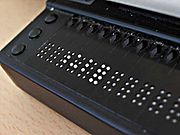
Because of the complexity of producing a reliable display that will cope with daily wear and tear, these displays are expensive. Usually, only 40 or 80 Braille cells are displayed. Models with between 18 and 40 cells exist in some notetaker devices.
On some models the position of the cursor
Cursor (computers)
In computing, a cursor is an indicator used to show the position on a computer monitor or other display device that will respond to input from a text input or pointing device. The flashing text cursor may be referred to as a caret in some cases...
is represented by vibrating the dots, and some models have a switch associated with each cell to move the cursor to that cell directly.
The mechanism which raises the dots uses the piezo effect of some crystals, where they expand when a voltage is applied to them. Such a crystal is connected to a lever, which in turn raises the dot. There has to be a crystal for each dot of the display, i.e. eight per character.
The software that controls the display is called a screen reader
Screen reader
A screen reader is a software application that attempts to identify and interpret what is being displayed on the screen . This interpretation is then re-presented to the user with text-to-speech, sound icons, or a Braille output device...
. It gathers the content of the screen from the operating system
Operating system
An operating system is a set of programs that manage computer hardware resources and provide common services for application software. The operating system is the most important type of system software in a computer system...
, converts it into braille characters and sends it to the display. Screen readers for graphical operating systems are especially complex, because graphical elements like windows or slidebars have to be interpreted and described in text form. Modern operating systems usually have an Application Programming Interface
Application programming interface
An application programming interface is a source code based specification intended to be used as an interface by software components to communicate with each other...
to help screen readers obtain this information, such as UI Automation (UIA) for Microsoft Windows
Microsoft Windows
Microsoft Windows is a series of operating systems produced by Microsoft.Microsoft introduced an operating environment named Windows on November 20, 1985 as an add-on to MS-DOS in response to the growing interest in graphical user interfaces . Microsoft Windows came to dominate the world's personal...
or AT-SPI for GNOME
GNOME
GNOME is a desktop environment and graphical user interface that runs on top of a computer operating system. It is composed entirely of free and open source software...
.
A new development, called the rotating-wheel Braille display, was developed in 2000 by the National Institute of Standards and Technology
National Institute of Standards and Technology
The National Institute of Standards and Technology , known between 1901 and 1988 as the National Bureau of Standards , is a measurement standards laboratory, otherwise known as a National Metrological Institute , which is a non-regulatory agency of the United States Department of Commerce...
(NIST) and although a second rotating display was designed at the Leuven University
Katholieke Universiteit Leuven
The Katholieke Universiteit Leuven is a Dutch-speaking university in Flanders, Belgium.It is located at the centre of the historic town of Leuven, and is a prominent part of the city, home to the university since 1425...
in Belgium both wheels are still in the process of commercialization. Braille dots are put on the edge of a spinning wheel
Wheel
A wheel is a device that allows heavy objects to be moved easily through rotating on an axle through its center, facilitating movement or transportation while supporting a load, or performing labor in machines. Common examples found in transport applications. A wheel, together with an axle,...
, which allows the user to read continuously with a stationary finger while the wheel spins at a selected speed. The Braille dots are set in a simple scanning-style fashion as the dots on the wheel spin past a stationary actuator
Actuator
An actuator is a type of motor for moving or controlling a mechanism or system. It is operated by a source of energy, usually in the form of an electric current, hydraulic fluid pressure or pneumatic pressure, and converts that energy into some kind of motion. An actuator is the mechanism by which...
that sets the Braille characters. As a result, manufacturing complexity is greatly reduced and rotating-wheel Braille displays, when in actual production, should be less expensive than traditional Braille displays.
History
The base of a refreshable braille display is a pure braille terminal. There, the input is performed by two sets of three keys plus a space bar (as in the Perkins BraillerPerkins Brailler
The Perkins Brailler is a "braille typewriter" with a key corresponding to each of the six dots of the braille code, a space key, a backspace key, and a line space key. Like a manual typewriter, it has two side knobs to advance paper through the machine and a carriage return lever above the keys...
), while output is via a refreshable braille display consisting of a row of electromechanical character cells, each of which can raise or lower a combination of six (or in some cases, eight) round-tipped pins. Other variants exist that use a conventional QWERTY
QWERTY
QWERTY is the most common modern-day keyboard layout. The name comes from the first six letters appearing in the topleft letter row of the keyboard, read left to right: Q-W-E-R-T-Y. The QWERTY design is based on a layout created for the Sholes and Glidden typewriter and sold to Remington in the...
keyboard for input and braille pins for output, as well as input-only and output-only devices. In 1951, David Abraham, a woodworking teacher at Perkins, created a portable braille terminal.
Braille computer monitor
The Braille computer monitor has rows and columns of rectangular cells. The cells include four rows and two columns of dots that can be felt for interpretation by the user. "The pins are driven by electromechanical impact drivers and are held in position by resilient elastomeric cords. The impact drivers are carried on a bi-directional printhead which travels beneath the movable pins. An erasing mechanism is provided to positively drive the pins downwardly to erase the characters produced by the printhead."The Braille computer monitor is under the United States Patent 6700553.