

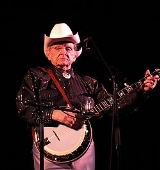
Ralph Stanley

Encyclopedia
Ralph Stanley also known as Dr. Ralph Stanley, is an American bluegrass
artist, known for his distinctive singing and banjo playing.
southwestern Virginia
—"in a little town called McClure at a place called Big Spraddle, just up the holler" from where he moved in 1936 and has lived ever since in Dickenson County. The son of Lee and Lucy Stanley, Ralph did not grow up around a lot of music in his home. As he says, his "daddy didn't play an instrument, but sometimes he would sing church music. And I'd hear him sing songs like 'Man of Constant Sorrow
,' 'Pretty Polly
' and 'Omie Wise
.'"
He learned to play the banjo
, clawhammer
style, from his mother:
He graduated from high school on May 2, 1945 and was inducted into the Army on May 16, serving "little more than a year." He immediately began performing when he got home:
-playing brother, Carter
, and form the Clinch Mountain Boys, in 1946. Drawing heavily on the musical traditions of the area, which included the unique minor-key singing style of the Primitive Baptist Universalist
church and the sweet down-home family harmonies of the Carter Family
, the Stanleys began playing on local radio stations. They first performed at Norton, Virginia
's WNVA, but didn't stay long there, moving on instead to Bristol, Virginia
and WCYB
to start the show Farm and Fun Time where they stayed "off and on for 12 years."
Initially covering "a lot of Bill Monroe
music", they soon "found out that didn't pay off—we needed something of our own. So we started writing songs in 1947, 1948. I guess I wrote 20 or so banjo tunes, but Carter was a better writer than me." When Columbia Records
signed the Stanley Brothers, Bill Monroe left in protest and joined Decca
. Later, the Stanleys split up and Carter went to sing for the "Father of Bluegrass." Asked how Monroe could be mad at the Stanley Brothers at one point and then hire Carter for his band, Ralph explained: "He knew Carter would make him a good singer. . . Bill Monroe loved our music and loved our singing."
The Stanley Brothers joined King Records
in the late '50s, a record company so eclectic it included James Brown
at the time. In fact he and his band were in the studio when the brothers recorded "Finger Poppin' Time." "James and his band were poppin' their fingers on that" according to Ralph. It was at King Records that they "went to a more 'Stanley style,' the sound that people most know today."
Ralph and Carter
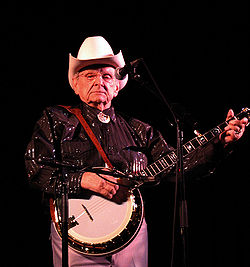
performed as The Stanley Brothers
with their band, the Clinch Mountain Boys from 1946 to 1966.
 ]
]
He decided to go it alone, eventually reviving the Clinch Mountain Boys. Larry Sparks
, Roy Lee Centers, and Charlie Sizemore were among those with whom he played in the revived band. He encountered Ricky Skaggs
and Keith Whitley
arriving late to his own show: "They were about 16 or 17, and they were holding the crowd 'til we got there. . . They sounded just exactly like (the Stanley Brothers)." Seeing their potential, he hired them "to give 'em a chance", even though that meant a seven-member band. Eventually, his son Ralph Stanley II, took over as lead singer and rhythm guitarist for the Clinch Mountain Boys.
only to state this:
, in which he sings the Appalachian dirge "O Death." The soundtrack's producer was T-Bone Burnett
. Stanley said the following about working with Burnett:
With that song, Stanley won a 2002 Grammy Award
in the category of Best Male Country Vocal Performance
. "That put the icing on the cake for me," he says. "It put me in a different category."
by the popular title, "Dr. Ralph Stanley" (after being awarded an honorary
Doctorate of Music from Lincoln Memorial University
in Harrogate, Tennessee
in 1976), Stanley was inducted into the International Bluegrass Music Hall of Honor
in 1992 and in 2000, and became the first person to be inducted into the Grand Ole Opry
in the third millennium.
He joined producers Randall Franks
and Alan Autry
for the In the Heat of the Night (TV Series)
cast CD “Christmas Time’s A Comin’” performing "Christmas Time's A Comin'" with the cast on the CD released on Sonlite and MGM/UA for one of the most popular Christmas releases of 1991 and 1992 with Southern retailers.
He is featured in the Josh Turner
hit song "Me and God," released in 2006.
 In 2006 he was awarded the National Medal of Arts
.
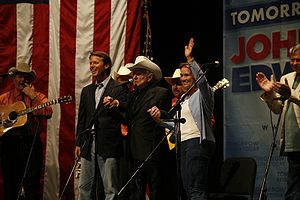
On November 10, 2007, Stanley and the Clinch Mountain Boys performed at a rally for presidential candidate John Edwards
in Des Moines, Iowa
, just prior to the Democratic Party
's annual Jefferson-Jackson Day
Dinner. Between renditions of "Man of Constant Sorrow
" and "Orange Blossom Special
," Stanley told the crowd that he had cast his first vote for Harry S. Truman
in 1948 and would cast his next for John Edwards in 2008—but after Edwards fell by the wayside, Stanley endorsed Barack Obama
on September 9, 2008. In October 2008, the Obama campaign aired a radio ad in Virginia featuring Stanley.
Stanley maintains an extensive touring schedule.
Country singer Dwight Yoakam
has stated that Ralph Stanley is one of his "musical heroes."
Stanley's autobiography
, Man of Constant Sorrow, coauthored with the music journalist Eddie Dean, was released by Gotham Books on October 15, 2009.
playing, sometimes called "Stanley Style". It evolved from Scruggs style
, which is a three finger technique. "Stanley style" is distinguished by incredibly fast "forward rolls," led by the index finger, sometimes in the higher registers utilizing a capo
. In "Stanley Style", the rolls of the banjo are continuous, while being picked fairly close the bridge
on the banjo, giving the tone of the instrument a very crisp, articulate snap to the strings as the player would strike them.
Bluegrass music
Bluegrass music is a form of American roots music, and a sub-genre of country music. It has mixed roots in Scottish, English, Welsh and Irish traditional music...
artist, known for his distinctive singing and banjo playing.
Biography
Ralph Edmond Stanley was born, grew up, and lives today in ruralRural
Rural areas or the country or countryside are areas that are not urbanized, though when large areas are described, country towns and smaller cities will be included. They have a low population density, and typically much of the land is devoted to agriculture...
southwestern Virginia
Virginia
The Commonwealth of Virginia , is a U.S. state on the Atlantic Coast of the Southern United States. Virginia is nicknamed the "Old Dominion" and sometimes the "Mother of Presidents" after the eight U.S. presidents born there...
—"in a little town called McClure at a place called Big Spraddle, just up the holler" from where he moved in 1936 and has lived ever since in Dickenson County. The son of Lee and Lucy Stanley, Ralph did not grow up around a lot of music in his home. As he says, his "daddy didn't play an instrument, but sometimes he would sing church music. And I'd hear him sing songs like 'Man of Constant Sorrow
Man of Constant Sorrow
"Man of Constant Sorrow" is a traditional American folk song first recorded by Dick Burnett, a partially blind fiddler from Kentucky. The song was originally recorded by Burnett as "Farewell Song" printed in a Richard Burnett songbook, c. 1913. An early version was recorded by Emry Arthur in 1928...
,' 'Pretty Polly
Pretty Polly (ballad)
"Pretty Polly", "The Gosport Tragedy" or "The Cruel Ship's Carpenter" is a traditional English-language folk song found in the British Isles, Canada, and the Appalachian region of North America, among other places....
' and 'Omie Wise
Omie Wise
Omie Wise or Naomi Wise was an American murder victim, who is remembered by a popular murder ballad about her death.-The song:Omie Wise's death became the subject of a traditional American ballad...
.'"
He learned to play the banjo
Banjo
In the 1830s Sweeney became the first white man to play the banjo on stage. His version of the instrument replaced the gourd with a drum-like sound box and included four full-length strings alongside a short fifth-string. There is no proof, however, that Sweeney invented either innovation. This new...
, clawhammer
Clawhammer
Clawhammer is a highly rhythmic banjo playing style and common component of American old-time music. The principal difference between clawhammer style and other styles is the picking direction...
style, from his mother:
He graduated from high school on May 2, 1945 and was inducted into the Army on May 16, serving "little more than a year." He immediately began performing when he got home:
Clinch Mountain Boys
After initially considering a course in "veterinary," he decided to throw in with his older guitarGuitar
The guitar is a plucked string instrument, usually played with fingers or a pick. The guitar consists of a body with a rigid neck to which the strings, generally six in number, are attached. Guitars are traditionally constructed of various woods and strung with animal gut or, more recently, with...
-playing brother, Carter
Carter Stanley
Carter Glen Stanley was a bluegrass music lead singer, songwriter, and rhythm guitar player. He formed the Stanley Brothers band together with his brother Ralph. The Stanley Brothers are generally acknowledged as the first band after Bill Monroe & the Blue Grass Boys to play in the bluegrass genre...
, and form the Clinch Mountain Boys, in 1946. Drawing heavily on the musical traditions of the area, which included the unique minor-key singing style of the Primitive Baptist Universalist
Primitive Baptist Universalist
The Primitive Baptist Universalists are Christian Universalist church based primarily in the central Appalachian region of the United States...
church and the sweet down-home family harmonies of the Carter Family
Carter Family
The Carter Family was a traditional American folk music group that recorded between 1927 and 1956. Their music had a profound impact on bluegrass, country, Southern Gospel, pop and rock musicians as well as on the U.S. folk revival of the 1960s. They were the first vocal group to become country...
, the Stanleys began playing on local radio stations. They first performed at Norton, Virginia
Norton, Virginia
Norton is an independent city within the confines of Wise County in the Commonwealth of Virginia. As of the 2010 Census, the city population was 3,958, making it the smallest city in the state by population...
's WNVA, but didn't stay long there, moving on instead to Bristol, Virginia
Bristol, Virginia
Bristol is an independent city in Virginia, United States, bounded by Washington County, Virginia, Bristol, Tennessee, and Sullivan County, Tennessee....
and WCYB
WZAP
WZAP is a Religious and Southern Gospel formatted broadcast radio station licensed to Bristol, Virginia. The station serves the Tennessee Tri-Cities area with an AM signal at 690 kilohertz. WZAP is owned and operated by RAM Communications, Inc.-History:...
to start the show Farm and Fun Time where they stayed "off and on for 12 years."
Initially covering "a lot of Bill Monroe
Bill Monroe
William Smith Monroe was an American musician who created the style of music known as bluegrass, which takes its name from his band, the "Blue Grass Boys," named for Monroe's home state of Kentucky. Monroe's performing career spanned 60 years as a singer, instrumentalist, composer and bandleader...
music", they soon "found out that didn't pay off—we needed something of our own. So we started writing songs in 1947, 1948. I guess I wrote 20 or so banjo tunes, but Carter was a better writer than me." When Columbia Records
Columbia Records
Columbia Records is an American record label, owned by Japan's Sony Music Entertainment, operating under the Columbia Music Group with Aware Records. It was founded in 1888, evolving from an earlier enterprise, the American Graphophone Company — successor to the Volta Graphophone Company...
signed the Stanley Brothers, Bill Monroe left in protest and joined Decca
Decca Records
Decca Records began as a British record label established in 1929 by Edward Lewis. Its U.S. label was established in late 1934; however, owing to World War II, the link with the British company was broken for several decades....
. Later, the Stanleys split up and Carter went to sing for the "Father of Bluegrass." Asked how Monroe could be mad at the Stanley Brothers at one point and then hire Carter for his band, Ralph explained: "He knew Carter would make him a good singer. . . Bill Monroe loved our music and loved our singing."
The Stanley Brothers joined King Records
King Records (USA)
King Records is an American record label, started in 1943 by Syd Nathan and originally headquartered in Cincinnati, Ohio.-History:At first it specialized in country music, at the time still known as "hillbilly music." King advertised, "If it's a King, It's a Hillbilly -- If it's a Hillbilly, it's a...
in the late '50s, a record company so eclectic it included James Brown
James Brown
James Joseph Brown was an American singer, songwriter, musician, and recording artist. He is the originator of Funk and is recognized as a major figure in the 20th century popular music for both his vocals and dancing. He has been referred to as "The Godfather of Soul," "Mr...
at the time. In fact he and his band were in the studio when the brothers recorded "Finger Poppin' Time." "James and his band were poppin' their fingers on that" according to Ralph. It was at King Records that they "went to a more 'Stanley style,' the sound that people most know today."
Ralph and Carter
Carter Stanley
Carter Glen Stanley was a bluegrass music lead singer, songwriter, and rhythm guitar player. He formed the Stanley Brothers band together with his brother Ralph. The Stanley Brothers are generally acknowledged as the first band after Bill Monroe & the Blue Grass Boys to play in the bluegrass genre...
performed as The Stanley Brothers
The Stanley Brothers
The Stanley Brothers were an American bluegrass duo made up of brothers Carter and Ralph Stanley.-Biography:Carter and Ralph Stanley hailed originally from Dickenson County, Virginia. The family soon moved to McClure, Virginia where their parents worked a small farm in the Clinch Mountains...
with their band, the Clinch Mountain Boys from 1946 to 1966.
Solo
After Carter died of complications of cirrhosis in 1966, after failing for "a year or so," Ralph faced a hard decision on whether to continue performing on his own. "I was worried, I didn't know if I could do it by myself. But boy, I got letters, 3,000 of 'em, and phone calls . . . I went to Syd Nathan at King and asked him if he wanted me to go on, and he said, 'Hell yes! You might be better than both of them.'"He decided to go it alone, eventually reviving the Clinch Mountain Boys. Larry Sparks
Larry Sparks
Larry Sparks is a Bluegrass singer and guitarist. He was the winner of the 2004 and 2005 International Bluegrass Music Association Male Vocalist of the Year Award. 2005, won IBMA for Album of the Year and Recorded Event of the Year for his album "40," celebrating his 40th year in bluegrass...
, Roy Lee Centers, and Charlie Sizemore were among those with whom he played in the revived band. He encountered Ricky Skaggs
Ricky Skaggs
Rickie Lee "Ricky" Skaggs is a country and bluegrass singer, musician, producer, and composer. He primarily plays mandolin; however, he also plays fiddle, guitar, and banjo.-Early career:...
and Keith Whitley
Keith Whitley
Jackie Keith Whitley , known professionally as Keith Whitley, was an American country music singer. Whitley's brief career in mainstream country music lasted from 1984 until his death in 1989, but he continues to influence an entire generation of singers and songwriters...
arriving late to his own show: "They were about 16 or 17, and they were holding the crowd 'til we got there. . . They sounded just exactly like (the Stanley Brothers)." Seeing their potential, he hired them "to give 'em a chance", even though that meant a seven-member band. Eventually, his son Ralph Stanley II, took over as lead singer and rhythm guitarist for the Clinch Mountain Boys.
Political career
Around 1970, he ran for Clerk of Court and Commissioner of Revenue in Dickenson CountyDickenson County, Virginia
As of the census of 2000, there were 16,395 people, 6,732 households, and 4,887 families residing in the county. The population density was 49 people per square mile . There were 7,684 housing units at an average density of 23 per square mile...
only to state this:
O Brother, Where Art Thou?
Stanley's work was featured in the 2000 film O Brother, Where Art Thou?O Brother, Where Art Thou?
O Brother, Where Art Thou? is a 2000 comedy film directed by Joel and Ethan Coen and starring George Clooney, John Turturro, Tim Blake Nelson, John Goodman, Holly Hunter, and Charles Durning. Set in 1937 rural Mississippi during the Great Depression, the film's story is a modern satire loosely...
, in which he sings the Appalachian dirge "O Death." The soundtrack's producer was T-Bone Burnett
T-Bone Burnett
Joseph Henry Burnett , widely known as T-Bone Burnett, is an American musician, songwriter, and soundtrack and record producer.He was a guitarist in Bob Dylan's band on the Rolling Thunder Revue...
. Stanley said the following about working with Burnett:
With that song, Stanley won a 2002 Grammy Award
Grammy Awards of 2002
The 44th Grammy Awards were held on February 27, 2002. The biggest was Alicia Keys, winning 5 Grammys, including Best New Artist and Song of the Year for "Fallin'". U2 won 4 awards including Record of the Year and Best Rock Album.-Award winners:...
in the category of Best Male Country Vocal Performance
Grammy Award for Best Male Country Vocal Performance
The Grammy Award for Best Male Country Vocal Performance was awarded between 1965 and 2011. The award has had several minor name changes:*From 1965 to 1967 the award was known as Best Country & Western Vocal Performance - Male...
. "That put the icing on the cake for me," he says. "It put me in a different category."
Today
Known in the world of bluegrass musicBluegrass music
Bluegrass music is a form of American roots music, and a sub-genre of country music. It has mixed roots in Scottish, English, Welsh and Irish traditional music...
by the popular title, "Dr. Ralph Stanley" (after being awarded an honorary
Honorary degree
An honorary degree or a degree honoris causa is an academic degree for which a university has waived the usual requirements, such as matriculation, residence, study, and the passing of examinations...
Doctorate of Music from Lincoln Memorial University
Lincoln Memorial University
Lincoln Memorial University is a private four-year co-educational liberal arts college located in Harrogate, Tennessee.LMU's campus borders on Cumberland Gap National Historical Park....
in Harrogate, Tennessee
Harrogate, Tennessee
Harrogate is a city in Claiborne County, Tennessee, United States. The community has been known as "Harrogate" since the 19th century, but did not incorporate as a city by that name until 1993....
in 1976), Stanley was inducted into the International Bluegrass Music Hall of Honor
International Bluegrass Music Hall of Honor
Induction to the International Bluegrass Music Hall of Fame, called the International Bluegrass Music Hall of Honor from its creation in 1991 through 2006, is managed by the International Bluegrass Music Association, and the Hall itself is maintained at the International Bluegrass Music Museum in...
in 1992 and in 2000, and became the first person to be inducted into the Grand Ole Opry
Grand Ole Opry
The Grand Ole Opry is a weekly country music stage concert in Nashville, Tennessee, that has presented the biggest stars of that genre since 1925. It is also among the longest-running broadcasts in history since its beginnings as a one-hour radio "barn dance" on WSM-AM...
in the third millennium.
He joined producers Randall Franks
Randall Franks
Randall Franks is an award-winning bluegrass singer and musician who plays fiddle, mandolin, guitar and mountain dulcimer. He was recognized by the International Bluegrass Music Museum in 2010 as a Bluegrass Legend; inducted into the Atlanta Country Music Hall of Fame in 2004; and was designated...
and Alan Autry
Alan Autry
Carlos Alan Autry is an American actor, politician, and former National Football League football player. He is best known for his role as Captain Bubba Skinner on the television series In the Heat of the Night; he also has been in numerous movies and other television shows...
for the In the Heat of the Night (TV Series)
In the Heat of the Night (TV series)
In the Heat of the Night is a television series based on the motion picture and novel of the same name. It was broadcast on NBC from 1988 until 1992, and then on CBS until 1995...
cast CD “Christmas Time’s A Comin’” performing "Christmas Time's A Comin'" with the cast on the CD released on Sonlite and MGM/UA for one of the most popular Christmas releases of 1991 and 1992 with Southern retailers.
He is featured in the Josh Turner
Josh Turner
Joshua Otis "Josh" Turner is a country music singer and actor signed to MCA Nashville Records in 2003, Turner has released four studio albums for the label. The first of these was 2003's Long Black Train, whose title track was his breakthrough single release...
hit song "Me and God," released in 2006.
National Medal of Arts
The National Medal of Arts is an award and title created by the United States Congress in 1984, for the purpose of honoring artists and patrons of the arts. It is the highest honor conferred to an individual artist on behalf of the people. Honorees are selected by the National Endowment for the...
.
On November 10, 2007, Stanley and the Clinch Mountain Boys performed at a rally for presidential candidate John Edwards
John Edwards
Johnny Reid "John" Edwards is an American politician, who served as a U.S. Senator from North Carolina. He was the Democratic nominee for Vice President in 2004, and was a candidate for the Democratic presidential nomination in 2004 and 2008.He defeated incumbent Republican Lauch Faircloth in...
in Des Moines, Iowa
Des Moines, Iowa
Des Moines is the capital and the most populous city in the US state of Iowa. It is also the county seat of Polk County. A small portion of the city extends into Warren County. It was incorporated on September 22, 1851, as Fort Des Moines which was shortened to "Des Moines" in 1857...
, just prior to the Democratic Party
Democratic Party (United States)
The Democratic Party is one of two major contemporary political parties in the United States, along with the Republican Party. The party's socially liberal and progressive platform is largely considered center-left in the U.S. political spectrum. The party has the lengthiest record of continuous...
's annual Jefferson-Jackson Day
Jefferson-Jackson Day
Jefferson-Jackson Day is the most common name given to the annual fundraising celebration held by Democratic Party organizations in the United States. It is named for Presidents Thomas Jefferson and Andrew Jackson...
Dinner. Between renditions of "Man of Constant Sorrow
Man of Constant Sorrow
"Man of Constant Sorrow" is a traditional American folk song first recorded by Dick Burnett, a partially blind fiddler from Kentucky. The song was originally recorded by Burnett as "Farewell Song" printed in a Richard Burnett songbook, c. 1913. An early version was recorded by Emry Arthur in 1928...
" and "Orange Blossom Special
Orange Blossom Special (song)
The fiddle tune "Orange Blossom Special", about the passenger train of the same name, was written by Ervin T. Rouse in 1938. The original recording was created by Ervin and Gordon Rouse in 1939. It is considered the best known fiddle tune of the twentieth century and is often called simply The...
," Stanley told the crowd that he had cast his first vote for Harry S. Truman
Harry S. Truman
Harry S. Truman was the 33rd President of the United States . As President Franklin D. Roosevelt's third vice president and the 34th Vice President of the United States , he succeeded to the presidency on April 12, 1945, when President Roosevelt died less than three months after beginning his...
in 1948 and would cast his next for John Edwards in 2008—but after Edwards fell by the wayside, Stanley endorsed Barack Obama
Barack Obama
Barack Hussein Obama II is the 44th and current President of the United States. He is the first African American to hold the office. Obama previously served as a United States Senator from Illinois, from January 2005 until he resigned following his victory in the 2008 presidential election.Born in...
on September 9, 2008. In October 2008, the Obama campaign aired a radio ad in Virginia featuring Stanley.
Stanley maintains an extensive touring schedule.
Country singer Dwight Yoakam
Dwight Yoakam
Dwight David Yoakam is an American singer-songwriter, actor and film director, most famous for his pioneering country music...
has stated that Ralph Stanley is one of his "musical heroes."
Stanley's autobiography
Autobiography
An autobiography is a book about the life of a person, written by that person.-Origin of the term:...
, Man of Constant Sorrow, coauthored with the music journalist Eddie Dean, was released by Gotham Books on October 15, 2009.
Musical style
Ralph created a unique style of banjoBanjo
In the 1830s Sweeney became the first white man to play the banjo on stage. His version of the instrument replaced the gourd with a drum-like sound box and included four full-length strings alongside a short fifth-string. There is no proof, however, that Sweeney invented either innovation. This new...
playing, sometimes called "Stanley Style". It evolved from Scruggs style
Scruggs style
Scruggs style is the most common style of playing the banjo in bluegrass music. It is a fingerpicking method, also known as three-finger style. It is named after Earl Scruggs, whose innovative approach and technical mastery of the instrument has influenced generations of bluegrass banjoists ever...
, which is a three finger technique. "Stanley style" is distinguished by incredibly fast "forward rolls," led by the index finger, sometimes in the higher registers utilizing a capo
Capo
A capo is a device used on the neck of a stringed instrument to shorten the playable length of the strings, hence raising the pitch. It is frequently used on guitars, mandolins, and banjos. G.B...
. In "Stanley Style", the rolls of the banjo are continuous, while being picked fairly close the bridge
Bridge
A bridge is a structure built to span physical obstacles such as a body of water, valley, or road, for the purpose of providing passage over the obstacle...
on the banjo, giving the tone of the instrument a very crisp, articulate snap to the strings as the player would strike them.
Selected discography
| Title | Details | Peak chart positions | |||
|---|---|---|---|---|---|
| US Grass | US Country | US Billboard 200 The Billboard 200 is a ranking of the 200 highest-selling music albums and EPs in the United States, published weekly by Billboard magazine. It is frequently used to convey the popularity of an artist or groups of artists... |
US Heat Top Heatseekers Top Heatseekers refers to either of two separate "Breaking and Entering" music charts issued weekly by Billboard Magazine: the Heatseekers Albums chart or the Heatseekers Songs chart. They were introduced by Billboard in 1993 with the purpose of highlighting the sales by new and developing musical... |
||
| Clinch Mountain Gospel |
|
— | — | — | — |
| Ralph Stanley |
Columbia Records Columbia Records is an American record label, owned by Japan's Sony Music Entertainment, operating under the Columbia Music Group with Aware Records. It was founded in 1888, evolving from an earlier enterprise, the American Graphophone Company — successor to the Volta Graphophone Company... /DMZ |
3 | 22 | 163 | 5 |
| Poor Rambler |
|
— | — | — | — |
| Shine On Shine On (Ralph Stanley album) Shine On is a 2005 album by American bluegrass artist Ralph Stanley.- Track listing :#"King of All Kings"#"The Roses Will Bloom"#"The Old Church Yard"#"This Little Light of Mine"#"My Main Trial Is Yet To Come"#"Sing Songs About Jesus"... |
|
6 | — | — | — |
| A Distant Land to Roam |
|
4 | — | — | — |
| Mountain Preacher's Child |
|
9 | — | — | — |
| A Mother's Prayer |
|
6 | — | — | — |
Other contributions
- Lifted: Songs of the Spirit (2002, SonySony, commonly referred to as Sony, is a Japanese multinational conglomerate corporation headquartered in Minato, Tokyo, Japan and the world's fifth largest media conglomerate measured by revenues....
/Hear MusicHear MusicHear Music, also known as StarCon is the brand name of Starbucks' retail music concept and record label. Hear Music began as a catalog company in Cambridge, Massachusetts, in 1990 before being purchased by Starbucks in 1999.-Concept:...
) - "Listen to the Shepherd"
Honors, awards, distinctions
- He's known in the world of bluegrass musicBluegrass musicBluegrass music is a form of American roots music, and a sub-genre of country music. It has mixed roots in Scottish, English, Welsh and Irish traditional music...
by the popular title, "Dr. Ralph Stanley" after being awarded an honoraryHonorary degreeAn honorary degree or a degree honoris causa is an academic degree for which a university has waived the usual requirements, such as matriculation, residence, study, and the passing of examinations...
Doctorate of Music from Lincoln Memorial UniversityLincoln Memorial UniversityLincoln Memorial University is a private four-year co-educational liberal arts college located in Harrogate, Tennessee.LMU's campus borders on Cumberland Gap National Historical Park....
in Harrogate, TennesseeHarrogate, TennesseeHarrogate is a city in Claiborne County, Tennessee, United States. The community has been known as "Harrogate" since the 19th century, but did not incorporate as a city by that name until 1993....
, in 1976. - He was inducted into the International Bluegrass Music Hall of HonorInternational Bluegrass Music Hall of HonorInduction to the International Bluegrass Music Hall of Fame, called the International Bluegrass Music Hall of Honor from its creation in 1991 through 2006, is managed by the International Bluegrass Music Association, and the Hall itself is maintained at the International Bluegrass Music Museum in...
in 1992 and in 2000. - He became the first person to be inducted into the Grand Ole OpryGrand Ole OpryThe Grand Ole Opry is a weekly country music stage concert in Nashville, Tennessee, that has presented the biggest stars of that genre since 1925. It is also among the longest-running broadcasts in history since its beginnings as a one-hour radio "barn dance" on WSM-AM...
in the third millennium. - His work was featured in the 2000 film O Brother, Where Art Thou?O Brother, Where Art Thou?O Brother, Where Art Thou? is a 2000 comedy film directed by Joel and Ethan Coen and starring George Clooney, John Turturro, Tim Blake Nelson, John Goodman, Holly Hunter, and Charles Durning. Set in 1937 rural Mississippi during the Great Depression, the film's story is a modern satire loosely...
, in which he sings the Appalachian dirge "O Death."- That song won him a 2002 Grammy AwardGrammy Awards of 2002The 44th Grammy Awards were held on February 27, 2002. The biggest was Alicia Keys, winning 5 Grammys, including Best New Artist and Song of the Year for "Fallin'". U2 won 4 awards including Record of the Year and Best Rock Album.-Award winners:...
in the category of Best Male Country Vocal PerformanceGrammy Award for Best Male Country Vocal PerformanceThe Grammy Award for Best Male Country Vocal Performance was awarded between 1965 and 2011. The award has had several minor name changes:*From 1965 to 1967 the award was known as Best Country & Western Vocal Performance - Male...
.
- That song won him a 2002 Grammy Award
- The Virginia Press Association made him their Distinguished Virginian of the Year in 2004.
- The Ralph Stanley Museum and Traditional Mountain Music Center opened in Clintwood, VirginiaClintwood, VirginiaClintwood is a town in Dickenson County, Virginia, United States. The population was 1,549 at the 2000 census. It is the county seat of Dickenson County....
in 2004. - He was awarded the National Medal of ArtsNational Medal of ArtsThe National Medal of Arts is an award and title created by the United States Congress in 1984, for the purpose of honoring artists and patrons of the arts. It is the highest honor conferred to an individual artist on behalf of the people. Honorees are selected by the National Endowment for the...
in 2006, the nation's highest honor for artistic excellence. - The Virginia legislature designated him the Outstanding Virginian of 2008.
- He was awarded the Key to the City of Garner, North CarolinaGarner, North CarolinaGarner is a town in Wake County, North Carolina, United States and a suburb of Raleigh. The population was 17,757 at the 2000 census and was 27,533 in 2009.-Geography:Garner is located at ....
on November 15, 2008 - He was named a Library of Congress Living LegendLibrary of Congress Living LegendA Library of Congress Living Legend is someone recognized by the Library of Congress for his or her creative contributions to American life. Those honored include artists, writers, activists, film makers, physicians, entertainers, sports figures, and public servants.-Partial list of honorees:*...
in April 2000
See also
- The Stanley BrothersThe Stanley BrothersThe Stanley Brothers were an American bluegrass duo made up of brothers Carter and Ralph Stanley.-Biography:Carter and Ralph Stanley hailed originally from Dickenson County, Virginia. The family soon moved to McClure, Virginia where their parents worked a small farm in the Clinch Mountains...
- George ShufflerGeorge ShufflerGeorge Shuffler is an innovative bluegrass guitar player and an early practitioner of the crosspicking style. During his career Shuffler played with The Bailey Brothers, The Stanley Brothers and Ralph Stanley's Clinch Mountain Boys...
- Dickenson County, VirginiaDickenson County, VirginiaAs of the census of 2000, there were 16,395 people, 6,732 households, and 4,887 families residing in the county. The population density was 49 people per square mile . There were 7,684 housing units at an average density of 23 per square mile...
- Bluegrass musicBluegrass musicBluegrass music is a form of American roots music, and a sub-genre of country music. It has mixed roots in Scottish, English, Welsh and Irish traditional music...
- Old-time musicOld-time musicOld-time music is a genre of North American folk music, with roots in the folk music of many countries, including England, Scotland, Ireland and countries in Africa. It developed along with various North American folk dances, such as square dance, buck dance, and clogging. The genre also...
- BanjoBanjoIn the 1830s Sweeney became the first white man to play the banjo on stage. His version of the instrument replaced the gourd with a drum-like sound box and included four full-length strings alongside a short fifth-string. There is no proof, however, that Sweeney invented either innovation. This new...
- International Bluegrass Music Hall of HonorInternational Bluegrass Music Hall of HonorInduction to the International Bluegrass Music Hall of Fame, called the International Bluegrass Music Hall of Honor from its creation in 1991 through 2006, is managed by the International Bluegrass Music Association, and the Hall itself is maintained at the International Bluegrass Music Museum in...
- Grand Ole OpryGrand Ole OpryThe Grand Ole Opry is a weekly country music stage concert in Nashville, Tennessee, that has presented the biggest stars of that genre since 1925. It is also among the longest-running broadcasts in history since its beginnings as a one-hour radio "barn dance" on WSM-AM...
- O Brother, Where Art Thou?O Brother, Where Art Thou?O Brother, Where Art Thou? is a 2000 comedy film directed by Joel and Ethan Coen and starring George Clooney, John Turturro, Tim Blake Nelson, John Goodman, Holly Hunter, and Charles Durning. Set in 1937 rural Mississippi during the Great Depression, the film's story is a modern satire loosely...
- Grammy Awards
- National Medal of ArtsNational Medal of ArtsThe National Medal of Arts is an award and title created by the United States Congress in 1984, for the purpose of honoring artists and patrons of the arts. It is the highest honor conferred to an individual artist on behalf of the people. Honorees are selected by the National Endowment for the...
External links
- American legends: Ralph Stanley - The Guardian
- http://www.slipcue.com/music/country/countryartists/stanley.html
- http://www.drralphstanley.com/index.shtml
- Ralph Stanley Museum & Traditional Mountain Music Center
- Ralph Stanley Interview
- [ Allmusic with audio]
- A capella performance of 'Me and God'
- http://www.ralphstanley.net/
- Ralph Stanley plays the Tiny Desk for NPR Music
- The Ralph Stanley "Twine"