

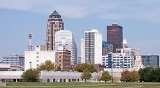
Des Moines, Iowa

Encyclopedia
Des Moines is the capital and the most populous city in the US state of Iowa
. It is also the county seat
of Polk County
. A small portion of the city extends into Warren County. It was incorporated on September 22, 1851, as Fort Des Moines which was shortened to "Des Moines" in 1857. It is named after the Des Moines River
, which may have been adapted from the French Rivière des Moines, literally meaning "River of the Monk
s." The five-county metropolitan area
is ranked 88th in terms of population in the United States with 569,633 residents according to the 2010 count by the United States Census Bureau
. The city proper population was 203,433 at the 2010 census.
Des Moines is a major center for the insurance industry and also has a sizable financial services and publishing business base. In fact, Des Moines was credited with the "number one spot for U.S. insurance companies" in a Business Wire
article. The city is the headquarters for the Principal Financial Group
, the Meredith Corporation
, Ruan Transportation, EMC Insurance Companies, and Wellmark Blue Cross Blue Shield. Other major corporations such as Wells Fargo
, ING Group
, Nationwide Mutual Insurance Company
, Marsh, Monsanto
and Pioneer Hi-Bred
have large operations in or near the metro area. Forbes magazine ranked Des Moines as the "Best Place for Business" in 2010. Kiplinger's Personal Finance
2008 Best Cities List featured Des Moines as #9. In November 2011, the city of Des Moines was listed as the #1 Greenest city for Women by Self Magazine.
Des Moines is an important city in United States presidential politics as the capital of Iowa, which is home to the Iowa caucuses. The caucuses have been the first major electoral event in nominating the President of the United States since 1972. Hence, many presidential candidates set up campaign headquarters in Des Moines. A 2007 article in The New York Times
stated "if you have any desire to witness presidential candidates in the most close-up and intimate of settings, there is arguably no better place to go than Des Moines."
. The French "des Moines" translates literally to either "monks" or "of the monks".
The historian Virgil Vogel claimed that "Moingona" was derived from the Algonquan clan name "Loon".
Some historians and researchers lacking linguistic or Algonquianist training concluded that Moingona meant "people by the portage" or something similar, a reference to the Des Moines Rapids
, where the earliest meetings between the Moingona and European explorers took place.
One popular interpretation of "Des Moines" ignores Vogel's research, and concludes that "Des Moines" refers to French Trappist monks
, who lived in huts on top of what is now known as Monks Mound near St. Louis some 200 miles (321.9 km) from the Des Moines River.
A controversial recent hypothesis using a study of Miami-Illinois tribal names concludes the word Moingona comes from mooyiinkweena, a derogatory name which translates roughly to "the excrement-faces." The name was apparently given to Marquette
and Joliet
by a tribal leader to dissuade them from doing business with a neighboring tribe. This alternative etymology has been rejected by the amateur historian Jim Fay. This rejection has been rejected by amateur historian Dean Freda.
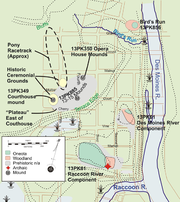 The juncture of the Des Moines
and Raccoon
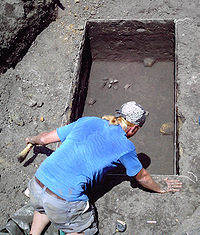
rivers has attracted humans for at least 7,000 years. Several prehistoric occupation areas have been identified in downtown Des Moines by archaeologists. Discovered in December 2010, the "Palace" is an expansive 7,000 year old site located at the new wastewater treatment plant in southeastern Des Moines. It contains well-preserved house deposits and numerous graves. John Doershuk was assisted by the University of Iowa archaeologists at this ongoing dig.
At least three Late Prehistoric villages stood in or near downtown Des Moines, dating from about AD 1300 to 1700. In addition, 15 to 18 prehistoric American Indian
mounds were observed in downtown Des Moines by early settlers. All have been destroyed.
Indians, who had been transplanted to the area from their traditional lands in eastern Iowa. The fort was abandoned in 1846 after the Sauk and Meskwaki were removed from the state.
The Sauk and Meskwaki did not fare well in Des Moines. The illegal whiskey trade, combined with the destruction of traditional lifeways, led to severe problems. One newspaper reported: "It is a fact that the location of Fort Des Moines among the Sac and Fox Indians (under its present commander) for the last two years, had corrupted them more and lowered them deeper in the scale of vice and degradation, than all their intercourse with the whites for the ten years previous."
Even after official removal, the Meskwaki continued to return to Des Moines until ca. 1857. Archaeological excavations have demonstrated that many fort-related features survived under what is now Martin Luther King, Jr.
Parkway and First Street. Soldiers stationed at Fort Des Moines opened the first coal mines in the area, mining coal from the riverbank for the fort's blacksmith.
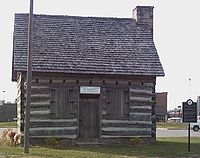
 Settlers occupied the abandoned fort and nearby areas. On May 25, 1846, Fort Des Moines became the seat of Polk County. Arozina Perkins, a school teacher who spent the winter of 1850–1851 in the town of Fort Des Moines, was not favorably impressed;
In May 1851, much of the town was destroyed during the Flood of 1851
. "The Des Moines and Raccoon rivers rose to an unprecedented height, inundating the entire country east of the Des Moines river. Crops were utterly destroyed, houses and fences swept away." This flood provided a clean slate for the city to grow on.
.
Growth was slow during the Civil War period, but the city exploded in size and importance after a railroad link was completed in 1866.
In 1864, the Des Moines Coal Company was organized to begin the first systematic mining in the region. Its first mine, north of town on the west side of the river, was exhausted by 1873. The Black Diamond mine, near the south end of the West Seventh Street Bridge, sunk a 150 feet (45.7 m) mine shaft to reach a 5 feet (1.5 m) coal bed. By 1876, this mine employed 150 men and shipped 20 carloads of coal per day. By 1885, there were numerous mine shafts within the city limits, and mining began to spread into the surrounding countryside. By
1893, there were 23 mines in the region. By 1908, the coal resources of Des Moines were largely exhausted. Nonetheless, in 1912, Des Moines was home to eight locals of the United Mine Workers
union representing a total of 1,410 miners. This represents about 1.7 percent of the city's population in 1910.
By 1900, Des Moines was Iowa's largest city with a population of 62,139.
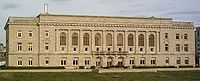
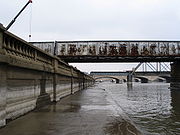 At the turn of the 20th century, Des Moines undertook a "City Beautiful" project in which large Beaux Arts public buildings and fountains were constructed along the Des Moines River. The former Des Moines Public Library building (now the home of the World Food Prize
), the central Post Office (now Polk County Administrative Building with a newer addition attached), and the City Hall are surviving examples of the 1900–1910 buildings.
The ornate riverfront balustrade that still line the Des Moines and Raccoon River were built by the federal Civilian Conservation Corps in the mid 1930s. The ornamental fountains that once stood along the riverbank were buried in the 1950s, when the city began a post-industrial decline which lasted until the late 1980s. The city has since rebounded, transforming from a blue-collar industrial city to a white-collar professional city.
In 1907, the city adopted a city commission government
known as the Des Moines Plan, comprising an elected mayor and four commissioners who were responsible for public works, public property, public safety, and finance. This form of government was scrapped in 1950 in favor of a council-manager government, and further changed in 1967 so that four of the seven city council members were elected by ward rather than at-large. As with many major urban areas, the city core began losing population to the suburbs in the 1960s (the peak population of 208,982 was recorded in 1960). The population was 198,682 in 2000 and grew slightly to 200,538 in 2009. However, the growth of the outlying suburbs has been a constant and the overall metro area population is over 560,000 today.
During the Great Flood of 1993
, heavy rains throughout June and early July caused the Des Moines and Raccoon Rivers to rise above flood stage levels. The Des Moines Water Works was submerged by flood waters during the early morning hours of July 11, 1993 leaving an estimated 250,000 people without running water for 12 days and without drinking water for 20 days. Des Moines suffered major flooding again in June 2008 with a major levee breach.
Today, Des Moines is a member of ICLEI Local Governments for Sustainability USA
, an organization promoting the United Nations' Agenda 21
. Through ICLEI, Des Moines has implemented "The Tomorrow Plan", a regional plan focused on developing central Iowa in a sustainable fashion, centrally planning growth and resource consumption to manage the local population.
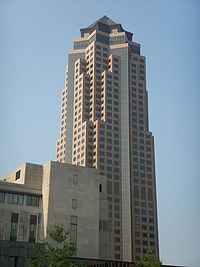 The skyline of Des Moines changed during the 1970s and 1980s as several new skyscrapers were built. Before then, the 19-story Equitable Building, from 1924, was the tallest building in the city and the tallest building in Iowa. At the time it was completed the Equitable Building was also the tallest building west of the Mississippi River. The 25-story Financial Center was completed in 1973 and the 36-story Ruan Center was completed in 1974. They were later joined by the 33-story Marriott
Hotel (1981), the 25-story Hub Tower and 25-story Plaza Building (1985), Iowa's tallest building, Principal Financial Group
's 45-story tower at 801 Grand
(1991), and the 19-story EMC Insurance Building (1997).
This time period also saw the opening of the Civic Center of Greater Des Moines
(1979) which hosts Broadway shows and special events, the Des Moines Botanical Center
(1979) which is a large city botanical garden/greenhouse on the east side of the river, the Polk County Convention Complex (1985), and the State of Iowa Historical Museum (1987). The Des Moines skywalk
system also began to take shape during the 1980s. The skywalk system is 4 miles (6.4 km) long and connects many downtown buildings.
The city is in the midst of major construction in the downtown area. The new Science Center of Iowa and Blank IMAX Dome Theater and the Iowa Events Center
opened in 2005, while the new central branch of the Des Moines Public Library, designed by renowned architect David Chipperfield
of London, opened on April 8, 2006.
The World Food Prize
Foundation, which is based in Des Moines, completed restoration of the former Des Moines Public Library
building in October 2011. The former library now serves as the home and headquarters of the Dr. Norman Borlaug
/World Food Prize
Hall of Laureates.
In 2002, the Principal Financial Group and the city announced plans for the Principal Riverwalk
, which will feature trails, pedestrian bridges across the river, a fountain and skating plaza, and a "civic garden" in front of the City Hall. Multiple existing downtown buildings are being converted to loft
apartments and condominium
s. This trend is highlighted by the success of the East Village district of shops, studios, and housing between the Capitol district and the Des Moines River.
, the city has a total area of 82.5 square miles (213.7 km²), of which 80.8 square miles (209.3 km²) is land and 1.7 square miles (4.4 km²) (2.08%) is water.
In November 2005, Des Moines voters approved a measure that allowed the city to involuntarily annex certain parcels of land in the northeast, southeast, and southern corners of Des Moines, particularly areas bordering the Iowa Highway 5/U.S. 65
bypass. The annexations became official on June 26, 2009, as 5,174 acres (9.27 square miles) and approximately 868 new residents were added to the city of Des Moines. An additional 759 acres (1.18 square miles) were voluntarily annexed to the city over that same period of time time.
consists of five central Iowa counties: Polk
, Dallas
, Warren, Madison
, and Guthrie
. The area had a 2000 census population of 481,394 and an estimated 2009 population of 562,906. The Des Moines-Newton
-Pella
Combined Statistical Area
consists of those five counties plus Jasper
and Marion
counties; the 2000 census population of this area was 550,659, and the estimated 2009 population was 631,805. Des Moines' suburban communities include Altoona
, Ankeny
, Bondurant
, Carlisle
, Clive
, Grimes
, Johnston
, Norwalk
, Pleasant Hill
, Urbandale
, Waukee
, West Des Moines
, and Windsor Heights
.
, with hot, humid summers and cold, snowy winters. Summer temperatures can often climb into the 90 °F (32 °C) range, occasionally reaching 100 °F (38 °C). Humidity can be high in spring and summer, with frequent afternoon thunderstorm
s. Fall brings pleasant temperatures and colorful fall foliage. Winters vary from moderately cold to bitterly cold, with low temperatures venturing below 0 °F (-18 °C) quite often. Annual snowfall averages 36.4 inches (92 cm), and annual precipitation averages 34.72 inches (882 mm), with a peak in the warmer months.
As of the census of 2000, there were 198,682 people, 80,504 households, and 48,704 families residing in the city. The population density was 2,621.3 people per square mile (1,012.0/km²). There were 85,067 housing units at an average density of 1,122.3 per square mile (433.3/km²). The racial makeup of the city was 82.3% White or Euro American
, 8.07% Black or African Americans
, 0.35% Native American Indian
, 3.50% Asian American, 0.05% Pacific Islander
, 3.52% from other races, and 2.23% from two or more races. 6.61% of the population were Hispanic or Latino
of any race. 20.9% were of German
, 10.3% Irish, 9.1% American and 8.0% English ancestry, according to Census 2000.
There were 80,504 households out of which 29.5% had children under the age of 18 living with them, 43.7% were married couples living together, 12.6% had a female householder with no husband present, and 39.5% were non-families. 31.9% of all households were made up of individuals and 10.2% had someone living alone who was 65 years of age or older. The average household size was 2.39 and the average family size was 3.04.
In the city the population was spread out with 24.8% under the age of 18, 10.6% from 18 to 24, 31.8% from 25 to 44, 20.4% from 45 to 64, and 12.4% who were 65 years of age or older. The median age was 34 years. For every 100 females, there were 93.8 males. For every 100 females age 18 and over, there were 90.5 males.
The median income for a household in the city was $38,408, and the median income for a family was $46,590. Males had a median income of $31,712 versus $25,832 for females. The per capita income for the city was $19,467. About 7.9% of families and 11.4% of the population were below the poverty line, including 14.9% of those under age 18 and 7.6% of those ages 65 or over.
Many insurance companies are headquartered in Des Moines, including the Principal Financial Group
, Marsh (formerly KVI), EMC Insurance Group, Allied Insurance (now part of Nationwide
), Aviva
, Holmes Murphy, and American Republic Insurance Company. Des Moines has been referred to as the "Hartford of the West" because of this. The Principal is one of two Fortune 500
companies having headquarters in Iowa, ranking 273rd on the magazine's list in 2009.
As a center of financial and insurance services, other major corporations headquartered outside of Iowa have established a presence in the Des Moines Metro area, including Wells Fargo
, ING Group
, and Electronic Data Systems
. The Meredith Corporation
, a leading publishing and marketing company, is also based in Des Moines. Meredith publishes Better Homes and Gardens
, one of the most widely circulated publications in the United States.
Other major employers in the area (with more than 1,000 local employees) include Mercy Medical Center, Iowa Health System, MidAmerican Energy Company
, Pioneer Hi-Bred
International, Firestone
Agricultural Tire Company, UPS
, FBL Financial Group
, Qwest
, Wellmark Blue Cross and Blue Shield
of Iowa, Hy-Vee
supermarkets, John Deere
Des Moines Works, John Deere
Credit, and CDS Global
.
In 2010, Forbes
magazine ranked the Des Moines metropolitan area first on its list of "Best Places For Business And Careers," based on factors such as the cost of doing business, cost of living, educational attainment, and crime rate.
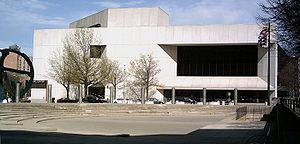 The City of Des Moines is a cultural center for Iowa and home to several art and history museums and performing arts
groups. The Civic Center of Greater Des Moines
routinely hosts the best Broadway shows and other live professional theater. Its president and CEO, Jeff Chelsvig, is a member of the League of American Theatres and Producers, Inc. The Temple for Performing Arts and Des Moines Playhouse are other venues for live theatre, comedy, and performance arts.
The Des Moines Metro Opera
has been a respected cultural resource in Des Moines since 1973. The Opera offers award-winning educational and outreach programs and is one of the largest performing arts organizations in the state. Ballet Des Moines was established in 2002. Currently performing two productions each year, the Ballet also provides opportunities for education and outreach.
The Des Moines Symphony performs frequently at different venues. In addition to performing seven pairs of classical concerts each season, the Symphony also entertains with New Year's Eve Pops and its annual Yankee Doodle Pops concerts.
The Metro Arts Alliance
produces 'Jazz in July every year, that offers free jazz shows daily at various venues throughout the city during the entire month of July.
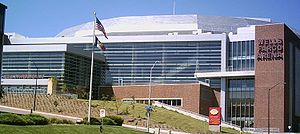 Wells Fargo Arena
is the Des Moines area's primary venue for sporting events and concerts since its opening in 2005. Named for title sponsor Wells Fargo Financial Services, Wells Fargo Arena holds 16,980 and books large, national touring acts for arena concert performances, while smaller venues such as the Vaudeville Mews, People's, and the House of Bricks host local, regional, and national bands. It is also the home of the Iowa Energy.
The Simon Estes
Riverfront Amphitheater is an outdoor concert venue located on the east bank of the Des Moines River
which hosts music events such as the Alive Concert Series.
The Des Moines Art Center
, with a wing designed by architect I.M. Pei, presents art exhibitions and educational programs as well as hands-on studio art classes. The Center houses an internationally renowned collection of artwork from the 19th century to the present. An extension of the world-renowned art center is located downtown in an energetic urban museum space, featuring three or four exciting and fresh exhibitions each year. A Museum shop offers unique gifts, jewelry, cards, and books.
Dedicated September 27, 2009, the Pappajohn Sculpture Park located in Western Gateway Park from 10th to 15th Streets and between Grand Avenue and Locust Street, showcases a collection of 24 world class sculptures valued at more than $40 million donated by Des Moines philanthropists John and Mary Pappajohn. Resting on 4.4 acre (2 ha) of green space, the sculpure park is designed as an outdoor art museum. Nearby is the beautifully restored and historic Temple for Performing Arts, reborn as a cultural center for the city. Next to the Temple is the 117000 square feet (10,869.7 m²) Central Library, with its ultramodern, freeform architecture and "organic" roof designed by renowned English architect David Chipperfield
.
Salisbury House and Gardens is a 42-room mansion on 10 acre (4 ha) of woodlands named after the King's House in Salisbury, England. Built in the 1920s by the Weeks family, the home contains authentic 16th century English oak and rafters dating to Shakespeare's days and a world-class collection of original art, tapestries, and rare books. Special events include Shakespeare on the Lawn, Salisbury Auto Classic, and the Holly and Ivy Tour.
Built in 1877 by prominent pioneer businessman Hoyt Sherman
, Hoyt Sherman Place mansion was Des Moines' first public art gallery and houses a distinctive collection of 19th and 20th century artwork. Its restored 1,250-seat theater features an intricate rococo plaster ceiling and excellent acoustics and is used for a variety of cultural performances and entertainment.
building with its 275 feet (83.8 m), 23-karat gold leafed dome towering above the city is a favorite of sightseers. Four smaller domes flank the main dome. The Capitol houses the governor's offices, legislature, and the old Supreme Court Chambers. The ornate interior also features a grand staircase, mural "Westward", five-story law library, scale model of the USS Iowa
, and collection of first lady dolls. Guided tours are available. The Capitol grounds include a World War II memorial with sculpture and Wall of Memories. Other monuments include the 1894 Soldiers and Sailors Monument of the Civil War
and memorials honoring those who served in the Spanish-American
, Korean
, and Vietnam War
s.
The West Capitol Terrace provides a stunning entrance from the west to the state's grandest building, the State Capitol Building. With its picturesque views, the lush, 10 acres (40,468.6 m²) "people's park" at the foot of the Capitol complex includes a promenade and landscaped gardens, in addition to providing public space for rallies and special events. A granite map of Iowa depicting all 99 counties rests at the base of the terrace and has become a popular attraction for in-state visitors, many of whom can be seen walking over the map to find their home county.
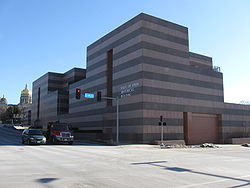 Iowa's history lives on in the State of Iowa Historical Museum. This modern granite and glass structure at the foot of the State Capitol Building houses permanent and temporary exhibits exploring the people, places, events, and issues of Iowa's past. The showcase includes native wildlife, American Indian
and pioneer artifacts, and political and military items. The Museum features a genealogy and Iowa history library, museum gift shop, and cafe.
Terrace Hill
, a National Historic Landmark and Iowa Governor's Residence, is among the best examples of American Victorian Second Empire architecture. This opulent 1869 home was built by Iowa's first millionaire, Benjamin F. Allen, and restored to the late 19th century period. It overlooks downtown Des Moines and is situated on 8 acres (32,374.9 m²) with a re-created Victorian formal garden. Tours are conducted Tuesdays through Saturdays from March through December.
The 110000 square feet (10,219.3 m²) Science Center of Iowa and Blank IMAX Dome Theater offers seven interactive learning areas, live programs, and hands-on activities encouraging learning and fun for all ages. Among its three theaters include the 216-seat Blank IMAX Dome Theater, 175-seat John Deere
Adventure Theater featuring live performances, and a 50 feet (15.2 m) domed Star Theater.
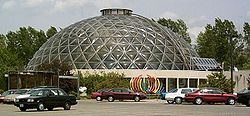 The Des Moines Botanical Center
is an indoor conservatory of over 15,000 exotic plants, one of the largest collections of tropical, subtropical, and desert-growing plants in the Midwest. The Center blooms with thousands of flowers year-round. Beautiful and extensive exterior gardens are also located here. Nearby are the Robert D. Ray Asian Gardens and Pavilion, named in honor of the former governor whose influence helped relocate thousands of Vietnamese refugees to Iowa homes in the 1970s and 1980s. Developed by the city's Asian community, the Gardens inlude a three-story Chinese pavilion, bonsai landscaping, and granite sculptures to highlight the importance of diversity and recognize Asian American contributions in Iowa.
Blank Park Zoo
is a beautifully landscaped 22 acres (89,030.9 m²) zoological park located on the south side. Among the exhibits include a tropical rain forest, Australian Outback, and Africa. The Zoo offers education classes, tours, and rental facilities.
The Great Ape Trust
of Iowa was established as a scientific research facility with a 230 acre (0.9307778 km²) campus housing bonobos and orangutans for the noninvasive interdisciplinary study of their cognitive and communicative capabilities. The Trust offers small public tours on a seasonal basis and only by reservation.
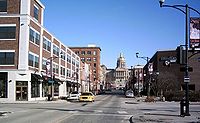 The East Village
, located on the east side of the Des Moines River
, begins at the river and extends about five blocks east to the State Capitol Building, offering an eclectic blend of historic buildings, hip eateries, boutiques, art galleries, and a wide variety of other retail establishments mixed with residences.
Adventureland Park is an amusement park in neighboring Altoona
, just northeast of Des Moines. The park boasts more than 100 rides, shows, and attractions, including three great roller coasters. A hotel and campground is located just outside the park. Also in Altoona is Prairie Meadows
Racetrack and Casino, a popular entertainment venue for gambling and horse racing enthusiasts. Open 24 hours a day, year-round, the racetrack and casino features live racing, plus over 1,750 slot machines, table games, and concert and show entertainment.
Living History Farms
in suburban Urbandale
tells the story of Midwestern agriculture and rural life in a 500 acres (2 km²) open-air museum with interpreters dressed in period costume who recreate the daily routines of early Iowans. Open daily from May through October, the Living History Farms include a 1700 Ioway Indian village, 1850 pioneer farm, 1875 frontier town, 1900 horse-powered farm, and a modern crop center.
Wallace House was the home of the first Henry Wallace, a national leader in agriculture and conservation and the first editor of Wallaces' Farmer farm journal. This restored 1883 Italianate Victorian houses exhibits, artifacts, and information covering four generations of Henry Wallaces and other family members.
Historic Jordan House in West Des Moines
is a stately Victorian home built in 1850 and added to in 1870 by the first white settler in West Des Moines, James C. Jordan. Completely refurbished, this mansion was once part of the Underground Railroad
and today houses 16 period rooms, a railroad museum, West Des Moines community history, and a museum dedicated to the Underground Railroad in Iowa.
The Chicago Tribune wrote that Iowa's capital city has "walker-friendly downtown streets and enough outdoor sculpture, sleek buildings, storefronts and cafes to delight the most jaded stroller."
in August, and the World Food Festival in October. On Saturdays from May through October, the popular Downtown Farmers' Market draws visitors from across the state.
The Court Avenue Entertainment District is the city's preeminent downtown restaurant and nightclub destination.
The 80/35 Music Festival
debuted in 2008. 80/35 celebrates music, artists, and fans with such acts as The Flaming Lips
and Girl Talk
.
Market Day is a monthly craft event which sets up with "the best of the best" of indie crafters in downtown Des Moines from May through November. It is the first monthly indie craft event of its kind.
Other annual cultural festivals include: ArtFest Midwest, Celebrasian Heritage Festival, Des Moines Pride Festival, Des Moines Renaissance Faire, Festa Italiana, Festival of Trees and Lights, Interrobang Film Festival, Latino Heritage Festival, Rib America Festival, Winefest, and Wild Rose Film Festival.
 Des Moines currently operates under a council-manager
form of government. The council consists of a mayor (who, as of 2009, is Frank Cownie
) and is elected in citywide vote, two at-large members, and four members representing each of the city's four wards.
A plan to merge the governments of Des Moines and Polk County was rejected by voters during the November 2, 2004, election. The consolidated city-county
government would have had a full-time mayor and a 15-member council that would have been divided among the city and its suburbs. Each suburb would have still retained its individual government but had the option to join the consolidated government at any time. Although a full merger was soundly rejected, many city and county departments and programs have been consolidated.
Interstate 235
cuts through the city, and Interstate 35
and Interstate 80
both pass through the Des Moines metropolitan area. On the northern side of the Des Moines metropolitan area, Interstates 35 and 80 converge into a long concurrency while Interstate 235 takes a direct route through Des Moines, Windsor Heights, and West Des Moines before meeting up with Interstates 35 and 80 on the western edge of the metro.
Des Moines' freeway design makes it easy for travellers. If you miss an exit at the interstate
"mixmasters" at the eastern and western edges of the metro, you will eventually end up at the convergence of the same interstates at the opposite side of the metro. These Interstates include I-35, I-80, and I-235. Iowa DOT has completed the Interstate 235 expansion project. This freeway, which takes the brunt of most congestion, is six lanes throughout the entire length and expands to eight and ten lanes near the downtown area. The remainder of traffic congestion in the area occurs near the Northeast and West Mixmasters on either side of Des Moines. Interstate 35 south of the West Mixmaster is currently planning to be widened to six lanes all the way down to the IA 5/US 65 bypass interchanges.
Due to increasing traffic congestion and prevalence of accidents along Interstate 235, the city of Des Moines is considering implementing a speeding camera program to curb excessive speeding through the most densely populated parts of Greater Des Moines. The northeast Mixmaster has also undergone a redesign with wider lanes and redesign of bridges allowing easier traffic flow in all directions along Interstates 35, 80, and 235. U.S. Highway 65 and Iowa Highway 5 form a freeway loop to the east and south of the city, providing an alternative route around the metropolitan area. U.S. Highways 6
and 69
and Iowa Highways 28, 141
, 163, and 415
are also important routes to and within the city.
There are plans to convert Iowa Highway 5 and U.S. Highway 65 into what would be renamed Interstate 335, giving the Des Moines Metropolitan Area an interstate running from the northeast suburb of Altoona to the southeastern suburb of Carlisle and then connect with Interstate 35 in the southern part of West Des Moines of This was proposed at a Des Moines City Council meeting on May 9, 2011.
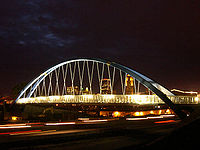 Des Moines's public transit system, operated by DART (Des Moines Area Regional Transit
), which was the Des Moines Metropolitan Transit Authority until October 2006, consists entirely of buses, including regular in-city routes and express and commuter buses to outlying suburban areas. Downtown Des Moines also features a 3.5 miles (5.6 km)-long (5.6 km) skywalk
system, allowing people to move between buildings without going outdoors. As of 2008 a light rail tram system has been proposed.
Greyhound Bus Lines and Jefferson Lines
run long-distance, inter-city bus routes to Des Moines. Megabus is now operated service between Des Moines and Chicago. The nearest Amtrak
train station is in Osceola
, about 40 miles (64.4 km) south of Des Moines. Trains on the route that passes through Osceola, the California Zephyr
, go east to Chicago, Illinois, and as far west as Oakland
, California.
The Des Moines International Airport
(DSM), located in the southern part of Des Moines, on Fleur Drive, offers non-stop service to destinations within the United States.
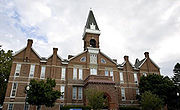 The Des Moines Public Schools
district is the largest community school district in Iowa with 30,683 enrolled students as of the 2007–2008 school year. The district consists of 63 schools: 38 elementary schools, ten middle school
s, five high schools (East
, Hoover
, Lincoln
, North
, and Roosevelt
), and ten special schools and programs. Small parts of the city are also served by the Southeast Polk Community School District
and the Saydel School District
. Private schools in the city include Grand View Park Baptist School, Des Moines Christian School, Iowa Christian Academy, Dowling Catholic High School
in West Des Moines, and Ankeny Christian Academy on the north side of the metro area.
Des Moines is also home to the main campuses of two four-year private colleges: Drake University
and Grand View University. Simpson College
, Upper Iowa University
, and William Penn University
also have classroom facilities in the area. For-profit colleges
with classrooms in the area include the University of Phoenix
. Des Moines Area Community College
is the area's community college
with campuses in Ankeny, downtown Des Moines, and West Des Moines. Other institutions of higher learning in Des Moines include the AIB College of Business
and Des Moines University
, an osteopathic medical school.
, Dallas, Story
, and Warren counties, was ranked 91st by Arbitron
as of the fall of 2007 with a population of 512,000 aged 12 and older. But in June 2011 it was moved up to 72nd with the addition of Boone
, Clarke
, Greene
, Guthrie
, Jasper
, Lucas
, Madison
and Marion
Counties.
owns five radio stations in the area, including WHO
1040 am, a 50,000-watt AM news/talk
station that has the highest ratings in the area and once employed future President Ronald Reagan
as a sportscaster. In addition to WHO, Clear Channel owns KDRB
100.3 FM (adult hits
), KKDM
107.5 FM (contemporary hits
), KPTL
106.3 FM (adult album alternative
), and KXNO
1460 am (sports radio
). (They also own news/talk station KASI
1430 am and modern rock
station KCCQ
105.1 FM, both of which broadcast from Ames
.) Citadel Broadcasting
owns five stations that broadcast from facilities in Urbandale
: KBGG
1700 am ([sports), KGGO
94.9 FM (classic rock
), KHKI
97.3 FM (country music
), KJJY
92.5 FM (country music
), and KWQW
98.3 FM (talk radio
). Saga Communications
owns six stations in the area: KAZR 103.3 FM (active rock
), KIOA
93.3 FM (oldies
), KLTI
104.1 FM (soft adult contemporary
), KPSZ
940 am (contemporary Christian music
), KRNT 1350 am (adult standards
), and KSTZ
102.5 FM (adult contemporary hits
). Connoisseur Communications
is a relative newcomer with a pair of move-ins, KZHC
96.3 (Country) and KZHZ
(Rhythmic Top 40
), both broadcasting from studios in Indianola
. Other stations in the Des Moines area include religious stations KNWI
107.1 FM, KWKY
1150 am, and KPUL
99.5 FM.
88.1 FM, a station operated by the Des Moines Public Schools
; KWDM
88.7 FM, a station operated by Valley High School; KJMC
89.3 FM, an urban contemporary station; and KDFR 91.3 FM, operated by Family Radio
. WOI
640 am and WOI-FM
90.1 are both based out of Iowa State University
in Ames and serve as the area's National Public Radio outlets.
Low-power FM stations include Drake University
's KDRA-LP
and Grand View University's KGVC-LP
, which share the 94.1 frequency, and KFMG-LP 99.1, a community radio station broadcasting from the Hotel Fort Des Moines and also webstreamed.
consists of 35 central Iowa counties: Adair, Adams
, Appanoose
, Audubon
, Boone
, Calhoun
, Carroll
, Clarke
, Dallas
, Decatur
, Franklin
, Greene
, Guthrie
, Hamilton
, Hardin
, Humboldt
, Jasper
, Kossuth
, Lucas
, Madison
, Mahaska
, Marion
, Marshall
, Monroe
, Pocahontas
, Polk
, Poweshiek
, Ringgold
, Story
, Taylor
, Union, Warren, Wayne
, Webster
, and Wright
. It is ranked 71st by Nielsen Media Research
for the 2008–2009 television season with 432,410 television households.
Commercial television stations serving Des Moines include KCCI
channel 8, a CBS
affiliate; WHO-TV
channel 13, an NBC
affiliate; KDSM-TV
channel 17, a Fox
affiliate; and KDMI
channel 56, a MyNetworkTV
affiliate that only has a digital signal. ABC
affiliate WOI-TV
channel 5 is licensed
to Ames and was owned by Iowa State University
until 1994. It currently broadcasts from studios in West Des Moines
. KCWI-TV
channel 23, the local CW
affiliate, is also licensed to Ames but broadcasts from studios in Ankeny
. KFPX
channel 39, the local ION affiliate, is licensed to Newton
. KDIN channel 11 is the local PBS
member station and flagship of the Iowa Public Television
network. Mediacom
is the Des Moines area's cable television provider.
Print
The Des Moines Register is the city's primary daily newspaper. As of March 31, 2007, the Register ranked 71st in circulation among daily newspapers in the United States according to the Audit Bureau of Circulations with 146,050 daily and 233,229 Sunday subscribers. Weekly newspapers include Juice, a publication aimed at the 25–34 demographic published by the Register on Wednesdays; Cityview
, an alternative weekly
published on Thursdays; and the Des Moines Business Record, a business journal published on Sundays, along with the West Des Moines Register, the Johnston Register, and the Waukee Register on Tuesdays, Wednesdays, or Thursdays depending on the address of the subscriber. Additionally, magazine publisher Meredith Corporation
is based in Des Moines.
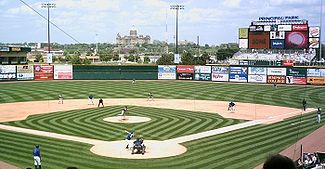 Des Moines is home to the Iowa Cubs
baseball team of the Pacific Coast League
. The I-Cubs, which are the Class AAA team of the major league Chicago Cubs
, play their home games at Principal Park
near the confluence of the Des Moines and Raccoon Rivers. Principal Park is also home to the Iowa High School Athletic Association's state baseball tournaments every summer.
The Wells Fargo Arena
of the Iowa Events Center was home to the Iowa Chops (formerly the Iowa Stars) of the American Hockey League
from 2005–2009 and has been the home of the Iowa Energy
of the NBA Development League
since 2007. In 2008, the Iowa Barnstormers
of the Arena Football League
league resumed play at Wells Fargo Arena. The Barnstormers previously played at Veterans Memorial Auditorium
as members of the Arena Football League from 1995 to 2000, and featured Kurt Warner
before he played in the NFL. While the original franchise became the New York Dragons
after the 2000 season, the Barnstormers nickname, colors, and uniforms were used for an AF2 franchise that suspended operations after one season in 2001.
Veterans Memorial Auditorium was also home to the Des Moines Dragons
of the International Basketball Association
from 1997–2001, and was also home to the state high school wrestling and basketball tournaments before they moved to the new Wells Fargo Arena in 2006.
Two other sports teams play in the Des Moines area: the Des Moines Buccaneers
of the United States Hockey League
play at Buccaneer Arena in Urbandale
, while the Des Moines Menace
soccer team plays at Valley Stadium in West Des Moines
.
Des Moines is also home to the famed Drake Relays
, which are held at Drake University
each April. In addition to the Drake Relays, Drake Stadium
hosted the 2008 & 2011 NCAA
Outdoor Track & Field Championships. It is scheduled to host the 2012 Championships. Drake also hosted the USA Outdoor Track and Field Championships
in 2010.
The Principal Charity Classic, a Champions Tour golf event, is held at Glen Oaks Country Club in West Des Moines every May/June and has been in the community since 2001. The Principal Charity Classic benefits children's charities in Iowa. The Hy-Vee Triathlon
, which debuted in 2007, is held every June and served as a qualifier to the Olympic Games in 2008. The IMT Des Moines Marathon
is held throughout the city each October.
Des Moines has also been announced as a potential home to an expansion franchise for the United Football League.
The Principal Riverwalk
is a riverwalk park district currently being constructed along the banks of the Des Moines River in the downtown. Spearheaded by the Principal Financial Group
, the Riverwalk is a multi-year, jointly funded project between the City of Des Moines, State of Iowa, and The Principal. Upon completion, it will feature a 1.2 miles (1.9 km) recreational trail connecting the east and west sides of downtown via two pedestrian bridges. A landscaped promenade along the street level is planned.
The Riverwalk includes the Brenton Skating Plaza. From November through March, the outdoor skating rink is open as a skating mecca for central Iowans. Located downtown along the east bank of the Des Moines River, the plaza is available for parties, social events, concerts during the warmer months of the year.
Gray's Lake, as part of popular Gray's Lake Park, features a boat rental facility, fishing pier, floating boardwalks, and a park resource center. Located just south of the downtown, the centerpiece of the park is a lighted trail encircling the entire park.
Jester Park, another locals' favorite, offers diverse recreational experiences for visitors on 1834 acre (742 ha) of land along the western shore of Saylorville Lake
. Camping, fishing, golfing, horseback riding, hiking, hunting, geocaching, and picnicking are among the myriad of activities offered. The park also includes an accessible playground and is the home of the Jester Park Lodge.
The Great Western Trail
is an 18 miles (29 km) journey from Des Moines to Martensdale offering adventure for the nature enthusiast, the history buff, and for those who want to put on their hiking boots or hop on a bicycle.
– Kofu, Japan (August 16, 1958) – Naucalpan
, Mexico (May 4, 1972) – Saint-Étienne
, France (May 29, 1985) – Shijiazhuang
, People's Republic of China (August 8, 1985) –.png) Stavropol
Stavropol
, Russia (July 27, 1992) – Province of Catanzaro
, Italy (June 26, 2006)
Iowa
Iowa is a state located in the Midwestern United States, an area often referred to as the "American Heartland". It derives its name from the Ioway people, one of the many American Indian tribes that occupied the state at the time of European exploration. Iowa was a part of the French colony of New...
. It is also the county seat
County seat
A county seat is an administrative center, or seat of government, for a county or civil parish. The term is primarily used in the United States....
of Polk County
Polk County, Iowa
Polk County is a county located in the U.S. state of Iowa. The population was 430,640 in the 2010 census, an increase from 374,601 in the 2000 census. The county seat is Des Moines, which is also the capital city of Iowa...
. A small portion of the city extends into Warren County. It was incorporated on September 22, 1851, as Fort Des Moines which was shortened to "Des Moines" in 1857. It is named after the Des Moines River
Des Moines River
The Des Moines River is a tributary river of the Mississippi River, approximately long to its farther headwaters, in the upper Midwestern United States...
, which may have been adapted from the French Rivière des Moines, literally meaning "River of the Monk
Monk
A monk is a person who practices religious asceticism, living either alone or with any number of monks, while always maintaining some degree of physical separation from those not sharing the same purpose...
s." The five-county metropolitan area
Des Moines metropolitan area
The Des Moines metropolitan area, officially known as the Des Moines-West Des Moines Metropolitan Statistical Area , consists of five counties in central Iowa, United States: Polk, Dallas, Warren, Madison, and Guthrie...
is ranked 88th in terms of population in the United States with 569,633 residents according to the 2010 count by the United States Census Bureau
United States Census Bureau
The United States Census Bureau is the government agency that is responsible for the United States Census. It also gathers other national demographic and economic data...
. The city proper population was 203,433 at the 2010 census.
Des Moines is a major center for the insurance industry and also has a sizable financial services and publishing business base. In fact, Des Moines was credited with the "number one spot for U.S. insurance companies" in a Business Wire
Business Wire
Business Wire is a company that disseminates full-text news releases from thousands of companies and organizations worldwide to news media, financial markets, disclosure systems, investors, information web sites, databases and other audiences. The company distributes news via its own patented...
article. The city is the headquarters for the Principal Financial Group
Principal Financial Group
Principal Financial Group is a publicly traded corporation based in Des Moines, Iowa, USA.The Principal Financial Group is a global financial services provider which offers a wide range of financial products and services, and is a U.S. leader in 401 plans. Headquartered in Des Moines, Iowa, the...
, the Meredith Corporation
Meredith Corporation
The Meredith Corporation is a media conglomerate based in Des Moines, Iowa, USA. The company has two divisions, National Media and Local Media.-History:...
, Ruan Transportation, EMC Insurance Companies, and Wellmark Blue Cross Blue Shield. Other major corporations such as Wells Fargo
Wells Fargo
Wells Fargo & Company is an American multinational diversified financial services company with operations around the world. Wells Fargo is the fourth largest bank in the U.S. by assets and the largest bank by market capitalization. Wells Fargo is the second largest bank in deposits, home...
, ING Group
ING Group
The ING Group is a global financial institution offering retail banking, direct banking, commercial banking, investment banking, asset management, and insurance services. ING is the Dutch member of the Inter-Alpha Group of Banks, a cooperative consortium of 11 prominent European banks...
, Nationwide Mutual Insurance Company
Nationwide Mutual Insurance Company
Nationwide Mutual Insurance Company & Affiliated Companies is a group of large U.S. insurance and financial services companies based in Columbus...
, Marsh, Monsanto
Monsanto
The Monsanto Company is a US-based multinational agricultural biotechnology corporation. It is the world's leading producer of the herbicide glyphosate, marketed in the "Roundup" brand of herbicides, and in other brands...
and Pioneer Hi-Bred
Pioneer Hi-Bred
Pioneer Hi-Bred is the largest U.S. producer of hybrid seeds for agriculture.- History :In 1926, farm journal editor and future U.S. Vice President Henry A. Wallace, along with a group of Des Moines, Iowa businessmen, founded the "Hi-Bred Corn Company". At the time, most corn farmers saved part of...
have large operations in or near the metro area. Forbes magazine ranked Des Moines as the "Best Place for Business" in 2010. Kiplinger's Personal Finance
Kiplinger's Personal Finance
Kiplinger's Personal Finance is a magazine that has been continuously published, on a monthly basis, from 1947 to the present day. It was the nation's first personal finance magazine, and claims to deliver "sound, unbiased advice in clear, concise language"...
2008 Best Cities List featured Des Moines as #9. In November 2011, the city of Des Moines was listed as the #1 Greenest city for Women by Self Magazine.
Des Moines is an important city in United States presidential politics as the capital of Iowa, which is home to the Iowa caucuses. The caucuses have been the first major electoral event in nominating the President of the United States since 1972. Hence, many presidential candidates set up campaign headquarters in Des Moines. A 2007 article in The New York Times
The New York Times
The New York Times is an American daily newspaper founded and continuously published in New York City since 1851. The New York Times has won 106 Pulitzer Prizes, the most of any news organization...
stated "if you have any desire to witness presidential candidates in the most close-up and intimate of settings, there is arguably no better place to go than Des Moines."
Etymology
Des Moines takes its name from Fort Des Moines (1843–46), which was named for the Des Moines RiverDes Moines River
The Des Moines River is a tributary river of the Mississippi River, approximately long to its farther headwaters, in the upper Midwestern United States...
. The French "des Moines" translates literally to either "monks" or "of the monks".
The historian Virgil Vogel claimed that "Moingona" was derived from the Algonquan clan name "Loon".
Some historians and researchers lacking linguistic or Algonquianist training concluded that Moingona meant "people by the portage" or something similar, a reference to the Des Moines Rapids
Des Moines Rapids
The Des Moines Rapids between Nauvoo, Illinois and Keokuk, Iowa-Hamilton, Illinois is one of two major rapids on the Mississippi River that limited Steamboat traffic on the river through the early 19th century....
, where the earliest meetings between the Moingona and European explorers took place.
One popular interpretation of "Des Moines" ignores Vogel's research, and concludes that "Des Moines" refers to French Trappist monks
Trappists
The Order of Cistercians of the Strict Observance , or Trappists, is a Roman Catholic religious order of cloistered contemplative monks who follow the Rule of St. Benedict...
, who lived in huts on top of what is now known as Monks Mound near St. Louis some 200 miles (321.9 km) from the Des Moines River.
A controversial recent hypothesis using a study of Miami-Illinois tribal names concludes the word Moingona comes from mooyiinkweena, a derogatory name which translates roughly to "the excrement-faces." The name was apparently given to Marquette
Jacques Marquette
Father Jacques Marquette S.J. , sometimes known as Père Marquette, was a French Jesuit missionary who founded Michigan's first European settlement, Sault Ste. Marie, and later founded St. Ignace, Michigan...
and Joliet
Louis Jolliet
Louis Jolliet , also known as Louis Joliet, was a French Canadian explorer known for his discoveries in North America...
by a tribal leader to dissuade them from doing business with a neighboring tribe. This alternative etymology has been rejected by the amateur historian Jim Fay. This rejection has been rejected by amateur historian Dean Freda.
Prehistoric inhabitants of early Des Moines
Des Moines River
The Des Moines River is a tributary river of the Mississippi River, approximately long to its farther headwaters, in the upper Midwestern United States...
and Raccoon
Raccoon River
The Raccoon River is a tributary of the Des Moines River in central Iowa in the United States. As measured using the longest of its three forks, its length increases to...
rivers has attracted humans for at least 7,000 years. Several prehistoric occupation areas have been identified in downtown Des Moines by archaeologists. Discovered in December 2010, the "Palace" is an expansive 7,000 year old site located at the new wastewater treatment plant in southeastern Des Moines. It contains well-preserved house deposits and numerous graves. John Doershuk was assisted by the University of Iowa archaeologists at this ongoing dig.
At least three Late Prehistoric villages stood in or near downtown Des Moines, dating from about AD 1300 to 1700. In addition, 15 to 18 prehistoric American Indian
Indigenous peoples of the Americas
The indigenous peoples of the Americas are the pre-Columbian inhabitants of North and South America, their descendants and other ethnic groups who are identified with those peoples. Indigenous peoples are known in Canada as Aboriginal peoples, and in the United States as Native Americans...
mounds were observed in downtown Des Moines by early settlers. All have been destroyed.
Origin of Fort Des Moines
The City of Des Moines traces its origins to May 1843, when Captain James Allen supervised the construction of a fort on the site where the Des Moines and Raccoon Rivers merge. Allen wanted to use the name Fort Raccoon; however, the U.S. War Department told him to name it Fort Des Moines. The fort was built to control the Sauk and MeskwakiMeskwaki
The Meskwaki are a Native American people often known to outsiders as the Fox tribe. They have often been closely linked to the Sauk people. In their own language, the Meskwaki call themselves Meshkwahkihaki, which means "the Red-Earths." Historically their homelands were in the Great Lakes region...
Indians, who had been transplanted to the area from their traditional lands in eastern Iowa. The fort was abandoned in 1846 after the Sauk and Meskwaki were removed from the state.
The Sauk and Meskwaki did not fare well in Des Moines. The illegal whiskey trade, combined with the destruction of traditional lifeways, led to severe problems. One newspaper reported: "It is a fact that the location of Fort Des Moines among the Sac and Fox Indians (under its present commander) for the last two years, had corrupted them more and lowered them deeper in the scale of vice and degradation, than all their intercourse with the whites for the ten years previous."
Even after official removal, the Meskwaki continued to return to Des Moines until ca. 1857. Archaeological excavations have demonstrated that many fort-related features survived under what is now Martin Luther King, Jr.
Martin Luther King, Jr.
Martin Luther King, Jr. was an American clergyman, activist, and prominent leader in the African-American Civil Rights Movement. He is best known for being an iconic figure in the advancement of civil rights in the United States and around the world, using nonviolent methods following the...
Parkway and First Street. Soldiers stationed at Fort Des Moines opened the first coal mines in the area, mining coal from the riverbank for the fort's blacksmith.
Early settlement
This is one of the strangest looking "cities" I ever saw... This town is at the juncture of the Des Moines and Raccoon rivers. It is mostly a level prairie with a few swells or hills around it. We have a court house of "brick", and one church, a plain, framed building belonging to the Methodists. There are two taverns here, one of which has a most important little bell that rings together some fifty boarders. I cannot tell you how many dwellings there are, for I have not counted them; some are of logs, some of brick, some framed, and some are the remains of the old dragoon houses...The people support two papers and there are several dry goods shops. I have been into but four of them... Society is as varied as the buildings are. There are people from nearly every state, and Dutch, Swedes, etc.
In May 1851, much of the town was destroyed during the Flood of 1851
Flood of 1851
The Great Flood of 1851 occurred after record-setting rainfalls across the U.S. Midwest and Plains from May to August, 1851. Hardest hit was the State of Iowa, with significant flooding extending to the Lower Mississippi River basin. Historical evidence suggest flooding occurred in the eastern...
. "The Des Moines and Raccoon rivers rose to an unprecedented height, inundating the entire country east of the Des Moines river. Crops were utterly destroyed, houses and fences swept away." This flood provided a clean slate for the city to grow on.
Era of growth
On September 22, 1851, Des Moines was incorporated as a city, the charter was approved by voters on October 18. In 1857, the name "Fort Des Moines" was shortened to "Des Moines" and the state capital was moved here from Iowa CityIowa City, Iowa
Iowa City is a city in Johnson County, State of Iowa. As of the 2010 Census, the city had a total population of about 67,862, making it the sixth-largest city in the state. Iowa City is the county seat of Johnson County and home to the University of Iowa...
.
Growth was slow during the Civil War period, but the city exploded in size and importance after a railroad link was completed in 1866.
In 1864, the Des Moines Coal Company was organized to begin the first systematic mining in the region. Its first mine, north of town on the west side of the river, was exhausted by 1873. The Black Diamond mine, near the south end of the West Seventh Street Bridge, sunk a 150 feet (45.7 m) mine shaft to reach a 5 feet (1.5 m) coal bed. By 1876, this mine employed 150 men and shipped 20 carloads of coal per day. By 1885, there were numerous mine shafts within the city limits, and mining began to spread into the surrounding countryside. By
1893, there were 23 mines in the region. By 1908, the coal resources of Des Moines were largely exhausted. Nonetheless, in 1912, Des Moines was home to eight locals of the United Mine Workers
United Mine Workers
The United Mine Workers of America is a North American labor union best known for representing coal miners and coal technicians. Today, the Union also represents health care workers, truck drivers, manufacturing workers and public employees in the United States and Canada...
union representing a total of 1,410 miners. This represents about 1.7 percent of the city's population in 1910.
By 1900, Des Moines was Iowa's largest city with a population of 62,139.
"City Beautiful", industrial decline, and rebirth
World Food Prize
The World Food Prize is an international award recognizing the achievements of individuals who have advanced human development by improving the quality, quantity or availability of food in the world.-The Prize:...
), the central Post Office (now Polk County Administrative Building with a newer addition attached), and the City Hall are surviving examples of the 1900–1910 buildings.
The ornate riverfront balustrade that still line the Des Moines and Raccoon River were built by the federal Civilian Conservation Corps in the mid 1930s. The ornamental fountains that once stood along the riverbank were buried in the 1950s, when the city began a post-industrial decline which lasted until the late 1980s. The city has since rebounded, transforming from a blue-collar industrial city to a white-collar professional city.
In 1907, the city adopted a city commission government
City commission government
City commission government is a form of municipal government which once was common in the United States, but many cities which were formerly governed by commission have since switched to the council-manager form of government...
known as the Des Moines Plan, comprising an elected mayor and four commissioners who were responsible for public works, public property, public safety, and finance. This form of government was scrapped in 1950 in favor of a council-manager government, and further changed in 1967 so that four of the seven city council members were elected by ward rather than at-large. As with many major urban areas, the city core began losing population to the suburbs in the 1960s (the peak population of 208,982 was recorded in 1960). The population was 198,682 in 2000 and grew slightly to 200,538 in 2009. However, the growth of the outlying suburbs has been a constant and the overall metro area population is over 560,000 today.
During the Great Flood of 1993
Great Flood of 1993
The Great Mississippi and Missouri Rivers Flood of 1993 occurred in the American Midwest, along the Mississippi and Missouri rivers and their tributaries, from April to October 1993. The flood was among the most costly and devastating to ever occur in the United States, with $15 billion in damages...
, heavy rains throughout June and early July caused the Des Moines and Raccoon Rivers to rise above flood stage levels. The Des Moines Water Works was submerged by flood waters during the early morning hours of July 11, 1993 leaving an estimated 250,000 people without running water for 12 days and without drinking water for 20 days. Des Moines suffered major flooding again in June 2008 with a major levee breach.
Today, Des Moines is a member of ICLEI Local Governments for Sustainability USA
ICLEI Local Governments for Sustainability USA
ICLEI-Local Governments for Sustainability USA is a 501 nonprofit membership organization of U.S. cities, towns, and counties working to address climate change, clean energy, and local sustainability. ICLEI USA is the U.S...
, an organization promoting the United Nations' Agenda 21
Agenda 21
Agenda 21 is an action plan of the United Nations related to sustainable development and was an outcome of the United Nations Conference on Environment and Development held in Rio de Janeiro, Brazil, in 1992...
. Through ICLEI, Des Moines has implemented "The Tomorrow Plan", a regional plan focused on developing central Iowa in a sustainable fashion, centrally planning growth and resource consumption to manage the local population.
Cityscape
Marriott International
Marriott International, Inc. is a worldwide operator and franchisor of a broad portfolio of hotels and related lodging facilities. Founded by J. Willard Marriott, the company is now led by son J.W. Marriott, Jr...
Hotel (1981), the 25-story Hub Tower and 25-story Plaza Building (1985), Iowa's tallest building, Principal Financial Group
Principal Financial Group
Principal Financial Group is a publicly traded corporation based in Des Moines, Iowa, USA.The Principal Financial Group is a global financial services provider which offers a wide range of financial products and services, and is a U.S. leader in 401 plans. Headquartered in Des Moines, Iowa, the...
's 45-story tower at 801 Grand
801 Grand
801 Grand, also known as The Principal Building, is a skyscraper located in Des Moines, Iowa. It is named after its street address, being located along Grand Avenue in the downtown area of the city between 8th & 9th Street . Completed in 1991 and standing at 630 ft it is currently the...
(1991), and the 19-story EMC Insurance Building (1997).
This time period also saw the opening of the Civic Center of Greater Des Moines
Civic Center of Greater Des Moines
The Civic Center of Greater Des Moines is a 2,744-seat performing arts center located in Des Moines, Iowa. It has been Iowa's largest theater since it opened on June 10, 1979, and is used for concerts, Broadway shows, and other special events. After an introductory Open House on June 10, 1979,...
(1979) which hosts Broadway shows and special events, the Des Moines Botanical Center
Des Moines Botanical Center
The Des Moines Botanical Center is a botanical garden in central Iowa, located at 909 Robert D. Ray Drive, Des Moines, Iowa, USA, on the east bank of the Des Moines River.Interest in a Des Moines botanical center began in 1929...
(1979) which is a large city botanical garden/greenhouse on the east side of the river, the Polk County Convention Complex (1985), and the State of Iowa Historical Museum (1987). The Des Moines skywalk
Skyway
In an urban setting, a skyway, catwalk, sky bridge, or skywalk is a type of pedway consisting of an enclosed or covered bridge between two buildings. This protects pedestrians from the weather. These skyways are usually owned by businesses, and are therefore not public spaces...
system also began to take shape during the 1980s. The skywalk system is 4 miles (6.4 km) long and connects many downtown buildings.
The city is in the midst of major construction in the downtown area. The new Science Center of Iowa and Blank IMAX Dome Theater and the Iowa Events Center
Iowa Events Center
The Iowa Events Center is a public events complex located in downtown Des Moines, Iowa.-Overview:The Iowa Events Center consists of the existing Veterans Memorial Auditorium, the existing Polk County Convention Complex, the new Hy-Vee Hall, and the new Wells Fargo Arena...
opened in 2005, while the new central branch of the Des Moines Public Library, designed by renowned architect David Chipperfield
David Chipperfield
Sir David Alan Chipperfield CBE, RA, RDI, RIBA is a British architect, born in London. He has offices in London, Berlin and Milan, and a representative office in Shanghai...
of London, opened on April 8, 2006.
The World Food Prize
World Food Prize
The World Food Prize is an international award recognizing the achievements of individuals who have advanced human development by improving the quality, quantity or availability of food in the world.-The Prize:...
Foundation, which is based in Des Moines, completed restoration of the former Des Moines Public Library
Public Library of Des Moines
The Public Library of Des Moines is an historic building in downtown Des Moines, Iowa, United States that was built in 1903. It was listed on the National Register of Historic Places in 1977. The building ceased to be a library in 2006 and now houses the Norman E...
building in October 2011. The former library now serves as the home and headquarters of the Dr. Norman Borlaug
Norman Borlaug
Norman Ernest Borlaug was an American agronomist, humanitarian, and Nobel laureate who has been called "the father of the Green Revolution". Borlaug was one of only six people to have won the Nobel Peace Prize, the Presidential Medal of Freedom and the Congressional Gold Medal...
/World Food Prize
World Food Prize
The World Food Prize is an international award recognizing the achievements of individuals who have advanced human development by improving the quality, quantity or availability of food in the world.-The Prize:...
Hall of Laureates.
In 2002, the Principal Financial Group and the city announced plans for the Principal Riverwalk
Principal Riverwalk
Principal Riverwalk is a recreational park district now being built along the banks of the Des Moines River in Des Moines, Iowa.Funded by the city of Des Moines, Principal Financial and the Iowa state government, Riverwalk will featuring a 1.2 mile recreational trail connecting the east and west...
, which will feature trails, pedestrian bridges across the river, a fountain and skating plaza, and a "civic garden" in front of the City Hall. Multiple existing downtown buildings are being converted to loft
Loft
A loft can be an upper story or attic in a building, directly under the roof. Alternatively, a loft apartment refers to large adaptable open space, often converted for residential use from some other use, often light industrial...
apartments and condominium
Condominium
A condominium, or condo, is the form of housing tenure and other real property where a specified part of a piece of real estate is individually owned while use of and access to common facilities in the piece such as hallways, heating system, elevators, exterior areas is executed under legal rights...
s. This trend is highlighted by the success of the East Village district of shops, studios, and housing between the Capitol district and the Des Moines River.
Geography
Des Moines is located at 41°35′27"N 93°37′15"W (41.590939, −93.620866). According to the United States Census BureauUnited States Census Bureau
The United States Census Bureau is the government agency that is responsible for the United States Census. It also gathers other national demographic and economic data...
, the city has a total area of 82.5 square miles (213.7 km²), of which 80.8 square miles (209.3 km²) is land and 1.7 square miles (4.4 km²) (2.08%) is water.
In November 2005, Des Moines voters approved a measure that allowed the city to involuntarily annex certain parcels of land in the northeast, southeast, and southern corners of Des Moines, particularly areas bordering the Iowa Highway 5/U.S. 65
U.S. Route 65
U.S. Route 65 is a north–south United States highway in the southern and midwestern United States. The southern terminus of the route is at U.S. Route 425 in Clayton, Louisiana. The northern terminus is at Interstate 35 just south of Interstate 90 in Albert Lea, Minnesota...
bypass. The annexations became official on June 26, 2009, as 5,174 acres (9.27 square miles) and approximately 868 new residents were added to the city of Des Moines. An additional 759 acres (1.18 square miles) were voluntarily annexed to the city over that same period of time time.
Metropolitan area
The Des Moines-West Des Moines Metropolitan Statistical AreaDes Moines metropolitan area
The Des Moines metropolitan area, officially known as the Des Moines-West Des Moines Metropolitan Statistical Area , consists of five counties in central Iowa, United States: Polk, Dallas, Warren, Madison, and Guthrie...
consists of five central Iowa counties: Polk
Polk County, Iowa
Polk County is a county located in the U.S. state of Iowa. The population was 430,640 in the 2010 census, an increase from 374,601 in the 2000 census. The county seat is Des Moines, which is also the capital city of Iowa...
, Dallas
Dallas County, Iowa
-2010 census:The 2010 census recorded a population of 66,135 in the county, with a population density of . There were 27,260 housing units, of which 25,240 were occupied.-2000 census:...
, Warren, Madison
Madison County, Iowa
-2010 census:The 2010 census recorded a population of 15,679 in the county, with a population density of . There were 6,554 housing units, of which 6,025 were occupied.-2000 census:...
, and Guthrie
Guthrie County, Iowa
-2010 census:The 2010 census recorded a population of 10,954 in the county, with a population density of . There were 5,756 housing units, of which 4,544 were occupied.-2000 census:...
. The area had a 2000 census population of 481,394 and an estimated 2009 population of 562,906. The Des Moines-Newton
Newton, Iowa
Newton is a city in and the county seat of Jasper County, Iowa, United States. As of the 2010 census, the city population was 15,254. It is the home of Maytag Dairy Farms and was formerly home to the Maytag Corporation's corporate headquarters until the Whirlpool Corporation acquired it in 2006...
-Pella
Pella, Iowa
Pella is a city in Marion County, Iowa, United States. The population was 9,832 at the 2000 census. Pella is the home of Central College as well as several manufacturing companies, including Pella Corporation and Vermeer Manufacturing Company.- History :...
Combined Statistical Area
Combined Statistical Area
The United States Office of Management and Budget defines micropolitan and metropolitan statistical areas. Metropolitan and micropolitan statistical areas consist of one or more counties...
consists of those five counties plus Jasper
Jasper County, Iowa
-2010 census:The 2010 census recorded a population of 36,842 in the county, with a population density of . There were 16,181 housing units, of which 14,806 were occupied.-2000 census:...
and Marion
Marion County, Iowa
-2010 census:The 2010 census recorded a population of 33,309 in the county, with a population density of . There were 13,914 housing units, of which 12,723 were occupied.-2000 census:...
counties; the 2000 census population of this area was 550,659, and the estimated 2009 population was 631,805. Des Moines' suburban communities include Altoona
Altoona, Iowa
Altoona is a city in Polk County, Iowa, United States and is a part of the Des Moines–West Des Moines Metropolitan Statistical Area. The population was 15,583 at the 2010 census; a special census taken in August 2005 counted 13,301 residents....
, Ankeny
Ankeny, Iowa
Ankeny is a city in Polk County, Iowa, United States. The population was 45,562 in the 2010 census, an increase of 68% from the 27,117 population in the 2000 census. It is part of the Des Moines–West Des Moines Metropolitan Statistical Area.-History:...
, Bondurant
Bondurant, Iowa
-2010 census:The 2010 census recorded a population of 3,860 in the city, with a population density of . There were 1,422 housing units, of which 1,362 were occupied....
, Carlisle
Carlisle, Iowa
Carlisle is a city in Warren and Polk counties in the U.S. state of Iowa. The population was 3,497 at the 2000 census. The city is part of the Des Moines–West Des Moines Metropolitan Statistical Area....
, Clive
Clive, Iowa
Clive is a city in Dallas and Polk counties in the U.S. state of Iowa. As of the 2010 Census the population is at 15,447. It is part of the Des Moines–West Des Moines Metropolitan Statistical Area. Clive is known for its outstanding Greenbelt Park and trail system running through the entire...
, Grimes
Grimes, Iowa
As of the census of 2000, there were 5,098 people, 1,887 households, and 1,437 families residing in the city. The population density was 569.4 people per square mile . There were 1,958 housing units at an average density of 218.7 per square mile...
, Johnston
Johnston, Iowa
-2010 census:The 2010 census recorded a population of 17,278 in the city, with a population density of . There were 6,618 housing units, of which 6,369 were occupied....
, Norwalk
Norwalk, Iowa
Norwalk is a city in Polk and Warren counties in the U.S. state of Iowa. The population was 6,884 at the 2000 census. The city is part of the Des Moines–West Des Moines Metropolitan Statistical Area and is located just south of the Des Moines International Airport.-History:The first log cabin...
, Pleasant Hill
Pleasant Hill, Iowa
Pleasant Hill is a city in Polk County, Iowa, United States. The population was 5,070 at the 2000 census. It is part of the Des Moines–West Des Moines Metropolitan Statistical Area. The waterpark White Water University is located in Pleasant Hill, as is part of Festival Park...
, Urbandale
Urbandale, Iowa
Urbandale is a city in Polk and Dallas counties in the U.S. state of Iowa. As of the 2000 census, the city population was 29,072; a special census taken by the city in 2005 counted 35,904 residents and the United States Census Bureau estimated that 38,369 residents lived there in 2008...
, Waukee
Waukee, Iowa
As of the census of 2000, there were 5,126 people, 1,927 households, and 1,445 families residing in the city. The population density was 610.9 people per square mile . There were 2,087 housing units at an average density of 248.7 per square mile...
, West Des Moines
West Des Moines, Iowa
West Des Moines is a city in Polk, Dallas, and Warren counties in the U.S. state of Iowa. As of the 2000 census, the city population was 46,403; a special census taken in the spring of 2005 counted 51,744 residents and the United States Census Bureau estimated that 53,889 residents lived there in...
, and Windsor Heights
Windsor Heights, Iowa
Windsor Heights is a city in Polk County, Iowa, United States. The population was 4,805 at the 2000 census. It is part of the Des Moines–West Des Moines Metropolitan Statistical Area.-History:Windsor Heights incorporated as a city on July 19, 1941...
.
Climate
Being located near the center of North America, far removed from a large body of water, the Des Moines area has a warm summer type Humid continental climateHumid continental climate
A humid continental climate is a climatic region typified by large seasonal temperature differences, with warm to hot summers and cold winters....
, with hot, humid summers and cold, snowy winters. Summer temperatures can often climb into the 90 °F (32 °C) range, occasionally reaching 100 °F (38 °C). Humidity can be high in spring and summer, with frequent afternoon thunderstorm
Thunderstorm
A thunderstorm, also known as an electrical storm, a lightning storm, thundershower or simply a storm is a form of weather characterized by the presence of lightning and its acoustic effect on the Earth's atmosphere known as thunder. The meteorologically assigned cloud type associated with the...
s. Fall brings pleasant temperatures and colorful fall foliage. Winters vary from moderately cold to bitterly cold, with low temperatures venturing below 0 °F (-18 °C) quite often. Annual snowfall averages 36.4 inches (92 cm), and annual precipitation averages 34.72 inches (882 mm), with a peak in the warmer months.
Demographics
As of the census of 2010, there were 203,433 people, 109,522 households and 57,025 famalies. there are 78.4% Whites,, 10.89 Black or african American.As of the census of 2000, there were 198,682 people, 80,504 households, and 48,704 families residing in the city. The population density was 2,621.3 people per square mile (1,012.0/km²). There were 85,067 housing units at an average density of 1,122.3 per square mile (433.3/km²). The racial makeup of the city was 82.3% White or Euro American
White American
White Americans are people of the United States who are considered or consider themselves White. The United States Census Bureau defines White people as those "having origins in any of the original peoples of Europe, the Middle East, or North Africa...
, 8.07% Black or African Americans
African American
African Americans are citizens or residents of the United States who have at least partial ancestry from any of the native populations of Sub-Saharan Africa and are the direct descendants of enslaved Africans within the boundaries of the present United States...
, 0.35% Native American Indian
Native Americans in the United States
Native Americans in the United States are the indigenous peoples in North America within the boundaries of the present-day continental United States, parts of Alaska, and the island state of Hawaii. They are composed of numerous, distinct tribes, states, and ethnic groups, many of which survive as...
, 3.50% Asian American, 0.05% Pacific Islander
Pacific Islander American
Pacific Islander Americans, also known as Oceanian Americans, are residents of the United States with original ancestry from Oceania. They represent the smallest racial group counted in the United States census of 2000. They numbered 874,000 people or 0.3 percent of the United States population...
, 3.52% from other races, and 2.23% from two or more races. 6.61% of the population were Hispanic or Latino
Hispanic and Latino Americans
Hispanic or Latino Americans are Americans with origins in the Hispanic countries of Latin America or in Spain, and in general all persons in the United States who self-identify as Hispanic or Latino.1990 Census of Population and Housing: A self-designated classification for people whose origins...
of any race. 20.9% were of German
Germans
The Germans are a Germanic ethnic group native to Central Europe. The English term Germans has referred to the German-speaking population of the Holy Roman Empire since the Late Middle Ages....
, 10.3% Irish, 9.1% American and 8.0% English ancestry, according to Census 2000.
There were 80,504 households out of which 29.5% had children under the age of 18 living with them, 43.7% were married couples living together, 12.6% had a female householder with no husband present, and 39.5% were non-families. 31.9% of all households were made up of individuals and 10.2% had someone living alone who was 65 years of age or older. The average household size was 2.39 and the average family size was 3.04.
In the city the population was spread out with 24.8% under the age of 18, 10.6% from 18 to 24, 31.8% from 25 to 44, 20.4% from 45 to 64, and 12.4% who were 65 years of age or older. The median age was 34 years. For every 100 females, there were 93.8 males. For every 100 females age 18 and over, there were 90.5 males.
The median income for a household in the city was $38,408, and the median income for a family was $46,590. Males had a median income of $31,712 versus $25,832 for females. The per capita income for the city was $19,467. About 7.9% of families and 11.4% of the population were below the poverty line, including 14.9% of those under age 18 and 7.6% of those ages 65 or over.
Economy
| 2008 Rank |
Employer | 1999 Rank |
|---|---|---|
| 1 | Principal Financial Group Principal Financial Group Principal Financial Group is a publicly traded corporation based in Des Moines, Iowa, USA.The Principal Financial Group is a global financial services provider which offers a wide range of financial products and services, and is a U.S. leader in 401 plans. Headquartered in Des Moines, Iowa, the... |
1 |
| 2 | Des Moines Public Schools Des Moines Public Schools The Des Moines Public Schools is the largest public school district in Iowa... |
2 |
| 3 | Iowa Health System Iowa health system -Hospitals:... |
3 |
| 4 | Nationwide Mutual Insurance Company Nationwide Mutual Insurance Company Nationwide Mutual Insurance Company & Affiliated Companies is a group of large U.S. insurance and financial services companies based in Columbus... |
– |
| 5 | Mercy Health Network | 4 |
| 6 | Hy-Vee Hy-Vee Hy-Vee is an employee-owned chain of supermarkets located in the Midwestern United States. Over 100 of its supermarkets are located in Iowa, with additional stores in Illinois, Kansas, Minnesota, Missouri, Nebraska, South Dakota and now Madison, Wisconsin... |
5 |
| 7 | United States Postal Service United States Postal Service The United States Postal Service is an independent agency of the United States government responsible for providing postal service in the United States... |
– |
| 8 | City of Des Moines | – |
| 9 | Firestone Tire and Rubber Company Firestone Tire and Rubber Company The Firestone Tire and Rubber Company is an American tire company founded by Harvey Firestone in 1900 to supply pneumatic tires for wagons, buggies, and other forms of wheeled transportation common in the era. Firestone soon saw the huge potential for marketing tires for automobiles. The company... |
6 |
| 10 | Wellmark Blue Cross and Blue Shield Blue Cross Blue Shield Association The Blue Cross Blue Shield Association is a federation of 39 separate health insurance organizations and companies in the United States. Combined, they directly or indirectly provide health insurance to over 100 million Americans. The history of Blue Cross dates back to 1929, while the history of... |
8 |
| Pioneer Pioneer Hi-Bred Pioneer Hi-Bred is the largest U.S. producer of hybrid seeds for agriculture.- History :In 1926, farm journal editor and future U.S. Vice President Henry A. Wallace, along with a group of Des Moines, Iowa businessmen, founded the "Hi-Bred Corn Company". At the time, most corn farmers saved part of... |
7 | |
| United Parcel Service United Parcel Service United Parcel Service, Inc. , typically referred to by the acronym UPS, is a package delivery company. Headquartered in Sandy Springs, Georgia, United States, UPS delivers more than 15 million packages a day to 6.1 million customers in more than 220 countries and territories around the... |
9 | |
| Younkers Younkers Younkers is an American department store chain founded as a family-run dry goods business in 1856 in Keokuk, Iowa. The retailer has since evolved over more than 150 years to include a presence in locations throughout Iowa and surrounding states in the Midwest region of the United States... |
10 |
Many insurance companies are headquartered in Des Moines, including the Principal Financial Group
Principal Financial Group
Principal Financial Group is a publicly traded corporation based in Des Moines, Iowa, USA.The Principal Financial Group is a global financial services provider which offers a wide range of financial products and services, and is a U.S. leader in 401 plans. Headquartered in Des Moines, Iowa, the...
, Marsh (formerly KVI), EMC Insurance Group, Allied Insurance (now part of Nationwide
Nationwide Mutual Insurance Company
Nationwide Mutual Insurance Company & Affiliated Companies is a group of large U.S. insurance and financial services companies based in Columbus...
), Aviva
Aviva
Aviva plc is a global insurance company headquartered in London, United Kingdom. It is the sixth-largest insurance company in the world measured by net premium income and has 53 million customers in 28 countries...
, Holmes Murphy, and American Republic Insurance Company. Des Moines has been referred to as the "Hartford of the West" because of this. The Principal is one of two Fortune 500
Fortune 500
The Fortune 500 is an annual list compiled and published by Fortune magazine that ranks the top 500 U.S. closely held and public corporations as ranked by their gross revenue after adjustments made by Fortune to exclude the impact of excise taxes companies collect. The list includes publicly and...
companies having headquarters in Iowa, ranking 273rd on the magazine's list in 2009.
As a center of financial and insurance services, other major corporations headquartered outside of Iowa have established a presence in the Des Moines Metro area, including Wells Fargo
Wells Fargo
Wells Fargo & Company is an American multinational diversified financial services company with operations around the world. Wells Fargo is the fourth largest bank in the U.S. by assets and the largest bank by market capitalization. Wells Fargo is the second largest bank in deposits, home...
, ING Group
ING Group
The ING Group is a global financial institution offering retail banking, direct banking, commercial banking, investment banking, asset management, and insurance services. ING is the Dutch member of the Inter-Alpha Group of Banks, a cooperative consortium of 11 prominent European banks...
, and Electronic Data Systems
Electronic Data Systems
HP Enterprise Services is the global business and technology services division of Hewlett Packard's HP Enterprise Business strategic business unit. It was formed by the combination of HP's legacy services consulting and outsourcing business and the integration of acquired Electronic Data Systems,...
. The Meredith Corporation
Meredith Corporation
The Meredith Corporation is a media conglomerate based in Des Moines, Iowa, USA. The company has two divisions, National Media and Local Media.-History:...
, a leading publishing and marketing company, is also based in Des Moines. Meredith publishes Better Homes and Gardens
Better Homes and Gardens (magazine)
Better Homes and Gardens is the fourth best selling magazine in the United States. The editor in Chief is Gayle Butler. Better Homes and Gardens focuses on interests regarding homes, cooking, gardening, crafts, healthy living, decorating, and entertaining. The magazine is published 12 times per...
, one of the most widely circulated publications in the United States.
Other major employers in the area (with more than 1,000 local employees) include Mercy Medical Center, Iowa Health System, MidAmerican Energy Company
MidAmerican Energy Company
MidAmerican Energy Company is an energy company based in Des Moines, Iowa. Its service area includes almost two-thirds of Iowa, as well as portions of Illinois, South Dakota, and Nebraska. Its territory is wholly encompassed by the territory of the Midwest Independent Transmission System Operator...
, Pioneer Hi-Bred
Pioneer Hi-Bred
Pioneer Hi-Bred is the largest U.S. producer of hybrid seeds for agriculture.- History :In 1926, farm journal editor and future U.S. Vice President Henry A. Wallace, along with a group of Des Moines, Iowa businessmen, founded the "Hi-Bred Corn Company". At the time, most corn farmers saved part of...
International, Firestone
Firestone Tire and Rubber Company
The Firestone Tire and Rubber Company is an American tire company founded by Harvey Firestone in 1900 to supply pneumatic tires for wagons, buggies, and other forms of wheeled transportation common in the era. Firestone soon saw the huge potential for marketing tires for automobiles. The company...
Agricultural Tire Company, UPS
United Parcel Service
United Parcel Service, Inc. , typically referred to by the acronym UPS, is a package delivery company. Headquartered in Sandy Springs, Georgia, United States, UPS delivers more than 15 million packages a day to 6.1 million customers in more than 220 countries and territories around the...
, FBL Financial Group
FBL Financial Group
FBL Financial Group, Inc. is a financial services company that sells life insurance and annuity products principally under the consumer brand names Farm Bureau Financial Services and EquiTrust Financial Services through the Midwestern and Western United States with a market niche aimed at farmers...
, Qwest
Qwest
Qwest Communications International, Inc. was a large United States telecommunications carrier. Qwest provided local service in 14 western U.S. states: Arizona, Colorado, Idaho, Iowa, Minnesota, Montana, Nebraska, New Mexico, North Dakota, Oregon, South Dakota, Utah, Washington, and Wyoming.On April...
, Wellmark Blue Cross and Blue Shield
Blue Cross and Blue Shield Association
The Blue Cross Blue Shield Association is a federation of 39 separate health insurance organizations and companies in the United States. Combined, they directly or indirectly provide health insurance to over 100 million Americans. The history of Blue Cross dates back to 1929, while the history of...
of Iowa, Hy-Vee
Hy-Vee
Hy-Vee is an employee-owned chain of supermarkets located in the Midwestern United States. Over 100 of its supermarkets are located in Iowa, with additional stores in Illinois, Kansas, Minnesota, Missouri, Nebraska, South Dakota and now Madison, Wisconsin...
supermarkets, John Deere
Deere & Company
Deere & Company, usually known by its brand name John Deere , is an American corporation based in Moline, Illinois, and the leading manufacturer of agricultural machinery in the world. In 2010, it was listed as 107th in the Fortune 500 ranking...
Des Moines Works, John Deere
Deere & Company
Deere & Company, usually known by its brand name John Deere , is an American corporation based in Moline, Illinois, and the leading manufacturer of agricultural machinery in the world. In 2010, it was listed as 107th in the Fortune 500 ranking...
Credit, and CDS Global
CDS Global
CDS Global, Inc. is a privately owned, international data management company based in Des Moines, Iowa that specializes in magazine fulfillment services for leading publishers around the world. Currently, the company is ranked the top fulfillment service bureau in North America...
.
In 2010, Forbes
Forbes
Forbes is an American publishing and media company. Its flagship publication, the Forbes magazine, is published biweekly. Its primary competitors in the national business magazine category are Fortune, which is also published biweekly, and Business Week...
magazine ranked the Des Moines metropolitan area first on its list of "Best Places For Business And Careers," based on factors such as the cost of doing business, cost of living, educational attainment, and crime rate.
Arts and theatre
Performing arts
The performing arts are those forms art which differ from the plastic arts insofar as the former uses the artist's own body, face, and presence as a medium, and the latter uses materials such as clay, metal or paint which can be molded or transformed to create some physical art object...
groups. The Civic Center of Greater Des Moines
Civic Center of Greater Des Moines
The Civic Center of Greater Des Moines is a 2,744-seat performing arts center located in Des Moines, Iowa. It has been Iowa's largest theater since it opened on June 10, 1979, and is used for concerts, Broadway shows, and other special events. After an introductory Open House on June 10, 1979,...
routinely hosts the best Broadway shows and other live professional theater. Its president and CEO, Jeff Chelsvig, is a member of the League of American Theatres and Producers, Inc. The Temple for Performing Arts and Des Moines Playhouse are other venues for live theatre, comedy, and performance arts.
The Des Moines Metro Opera
Des Moines Metro Opera
The Des Moines Metro Opera is based in Indianola, Iowa, a town of approximately 14,000 located 12 miles south of Des Moines, Iowa. DMMO was founded by Dr. Robert L. Larsen and Douglas Duncan in 1973. A summer opera festival, the company usually performs three operas in rolling repertory during...
has been a respected cultural resource in Des Moines since 1973. The Opera offers award-winning educational and outreach programs and is one of the largest performing arts organizations in the state. Ballet Des Moines was established in 2002. Currently performing two productions each year, the Ballet also provides opportunities for education and outreach.
The Des Moines Symphony performs frequently at different venues. In addition to performing seven pairs of classical concerts each season, the Symphony also entertains with New Year's Eve Pops and its annual Yankee Doodle Pops concerts.
The Metro Arts Alliance
Metro Arts Alliance of Greater Des Moines
began in 1969 after city leaders recommended forming a community council to review human service needs and resources. That group reviewed existing programs and recommended changes to eliminate gaps, duplications and shortcomings. This assessment led to the study and formation in 1975 of the Arts...
produces 'Jazz in July every year, that offers free jazz shows daily at various venues throughout the city during the entire month of July.
Wells Fargo Arena (Des Moines)
Wells Fargo Arena is a 16,980-seat multi-purpose arena in Des Moines, Iowa, USA. Part of the Iowa Events Center, the arena opened in 2005, at a cost of $99 million....
is the Des Moines area's primary venue for sporting events and concerts since its opening in 2005. Named for title sponsor Wells Fargo Financial Services, Wells Fargo Arena holds 16,980 and books large, national touring acts for arena concert performances, while smaller venues such as the Vaudeville Mews, People's, and the House of Bricks host local, regional, and national bands. It is also the home of the Iowa Energy.
The Simon Estes
Simon Estes
Simon Estes is an operatic bass-baritone of African-American descent who had a major international opera career since the 1960s...
Riverfront Amphitheater is an outdoor concert venue located on the east bank of the Des Moines River
Des Moines River
The Des Moines River is a tributary river of the Mississippi River, approximately long to its farther headwaters, in the upper Midwestern United States...
which hosts music events such as the Alive Concert Series.
The Des Moines Art Center
Des Moines Art Center
The Des Moines Art Center is an art museum with an extensive collection of paintings, sculpture, modern art and mixed media. It was established in 1948 in Des Moines, Iowa.-Description:...
, with a wing designed by architect I.M. Pei, presents art exhibitions and educational programs as well as hands-on studio art classes. The Center houses an internationally renowned collection of artwork from the 19th century to the present. An extension of the world-renowned art center is located downtown in an energetic urban museum space, featuring three or four exciting and fresh exhibitions each year. A Museum shop offers unique gifts, jewelry, cards, and books.
Dedicated September 27, 2009, the Pappajohn Sculpture Park located in Western Gateway Park from 10th to 15th Streets and between Grand Avenue and Locust Street, showcases a collection of 24 world class sculptures valued at more than $40 million donated by Des Moines philanthropists John and Mary Pappajohn. Resting on 4.4 acre (2 ha) of green space, the sculpure park is designed as an outdoor art museum. Nearby is the beautifully restored and historic Temple for Performing Arts, reborn as a cultural center for the city. Next to the Temple is the 117000 square feet (10,869.7 m²) Central Library, with its ultramodern, freeform architecture and "organic" roof designed by renowned English architect David Chipperfield
David Chipperfield
Sir David Alan Chipperfield CBE, RA, RDI, RIBA is a British architect, born in London. He has offices in London, Berlin and Milan, and a representative office in Shanghai...
.
Salisbury House and Gardens is a 42-room mansion on 10 acre (4 ha) of woodlands named after the King's House in Salisbury, England. Built in the 1920s by the Weeks family, the home contains authentic 16th century English oak and rafters dating to Shakespeare's days and a world-class collection of original art, tapestries, and rare books. Special events include Shakespeare on the Lawn, Salisbury Auto Classic, and the Holly and Ivy Tour.
Built in 1877 by prominent pioneer businessman Hoyt Sherman
Hoyt Sherman
Major Hoyt Sherman , a member of the prominent Sherman family, was an American banker.-Biography:Hoyt Sherman was born in Lancaster, Ohio, the son of Charles R. Sherman, Judge of the Ohio Supreme Court...
, Hoyt Sherman Place mansion was Des Moines' first public art gallery and houses a distinctive collection of 19th and 20th century artwork. Its restored 1,250-seat theater features an intricate rococo plaster ceiling and excellent acoustics and is used for a variety of cultural performances and entertainment.
Attractions
Arising in the east and facing westward toward downtown, the Iowa State CapitolIowa State Capitol
The Iowa State Capitol is located in Iowa's capital city, Des Moines, and houses the Iowa Senate, Iowa House of Representatives, the Office of the Governor, and the Offices of the Attorney General, Auditor, Treasurer, and Secretary of State...
building with its 275 feet (83.8 m), 23-karat gold leafed dome towering above the city is a favorite of sightseers. Four smaller domes flank the main dome. The Capitol houses the governor's offices, legislature, and the old Supreme Court Chambers. The ornate interior also features a grand staircase, mural "Westward", five-story law library, scale model of the USS Iowa
USS Iowa (BB-61)
USS Iowa was the lead ship of her class of battleship and the fourth in the United States Navy to be named in honor of the 29th state...
, and collection of first lady dolls. Guided tours are available. The Capitol grounds include a World War II memorial with sculpture and Wall of Memories. Other monuments include the 1894 Soldiers and Sailors Monument of the Civil War
American Civil War
The American Civil War was a civil war fought in the United States of America. In response to the election of Abraham Lincoln as President of the United States, 11 southern slave states declared their secession from the United States and formed the Confederate States of America ; the other 25...
and memorials honoring those who served in the Spanish-American
Spanish-American War
The Spanish–American War was a conflict in 1898 between Spain and the United States, effectively the result of American intervention in the ongoing Cuban War of Independence...
, Korean
Korean War
The Korean War was a conventional war between South Korea, supported by the United Nations, and North Korea, supported by the People's Republic of China , with military material aid from the Soviet Union...
, and Vietnam War
Vietnam War
The Vietnam War was a Cold War-era military conflict that occurred in Vietnam, Laos, and Cambodia from 1 November 1955 to the fall of Saigon on 30 April 1975. This war followed the First Indochina War and was fought between North Vietnam, supported by its communist allies, and the government of...
s.
The West Capitol Terrace provides a stunning entrance from the west to the state's grandest building, the State Capitol Building. With its picturesque views, the lush, 10 acres (40,468.6 m²) "people's park" at the foot of the Capitol complex includes a promenade and landscaped gardens, in addition to providing public space for rallies and special events. A granite map of Iowa depicting all 99 counties rests at the base of the terrace and has become a popular attraction for in-state visitors, many of whom can be seen walking over the map to find their home county.
Indigenous peoples of the Americas
The indigenous peoples of the Americas are the pre-Columbian inhabitants of North and South America, their descendants and other ethnic groups who are identified with those peoples. Indigenous peoples are known in Canada as Aboriginal peoples, and in the United States as Native Americans...
and pioneer artifacts, and political and military items. The Museum features a genealogy and Iowa history library, museum gift shop, and cafe.
Terrace Hill
Terrace Hill
Terrace Hill, also known as Hubbell Mansion, Benjamin F. Allen House, and Iowa Governor's Mansion, is the official residence of the Governor of Iowa. Located in Des Moines, Iowa, it is an example of Second Empire architecture. The home measures 18,000 square feet...
, a National Historic Landmark and Iowa Governor's Residence, is among the best examples of American Victorian Second Empire architecture. This opulent 1869 home was built by Iowa's first millionaire, Benjamin F. Allen, and restored to the late 19th century period. It overlooks downtown Des Moines and is situated on 8 acres (32,374.9 m²) with a re-created Victorian formal garden. Tours are conducted Tuesdays through Saturdays from March through December.
The 110000 square feet (10,219.3 m²) Science Center of Iowa and Blank IMAX Dome Theater offers seven interactive learning areas, live programs, and hands-on activities encouraging learning and fun for all ages. Among its three theaters include the 216-seat Blank IMAX Dome Theater, 175-seat John Deere
John Deere
John Deere was an American blacksmith and manufacturer who founded Deere & Company, one of the largest and leading agricultural and construction equipment manufacturers in the world...
Adventure Theater featuring live performances, and a 50 feet (15.2 m) domed Star Theater.
Des Moines Botanical Center
The Des Moines Botanical Center is a botanical garden in central Iowa, located at 909 Robert D. Ray Drive, Des Moines, Iowa, USA, on the east bank of the Des Moines River.Interest in a Des Moines botanical center began in 1929...
is an indoor conservatory of over 15,000 exotic plants, one of the largest collections of tropical, subtropical, and desert-growing plants in the Midwest. The Center blooms with thousands of flowers year-round. Beautiful and extensive exterior gardens are also located here. Nearby are the Robert D. Ray Asian Gardens and Pavilion, named in honor of the former governor whose influence helped relocate thousands of Vietnamese refugees to Iowa homes in the 1970s and 1980s. Developed by the city's Asian community, the Gardens inlude a three-story Chinese pavilion, bonsai landscaping, and granite sculptures to highlight the importance of diversity and recognize Asian American contributions in Iowa.
Blank Park Zoo
Blank Park Zoo
Blank Park Zoo is a zoo on the south side of Des Moines, Iowa near Fort Des Moines.-Early years:In 1963, Mr. A.H. Blank donated $150,000 for the construction of a children's zoo on decommissioned Fort Des Moines property. The Des Moines Children’s Zoo was officially opened on May 8, 1966...
is a beautifully landscaped 22 acres (89,030.9 m²) zoological park located on the south side. Among the exhibits include a tropical rain forest, Australian Outback, and Africa. The Zoo offers education classes, tours, and rental facilities.
The Great Ape Trust
Great Ape Trust
The Great Ape Trust is a ape sanctuary and language study in Des Moines, Iowa, that houses orangutans and bonobos. The sanctuary opened to primates on September 28, 2004. The mission of the Great Ape Trust is studying language, culture, intelligence, and tool use in primates...
of Iowa was established as a scientific research facility with a 230 acre (0.9307778 km²) campus housing bonobos and orangutans for the noninvasive interdisciplinary study of their cognitive and communicative capabilities. The Trust offers small public tours on a seasonal basis and only by reservation.
East Village, Des Moines
The East Village is a commercial and residential neighborhood in Des Moines, Iowa, United States. It is bounded by Des Moines Street on the north, the Des Moines River on the west, Vine Street on the south, and East 14th Street on the east...
, located on the east side of the Des Moines River
Des Moines River
The Des Moines River is a tributary river of the Mississippi River, approximately long to its farther headwaters, in the upper Midwestern United States...
, begins at the river and extends about five blocks east to the State Capitol Building, offering an eclectic blend of historic buildings, hip eateries, boutiques, art galleries, and a wide variety of other retail establishments mixed with residences.
Adventureland Park is an amusement park in neighboring Altoona
Altoona, Iowa
Altoona is a city in Polk County, Iowa, United States and is a part of the Des Moines–West Des Moines Metropolitan Statistical Area. The population was 15,583 at the 2010 census; a special census taken in August 2005 counted 13,301 residents....
, just northeast of Des Moines. The park boasts more than 100 rides, shows, and attractions, including three great roller coasters. A hotel and campground is located just outside the park. Also in Altoona is Prairie Meadows
Prairie Meadows
Prairie Meadows is a Thoroughbred and Quarter Horse racetrack and racino in Altoona, Iowa.-History and information:In 1984, Prairie Meadows received a license from the Iowa Racing and Gaming commission to operate a horse racing facility after parimutuel betting was legalized by the state the...
Racetrack and Casino, a popular entertainment venue for gambling and horse racing enthusiasts. Open 24 hours a day, year-round, the racetrack and casino features live racing, plus over 1,750 slot machines, table games, and concert and show entertainment.
Living History Farms
Living History Farms
Living History Farms is a 500-acre open air museum located in Urbandale, Iowa. The museum's mission is to educate visitors and demonstrate the past 300 hundred years of Iowa's agricultural history...
in suburban Urbandale
Urbandale, Iowa
Urbandale is a city in Polk and Dallas counties in the U.S. state of Iowa. As of the 2000 census, the city population was 29,072; a special census taken by the city in 2005 counted 35,904 residents and the United States Census Bureau estimated that 38,369 residents lived there in 2008...
tells the story of Midwestern agriculture and rural life in a 500 acres (2 km²) open-air museum with interpreters dressed in period costume who recreate the daily routines of early Iowans. Open daily from May through October, the Living History Farms include a 1700 Ioway Indian village, 1850 pioneer farm, 1875 frontier town, 1900 horse-powered farm, and a modern crop center.
Wallace House was the home of the first Henry Wallace, a national leader in agriculture and conservation and the first editor of Wallaces' Farmer farm journal. This restored 1883 Italianate Victorian houses exhibits, artifacts, and information covering four generations of Henry Wallaces and other family members.
Historic Jordan House in West Des Moines
West Des Moines, Iowa
West Des Moines is a city in Polk, Dallas, and Warren counties in the U.S. state of Iowa. As of the 2000 census, the city population was 46,403; a special census taken in the spring of 2005 counted 51,744 residents and the United States Census Bureau estimated that 53,889 residents lived there in...
is a stately Victorian home built in 1850 and added to in 1870 by the first white settler in West Des Moines, James C. Jordan. Completely refurbished, this mansion was once part of the Underground Railroad
Underground Railroad
The Underground Railroad was an informal network of secret routes and safe houses used by 19th-century black slaves in the United States to escape to free states and Canada with the aid of abolitionists and allies who were sympathetic to their cause. The term is also applied to the abolitionists,...
and today houses 16 period rooms, a railroad museum, West Des Moines community history, and a museum dedicated to the Underground Railroad in Iowa.
The Chicago Tribune wrote that Iowa's capital city has "walker-friendly downtown streets and enough outdoor sculpture, sleek buildings, storefronts and cafes to delight the most jaded stroller."
Festivals and events
Des Moines plays host to a growing number of nationally acclaimed cultural events, including the annual Des Moines Arts Festival in June, Iowa State FairIowa State Fair
The Iowa State Fair is an annual state fair held in Des Moines, Iowa.The 2011 Iowa State Fair was held August 11–21 and marked 100 years of the butter cow sculpture.-History:...
in August, and the World Food Festival in October. On Saturdays from May through October, the popular Downtown Farmers' Market draws visitors from across the state.
The Court Avenue Entertainment District is the city's preeminent downtown restaurant and nightclub destination.
The 80/35 Music Festival
80/35 Music Festival
80/35 is a multi-day music festival in Des Moines, Iowa celebrating music and the people who support music. The name comes from the two prominent interstates, I-80 and I-35, that meet at the corner of Des Moines. The festival includes a stage for national touring bands and several smaller stages...
debuted in 2008. 80/35 celebrates music, artists, and fans with such acts as The Flaming Lips
The Flaming Lips
The Flaming Lips are an American alternative rock band, formed in Oklahoma City, Oklahoma in 1983.Melodically, their sound contains lush, multi-layered, psychedelic rock arrangements, but lyrically their compositions show elements of space rock, including unusual song and album titles—such as "What...
and Girl Talk
Girl Talk
Girl Talk may refer to:* Girl Talk , American music producer and mashup artist Gregg Gillis* Girl Talk , a British female duo of the 1980s* Girl Talk * Girl Talk...
.
Market Day is a monthly craft event which sets up with "the best of the best" of indie crafters in downtown Des Moines from May through November. It is the first monthly indie craft event of its kind.
Other annual cultural festivals include: ArtFest Midwest, Celebrasian Heritage Festival, Des Moines Pride Festival, Des Moines Renaissance Faire, Festa Italiana, Festival of Trees and Lights, Interrobang Film Festival, Latino Heritage Festival, Rib America Festival, Winefest, and Wild Rose Film Festival.
Museums
- Des Moines Art CenterDes Moines Art CenterThe Des Moines Art Center is an art museum with an extensive collection of paintings, sculpture, modern art and mixed media. It was established in 1948 in Des Moines, Iowa.-Description:...
- Des Moines Police Museum & Historical Society
- Fort Des Moines Museum and Education Center
- Jordan House Museum
- Salisbury House
- Science Center of Iowa
- State Historical Society of IowaState Historical Society of IowaThe State Historical Society of Iowa , a division of the , serves as the official historical repository for the State of Iowa and also provides grants, public education, and outreach about Iowa history and archaeology. The SHSI maintains a museum, library, archives, and research center in Des...
- Terrace HillTerrace HillTerrace Hill, also known as Hubbell Mansion, Benjamin F. Allen House, and Iowa Governor's Mansion, is the official residence of the Governor of Iowa. Located in Des Moines, Iowa, it is an example of Second Empire architecture. The home measures 18,000 square feet...
– Official residence of the Governor of Iowa - Wallace House Museum
Government
Council-manager government
The council–manager government form is one of two predominant forms of municipal government in the United States; the other common form of local government is the mayor-council government form, which characteristically occurs in large cities...
form of government. The council consists of a mayor (who, as of 2009, is Frank Cownie
Frank Cownie
Thomas Michael Franklin "Frank" Cownie is the current mayor of Des Moines, Iowa in the United States.He owns and operates a Cownie Furs, a store that has been in his family for generations....
) and is elected in citywide vote, two at-large members, and four members representing each of the city's four wards.
A plan to merge the governments of Des Moines and Polk County was rejected by voters during the November 2, 2004, election. The consolidated city-county
Consolidated city-county
In United States local government, a consolidated city–county is a city and county that have been merged into one unified jurisdiction. As such it is simultaneously a city, which is a municipal corporation, and a county, which is an administrative division of a state...
government would have had a full-time mayor and a 15-member council that would have been divided among the city and its suburbs. Each suburb would have still retained its individual government but had the option to join the consolidated government at any time. Although a full merger was soundly rejected, many city and county departments and programs have been consolidated.
Transportation
Des Moines has an extensive skywalk system within its Downtown Core. With over 4 miles of enclosed walkway, it is one of the largest of such systems in the United States. The Des Moines Skywalk System has been criticised for hurting street-level business, though a recent iniative has been made to make street-level Skywalk entrances more visible.Interstate 235
Interstate 235 (Iowa)
Interstate 235 in Iowa is an auxiliary Interstate Highway that runs just north of downtown Des Moines through the heart of the Des Moines metropolitan area. I-235 runs from the junction of Interstate 35 and Interstate 80 in West Des Moines to the separation of the same two interstates in Ankeny...
cuts through the city, and Interstate 35
Interstate 35
Interstate 35 is a north–south Interstate Highway in the central United States. I-35 stretches from Laredo, Texas, on the U.S.-Mexico border to Duluth, Minnesota, at Minnesota Highway 61 and 26th Avenue East. Many interstates used to have splits or spurs indicated with suffixed letters , but I-35...
and Interstate 80
Interstate 80
Interstate 80 is the second-longest Interstate Highway in the United States, following Interstate 90. It is a transcontinental artery running from downtown San Francisco, California to Teaneck, New Jersey in the New York City Metropolitan Area...
both pass through the Des Moines metropolitan area. On the northern side of the Des Moines metropolitan area, Interstates 35 and 80 converge into a long concurrency while Interstate 235 takes a direct route through Des Moines, Windsor Heights, and West Des Moines before meeting up with Interstates 35 and 80 on the western edge of the metro.
Des Moines' freeway design makes it easy for travellers. If you miss an exit at the interstate
"mixmasters" at the eastern and western edges of the metro, you will eventually end up at the convergence of the same interstates at the opposite side of the metro. These Interstates include I-35, I-80, and I-235. Iowa DOT has completed the Interstate 235 expansion project. This freeway, which takes the brunt of most congestion, is six lanes throughout the entire length and expands to eight and ten lanes near the downtown area. The remainder of traffic congestion in the area occurs near the Northeast and West Mixmasters on either side of Des Moines. Interstate 35 south of the West Mixmaster is currently planning to be widened to six lanes all the way down to the IA 5/US 65 bypass interchanges.
Due to increasing traffic congestion and prevalence of accidents along Interstate 235, the city of Des Moines is considering implementing a speeding camera program to curb excessive speeding through the most densely populated parts of Greater Des Moines. The northeast Mixmaster has also undergone a redesign with wider lanes and redesign of bridges allowing easier traffic flow in all directions along Interstates 35, 80, and 235. U.S. Highway 65 and Iowa Highway 5 form a freeway loop to the east and south of the city, providing an alternative route around the metropolitan area. U.S. Highways 6
U.S. Route 6
U.S. Route 6 , also called the Grand Army of the Republic Highway, a name that honors an American Civil War veterans association, is a main route of the U.S. Highway system, running east-northeast from Bishop, California to Provincetown, Massachusetts. Until 1964, it continued south from Bishop to...
and 69
U.S. Route 69
U.S. Route 69 is a north–south United States highway. When it was first created, it was only long, but it has since been expanded into a Minnesota to Texas cross-country route. The highway's southern terminus is in Port Arthur, Texas at an intersection with State Highway 87...
and Iowa Highways 28, 141
Iowa Highway 141
Iowa Highway 141 is a major east–west highway in the western and central portions of the state. It is the most direct link between Sioux City and Des Moines. It also serves as a freeway link between Des Moines and the outlying communities of Perry, Granger, and Grimes. Iowa 141's western...
, 163, and 415
Iowa Highway 415
Iowa Highway 415 is a short state highway that runs mostly north-to-south in central Iowa. Iowa 415 begins at U.S. Route 6 in Des Moines and ends at Iowa Highway 141 east of Granger. Prior to 2003, Iowa 415 extended north from Polk City and ended at Iowa Highway 17 south of Madrid...
are also important routes to and within the city.
There are plans to convert Iowa Highway 5 and U.S. Highway 65 into what would be renamed Interstate 335, giving the Des Moines Metropolitan Area an interstate running from the northeast suburb of Altoona to the southeastern suburb of Carlisle and then connect with Interstate 35 in the southern part of West Des Moines of This was proposed at a Des Moines City Council meeting on May 9, 2011.
Des Moines Area Regional Transit
Des Moines Area Regional Transit Authority operates mass transit service in the Des Moines, Iowa area. Bus service is provided to the cities of Altoona, Ankeny, Des Moines, Clive, Pleasant Hill, Urbandale, West Des Moines and Windsor Heights in Polk and Warren counties, Iowa, USA...
), which was the Des Moines Metropolitan Transit Authority until October 2006, consists entirely of buses, including regular in-city routes and express and commuter buses to outlying suburban areas. Downtown Des Moines also features a 3.5 miles (5.6 km)-long (5.6 km) skywalk
Skyway
In an urban setting, a skyway, catwalk, sky bridge, or skywalk is a type of pedway consisting of an enclosed or covered bridge between two buildings. This protects pedestrians from the weather. These skyways are usually owned by businesses, and are therefore not public spaces...
system, allowing people to move between buildings without going outdoors. As of 2008 a light rail tram system has been proposed.
Greyhound Bus Lines and Jefferson Lines
Jefferson Lines
Jefferson Lines is a regional intercity bus company operating in United States. The company's name originates in the Jefferson Highway, a north-south route in the early National Auto Trail system which once ran from Winnipeg in Manitoba, Canada, south to New Orleans, Louisiana. The service to...
run long-distance, inter-city bus routes to Des Moines. Megabus is now operated service between Des Moines and Chicago. The nearest Amtrak
Amtrak
The National Railroad Passenger Corporation, doing business as Amtrak , is a government-owned corporation that was organized on May 1, 1971, to provide intercity passenger train service in the United States. "Amtrak" is a portmanteau of the words "America" and "track". It is headquartered at Union...
train station is in Osceola
Osceola, Iowa
Osceola is a city in Clarke County, Iowa, United States. The population was 4,659 at the 2000 census. It is the county seat of Clarke County.-Geography:Osceola is located at , at the junction of Interstate 35 and U.S. Routes 34 and 69...
, about 40 miles (64.4 km) south of Des Moines. Trains on the route that passes through Osceola, the California Zephyr
California Zephyr
The California Zephyr is a long passenger train route operated by Amtrak in the midwestern and western United States.It runs from Chicago, Illinois, in the east to Emeryville, California, in the west, passing through the states of Illinois, Iowa, Nebraska, Colorado, Utah, Nevada, and California...
, go east to Chicago, Illinois, and as far west as Oakland
Oakland, California
Oakland is a major West Coast port city on San Francisco Bay in the U.S. state of California. It is the eighth-largest city in the state with a 2010 population of 390,724...
, California.
The Des Moines International Airport
Des Moines International Airport
Des Moines International Airport is a public-use airport located three nautical miles southwest of the central business district of Des Moines, a city in Polk County, Iowa, United States. The airport serves the Des Moines metropolitan area with 19 connections to major airline hubs...
(DSM), located in the southern part of Des Moines, on Fleur Drive, offers non-stop service to destinations within the United States.
Education
Des Moines Public Schools
The Des Moines Public Schools is the largest public school district in Iowa...
district is the largest community school district in Iowa with 30,683 enrolled students as of the 2007–2008 school year. The district consists of 63 schools: 38 elementary schools, ten middle school
Middle school
Middle School and Junior High School are levels of schooling between elementary and high schools. Most school systems use one term or the other, not both. The terms are not interchangeable...
s, five high schools (East
East High School (Des Moines)
East High School, usually referred to simply as East, is a secondary school located in Des Moines, Iowa, USA. East was the third largest high school in Iowa with 2,115 students, following Lincoln and West in Davenport as of the 2005-2006 school year...
, Hoover
Herbert Hoover High School (Des Moines)
Herbert Hoover High School, usually referred to simply as Hoover High School or Hoover, is a secondary school located on the Northwest side of Des Moines, Iowa. It is one of five secondary schools under the district of the Des Moines Public Schools, and was named after the 31st United States...
, Lincoln
Abraham Lincoln High School (Des Moines)
Abraham Lincoln High School, also referred to as Lincoln High School or Lincoln, is a secondary school located in Des Moines, Iowa, USA. It is the largest high school in the state. It is one of five secondary schools under the district of the Des Moines Public Schools, and was named after the 16th...
, North
North High School (Des Moines)
North High School, usually referred to simply as North, is a secondary school located in Des Moines, Iowa. It is one of five secondary schools under the district of the Des Moines Public Schools.The school's mascot is the Polar Bear.-Curriculum:...
, and Roosevelt
Theodore Roosevelt High School (Des Moines)
Theodore Roosevelt High School, usually referred to simply as Roosevelt High School or TRHS, is a secondary school located on the west side of Des Moines, Iowa...
), and ten special schools and programs. Small parts of the city are also served by the Southeast Polk Community School District
Southeast Polk Community School District
Southeast Polk Community School District is centered just to the east of Des Moines, in southeastern Polk County. The high school and junior high are located in Pleasant Hill, Iowa. The district includes Runnells, Altoona, Mitchellville, parts of Pleasant Hill, Bondurant and Des Moines, and the...
and the Saydel School District
Saydel School District
The Saydel Community School District is a school district located in the northeast area of Des Moines, Iowa. Within the district are four schools: two elementary schools, a middle school, and one high school. District offices are located in Des Moines....
. Private schools in the city include Grand View Park Baptist School, Des Moines Christian School, Iowa Christian Academy, Dowling Catholic High School
Dowling Catholic High School
Dowling Catholic High School is a Catholic secondary school in West Des Moines, Polk County, Iowa. It is located in the Roman Catholic Diocese of Des Moines.-Background:...
in West Des Moines, and Ankeny Christian Academy on the north side of the metro area.
Des Moines is also home to the main campuses of two four-year private colleges: Drake University
Drake University
Drake University is a private, co-educational university located in Des Moines, Iowa, USA. The institution offers a number of undergraduate and graduate programs, as well as professional programs in law and pharmacy. Today, Drake is one of the twenty-five oldest law schools in the country....
and Grand View University. Simpson College
Simpson College
Simpson College is a four-year, coeducational liberal arts institution situated in Indianola, Iowa, USA, and affiliated with the United Methodist Church. Simpson, which has been fully accredited by North Central Association since 1913, is a small school with approximately 1,400 full-time students...
, Upper Iowa University
Upper Iowa University
Established in 1857, Upper Iowa University is a private institution of higher education with its residential campus located in northeast Iowa near the Volga River in the rural community of Fayette, where around 900 students are enrolled....
, and William Penn University
William Penn University
William Penn University is a private, liberal arts university in Oskaloosa, Iowa, United States. It was founded by members of the Religious Society of Friends in 1873 as Penn College...
also have classroom facilities in the area. For-profit colleges
For-Profit School
For-profit education refers to educational institutions operated by private, profit-seeking businesses....
with classrooms in the area include the University of Phoenix
University of Phoenix
The University of Phoenix is a for-profit institution of higher learning. It is a wholly owned subsidiary of Apollo Group Inc. which is publicly traded , an S&P 500 corporation based in Phoenix, Arizona...
. Des Moines Area Community College
Des Moines Area Community College
The Des Moines Area Community College is a community college in Iowa that offers classes in Ankeny, Boone, Carroll, Des Moines , Newton, and West Des Moines The Des Moines Area Community College (DMACC) is a community college in Iowa that offers classes in Ankeny, Boone, Carroll, Des Moines (the...
is the area's community college
Community college
A community college is a type of educational institution. The term can have different meanings in different countries.-Australia:Community colleges carry on the tradition of adult education, which was established in Australia around mid 19th century when evening classes were held to help adults...
with campuses in Ankeny, downtown Des Moines, and West Des Moines. Other institutions of higher learning in Des Moines include the AIB College of Business
AIB College of Business
AIB College of Business is an independent, nonprofit, coeducational college of business in Des Moines, Iowa in the United States. AIB has an enrollment of almost 1,000 day, evening and online students. The campus features 17 buildings on near downtown Des Moines. Residential, apartment-style...
and Des Moines University
Des Moines University
Des Moines University is a United States' osteopathic medical college and is located in Des Moines, Iowa. Des Moines University is the second oldest Osteopathic medical school and the fifteenth largest medical school in the United States. There are 14,124 total alumni .-History:Des Moines...
, an osteopathic medical school.
Media
The Des Moines market, which originally consisted of PolkPolk County, Iowa
Polk County is a county located in the U.S. state of Iowa. The population was 430,640 in the 2010 census, an increase from 374,601 in the 2000 census. The county seat is Des Moines, which is also the capital city of Iowa...
, Dallas, Story
Story County, Iowa
-2010 census:The 2010 census recorded a population of 89,542 in the county, with a population density of . There were 36,789 housing units, of which 34,736 were occupied.-2000 census:...
, and Warren counties, was ranked 91st by Arbitron
Arbitron
Arbitron is a consumer research company in the United States that collects listener data on radio audiences. It was founded as American Research Bureau by Jim Seiler in 1949 and became national by merging with L.A. based Coffin, Cooper and Clay in the early 1950s...
as of the fall of 2007 with a population of 512,000 aged 12 and older. But in June 2011 it was moved up to 72nd with the addition of Boone
Boone County, Iowa
-2010 census:The 2010 census recorded a population of 26,306 in the county, with a population density of . There were 11,756 housing units, of which 10,728 were occupied.-2000 census:...
, Clarke
Clarke County, Iowa
-2010 census:The 2010 census recorded a population of 9,286 in the county, with a population density of . There were 4,086 housing units, of which 3,701 were occupied.-2000 census:...
, Greene
Greene County, Iowa
-2010 census:The 2010 census recorded a population of 9,336 in the county, with a population density of . There were 4,546 housing units, of which 3,996 were occupied.-2000 census:...
, Guthrie
Guthrie County, Iowa
-2010 census:The 2010 census recorded a population of 10,954 in the county, with a population density of . There were 5,756 housing units, of which 4,544 were occupied.-2000 census:...
, Jasper
Jasper County, Iowa
-2010 census:The 2010 census recorded a population of 36,842 in the county, with a population density of . There were 16,181 housing units, of which 14,806 were occupied.-2000 census:...
, Lucas
Lucas County, Iowa
-2010 census:The 2010 census recorded a population of 8,898 in the county, with a population density of . There were 4,238 housing units, of which 3,689 were occupied.-2000 census:...
, Madison
Madison County, Iowa
-2010 census:The 2010 census recorded a population of 15,679 in the county, with a population density of . There were 6,554 housing units, of which 6,025 were occupied.-2000 census:...
and Marion
Marion County, Iowa
-2010 census:The 2010 census recorded a population of 33,309 in the county, with a population density of . There were 13,914 housing units, of which 12,723 were occupied.-2000 census:...
Counties.
Commercial stations
Most of Des Moines' commercial radio stations are owned by one of four companies. Clear Channel CommunicationsClear Channel Communications
Clear Channel Communications, Inc. is an American media conglomerate company headquartered in San Antonio, Texas. It was founded in 1972 by Lowry Mays and Red McCombs, and was taken private by Bain Capital LLC and Thomas H. Lee Partners LP in a leveraged buyout in 2008...
owns five radio stations in the area, including WHO
WHO (AM)
WHO is a clear channel radio station broadcasting 50,000 watts on 1040 AM with a news/talk format. The station is owned by Clear Channel Communications and is located in Des Moines, Iowa. The station can be heard over most of the continental United States during nighttime hours...
1040 am, a 50,000-watt AM news/talk
Talk radio
Talk radio is a radio format containing discussion about topical issues. Most shows are regularly hosted by a single individual, and often feature interviews with a number of different guests. Talk radio typically includes an element of listener participation, usually by broadcasting live...
station that has the highest ratings in the area and once employed future President Ronald Reagan
Ronald Reagan
Ronald Wilson Reagan was the 40th President of the United States , the 33rd Governor of California and, prior to that, a radio, film and television actor....
as a sportscaster. In addition to WHO, Clear Channel owns KDRB
KDRB
KDRB, "100.3 The Bus," is an adult hits radio station similar to Jack FM serving the Des Moines, Iowa, area in the USA. It broadcasts at 100.3 FM. The station's studios are located at 2141 Grand Avenue in Des Moines along with Clear Channel Communications' other Des Moines stations...
100.3 FM (adult hits
Adult hits
Adult hits is a radio format, popular in the early 2000s, that does not adhere to a specific music genre, but instead draws from a wider playlist...
), KKDM
KKDM
KKDM is a contemporary hit radio station based in Des Moines, Iowa. The station is owned by Clear Channel Communications.-History:KKDM was established by local businessman Rich Eychaner as Midwest Radio, Inc...
107.5 FM (contemporary hits
Contemporary hit radio
Contemporary hit radio is a radio format that is common in the United States, United Kingdom, Canada and Australia that focuses on playing current and recurrent popular music as determined by the Top 40 music charts...
), KPTL
KPTL
KPTL, "Capital 106.3," is a Modern Adult Contemporary radio station serving the Des Moines, Iowa, area. It is located at 106.3 on the FM dial. The station's studios are located at 2141 Grand Avenue in Des Moines along with Clear Channel Communications' other Des Moines stations .-KANY/KJJY: The...
106.3 FM (adult album alternative
Adult album alternative
Adult album alternative is a radio format. A spinoff from the album-oriented rock format, its roots trace to the 1960s and 1970s from the earlier freeform and progressive formats....
), and KXNO
KXNO
KXNO is a sports radio station based in Des Moines, Iowa. It is located at 1460 on the AM band.-History:KXNO's roots can be traced back to KSO , a station that first broadcast from Clarinda, Iowa, on November 2, 1925...
1460 am (sports radio
Sports radio
Sports radio is a radio format devoted entirely to discussion and broadcasting of sporting events. A popular format with an almost exclusively male demographic in most areas, sports radio is characterized by an often-boisterous on-air style and extensive debate and analysis by both hosts and...
). (They also own news/talk station KASI
KASI
KASI is a radio station licensed to serve Ames, Iowa. The station is owned by Clear Channel Communications and licensed to Citicasters Licenses, Inc. It airs a News/Talk radio format....
1430 am and modern rock
Modern rock
Modern rock is a rock format commonly found on commercial radio; the format consists primarily of the alternative rock genre...
station KCCQ
KCCQ
KCCQ is a commercial radio station located in Ames, Iowa, broadcasting to the Des Moines, Iowa area on 105.1 FM. KCCQ airs an Alternative rock music format branded as "New Rock 105.1"...
105.1 FM, both of which broadcast from Ames
Ames, Iowa
Ames is a city located in the central part of the U.S. state of Iowa in Story County, and approximately north of Des Moines. The U.S. Census Bureau designates that Ames, Iowa metropolitan statistical area as encompassing all of Story County, and which, when combined with the Boone, Iowa...
.) Citadel Broadcasting
Citadel Broadcasting
Citadel Broadcasting Corporation was a Las Vegas, Nevada-based broadcast holding company. Citadel owned 243 radio stations across the United States and was the third-largest radio station owner in the country...
owns five stations that broadcast from facilities in Urbandale
Urbandale, Iowa
Urbandale is a city in Polk and Dallas counties in the U.S. state of Iowa. As of the 2000 census, the city population was 29,072; a special census taken by the city in 2005 counted 35,904 residents and the United States Census Bureau estimated that 38,369 residents lived there in 2008...
: KBGG
KBGG
KBGG , is a radio station in the Des Moines, Iowa area. It formerly broadcast a Spanish language format and was known as "La Indomable AM." The station is owned by Cumulus Media....
1700 am ([sports), KGGO
KGGO
KGGO is a classic rock radio station based in Des Moines, Iowa. It is located at 94.9 on the FM band. The station's studios are in Urbandale, Iowa, with Cumulus Media's other Des Moines stations: KJJY, KHKI, KWQW, and KBGG...
94.9 FM (classic rock
Classic rock
Classic rock is a radio format which developed from the album-oriented rock format in the early 1980s. In the United States, the classic rock format features music ranging generally from the late 1960s to the late 1980s, primarily focusing on the hard rock genre that peaked in popularity in the...
), KHKI
KHKI
KHKI is a country music radio station located in Des Moines, Iowa, broadcasting on 97.3 FM. The station's studios are in Urbandale, Iowa, with Cumulus Media's other Des Moines stations: KJJY, KGGO, KWQW, and KBGG.-Programming:...
97.3 FM (country music
Country music
Country music is a popular American musical style that began in the rural Southern United States in the 1920s. It takes its roots from Western cowboy and folk music...
), KJJY
KJJY
KJJY is a commercial radio station licensed to West Des Moines, Iowa, broadcasting on 92.5 FM. KJJY airs a country music format and is under ownership of Cumulus Media, who also owns the market's other country music outlet, KHKI.-History:...
92.5 FM (country music
Country music
Country music is a popular American musical style that began in the rural Southern United States in the 1920s. It takes its roots from Western cowboy and folk music...
), and KWQW
KWQW
KWQW "WOW-FM" is a radio station broadcasting a talk radio format. Licensed to Boone, Iowa, the station serves the Des Moines area. The station is currently owned by Cumulus Media. KWQW's studios are in Urbandale, Iowa, along with Cumulus' other stations: KGGO, KJJY, KHKI, and KBGG.-History: The...
98.3 FM (talk radio
Talk radio
Talk radio is a radio format containing discussion about topical issues. Most shows are regularly hosted by a single individual, and often feature interviews with a number of different guests. Talk radio typically includes an element of listener participation, usually by broadcasting live...
). Saga Communications
Saga Communications
Saga Communications is a broadcasting company that owns and operates stations in 26 markets in the United States. The company, which is based in Grosse Pointe Farms, Michigan, primarily operates radio stations , but it also operates 9 television stations Saga Communications is a broadcasting...
owns six stations in the area: KAZR 103.3 FM (active rock
Active rock
Active rock is a radio format used by many commercial radio stations across the United States and Canada. Active rock plays contemporary rock artists with a mix of songs common in the classic rock radio format.-Format background:...
), KIOA
KIOA
KIOA, "93.3 KIOA," is a classic hits radio station serving the Des Moines, Iowa, area. It is located at 93.3 on the FM dial. The station's studios are located at 1416 Locust Street in Des Moines along with Saga Communications' other Des Moines stations .-KWDM-Part 2:The 93.3 frequency got its...
93.3 FM (oldies
Oldies
Oldies is a term commonly used to describe a radio format that concentrates on music from a period of about 15 to 55 years before the present day....
), KLTI
KLTI-FM
KLTI-FM is an American radio station broadcasting an adult contemporary music format. Licensed to Ames, Iowa, USA, the station serves the Des Moines area...
104.1 FM (soft adult contemporary
Adult contemporary music
Adult contemporary music is a broad style of popular music that ranges from lush 1950s and 1960s vocal music to predominantly ballad-heavy music with varying degrees of rock influence, as well as a radio format that plays such music....
), KPSZ
KPSZ
KPSZ, "Praise 940", is an Christian radio station serving the Des Moines, Iowa, area. It is located at 940 on the AM dial. The station's studios are located at 1416 Locust Street in Des Moines along with Saga Communications' other Des Moines stations .-The Independent Years: 1948-1957:KIOA signed...
940 am (contemporary Christian music
Contemporary Christian music
Contemporary Christian music is a genre of modern popular music which is lyrically focused on matters concerned with the Christian faith...
), KRNT 1350 am (adult standards
Adult standards
Adult standards is a North American radio format heard primarily on AM or class A FM stations.Adult standards is aimed at "mature" adults, meaning mainly those persons over 50 years of age, but it is mostly targeted for senior citizens...
), and KSTZ
KSTZ
KSTZ, known as "Star 102.5," is an FM radio station based in Des Moines, Iowa. The station plays Hot Adult Contemporary music. KSTZ is part of Saga Communications' Des Moines Radio Group, along with KPSZ, KRNT, KAZR, KIOA, and KLTI-FM.-History:...
102.5 FM (adult contemporary hits
Contemporary hit radio
Contemporary hit radio is a radio format that is common in the United States, United Kingdom, Canada and Australia that focuses on playing current and recurrent popular music as determined by the Top 40 music charts...
). Connoisseur Communications
Connoisseur Communications
Connoisseur Communications is a radio station holding company based in Westport, Connecticut that owns 28 radio stations in seven cities around the United States....
is a relative newcomer with a pair of move-ins, KZHC
KZHC
KICL is an American radio station licensed to Pleasantville, Iowa, USA. The station serves the Des Moines area. A sale of KICP and sister station KICL to Iowa State University was completed in early November 2011...
96.3 (Country) and KZHZ
KZHZ
KICP is a radio station licensed to Patterson, Iowa. KICP serves the Central Iowa-Des Moines area. A sale of KICP and sister station KICL to Iowa State University was completed in early November 2011...
(Rhythmic Top 40
Rhythmic Contemporary
Rhythmic contemporary, also known as rhythmic top 40, rhythmic contemporary hit radio or rhythmic crossover, is a music radio format that includes a mix of EDM, upbeat rhythmic pop, hip-hop and R&B hits. Rhythmic contemporary rarely uses rock music or country music in its airplay, but it may...
), both broadcasting from studios in Indianola
Indianola, Iowa
As of the census of 2000, there were 12,998 people, 4,748 households, and 3,261 families residing in the city. The population density was 1,414.7 people per square mile . There were 4,981 housing units at an average density of 542.1 per square mile...
. Other stations in the Des Moines area include religious stations KNWI
KNWI
KNWI, known on-air as Life 107.1, is a radio station in Des Moines, Iowa, that is owned and operated by Northwestern College in Roseville, Minnesota and supported by donations from the local community throughout the year and a once-per-year share-a-thon. The station also simulcasts on KNWM at 96.1...
107.1 FM, KWKY
KWKY
KWKY is a radio station broadcasting a Talk/Personality format to the Des Moines, Iowa, USA area. The station is owned by Saint Gabriel Communications and features programming from Salem Communications and Westwood One.-Early years:...
1150 am, and KPUL
KPUL
KPUL is a Christian CHR formatted radio station that broadcasts at 99.5 MHz licensed to Winterset, Iowa, with studios located in Waukee. It is notable for being one of a very few independent stations left in the Des Moines market...
99.5 FM.
Non-commercial stations
Non-commercial radio stations in the Des Moines area include KDPSKDPS
KDPS is a radio station in Des Moines, Iowa. The station is currently owned by Des Moines Public Schools. The school district programs the station during daytime hours with a variety of rock music styles and staffs it with high school students who are learning radio...
88.1 FM, a station operated by the Des Moines Public Schools
Des Moines Public Schools
The Des Moines Public Schools is the largest public school district in Iowa...
; KWDM
KWDM
KWDM, "88.7 KWDM The Point," is a modern rock high school radio station serving the Des Moines, Iowa, area. It is located at 88.7 on the FM dial. The radio station's studio is located at Valley High School in West Des Moines. It is owned and operated by the West Des Moines Community School...
88.7 FM, a station operated by Valley High School; KJMC
KJMC
KJMC is a non-commercial educational radio station serving the Des Moines, Iowa area with an Urban Adult Contemporary format. KJMC is owned by Minority Communications, Inc....
89.3 FM, an urban contemporary station; and KDFR 91.3 FM, operated by Family Radio
Family Radio
Family Radio, also known by its licensee name Family Stations Inc., is a Christian radio network based in Oakland, California, USA, founded by Lloyd Lindquist, Richard H. Palmquist and Harold Camping...
. WOI
WOI (AM)
WOI is a News/Talk radio station affiliated with National Public Radio serving the Des Moines, Iowa area. It is located at 640 on the AM dial.Due to its dial position, power and Iowa's flat landscape, it can be heard throughout most of the state of Iowa . Its signal also reaches parts of...
640 am and WOI-FM
WOI-FM
WOI-FM is a radio station licensed to Ames, serving the greater Ames/Des Moines area. The station is owned by Iowa State University. WOI-FM is an affiliate of Iowa Public Radio, and mostly carries the network's "Classical Network" service, in addition to NPR's Morning Edition and All Things...
90.1 are both based out of Iowa State University
Iowa State University
Iowa State University of Science and Technology, more commonly known as Iowa State University , is a public land-grant and space-grant research university located in Ames, Iowa, United States. Iowa State has produced astronauts, scientists, and Nobel and Pulitzer Prize winners, along with a host of...
in Ames and serve as the area's National Public Radio outlets.
Low-power FM stations include Drake University
Drake University
Drake University is a private, co-educational university located in Des Moines, Iowa, USA. The institution offers a number of undergraduate and graduate programs, as well as professional programs in law and pharmacy. Today, Drake is one of the twenty-five oldest law schools in the country....
's KDRA-LP
KDRA-LP
KDRA-LP is a radio station licensed to Des Moines, Iowa, USA. The station is currently owned by Drake University....
and Grand View University's KGVC-LP
KGVC-LP
KGVC-LP is a radio station licensed to Des Moines, Iowa, USA and serving the Grand View College area. The station is currently owned by Grand View College.-External links:*...
, which share the 94.1 frequency, and KFMG-LP 99.1, a community radio station broadcasting from the Hotel Fort Des Moines and also webstreamed.
Television
The Des Moines-Ames media marketMedia market
A media market, broadcast market, media region, designated market area , Television Market Area , or simply market is a region where the population can receive the same television and radio station offerings, and may also include other types of media including newspapers and Internet content...
consists of 35 central Iowa counties: Adair, Adams
Adams County, Iowa
-2010 census:The 2010 census recorded a population of 4,029 in the county, with a population density of . There were 2,010 housing units, of which 1,715 were occupied.-2000 census:...
, Appanoose
Appanoose County, Iowa
-2010 census:The 2010 census recorded a population of 12,884 in the county, with a population density of . There were 6,633 housing units, of which 5,627 were occupied.-2000 census:...
, Audubon
Audubon County, Iowa
-2010 census:The 2010 census recorded a population of 6,119 in the county, with a population density of . There were 2,972 housing units, of which 2,617 were occupied.-2000 census:...
, Boone
Boone County, Iowa
-2010 census:The 2010 census recorded a population of 26,306 in the county, with a population density of . There were 11,756 housing units, of which 10,728 were occupied.-2000 census:...
, Calhoun
Calhoun County, Iowa
-2010 census:The 2010 census recorded a population of 14,867 in the county, with a population density of . There were 5,108 housing units, of which 4,242 were occupied.-2000 census:...
, Carroll
Carroll County, Iowa
-2010 census:The 2010 census recorded a population of 20,816 in the county, with a population density of . There were 9,376 housing units, of which 8,683 were occupied.-2000 census:...
, Clarke
Clarke County, Iowa
-2010 census:The 2010 census recorded a population of 9,286 in the county, with a population density of . There were 4,086 housing units, of which 3,701 were occupied.-2000 census:...
, Dallas
Dallas County, Iowa
-2010 census:The 2010 census recorded a population of 66,135 in the county, with a population density of . There were 27,260 housing units, of which 25,240 were occupied.-2000 census:...
, Decatur
Decatur County, Iowa
-2010 census:The 2010 census recorded a population of 8,457 in the county, with a population density of . There were 3,834 housing units, of which 3,223 were occupied.-2000 census:...
, Franklin
Franklin County, Iowa
-2010 census:The 2010 census recorded a population of 10,680 in the county, with a population density of . There were 4,894 housing units, of which 4,332 were occupied.-2000 census:...
, Greene
Greene County, Iowa
-2010 census:The 2010 census recorded a population of 9,336 in the county, with a population density of . There were 4,546 housing units, of which 3,996 were occupied.-2000 census:...
, Guthrie
Guthrie County, Iowa
-2010 census:The 2010 census recorded a population of 10,954 in the county, with a population density of . There were 5,756 housing units, of which 4,544 were occupied.-2000 census:...
, Hamilton
Hamilton County, Iowa
-2010 census:The 2010 census recorded a population of 15,673 in the county, with a population density of . There were 7,219 housing units, of which 6,540 were occupied.-2000 census:...
, Hardin
Hardin County, Iowa
-2010 census:The 2010 census recorded a population of 17,534 in the county, with a population density of . There were 8,224 housing units, of which 7,296 were occupied.-2000 census:...
, Humboldt
Humboldt County, Iowa
-2010 census:The 2010 census recorded a population of 9,815 in the county, with a population density of . There were 4,684 housing units, of which 4,209 were occupied.-2000 census:...
, Jasper
Jasper County, Iowa
-2010 census:The 2010 census recorded a population of 36,842 in the county, with a population density of . There were 16,181 housing units, of which 14,806 were occupied.-2000 census:...
, Kossuth
Kossuth County, Iowa
-2010 census:The 2010 census recorded a population of 15,543 in the county, with a population density of . There were 7,486 housing units, of which 6,697 were occupied.-2000 census:...
, Lucas
Lucas County, Iowa
-2010 census:The 2010 census recorded a population of 8,898 in the county, with a population density of . There were 4,238 housing units, of which 3,689 were occupied.-2000 census:...
, Madison
Madison County, Iowa
-2010 census:The 2010 census recorded a population of 15,679 in the county, with a population density of . There were 6,554 housing units, of which 6,025 were occupied.-2000 census:...
, Mahaska
Mahaska County, Iowa
-2010 census:The 2010 census recorded a population of 22,381 in the county, with a population density of . There were 9,766 housing units, of which 8,975 were occupied.-2000 census:...
, Marion
Marion County, Iowa
-2010 census:The 2010 census recorded a population of 33,309 in the county, with a population density of . There were 13,914 housing units, of which 12,723 were occupied.-2000 census:...
, Marshall
Marshall County, Iowa
-2010 census:The 2010 census recorded a population of 40,648 in the county, with a population density of . There were 16,831 housing units, of which 15,538 were occupied.-2000 census:...
, Monroe
Monroe County, Iowa
-2010 census:The 2010 census recorded a population of 7,970 in the county, with a population density of . There were 3,884 housing units, of which 3,213 were occupied.-2000 census:...
, Pocahontas
Pocahontas County, Iowa
-2010 census:The 2010 census recorded a population of 7,310 in the county, with a population density of . There were 3,794 housing units, of which 3,233 were occupied.-2000 census:...
, Polk
Polk County, Iowa
Polk County is a county located in the U.S. state of Iowa. The population was 430,640 in the 2010 census, an increase from 374,601 in the 2000 census. The county seat is Des Moines, which is also the capital city of Iowa...
, Poweshiek
Poweshiek County, Iowa
-2010 census:The 2010 census recorded a population of 18,914 in the county, with a population density of . There were 8,949 housing units, of which 7,555 were occupied.-2000 census:...
, Ringgold
Ringgold County, Iowa
-2010 census:The 2010 census recorded a population of 5,131 in the county, with a population density of . There were 2,613 housing units, of which 2,047 were occupied.-2000 census:...
, Story
Story County, Iowa
-2010 census:The 2010 census recorded a population of 89,542 in the county, with a population density of . There were 36,789 housing units, of which 34,736 were occupied.-2000 census:...
, Taylor
Taylor County, Iowa
-2010 census:The 2010 census recorded a population of 6,317 in the county, with a population density of . There were 3,107 housing units, of which 2,679 were occupied.-2000 census:...
, Union, Warren, Wayne
Wayne County, Iowa
-2010 census:The 2010 census recorded a population of 6,403 in the county, with a population density of . There were 3,212 housing units, of which 2,652 were occupied.-2000 census:...
, Webster
Webster County, Iowa
-2010 census:The 2010 census recorded a population of 38,013 in the county, with a population density of . There were 17,035 housing units, of which 15,580 were occupied.-2000 census:...
, and Wright
Wright County, Iowa
-2010 census:The 2010 census recorded a population of 13,229 in the county, with a population density of . There were 6,529 housing units, of which 5,625 were occupied.-2000 census:...
. It is ranked 71st by Nielsen Media Research
Nielsen Media Research
Nielsen Media Research is an American firm that measures media audiences, including television, radio, theatre films and newspapers...
for the 2008–2009 television season with 432,410 television households.
Commercial television stations serving Des Moines include KCCI
KCCI
KCCI is a television station that broadcasts on channel 8 in Des Moines, Iowa. It is affiliated with the CBS television network and serves most of central Iowa. Owned by Hearst Television, KCCI has studios in downtown Des Moines. The station's transmitter is located in Alleman, Iowa, about midway...
channel 8, a CBS
CBS
CBS Broadcasting Inc. is a major US commercial broadcasting television network, which started as a radio network. The name is derived from the initials of the network's former name, Columbia Broadcasting System. The network is sometimes referred to as the "Eye Network" in reference to the shape of...
affiliate; WHO-TV
WHO-TV
WHO-DT is a television station that broadcasts on Channel 13 in Des Moines, Iowa. It is affiliated with the NBC television network and serves most of central Iowa. The station transmits from the WOI Tower in Alleman, Iowa, which is actually owned by WHO-DT's owners. WHO-DT brands itself as WHO-HD...
channel 13, an NBC
NBC
The National Broadcasting Company is an American commercial broadcasting television network and former radio network headquartered in the GE Building in New York City's Rockefeller Center with additional major offices near Los Angeles and in Chicago...
affiliate; KDSM-TV
KDSM-TV
KDSM-TV is the Fox-affiliated television station for Central Iowa licensed to Des Moines. It broadcasts a high definition digital signal on UHF channel 16 from a transmitter in Alleman. The station can also be seen on Mediacom channel 6 and in high definition on digital channel 817. Owned by the...
channel 17, a Fox
Fox Broadcasting Company
Fox Broadcasting Company, commonly referred to as Fox Network or simply Fox , is an American commercial broadcasting television network owned by Fox Entertainment Group, part of Rupert Murdoch's News Corporation. Launched on October 9, 1986, Fox was the highest-rated broadcast network in the...
affiliate; and KDMI
KDMI
KDMI is a digital-only television station that broadcasts out of Des Moines, Iowa on channel 19. KDMI currently carries This TV and MyNetworkTV; as a primary affiliate of This TV, it is one of the few television stations in the country to carry the network as a main channel affiliation. It is owned...
channel 56, a MyNetworkTV
MyNetworkTV
MyNetworkTV is a television broadcast syndication service in the United States, owned by the Fox Entertainment Group, a division of News Corporation...
affiliate that only has a digital signal. ABC
American Broadcasting Company
The American Broadcasting Company is an American commercial broadcasting television network. Created in 1943 from the former NBC Blue radio network, ABC is owned by The Walt Disney Company and is part of Disney-ABC Television Group. Its first broadcast on television was in 1948...
affiliate WOI-TV
WOI-TV
WOI-DT, channel 5, is the ABC-affiliated television station licensed to Ames, and serving the Des Moines, Iowa market. Its studios are in West Des Moines...
channel 5 is licensed
City of license
A city of license or community of license, in American and Canadian broadcasting, is the community that a radio station or television station is officially licensed to serve by that country's broadcast regulator....
to Ames and was owned by Iowa State University
Iowa State University
Iowa State University of Science and Technology, more commonly known as Iowa State University , is a public land-grant and space-grant research university located in Ames, Iowa, United States. Iowa State has produced astronauts, scientists, and Nobel and Pulitzer Prize winners, along with a host of...
until 1994. It currently broadcasts from studios in West Des Moines
West Des Moines, Iowa
West Des Moines is a city in Polk, Dallas, and Warren counties in the U.S. state of Iowa. As of the 2000 census, the city population was 46,403; a special census taken in the spring of 2005 counted 51,744 residents and the United States Census Bureau estimated that 53,889 residents lived there in...
. KCWI-TV
KCWI-TV
KCWI-TV is a television station that broadcasts on channel 23 in the Des Moines, Iowa, area. It is The CW affiliate for central Iowa. KCWI is licensed to Ames, but its studios are located in Downtown Des Moines while its transmitter is near Alleman....
channel 23, the local CW
The CW Television Network
The CW Television Network is a television network in the United States launched at the beginning of the 2006–2007 television season. It is a joint venture between CBS Corporation, the former owners of United Paramount Network , and Time Warner's Warner Bros., former majority owner of The WB...
affiliate, is also licensed to Ames but broadcasts from studios in Ankeny
Ankeny, Iowa
Ankeny is a city in Polk County, Iowa, United States. The population was 45,562 in the 2010 census, an increase of 68% from the 27,117 population in the 2000 census. It is part of the Des Moines–West Des Moines Metropolitan Statistical Area.-History:...
. KFPX
KFPX
KFPX-TV, channel 39, is a television station licensed to Newton, Iowa, and serving the Des Moines-Ames market. It is owned and operated by Ion Media Networks. It runs programming from the Ion Television network. The station operates with 4470 kW of power....
channel 39, the local ION affiliate, is licensed to Newton
Newton, Iowa
Newton is a city in and the county seat of Jasper County, Iowa, United States. As of the 2010 census, the city population was 15,254. It is the home of Maytag Dairy Farms and was formerly home to the Maytag Corporation's corporate headquarters until the Whirlpool Corporation acquired it in 2006...
. KDIN channel 11 is the local PBS
Public Broadcasting Service
The Public Broadcasting Service is an American non-profit public broadcasting television network with 354 member TV stations in the United States which hold collective ownership. Its headquarters is in Arlington, Virginia....
member station and flagship of the Iowa Public Television
Iowa Public Television
Iowa Public Television is a state network of Public Broadcasting Service member non-commercial educational Public television stations in the state of Iowa. A member of the PBS, it is owned by the Iowa Public Broadcasting Board, an agency of the state education department which holds the licenses...
network. Mediacom
Mediacom
Mediacom is a cable television and communications provider in the United States. Founded in July 1995, it serves primarily smaller markets in the Midwest and Southern United States. Formerly a publicly traded firm, it went private in a $600.0 million transaction in March 2011 and is, as of 2011,...
is the Des Moines area's cable television provider.
Cityview
Cityview is a publication of Big Green Umbrella Media, Inc., an Iowa company owned by Shane Goodman and Michael Gartner. The company also publishes Iowa Living magazines, a group of 18 monthly lifestyle magazines in the Iowa communities of Johnston, Urbandale, Adel, West Des Moines, Clive, Norwalk,...
, an alternative weekly
Alternative weekly
An alternative newspaper is a type of newspaper, that eschews comprehensive coverage of general news in favor of stylized reporting, opinionated reviews and columns, investigations into edgy topics and magazine-style feature stories highlighting local people and culture. Their news coverage is more...
published on Thursdays; and the Des Moines Business Record, a business journal published on Sundays, along with the West Des Moines Register, the Johnston Register, and the Waukee Register on Tuesdays, Wednesdays, or Thursdays depending on the address of the subscriber. Additionally, magazine publisher Meredith Corporation
Meredith Corporation
The Meredith Corporation is a media conglomerate based in Des Moines, Iowa, USA. The company has two divisions, National Media and Local Media.-History:...
is based in Des Moines.
Web
Des Moines has a large presence on the internet, which is highlighted by the Greater Des Moines Partnership page on Facebook, forum posts on AbsoluteDSM.com and blog posts on LivingDowntownDesMoines.com; DesMoinesIsNotBoring.com..Sports
Iowa Cubs
The Iowa Cubs are a Triple-A minor league baseball team, affiliated with the Chicago Cubs, that plays in the Pacific Coast League. Their home games are played in Des Moines, Iowa, at Principal Park.-Franchise history:...
baseball team of the Pacific Coast League
Pacific Coast League
The Pacific Coast League is a minor-league baseball league operating in the Western, Midwestern and Southeastern United States. Along with the International League and the Mexican League, it is one of three leagues playing at the Triple-A level, which is one step below Major League Baseball.The...
. The I-Cubs, which are the Class AAA team of the major league Chicago Cubs
Chicago Cubs
The Chicago Cubs are a professional baseball team located in Chicago, Illinois. They are members of the Central Division of Major League Baseball's National League. They are one of two Major League clubs based in Chicago . The Cubs are also one of the two remaining charter members of the National...
, play their home games at Principal Park
Principal Park
Principal Park, formerly Sec Taylor Stadium, is a minor league baseball stadium located in Des Moines, Iowa. It is the home field of the Pacific Coast League's Iowa Cubs....
near the confluence of the Des Moines and Raccoon Rivers. Principal Park is also home to the Iowa High School Athletic Association's state baseball tournaments every summer.
The Wells Fargo Arena
Wells Fargo Arena (Des Moines)
Wells Fargo Arena is a 16,980-seat multi-purpose arena in Des Moines, Iowa, USA. Part of the Iowa Events Center, the arena opened in 2005, at a cost of $99 million....
of the Iowa Events Center was home to the Iowa Chops (formerly the Iowa Stars) of the American Hockey League
American Hockey League
The American Hockey League is a 30-team professional ice hockey league based in the United States and Canada that serves as the primary developmental circuit for the National Hockey League...
from 2005–2009 and has been the home of the Iowa Energy
Iowa Energy
The Iowa Energy are a 2007-08 expansion team of the NBA Development League, of which they are the current defending champions. They play their home games at the Wells Fargo Arena at Iowa Events Center....
of the NBA Development League
NBA Development League
The NBA Development League, or NBA D-League, is the National Basketball Association's official minor league basketball organization. Known until summer 2005 as the National Basketball Development League , the NBA D-League started with eight teams in the fall of 2001...
since 2007. In 2008, the Iowa Barnstormers
Iowa Barnstormers
The Iowa Barnstormers are an arena football team based in Des Moines, Iowa. They are currently members of the Arena Football League , which they joined in 2010 following the organization's restructuring...
of the Arena Football League
Arena Football League
The Arena Football League is the highest level of professional indoor American football in the United States. It is currently the second longest running professional football league in the United States, after the National Football League. It was founded in 1987 by Jim Foster...
league resumed play at Wells Fargo Arena. The Barnstormers previously played at Veterans Memorial Auditorium
Veterans Memorial Auditorium (Des Moines)
Veterans Memorial Auditorium is an arena in Des Moines, Iowa, that is part of the Iowa Events Center complex. It opened on February 1, 1955, and was named to honor the World War II veterans of Polk County. It has 7,227 permanent seats, with the capacity to add an additional 4,000 seats for concerts...
as members of the Arena Football League from 1995 to 2000, and featured Kurt Warner
Kurt Warner
Kurtis Eugene "Kurt" Warner is a retired American football player. He played quarterback for three National Football League teams: the St. Louis Rams, the New York Giants, and the Arizona Cardinals. He was originally signed by the Green Bay Packers as an undrafted free agent in 1994 after playing...
before he played in the NFL. While the original franchise became the New York Dragons
New York Dragons
The New York Dragons were an Arena Football League team based in the New York metropolitan area. The team was founded in as the original incarnation of the Iowa Barnstormers, and relocated to New York in . They played in New York until 2008, when the league folded...
after the 2000 season, the Barnstormers nickname, colors, and uniforms were used for an AF2 franchise that suspended operations after one season in 2001.
Veterans Memorial Auditorium was also home to the Des Moines Dragons
Des Moines Dragons
The Des Moines Dragons were a minor league basketball team in the International Basketball Association. They were located in Des Moines, Iowa, and played at the Iowa Veterans Memorial Auditorium. The Dragons was owned by Paul Miller and Dick Giesen. The Des Moines Dragons were the International...
of the International Basketball Association
International Basketball Association
The International Basketball Association was founded by Alexandria, Minnesota entrepreneur Thomas Anderson in 1995. Anderson traveled the Upper Midwest searching for franchise owners for a couple of years before the league began play with five teams in the 1995-1996 season...
from 1997–2001, and was also home to the state high school wrestling and basketball tournaments before they moved to the new Wells Fargo Arena in 2006.
Two other sports teams play in the Des Moines area: the Des Moines Buccaneers
Des Moines Buccaneers
The Des Moines Buccaneers are a Tier 1 junior ice hockey team of the United States Hockey League . The team played in the West Division starting in the 2009 - 2010 season....
of the United States Hockey League
United States Hockey League
The United States Hockey League is the top junior ice hockey league in the United States. The USHL has 16 member teams located in the Midwestern United States, consisting of players who are 20 years of age and younger...
play at Buccaneer Arena in Urbandale
Urbandale, Iowa
Urbandale is a city in Polk and Dallas counties in the U.S. state of Iowa. As of the 2000 census, the city population was 29,072; a special census taken by the city in 2005 counted 35,904 residents and the United States Census Bureau estimated that 38,369 residents lived there in 2008...
, while the Des Moines Menace
Des Moines Menace
Des Moines Menace is an American soccer team based in Des Moines, Iowa, United States. Founded in 1994, the team plays in the USL Premier Development League , the fourth tier of the American Soccer Pyramid, in the Heartland Division of the Central Conference.The team plays its home games at Valley...
soccer team plays at Valley Stadium in West Des Moines
West Des Moines, Iowa
West Des Moines is a city in Polk, Dallas, and Warren counties in the U.S. state of Iowa. As of the 2000 census, the city population was 46,403; a special census taken in the spring of 2005 counted 51,744 residents and the United States Census Bureau estimated that 53,889 residents lived there in...
.
Des Moines is also home to the famed Drake Relays
Drake Relays
The Drake Relays is an annual outdoor track and field event held in Des Moines, Iowa, United States, in Drake Stadium on the campus of Drake University...
, which are held at Drake University
Drake University
Drake University is a private, co-educational university located in Des Moines, Iowa, USA. The institution offers a number of undergraduate and graduate programs, as well as professional programs in law and pharmacy. Today, Drake is one of the twenty-five oldest law schools in the country....
each April. In addition to the Drake Relays, Drake Stadium
Drake Stadium
Drake Stadium is a stadium in Des Moines, Iowa, United States. It is primarily used for the Drake Relays, and is the home field of the Drake University Bulldogs. It opened in 1925 and underwent a $15 million renovation in 2005. Widening the track reduced the stadium's seating capacity from 18,000...
hosted the 2008 & 2011 NCAA
National Collegiate Athletic Association
The National Collegiate Athletic Association is a semi-voluntary association of 1,281 institutions, conferences, organizations and individuals that organizes the athletic programs of many colleges and universities in the United States...
Outdoor Track & Field Championships. It is scheduled to host the 2012 Championships. Drake also hosted the USA Outdoor Track and Field Championships
USA Outdoor Track and Field Championships
The USA Outdoor Track and Field Championships is an annual track and field competition organized by USA Track & Field, which serves as the American national championships for the sport...
in 2010.
The Principal Charity Classic, a Champions Tour golf event, is held at Glen Oaks Country Club in West Des Moines every May/June and has been in the community since 2001. The Principal Charity Classic benefits children's charities in Iowa. The Hy-Vee Triathlon
Hy-Vee Triathlon
The Hy-Vee Triathlon is an Olympic-distance triathlon race held in Des Moines, Iowa, USA. It has been a participant in the ITU Triathlon World Cup series three times from 2008 to 2010, and serves as the World Triathlon Corporation's 5150 Series 2011 U.S. Championships...
, which debuted in 2007, is held every June and served as a qualifier to the Olympic Games in 2008. The IMT Des Moines Marathon
Des Moines Marathon
The IMT Des Moines Marathon is a marathon held annually in downtown Des Moines, Iowa. It serves as a qualifier for the Boston Marathon.The first running of the Marathon was in 2002.-Men's Winners:-Women's Winners:...
is held throughout the city each October.
Des Moines has also been announced as a potential home to an expansion franchise for the United Football League.
| Club | League | Venue | Established | Championships |
|---|---|---|---|---|
| Iowa Cubs Iowa Cubs The Iowa Cubs are a Triple-A minor league baseball team, affiliated with the Chicago Cubs, that plays in the Pacific Coast League. Their home games are played in Des Moines, Iowa, at Principal Park.-Franchise history:... |
PCL Pacific Coast League The Pacific Coast League is a minor-league baseball league operating in the Western, Midwestern and Southeastern United States. Along with the International League and the Mexican League, it is one of three leagues playing at the Triple-A level, which is one step below Major League Baseball.The... , Baseball |
Principal Park Principal Park Principal Park, formerly Sec Taylor Stadium, is a minor league baseball stadium located in Des Moines, Iowa. It is the home field of the Pacific Coast League's Iowa Cubs.... |
1969 | 1 |
| Iowa Barnstormers Iowa Barnstormers The Iowa Barnstormers are an arena football team based in Des Moines, Iowa. They are currently members of the Arena Football League , which they joined in 2010 following the organization's restructuring... |
Arena Football League Arena Football League The Arena Football League is the highest level of professional indoor American football in the United States. It is currently the second longest running professional football league in the United States, after the National Football League. It was founded in 1987 by Jim Foster... , Arena football |
Wells Fargo Arena Wells Fargo Arena (Des Moines) Wells Fargo Arena is a 16,980-seat multi-purpose arena in Des Moines, Iowa, USA. Part of the Iowa Events Center, the arena opened in 2005, at a cost of $99 million.... |
1995 (re-established 2008) | 0 |
| Iowa Energy Iowa Energy The Iowa Energy are a 2007-08 expansion team of the NBA Development League, of which they are the current defending champions. They play their home games at the Wells Fargo Arena at Iowa Events Center.... |
D-League NBA Development League The NBA Development League, or NBA D-League, is the National Basketball Association's official minor league basketball organization. Known until summer 2005 as the National Basketball Development League , the NBA D-League started with eight teams in the fall of 2001... , Basketball |
Wells Fargo Arena Wells Fargo Arena (Des Moines) Wells Fargo Arena is a 16,980-seat multi-purpose arena in Des Moines, Iowa, USA. Part of the Iowa Events Center, the arena opened in 2005, at a cost of $99 million.... |
2007 | 1 |
| Des Moines Menace Des Moines Menace Des Moines Menace is an American soccer team based in Des Moines, Iowa, United States. Founded in 1994, the team plays in the USL Premier Development League , the fourth tier of the American Soccer Pyramid, in the Heartland Division of the Central Conference.The team plays its home games at Valley... |
PDL, Soccer | Valley Stadium | 1994 | 1 |
| Des Moines Buccaneers Des Moines Buccaneers The Des Moines Buccaneers are a Tier 1 junior ice hockey team of the United States Hockey League . The team played in the West Division starting in the 2009 - 2010 season.... |
USHL United States Hockey League The United States Hockey League is the top junior ice hockey league in the United States. The USHL has 16 member teams located in the Midwestern United States, consisting of players who are 20 years of age and younger... , Hockey |
Buccaneer Arena | 1981 | 4 |
| Drake Bulldogs Drake Bulldogs The Drake Bulldogs are the athletic teams of Drake University. Athletic scholarships are offered in basketball, cross-country, golf, soccer, softball, track and field, tennis, and volleyball. However, all football players are walk-ons as Drake does not offer athletic scholarships in that sport... |
MVC Missouri Valley Conference The Missouri Valley Conference is a college athletic conference whose members are located in the midwestern United States... , NCAA Division I Athletics |
Drake Stadium, Drake Knapp Center, Cownie Soccer Complex | 1881 | 6 |
Parks and recreation
Des Moines' 53 city parks offer a variety of recreation facilities including hiking, biking, picnicking, swimming, and tennis. The city boasts three golf courses, three family aquatic centers, five community centers, three swimming pools, and 28 miles (45.1 km) of trail for walking, running, or biking.The Principal Riverwalk
Principal Riverwalk
Principal Riverwalk is a recreational park district now being built along the banks of the Des Moines River in Des Moines, Iowa.Funded by the city of Des Moines, Principal Financial and the Iowa state government, Riverwalk will featuring a 1.2 mile recreational trail connecting the east and west...
is a riverwalk park district currently being constructed along the banks of the Des Moines River in the downtown. Spearheaded by the Principal Financial Group
Principal Financial Group
Principal Financial Group is a publicly traded corporation based in Des Moines, Iowa, USA.The Principal Financial Group is a global financial services provider which offers a wide range of financial products and services, and is a U.S. leader in 401 plans. Headquartered in Des Moines, Iowa, the...
, the Riverwalk is a multi-year, jointly funded project between the City of Des Moines, State of Iowa, and The Principal. Upon completion, it will feature a 1.2 miles (1.9 km) recreational trail connecting the east and west sides of downtown via two pedestrian bridges. A landscaped promenade along the street level is planned.
The Riverwalk includes the Brenton Skating Plaza. From November through March, the outdoor skating rink is open as a skating mecca for central Iowans. Located downtown along the east bank of the Des Moines River, the plaza is available for parties, social events, concerts during the warmer months of the year.
Gray's Lake, as part of popular Gray's Lake Park, features a boat rental facility, fishing pier, floating boardwalks, and a park resource center. Located just south of the downtown, the centerpiece of the park is a lighted trail encircling the entire park.
Jester Park, another locals' favorite, offers diverse recreational experiences for visitors on 1834 acre (742 ha) of land along the western shore of Saylorville Lake
Saylorville Lake
Saylorville Lake is a reservoir on the Des Moines River in Iowa. It is located upstream from the city of Des Moines, and from the mouth of the Des Moines River at the Mississippi River...
. Camping, fishing, golfing, horseback riding, hiking, hunting, geocaching, and picnicking are among the myriad of activities offered. The park also includes an accessible playground and is the home of the Jester Park Lodge.
The Great Western Trail
Great Western Trail
The Great Western Trail is a north-south long distance multiple use route which runs from Canada to Mexico through five western states in the United States....
is an 18 miles (29 km) journey from Des Moines to Martensdale offering adventure for the nature enthusiast, the history buff, and for those who want to put on their hiking boots or hop on a bicycle.
Sister cities
The Greater Des Moines Sister City Commission, with members from the City of Des Moines and the suburbs of West Des Moines, Windsor Heights, Johnston, and Ankeny, maintains sister city relationships with six world communities:–
Kofu, Japan (August 16, 1958) – NaucalpanNaucalpan
Naucalpan, officially Naucalpan de Juárez, is a city and municipality located just northwest of Mexico City in adjoining Mexico State. The name Naucalpan comes from Nahuatl and means “place of the four neighborhoods or four houses. “de Juárez was added to the official name in 1874 in honor of...
, Mexico (May 4, 1972) – Saint-Étienne
Saint-Étienne
Saint-Étienne is a city in eastern central France. It is located in the Massif Central, southwest of Lyon in the Rhône-Alpes region, along the trunk road that connects Toulouse with Lyon...
, France (May 29, 1985) – Shijiazhuang
Shijiazhuang
Shijiazhuang is the capital and largest city of North China's Hebei province. Administratively a prefecture-level city, it is about south of Beijing...
, People's Republic of China (August 8, 1985) –
StavropolStavropol
-International relations:-Twin towns/sister cities:Stavropol is twinned with: Des Moines, United States Béziers, France Pazardzhik, Bulgaria-External links:* **...
, Russia (July 27, 1992) –
Province of CatanzaroProvince of Catanzaro
The Province of Catanzaro is a province of the Calabria region, in Italy. The city of Catanzaro is capital both of the province and of the region.- Demographics :The following is a list of the province of Catanzaro comunes with population over 5,000:...
, Italy (June 26, 2006)
See also
- Beaverdale, IowaBeaverdale, IowaBeaverdale is a neighborhood on the northwest side of Des Moines, Iowa, United States. Although it has never been incorporated, it has retained a distinct and separate identity from the rest of the capital city...
, a small coal mining town which was incorporated into the city of Des Moines - List of people from Des Moines, Iowa
External links
- Official City Website
- Greater Des Moines Convention & Visitors Bureau
- The Des Moines Register
- Des Moines weather
- Des Moines Historical Society
- City Data Comprehensive Statistical Data and more about Des Moines, Iowa
- Des Moines Featured on NPR's State of the Re:UnionState of the Re:UnionState of the Re:Union is a nationally aired Public Radio show created and hosted by playwright and performance artist Al Letson. With a journalistic, documentary-style approach, the hour-long program focuses exclusively on one city or town in the scope of an episode featuring interviews,...
- Des Moines is NOT Boring