

RISC OS

Encyclopedia
RISC OS is a computer operating system
originally developed by Acorn Computers Ltd in Cambridge
, England
for their range of desktop computers, based on their own ARM architecture
. First released in 1987, under the name Arthur, the subsequent iteration was renamed as in 1988. The operating system takes its name from the RISC (Reduced Instruction Set Computing) architecture used on supported systems.
From 1988 to 1998, RISC OS was bundled with nearly every ARM based Acorn computer model, including the Archimedes
range of computers, and RiscPC and A7000
computers.
After the breakup of Acorn in 1998, development of RISC OS was continued by several companies, including RISCOS Ltd
and Castle Technology
. Also since 1998, RISC OS has been bundled with a number of ARM-based Acorn Clone personal computers such as the Iyonix and A9home
.
Most recent stable versions run on either the Iyonix's
ARMv5 or (natively on the RiscPC or under emulation) ARMv3/ARMv4. Since early 2009, a development version made available by RISC OS Open
has been running on Cortex-A8 ARMv7 processors, such as that used in the BeagleBoard and Touch Book
. In 2011, a port for the Cortex-A9 PandaBoard
was announced.
Acorn officially halted work on the OS in January 1999, renaming themselves Element 14. In March 1999 a new company called RISCOS Ltd
licensed the rights to RISC OS from Element 14 (and eventually from the new owner, Pace Micro Technology) and continued the development of OS 3.8, releasing it as RISC OS 4 in July 1999. According to the company, over 6,400 copies of RISC OS 4.02 on ROM were sold up until production was ceased in mid 2005.
In May 2001 the company launched RISC OS Select, a subscription scheme allowing users access to the latest OS updates. These upgrades are released as soft-loadable ROM image
s, separate to the ROM where the boot OS is stored, and are loaded at boot time. Select 1 was shipped in May 2002, with Select 2 following in November 2002 and the final release of Select 3 in June 2004. RISCOS Ltd released the ROM based version 4.39 the same month, dubbed RISC OS Adjust as a play on the RISC OS GUI convention of calling the three mouse buttons 'Select', 'Menu' and 'Adjust'. RISCOS Ltd sold its 500th Adjust ROM in early 2006.
In October 2002, the Acorn clone Iyonix PC
was released by Castle Technology
. This runs RISC OS 5, a separate evolution based upon the NCOS
work done by Pace for set-top box
es. In October 2006, Castle announced a source sharing license plan for elements of RISC OS 5. This Shared Source Initiative (SSI) is managed by RISC OS Open Limited.
Also in October 2006, RISCOS Ltd announced RISC OS Six, the next generation of their stream of the operating system. The first product to be launched under the name was the continuation of the Select scheme, Select 4. A beta-version of RISC OS 6, Preview 1 (Select 4i1), was available in 2007 as a free download to all subscribers to the Select scheme, while in April 2009 the final release of Select 5 was shipped.
The latest release of RISC OS from RISCOS Ltd is Select 6i1, shipped in December 2009.
In addition a commercial emulator available from VirtualAcorn
is available as a standalone product or pre-bundled with Microsoft Windows PCs from Microdigital, Advantage Six and R-Comp.
RISC OS has also been used by Acorn and Pace Micro Technology, in various TV connected Set Top Boxes.
, giving a fast bootup time and safety from operating system corruption. RISC OS 4 and 5 are stored in of flash memory
, allowing the operating system to be updated without having to replace the ROM chip. The OS is made up of a number of modules. These can be added to and replaced, including soft-loading of modules not present in ROM at run time and on-the-fly replacement. This design has led to OS developers releasing rolling updates to their versions of the OS, while third parties are able to write OS replacement modules to add new features. OS modules are accessed via software interrupts (SWIs), similar to system call
s in other operating systems.
The OS is single-user and employs co-operative multitasking (CMT). While most current desktop OSes use pre-emptive
multitasking
(PMT) and multithreading
, remains with a CMT system. Many users have called for the OS to migrate to PMT. The OS also has rudimentary memory protection
, and all users have full superuser
privileges.
The file system
is volume-oriented: the top level of the file hierarchy is a volume (disc, network share) prefixed by the filesystem type. To determine file type, the OS uses metadata
instead of file extensions. Colons are used to separate the filesystem from the rest of the path; the root is represented by a dollar (
filesystem.
A file system can present a file of a particular type as a volume in its own right, similar to a loop device
. The OS refers to this functionality as an image filing system. This allows transparent handling of archives and similar files, which appear as directories with some special properties. Files inside the image file appear in the hierarchy underneath the parent archive. It is not necessary for the archive to contain the data it refers to: some symbolic link and network share filesystems put a reference inside the image file and go elsewhere for the data.
Most of the OS has defined ABI
s to handle filters and vectors. The OS provides many ways in which the programmer can intercept and modify its operation. This simplifies the task of modifying its behaviour, either in the GUI or deeper. As a result, there is a number of third-party programs which allow the OS look and feel to be customised.
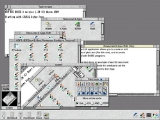
interface (see link for explanation; Acorn used wimp to refer to their gui) incorporates three mouse button
s (named Select, Menu and Adjust), context-sensitive menus, window order control (i.e. send to back) and dynamic window focus
(a window can have input focus at any position on the stack). The Icon bar
holds icons which represent mounted disc drives, RAM discs, running applications and system utilities. These icons have context-sensitive menus and support drag-and-drop
behaviour. They represent the running application as a whole, irrespective of whether it has open windows.
The GUI is centred around the concept of files. The Filer displays the contents of a disc. Applications are run from the Filer view and files can be dragged to the Filer view from applications to perform saves. Application directories are used to store applications. The OS differentiates them from normal directories through the use of a pling (exclamation mark, also called shreik) prefix. Double-clicking on such a directory launches the application rather than opening the directory. The application's executable files and resources are contained within the directory, but normally they remain hidden from the user. Because applications are self-contained, this allows drag-and-drop installation and removal.
The outline font manager provides anti-aliasing
of fonts, the OS being the first operating system to include such a feature, having included it since before January 1989
The Style Guide encourages a consistent look and feel across applications. This was introduced in and specifies application appearance and behaviour. Acorn's own main bundled applications were not updated to comply with the guide until 's Select release in 2001.
.
Operating system
An operating system is a set of programs that manage computer hardware resources and provide common services for application software. The operating system is the most important type of system software in a computer system...
originally developed by Acorn Computers Ltd in Cambridge
Cambridge
The city of Cambridge is a university town and the administrative centre of the county of Cambridgeshire, England. It lies in East Anglia about north of London. Cambridge is at the heart of the high-technology centre known as Silicon Fen – a play on Silicon Valley and the fens surrounding the...
, England
England
England is a country that is part of the United Kingdom. It shares land borders with Scotland to the north and Wales to the west; the Irish Sea is to the north west, the Celtic Sea to the south west, with the North Sea to the east and the English Channel to the south separating it from continental...
for their range of desktop computers, based on their own ARM architecture
ARM architecture
ARM is a 32-bit reduced instruction set computer instruction set architecture developed by ARM Holdings. It was named the Advanced RISC Machine, and before that, the Acorn RISC Machine. The ARM architecture is the most widely used 32-bit ISA in numbers produced...
. First released in 1987, under the name Arthur, the subsequent iteration was renamed as in 1988. The operating system takes its name from the RISC (Reduced Instruction Set Computing) architecture used on supported systems.
From 1988 to 1998, RISC OS was bundled with nearly every ARM based Acorn computer model, including the Archimedes
Acorn Archimedes
The Acorn Archimedes was Acorn Computers Ltd's first general purpose home computer to be based on their own ARM architecture.Using a RISC design with a 32-bit CPU, at its launch in June 1987, the Archimedes was stated as running at 4 MIPS, with a claim of 18 MIPS during tests.The name is commonly...
range of computers, and RiscPC and A7000
Acorn A7000
The A7000 and A7000+ were Acorn Computers's entry level computer based on the Risc PC architecture. Launched in 1995, they replaced some of the models of the Acorn Archimedes range. After the breakup of Acorn Computers in 1998, Castle Technology bought the rights to continue production of the A7000+...
computers.
After the breakup of Acorn in 1998, development of RISC OS was continued by several companies, including RISCOS Ltd
RISCOS Ltd
RISCOS Ltd. is a limited company engaged in computer software and IT consulting. It licensed the rights to from Element 14 and subsequently Pace Micro Technology. It continues to develop...
and Castle Technology
Castle Technology
Castle Technology Ltd. is a British limited company engaged in computer software and IT consulting. It produced and sold ARM computers, and sold the Acorn-branded range of desktop computers that run RISC OS. Prior to Acorn's demise, it was the largest of their dealerships...
. Also since 1998, RISC OS has been bundled with a number of ARM-based Acorn Clone personal computers such as the Iyonix and A9home
A9Home
The A9Home is a small form factor desktop computer running RISC OS Adjust32. It was officially unveiled at the 2005 Wakefield Show, and is the second commercial ARM based RISC OS computer to run a 32-bit version of RISC OS...
.
Most recent stable versions run on either the Iyonix's
Iyonix PC
The Iyonix PC was an Acorn-clone personal computer from Castle Technology. It was released in 2002 and runs .- History :The Iyonix originated as a secret project by Pace engineers in connection with development of set-top boxes . Pace had a licence to develop RISCOS Ltd's OS sources for use in the...
ARMv5 or (natively on the RiscPC or under emulation) ARMv3/ARMv4. Since early 2009, a development version made available by RISC OS Open
RISC OS Open
RISC OS Open Ltd. is a limited company engaged in computer software and IT consulting. It is managing the process of publishing the source code to RISC OS...
has been running on Cortex-A8 ARMv7 processors, such as that used in the BeagleBoard and Touch Book
Touch Book
The Touch Book is a portable computing device that functions as a netbook, and also as a tablet. Designed by Always Innovating, it was launched at the DEMO conference in March 2009. Its designers stated at launch that it is the first netbook featuring a detachable keyboard with a long battery life...
. In 2011, a port for the Cortex-A9 PandaBoard
PandaBoard
The PandaBoard is a low-power, low-cost single-board computer based on the Texas Instruments OMAP4430 processor. The board has been available to the public at the subsidized price of US$174 since 27 October 2010...
was announced.
History
RISC OS was originally released in 1987 as Arthur 1.20. The next version, , became and was completed and made available in April 1989. RISC OS 3.00 was released with the very earliest version of the A5000 in 1991 and contained a series of new features. By 1996 RISC OS had been shipped on over 500,000 systems.Acorn officially halted work on the OS in January 1999, renaming themselves Element 14. In March 1999 a new company called RISCOS Ltd
RISCOS Ltd
RISCOS Ltd. is a limited company engaged in computer software and IT consulting. It licensed the rights to from Element 14 and subsequently Pace Micro Technology. It continues to develop...
licensed the rights to RISC OS from Element 14 (and eventually from the new owner, Pace Micro Technology) and continued the development of OS 3.8, releasing it as RISC OS 4 in July 1999. According to the company, over 6,400 copies of RISC OS 4.02 on ROM were sold up until production was ceased in mid 2005.
In May 2001 the company launched RISC OS Select, a subscription scheme allowing users access to the latest OS updates. These upgrades are released as soft-loadable ROM image
ROM image
A ROM image, or ROM file, is a computer file which contains a copy of the data from a read-only memory chip, often from a video game cartridge, a computer's firmware, or from an arcade game's main board...
s, separate to the ROM where the boot OS is stored, and are loaded at boot time. Select 1 was shipped in May 2002, with Select 2 following in November 2002 and the final release of Select 3 in June 2004. RISCOS Ltd released the ROM based version 4.39 the same month, dubbed RISC OS Adjust as a play on the RISC OS GUI convention of calling the three mouse buttons 'Select', 'Menu' and 'Adjust'. RISCOS Ltd sold its 500th Adjust ROM in early 2006.
In October 2002, the Acorn clone Iyonix PC
Iyonix PC
The Iyonix PC was an Acorn-clone personal computer from Castle Technology. It was released in 2002 and runs .- History :The Iyonix originated as a secret project by Pace engineers in connection with development of set-top boxes . Pace had a licence to develop RISCOS Ltd's OS sources for use in the...
was released by Castle Technology
Castle Technology
Castle Technology Ltd. is a British limited company engaged in computer software and IT consulting. It produced and sold ARM computers, and sold the Acorn-branded range of desktop computers that run RISC OS. Prior to Acorn's demise, it was the largest of their dealerships...
. This runs RISC OS 5, a separate evolution based upon the NCOS
NCOS
NCOS was the graphical user interface-based operating system developed for use in Oracle's Network Computers. It was adapted by Acorn Computers from its own , which was originally developed for their range of Archimedes desktop computers...
work done by Pace for set-top box
Set-top box
A set-top box or set-top unit is an information appliance device that generally contains a tuner and connects to a television set and an external source of signal, turning the signal into content which is then displayed on the television screen or other display device.-History:Before the...
es. In October 2006, Castle announced a source sharing license plan for elements of RISC OS 5. This Shared Source Initiative (SSI) is managed by RISC OS Open Limited.
Also in October 2006, RISCOS Ltd announced RISC OS Six, the next generation of their stream of the operating system. The first product to be launched under the name was the continuation of the Select scheme, Select 4. A beta-version of RISC OS 6, Preview 1 (Select 4i1), was available in 2007 as a free download to all subscribers to the Select scheme, while in April 2009 the final release of Select 5 was shipped.
The latest release of RISC OS from RISCOS Ltd is Select 6i1, shipped in December 2009.
Supported hardware
Versions of RISC OS run or have run on the following hardware.- Acorn ArchimedesAcorn ArchimedesThe Acorn Archimedes was Acorn Computers Ltd's first general purpose home computer to be based on their own ARM architecture.Using a RISC design with a 32-bit CPU, at its launch in June 1987, the Archimedes was stated as running at 4 MIPS, with a claim of 18 MIPS during tests.The name is commonly...
- Acorn Risc PCRisc PCThe RiscPC was Acorn Computers's next generation RISC OS/Acorn RISC Machine computer, launched on 15 April 1994, which superseded the Acorn Archimedes. The Acorn PC card and software allows PC compatible software to be run....
- Acorn A7000 and A7000+Acorn A7000The A7000 and A7000+ were Acorn Computers's entry level computer based on the Risc PC architecture. Launched in 1995, they replaced some of the models of the Acorn Archimedes range. After the breakup of Acorn Computers in 1998, Castle Technology bought the rights to continue production of the A7000+...
- Acorn Phoebe
- RiscStation R7500
- MicroDigital Medi
- MicroDigital Mico
- MicroDigital OmegaMicroDigital OmegaThe MicroDigital Omega was a home computer developed and sold in the early 2000s by MicroDigital. It runs the RISC OS operating system.The Omega suffered a protracted development, announced in 2000, it was released in 2003.- External links:********...
- Iyonix Ltd Iyonix PCIyonix PCThe Iyonix PC was an Acorn-clone personal computer from Castle Technology. It was released in 2002 and runs .- History :The Iyonix originated as a secret project by Pace engineers in connection with development of set-top boxes . Pace had a licence to develop RISCOS Ltd's OS sources for use in the...
- Advantage Six A75
- Advantage Six A9HomeA9HomeThe A9Home is a small form factor desktop computer running RISC OS Adjust32. It was officially unveiled at the 2005 Wakefield Show, and is the second commercial ARM based RISC OS computer to run a 32-bit version of RISC OS...
- Texas InstrumentsTexas InstrumentsTexas Instruments Inc. , widely known as TI, is an American company based in Dallas, Texas, United States, which develops and commercializes semiconductor and computer technology...
OMAP 3530 hardware;- Beagleboard
- Always Innovating Touch BookTouch BookThe Touch Book is a portable computing device that functions as a netbook, and also as a tablet. Designed by Always Innovating, it was launched at the DEMO conference in March 2009. Its designers stated at launch that it is the first netbook featuring a detachable keyboard with a long battery life...
- Raspberry PiRaspberry PiThe Raspberry Pi is a single-board computer developed by the Raspberry Pi Foundation. Scheduled for public release in December 2011, the foundation plans to release two versions that range from US$25 to $35...
In addition a commercial emulator available from VirtualAcorn
VirtualAcorn
VirtualAcorn is the brand name of several commercial emulators of Acorn Computers computer hardware platforms.-Development:VirtualAcorn is developed by Graeme Barnes and Aaron Timbrell. It is a commercial version of the freeware emulator Red Squirrel, developed by Barnes...
is available as a standalone product or pre-bundled with Microsoft Windows PCs from Microdigital, Advantage Six and R-Comp.
RISC OS has also been used by Acorn and Pace Micro Technology, in various TV connected Set Top Boxes.
OS core
The core of the OS is stored in ROMRead-only memory
Read-only memory is a class of storage medium used in computers and other electronic devices. Data stored in ROM cannot be modified, or can be modified only slowly or with difficulty, so it is mainly used to distribute firmware .In its strictest sense, ROM refers only...
, giving a fast bootup time and safety from operating system corruption. RISC OS 4 and 5 are stored in of flash memory
Flash memory
Flash memory is a non-volatile computer storage chip that can be electrically erased and reprogrammed. It was developed from EEPROM and must be erased in fairly large blocks before these can be rewritten with new data...
, allowing the operating system to be updated without having to replace the ROM chip. The OS is made up of a number of modules. These can be added to and replaced, including soft-loading of modules not present in ROM at run time and on-the-fly replacement. This design has led to OS developers releasing rolling updates to their versions of the OS, while third parties are able to write OS replacement modules to add new features. OS modules are accessed via software interrupts (SWIs), similar to system call
System call
In computing, a system call is how a program requests a service from an operating system's kernel. This may include hardware related services , creating and executing new processes, and communicating with integral kernel services...
s in other operating systems.
The OS is single-user and employs co-operative multitasking (CMT). While most current desktop OSes use pre-emptive
Preemption (computing)
In computing, preemption is the act of temporarily interrupting a task being carried out by a computer system, without requiring its cooperation, and with the intention of resuming the task at a later time. Such a change is known as a context switch...
multitasking
Computer multitasking
In computing, multitasking is a method where multiple tasks, also known as processes, share common processing resources such as a CPU. In the case of a computer with a single CPU, only one task is said to be running at any point in time, meaning that the CPU is actively executing instructions for...
(PMT) and multithreading
Thread (computer science)
In computer science, a thread of execution is the smallest unit of processing that can be scheduled by an operating system. The implementation of threads and processes differs from one operating system to another, but in most cases, a thread is contained inside a process...
, remains with a CMT system. Many users have called for the OS to migrate to PMT. The OS also has rudimentary memory protection
Memory protection
Memory protection is a way to control memory access rights on a computer, and is a part of most modern operating systems. The main purpose of memory protection is to prevent a process from accessing memory that has not been allocated to it. This prevents a bug within a process from affecting...
, and all users have full superuser
Superuser
On many computer operating systems, the superuser is a special user account used for system administration. Depending on the operating system, the actual name of this account might be: root, administrator or supervisor....
privileges.
The file system
File system
A file system is a means to organize data expected to be retained after a program terminates by providing procedures to store, retrieve and update data, as well as manage the available space on the device which contain it. A file system organizes data in an efficient manner and is tuned to the...
is volume-oriented: the top level of the file hierarchy is a volume (disc, network share) prefixed by the filesystem type. To determine file type, the OS uses metadata
Metadata
The term metadata is an ambiguous term which is used for two fundamentally different concepts . Although the expression "data about data" is often used, it does not apply to both in the same way. Structural metadata, the design and specification of data structures, cannot be about data, because at...
instead of file extensions. Colons are used to separate the filesystem from the rest of the path; the root is represented by a dollar (
$) sign and directories by a period (.). Extensions from foreign filesystems are shown using a forward slash (example.txt becomes example/txt). For example, ADFS::HardDisc4.$. is the root of the disc named HardDisc4 using the ADFSAdvanced Disc Filing System
The Advanced Disc Filing System is a computing file system particular to the Acorn computer range and RISC OS based successors. Initially based on the rare Acorn Winchester Filing System, it was renamed to the Advanced Disc Filing System when support for floppy discs was added and on later 32 bit...
filesystem.
A file system can present a file of a particular type as a volume in its own right, similar to a loop device
Loop device
In Unix-like operating systems, a loop device, vnd , or lofi is a pseudo-device that makes a file accessible as a block device....
. The OS refers to this functionality as an image filing system. This allows transparent handling of archives and similar files, which appear as directories with some special properties. Files inside the image file appear in the hierarchy underneath the parent archive. It is not necessary for the archive to contain the data it refers to: some symbolic link and network share filesystems put a reference inside the image file and go elsewhere for the data.
Most of the OS has defined ABI
Application binary interface
In computer software, an application binary interface describes the low-level interface between an application program and the operating system or another application.- Description :...
s to handle filters and vectors. The OS provides many ways in which the programmer can intercept and modify its operation. This simplifies the task of modifying its behaviour, either in the GUI or deeper. As a result, there is a number of third-party programs which allow the OS look and feel to be customised.
Desktop
The WIMPWIMP (computing)
In human–computer interaction, WIMP stands for "windows, icons, menus and pointers", denoting a style of interaction using these elements. It was coined by Merzouga Wilberts in 1980...
interface (see link for explanation; Acorn used wimp to refer to their gui) incorporates three mouse button
Mouse button
A mouse button is a microswitch on a computer mouse which can be pressed in order to select or interact with an element of a graphical user interface.The three-button scrollmouse has become the most commonly available design...
s (named Select, Menu and Adjust), context-sensitive menus, window order control (i.e. send to back) and dynamic window focus
Focus (computing)
In computing, the focus indicates the component of the graphical user interface which is currently selected to receive input. Text entered at the keyboard or pasted from a clipboard is sent to the component which currently has the focus. Moving the focus away from a specific user interface element...
(a window can have input focus at any position on the stack). The Icon bar
Icon bar
In computing, the icon bar is the name of the dock in Acorn's RISC OS operating system, and is fundamental to the OS. Its introduction in 1987 was a new concept in GUIs...
holds icons which represent mounted disc drives, RAM discs, running applications and system utilities. These icons have context-sensitive menus and support drag-and-drop
Drag-and-drop
In computer graphical user interfaces, drag-and-drop is the action of selecting a virtual object by "grabbing" it and dragging it to a different location or onto another virtual object...
behaviour. They represent the running application as a whole, irrespective of whether it has open windows.
The GUI is centred around the concept of files. The Filer displays the contents of a disc. Applications are run from the Filer view and files can be dragged to the Filer view from applications to perform saves. Application directories are used to store applications. The OS differentiates them from normal directories through the use of a pling (exclamation mark, also called shreik) prefix. Double-clicking on such a directory launches the application rather than opening the directory. The application's executable files and resources are contained within the directory, but normally they remain hidden from the user. Because applications are self-contained, this allows drag-and-drop installation and removal.
The outline font manager provides anti-aliasing
Anti-aliasing
In digital signal processing, spatial anti-aliasing is the technique of minimizing the distortion artifacts known as aliasing when representing a high-resolution image at a lower resolution...
of fonts, the OS being the first operating system to include such a feature, having included it since before January 1989
The Style Guide encourages a consistent look and feel across applications. This was introduced in and specifies application appearance and behaviour. Acorn's own main bundled applications were not updated to comply with the guide until 's Select release in 2001.
Bundled applications
is delivered with a number of desktop applications in the form of pre-installed softwarePre-installed software
Pre-installed software is the software already installed and licensed on a computer bought from an original equipment manufacturer .-Bundled software:...
.
See also
- Acorn C/C++Acorn C/C++Acorn C/C++ in computing is a set of C/C++ programming tools for use under the operating system. The tools use the Norcroft compiler suite and were authored by Codemist and Acorn Computers...
- DrobeDrobeDrobe was a computing news web site with a focus on the operating system. Its archived material is retained online, curated by editor Chris Williams.-History:...
- List of users' groups#RISC OS
- riscos.infoRiscos.inforiscos.info is a web site for users of the operating system, run by Peter Naulls and John Tytgat. It is a community web site, intended to encourage user involvement. It hosts the FAQ, which was formerly distributed via the comp.sys.acorn.* newsgroups...
- The Icon Bar
External links
- Archiology: Micahel Gilbert's collection of "relics from Acorn's past"
- Arthur Lives!: a guide by Ben Jefferys
- Arthur OS Emulator
- What is RISC OS?
- Pink Noise Productions OS documentation