


Quezon Memorial Circle

Encyclopedia
The Quezon Memorial Circle is a national park and shrine located in Quezon City
, former capital of the Philippines
(1948–1976). The park is an ellipse
bounded by the Elliptical Road. Its main feature is a mausoleum
containing the remains of Manuel L. Quezon
, the second President of the Philippines
, and his wife, First Lady
Aurora Quezon
.
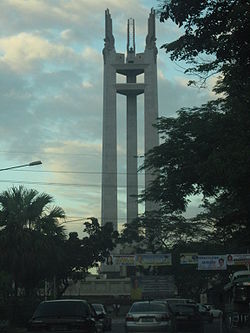 The site was originally intended as the grounds of the National Capitol to be built in Quezon City to house the Congress of the Philippines
. The location was also part of a larger National Government Center located around Elliptical Road and the Quezon City Quadrangle (made up of the North, South, East, and West Triangles). The NGC was meant to house the three branches of the Philippine government (legislative, executive, and judicial). While the cornerstone for the structure was laid on November 15, 1940, only the foundations were in place when construction was interrupted by the beginning of the Second World War
in the Philippines. After World War II, President Sergio Osmeña
issued an executive order stipulating the creation of a Quezon Memorial Committee to r funds by public subscription to erect a memorial to his predecessor, President Manuel L. Quezon
. After a national contest was held for the purpose of designing the Quezon Memorial Project, a winning entry by Filipino architect Federico S. Ilustre was selected. Aside from the monument itself, a complex of three buildings, including a presidential library, a museum, and a theater, were also planned to be erected.
, the Visayas
, and Mindanao
), 66 meters (217 ft) tall (Quezon's age when he died), surmounted by three mourning angels holding sampaguita (the national flower) wreaths sculpted by the Italian
sculptor Monti
. The three pylons would in turn circumscribe a drum-like two-story structure containing a gallery from which visitors could look down at Quezon's catafalque
, modeled after Napoleon Bonaparte's in the Invalides. The gallery and the catafalque below are lit by an oculus
, in turn reminiscent of Grant's Tomb
.

 Construction of the Quezon Memorial was begun in 1952 but proceeded slowly, in part due to the cost of importing Carrara marble, brought in blocks and then carved and shaped on-site. There were also problems associated with the theft of the marble blocks and the management of memorial funds. The monument was finally completed in 1978, the centennial of Quezon's birth. His remains were reinterred in the memorial on August 19, 1979. It was during that time that by virtue of a presidential decree, President Ferdinand E. Marcos mandated the site as a National Shrine
. The National Historical Institute manages, and has authority, over the monument itself, while the Quezon City government administers the park.
The planned auxiliary structures (presidential library, museum, and theater) were never built. Two smaller museums, one containing the presidential memorabilia of Quezon, and the other containing items on the history of Quezon City, were installed within the monument itself. In the 1980s, missing, lost, or incomplete bas reliefs for the outside of the memorial were installed. A development plan was also drawn up and partially implemented, including the building of recreation and dining structures.
On April 28, 2005, the remains of Mrs. Aurora Quezon
, widow of the president, were solemnly reinterred in the memorial as well.
Quezon City
Quezon City is the former capital and the most populous city in the Philippines. Located on the island of Luzon, Quezon City is one of the cities and municipalities that make up Metro Manila, the National Capital Region. The city was named after Manuel L...
, former capital of the Philippines
Philippines
The Philippines , officially known as the Republic of the Philippines , is a country in Southeast Asia in the western Pacific Ocean. To its north across the Luzon Strait lies Taiwan. West across the South China Sea sits Vietnam...
(1948–1976). The park is an ellipse
Ellipse
In geometry, an ellipse is a plane curve that results from the intersection of a cone by a plane in a way that produces a closed curve. Circles are special cases of ellipses, obtained when the cutting plane is orthogonal to the cone's axis...
bounded by the Elliptical Road. Its main feature is a mausoleum
Mausoleum
A mausoleum is an external free-standing building constructed as a monument enclosing the interment space or burial chamber of a deceased person or persons. A monument without the interment is a cenotaph. A mausoleum may be considered a type of tomb or the tomb may be considered to be within the...
containing the remains of Manuel L. Quezon
Manuel L. Quezon
Manuel Luis Quezón y Molina served as president of the Commonwealth of the Philippines from 1935 to 1944. He was the first Filipino to head a government of the Philippines...
, the second President of the Philippines
President of the Philippines
The President of the Philippines is the head of state and head of government of the Philippines. The president leads the executive branch of the Philippine government and is the commander-in-chief of the Armed Forces of the Philippines...
, and his wife, First Lady
First Lady of the Philippines
The First Lady/ Gentleman of the Philippines is the unofficial title of the hostess/host of the Malacañang Palace, the nation's residence of its head of state...
Aurora Quezon
Aurora Quezon
Aurora Antonia Aragón de Molina Vd.ª De Quezón , usually known simply as Aurora Quezón, and sometimes as Aurora Aragón-Quezón, was the wife of Philippine President Manuel Luis Quezón and the First Lady of the Philippines from 1935 to 1944...
.
History
Congress of the Philippines
The Congress of the Philippines is the national legislature of the Republic of the Philippines. It is a bicameral body consisting of the Senate , and the House of Representatives although commonly in the Philippines the term congress refers to the latter.The Senate is composed of 24 senators half...
. The location was also part of a larger National Government Center located around Elliptical Road and the Quezon City Quadrangle (made up of the North, South, East, and West Triangles). The NGC was meant to house the three branches of the Philippine government (legislative, executive, and judicial). While the cornerstone for the structure was laid on November 15, 1940, only the foundations were in place when construction was interrupted by the beginning of the Second World War
World War II
World War II, or the Second World War , was a global conflict lasting from 1939 to 1945, involving most of the world's nations—including all of the great powers—eventually forming two opposing military alliances: the Allies and the Axis...
in the Philippines. After World War II, President Sergio Osmeña
Sergio Osmeña
Sergio Osmeña y Suico was a Filipino politician who served as the 4th President of the Philippines from 1944 to 1946. He was Vice President under Manuel L. Quezon, and rose to the presidency upon Quezon's death in 1944, being the oldest Philippine president to hold office at age 65...
issued an executive order stipulating the creation of a Quezon Memorial Committee to r funds by public subscription to erect a memorial to his predecessor, President Manuel L. Quezon
Manuel L. Quezon
Manuel Luis Quezón y Molina served as president of the Commonwealth of the Philippines from 1935 to 1944. He was the first Filipino to head a government of the Philippines...
. After a national contest was held for the purpose of designing the Quezon Memorial Project, a winning entry by Filipino architect Federico S. Ilustre was selected. Aside from the monument itself, a complex of three buildings, including a presidential library, a museum, and a theater, were also planned to be erected.
Description
The monument would consist of three vertical pylons (representing the three main geographic divisions of the country: LuzonLuzon
Luzon is the largest island in the Philippines. It is located in the northernmost region of the archipelago, and is also the name for one of the three primary island groups in the country centered on the Island of Luzon...
, the Visayas
Visayas
The Visayas or Visayan Islands and locally known as Kabisay-an gid, is one of the three principal geographical divisions of the Philippines, along with Mindanao and Luzon. It consists of several islands, primarily surrounding the Visayan Sea, although the Visayas are considered the northeast...
, and Mindanao
Mindanao
Mindanao is the second largest and easternmost island in the Philippines. It is also the name of one of the three island groups in the country, which consists of the island of Mindanao and smaller surrounding islands. The other two are Luzon and the Visayas. The island of Mindanao is called The...
), 66 meters (217 ft) tall (Quezon's age when he died), surmounted by three mourning angels holding sampaguita (the national flower) wreaths sculpted by the Italian
Italy
Italy , officially the Italian Republic languages]] under the European Charter for Regional or Minority Languages. In each of these, Italy's official name is as follows:;;;;;;;;), is a unitary parliamentary republic in South-Central Europe. To the north it borders France, Switzerland, Austria and...
sculptor Monti
Monti
Monti can refer to:Places* Monti, Lazio, the first rione of Rome, Italy* Monti, Sardinia, in the province of Olbia-Tempio, Italy* Monti, Iowa, a tiny town of six to eight houses in Buchanan County, Iowa, United StatesPeople...
. The three pylons would in turn circumscribe a drum-like two-story structure containing a gallery from which visitors could look down at Quezon's catafalque
Catafalque
A catafalque is a raised bier, soapbox, or similar platform, often movable, that is used to support the casket, coffin, or body of the deceased during a funeral or memorial service. Following a Roman Catholic Requiem Mass, a catafalque may be used to stand in place of the body at the Absolution of...
, modeled after Napoleon Bonaparte's in the Invalides. The gallery and the catafalque below are lit by an oculus
Oculus
An Oculus, circular window, or rain-hole is a feature of Classical architecture since the 16th century. They are often denoted by their French name, oeil de boeuf, or "bull's-eye". Such circular or oval windows express the presence of a mezzanine on a building's façade without competing for...
, in turn reminiscent of Grant's Tomb
Grant's Tomb
General Grant National Memorial , better known as Grant's Tomb, is a mausoleum containing the bodies of Ulysses S. Grant , American Civil War General and 18th President of the United States, and his wife, Julia Dent Grant...
.
Construction and completion
National shrine
A National Shrine is a Catholic church or other sacred place which has met certain requirements and is given this honor by the nation's Conference of Catholic Bishops to recognize the church's special historical, cultural and religious significance.- Process:...
. The National Historical Institute manages, and has authority, over the monument itself, while the Quezon City government administers the park.
The planned auxiliary structures (presidential library, museum, and theater) were never built. Two smaller museums, one containing the presidential memorabilia of Quezon, and the other containing items on the history of Quezon City, were installed within the monument itself. In the 1980s, missing, lost, or incomplete bas reliefs for the outside of the memorial were installed. A development plan was also drawn up and partially implemented, including the building of recreation and dining structures.
On April 28, 2005, the remains of Mrs. Aurora Quezon
Aurora Quezon
Aurora Antonia Aragón de Molina Vd.ª De Quezón , usually known simply as Aurora Quezón, and sometimes as Aurora Aragón-Quezón, was the wife of Philippine President Manuel Luis Quezón and the First Lady of the Philippines from 1935 to 1944...
, widow of the president, were solemnly reinterred in the memorial as well.