
All Topics  
President of the Philippines


President of the Philippines


The President of the Philippines is the head of state and government of the Republic of the PhilippinesPhilippines

The Philippines , officially the Republic of the Philippines , is an island nation located in the Malay archipelago in...
. The President of the Philippines in Filipino is referred to as Ang Pangulo or Pangulo ("Presidente," informally). The executive power is vested in the President of the Philippines.

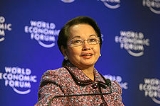
The current incumbent President is Gloria Macapagal-ArroyoGloria Macapagal-Arroyo

Gloria Macaraeg Macapagal-Arroyo is the 14th and current president of the Philippines....
.
QualificationsUnder Article 7, Section 2 of the Philippine Constitution, In order to serve as President, an individual must be at least 40 years of age, a registered voter, able to read and write, a Filipino citizen by birth, and a resident of the Philippines for at least 10 years prior to election.
OathUnder Article 7, Section 5 of the Philippine Constitution, before the president enters on the execution of his/her office, the President shall take the following oath or affirmation :

[In case of affirmation, last sentence will be omitted]
PowersUnder Article 7, Section 1 of the Philippine Constitution, the president heads the Executive branch of the government, which includes the Cabinet and all executive departments.


Discussion
Ask a question about 'President of the Philippines'
Start a new discussion about 'President of the Philippines'
Answer questions from other users
Full Discussion Forum


Timeline

1965   Ferdinand Marcos becomes President of the Philippines.

1972   Philippine president Ferdinand Marcos issued Proclamation No. 1081 placing the entire country under martial law.


Encyclopedia


The President of the Philippines is the head of state and government of the Republic of the PhilippinesPhilippines

The Philippines , officially the Republic of the Philippines , is an island nation located in the Malay archipelago in...
. The President of the Philippines in Filipino is referred to as Ang Pangulo or Pangulo ("Presidente," informally). The executive power is vested in the President of the Philippines.

The current incumbent President is Gloria Macapagal-ArroyoGloria Macapagal-Arroyo

Gloria Macaraeg Macapagal-Arroyo is the 14th and current president of the Philippines....
.

Qualifications

Under Article 7, Section 2 of the Philippine Constitution, In order to serve as President, an individual must be at least 40 years of age, a registered voter, able to read and write, a Filipino citizen by birth, and a resident of the Philippines for at least 10 years prior to election.

Oath

Under Article 7, Section 5 of the Philippine Constitution, before the president enters on the execution of his/her office, the President shall take the following oath or affirmation :

[In case of affirmation, last sentence will be omitted]

Powers

Under Article 7, Section 1 of the Philippine Constitution, the president heads the Executive branch of the government, which includes the Cabinet and all executive departments. The executive power, as such, is vested on the President alone.

Section 18 of the Philippine Constitution, the president is also the Commander-in-Chief of the Armed Forces of the PhilippinesArmed Forces of the Philippines

The Armed Forces of the Philippines or AFP originated in the revolutionary battles during the Philippine War of Indep...
. As Commander-in-Chief, the President can call out such armed forces to prevent or suppress lawless violence, invasion or rebellion. In case of invasion or rebellion, when the public safety requires it, he or she may, for a period not exceeding sixty days, suspend the privilege of the writ of habeas corpus or place the Philippines or any part thereof under martial lawMartial law

Martial law is the system of rules that takes effect when a military authority takes control of the normal administration o...
.

Section 19 gives the president power to grant reprieves, commutations, and pardons, and remit fines and forfeitures, after conviction by final judgment, except when the President is under impeachment.

Section 20 provides the president to contract or guarantee foreign loans on behalf of the Republic of the Philippines with the prior concurrence of the Monetary Board, and subject to such limitations as may be provided by law.

The president exercises general supervision over local government units.

The president appoints, with consent of the Commission on Appointments, members of the Constitutional Commission, ambassadors, other public ministers and consuls, or officers of the armed forces from the rank of colonel or naval captain, and other officers whose appointments are vested in the President in 1987 Constitution.

The members of the Supreme CourtSupreme Court of the Philippines

The Supreme Court of the Philippines is the country's highest judicial court, as well as the court of last resort....
 are appointed by the president, based on a list prepared by the Judicial and Bar Council. These appointments do not need the consent of the Commission on Appointments.

Official title


The official title of the president is the "President of the Philippines," as specified in the present Constitution of the Philippines (1987). The honorific for the President of the Philippines is "Your Excellency" or "His/Her Excellency", adopted from the title of the Governor-GeneralGovernor-General

A Governor-General is most generally a governor of high rank, or a principal governor ranking above 'ordinary' governors ....
 of the Philippines during Spanish and American occupation. The term "President of the Republic of the Philippines" is commonly, but erroneously, used, dating back to when President José P. LaurelJose P. Laurel Overview

Jos Paciano Laurel y Garcia was the president of the Japanese-sponsored Republic of the Philippines from 1943 to 1945....
 wanted to express the difference between his government and the previous Commonwealth government (then in exile) under President Manuel L. QuezonFacts About Manuel L. Quezon

Manuel Luis Quezon y Molina was the first president of the Commonwealth of the Philippines....
. The restoration of the Commonwealth in 1945 and the subsequent independence of the Philippines led to the restoration of the constitutionally-sanctioned title "President of the Philippines" until President Ferdinand E. Marcos proclaimed martial lawMartial law

Martial law is the system of rules that takes effect when a military authority takes control of the normal administration o...
 and once more wanted to differentiate his government from those that came before. It was then that "President of the Republic of the Philippines" was adopted and indeed, specified in the 1973 Constitution of the Philippines. However, that Constitution was superseded by a new one in 1987 which restored the more traditional "President of the Philippines."

Official residence

Malacañan Palace, often known as Malacañang Palace, is the official residence of the President of the Philippines. The president is entitled to have an official residence as required under Article 7, Section 6 of the Philippine Constitution. The palace is located along the north bank of the Pasig River in Manila. It is called Palasyo ng Malakanyang in Filipino, and Malacañan Palace when referred to as the official residence of the President of the Philippines, and simply Malacañang when referred to as the office of the president, as well as in everyday parlance and in the media. Malacañang Palace is depicted on the verso (back) side of the present-day 20-peso bill.

State of the Nation Address

The State of the Nation Address (abbreviated SONA) is an annual event in the Republic of the PhilippinesPhilippines

The Philippines , officially the Republic of the Philippines , is an island nation located in the Malay archipelago in...
, in which the President of the Philippines reports on the status of the nationNation

One of the most influential doctrines in history is that all humans are divided into groups called nations....
, normally to the resumption of a joint session of the CongressCongress of the Philippines

*Second Congress: 1946 ...
 (the House of Representatives and the Senate). This is a duty of the President as stated in Article VII, Section 23 of the 1987 ConstitutionConstitution of the Philippines

The Constitution of the Philippines is the supreme law of the Philippines. ...
  :


Succession


At the start of the term

Under Article 7, Section 7 of the Philippine Constitution, In case the president-elect fails to qualify, the Vice-President-elect shall act as President until the President-elect shall have qualified.

If at the beginning of the term of the President, the President-elect shall have died or shall have become permanently disabled, the Vice President-elect shall become President.

Where no President and Vice-President shall have been chosen or shall have qualified, or where both shall have died or become permanently disabled, the President of the Senate or, in case of his inability, the Speaker of the House of Representatives, shall act as President until a President or a Vice-President shall have been chosen and qualified.

During the term

Article 7, Sections 8 and 11 of the Philippine Constitution provide rules of succession to the presidency. In case of death, permanent disability, removal from office, or resignation of the President, the Vice-President will become the President to serve the unexpired term. In case of death, permanent disability, removal from office, or resignation of both the President and Vice-President; the President of the Senate or, in case of his inability, the Speaker of the House of Representatives, shall then act as President until the President or Vice-President shall have been elected and qualified.

The Congress shall, by law, provide who shall serve as President in case of death, permanent disability, or resignation of the Acting President. He shall serve until the President or the Vice-President shall have been elected and qualified, and be subject to the same restrictions of powers and disqualifications as the Acting President.

The line of presidential succession as specified by Article 7, Section 10 of the Philippine Constitution are the Vice-President, Senate President and the Speaker of the House of Representatives.

The current Presidential line of succession is:
#NamePosition
1Manuel L. de Castro, Jr.Noli de Castro

Manuel "Noli" Leuterio De Castro, Jr. is a politician and former broadcast journalist in the Philippines....
Vice PresidentVice President of the Philippines

The Vice President of the Philippines is the second highest executive official of the Philippine government....
2Manuel B. Villar, Jr.Manny Villar

Manuel "Manny" Bamba Villar, Jr. is a Filipino businessman and politician, currently the President of the Senate — the...
Senate PresidentPresident of the Senate of the Philippines

The President of the Senate of the Philippines is the presiding officer and the highest ranking-official of the Senate of th...
3Prospero C. NogralesSpeaker of the HouseSpeaker of the Philippine House of Representatives

The Speaker of the Philippine House of Representatives is the presiding officer of the lower house of Congress, the House of...


Contrary to popular belief, the Constitution doesn't name the Chief Justice of the Philippine Supreme Court in the line of succession.

If the offices of both the President and the Vice President become vacant at the same time, Congress shall enact a law calling for special election. However, if the presidential election is 18 months away, no special election shall be called.

History

The Philippines has had a total of fourteen presidents. Despite the differences in constitutionsConstitution of the Philippines Summary

The Constitution of the Philippines is the supreme law of the Philippines. ...
 and government, the line of presidents is considered to be continuous. For instance, the current president, Gloria Macapagal-ArroyoGloria Macapagal-Arroyo

Gloria Macaraeg Macapagal-Arroyo is the 14th and current president of the Philippines....
, is considered the 14th president. While the Philippines consider Emilio Aguinaldo to be the first president, the First Republic fell under the United States following the Philippine-American WarPhilippine-American War

The Philippine-American War was a conflict between the armed forces of the United States and the First Philippine Republic f...
. Manuel L. QuezonManuel L. Quezon

Manuel Luis Quezon y Molina was the first president of the Commonwealth of the Philippines....
 is considered to be the first president by the United States and the first to win an election.

The Philippines had two presidents at one point during World War II heading two governments. One was Quezon heading the Commonwealth government-in-exile (considered de jureDe jure

De jure is an expression that means "based on law" or "by the jury", to be closer to the term, as contrasted with de ...
) and the other was J. P. Laurel heading the Japanese-sponsored republic (considered de factoDe facto

De facto is a Latin expression that means "in fact" or "in practice"....
). Laurel was instructed to remain in Manila by President Manuel Quezon. Laurel was not recognized as a Philippine president formally until the Macapagal administration. The recognition coincided with the movement of the Philippine Independence Day from July 4 to June 12. However, it must be borne in mind that in the roster of presidents, it is inaccurate to consider Laurel the successor of Osmeña or vice versa; Laurel's republic was formally rejected after World War II and none of its statutes or actions were considered legal or binding. The inclusion of Laurel causes some problems in determining the order of presidents. Quezon, Osmeña, and Roxas, for example, were three of a continuous constitutional line; Laurel was the first and only President of the Second Republic. Thus, Laurel has no predecessor and successor, while Osmeña was Quezon's successor and Roxas was Osmeña's successor.


ImageSize = width:800 height:auto barincrement:12
PlotArea = top:10 bottom:70 right:130 left:20
AlignBars = late

DateFormat = mm/dd/yyyy
Period = from:01/01/1897 till:06/30/2010
TimeAxis = orientation:horizontal
ScaleMajor = unit:year increment:10 start:1900

Colors =
id:canvas value:gray(0.9)
id:GG value:gray(0.6) legend:Governors-General
id:Nonevalue:gray(0.3) legend:none
id:NP value:green legend:Nacionalista
id:LP value:dullyellow legend:Liberal
id:KBL value:red legend:KBL
id:UNIDO value:yellow legend:UNIDO
id:Lakas value:bluelegend:Lakas-CMD
id:LAMP value:orange legend:PMP
id:Japan value:claret legend:no_party_(Japanese-sponsored)

id:linemark value:gray(0.8)
id:linemark2 value:gray(0.9)

Legend = columns:1 left:20 top:50 columnwidth:200

BarData =
Barset:others
Barset:Marcos
Barset:others1

PlotData=
width:5 align:left fontsize:S shift anchor:till
barset:others
from:03/22/1897 till:04/01/1901 text:"Emilio Aguinaldo" color:None
from:08/14/1898 till:07/04/1901 text:"U.S. Military Governors" color:GG
from:07/04/1901 till:11/15/1935 text:"U.S. Civil Governors/Governors-General" color:GG
from:11/15/1935 till:08/01/1944 text:"Manuel L. Quezon" color:NP
from:10/14/1943 till:08/14/1945 text:"Jose P. Laurel" color:Japan
from:08/01/1944 till:05/28/1946 text:"Sergio Osmeña" color:NP
from:05/28/1946 till:04/15/1948 text:"Manuel Roxas" color:LP
from:04/17/1948 till:12/30/1953 text:"Elpidio Quirino" color:LP
from:12/30/1953 till:03/17/1957 text:"Ramon Magsaysay" color:NP
from:03/18/1957 till:12/30/1961 text:"Carlos P. Garcia" color:NP
from:12/30/1961 till:12/30/1965 text:"Diosdado Macapagal" color:LP
barset:Marcos
from:12/30/1965 till:04/09/1978 color:NP
barset:break
from:04/09/1978 till:02/25/1986 text:"Ferdinand Marcos" color:KBL
barset:others1
from:02/25/1986 till:06/30/1992 text:"Corazon Aquino" color:UNIDO
from:06/30/1992 till:06/30/1998 text:"Fidel V. Ramos" color:Lakas
from:06/30/1998 till:01/20/2001 text:"Joseph Estrada" color:LAMP
from:01/20/2001 till:06/30/2010 text:"Gloria Macapagal-Arroyo" color:Lakas

Former Presidents


As of 2008 there are three living former Presidents:
  • Corazon AquinoCorazon Aquino

    Maria Corazon Sumulong Cojuangco–Aquino, widely known as 'Cory Aquino', was President of the Philippines from 1986 to...
  • Fidel V. RamosFidel V. Ramos

    Fidel Valdez Ramos was the 12th President of the Philippines....
  • Joseph EstradaJoseph Estrada

    Joseph Ejercito Estrada widely known as 'Erap' is a popular film actor in the Philippines and was the 13th President of the ...


Among other honors, former Presidents and their immediate family are entitled to no less than three soldiers as guard detail. Even Joseph Estrada, who was impeached, is entitled.

See also

  • Seal of the President of the PhilippinesSeal of the President of the Philippines

    The Seal of the President of the Philippines is a symbol used to represent the history and dignity of the president of the P...


External links