All Topics  
Quantum harmonic oscillator


   Email Print
   Bookmark   Link


Quantum harmonic oscillator


The quantum harmonic oscillator is the quantum mechanical
Quantum mechanics

Quantum mechanics is a set of principles underlying the most fundamental known description of all physical systems at the microscopic scale . Notable amongst these principles are both a dual wave-like and particle-like behavior of matter and radiation, and prediction of probabilities in situations where classical physics predicts certaintie...
 analogue of the classical harmonic oscillator
Harmonic oscillator

In classical mechanics, a harmonic oscillator is a system which, when displaced from its equilibrium position, experiences a restoring force proportional to the displacement according to Hooke's law:...
. It is one of the most important model systems in quantum mechanics because an arbitrary potential can be approximated as a harmonic potential at the vicinity of a stable equilibrium point
Equilibrium point

In mathematics, the point is an equilibrium point for the differential equationif for all .Similarly, the point is an equilibrium point for the difference equation...
. Furthermore, it is one of the few quantum mechanical systems for which a simple exact solution is known.

lassical mechanics, is called the spring stiffness coefficient, force constant or spring constant, and the circular frequency
Angular frequency

In physics , angular frequency ? is a scalar measure of rotation rate. Angular frequency is the magnitude of the vector quantity angular velocity....
.

The Hamiltonian
Hamiltonian (quantum mechanics)

In quantum mechanics, the Hamiltonian H is the observable corresponding to the total energy of the system. As with all observables, the Spectrum of the Hamiltonian is the set of possible outcomes when one measures the total energy of a system....
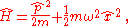
 of the particle is:

where x is the position
Space

Space is the boundless, three-dimensional extent in which Physical body and events occur and have relative position and direction. Physical space is often conceived in three linear dimensions, although modern physics usually consider it, with time, to be part of the boundless four-dimensional continuum known as spacetime....
 operator, and p is the momentum
Momentum

In classical mechanics, momentum is the product of the mass and velocity of an object . For more accurate measures of momentum, see the section Momentum#Modern definitions of momentum on this page....
 operator .


Discussion
Ask a question about 'Quantum harmonic oscillator'
Start a new discussion about 'Quantum harmonic oscillator'
Answer questions from other users
Full Discussion Forum


Recent Posts


Encyclopedia


The quantum harmonic oscillator is the quantum mechanical
Quantum mechanics

Quantum mechanics is a set of principles underlying the most fundamental known description of all physical systems at the microscopic scale . Notable amongst these principles are both a dual wave-like and particle-like behavior of matter and radiation, and prediction of probabilities in situations where classical physics predicts certaintie...
 analogue of the classical harmonic oscillator
Harmonic oscillator

In classical mechanics, a harmonic oscillator is a system which, when displaced from its equilibrium position, experiences a restoring force proportional to the displacement according to Hooke's law:...
. It is one of the most important model systems in quantum mechanics because an arbitrary potential can be approximated as a harmonic potential at the vicinity of a stable equilibrium point
Equilibrium point

In mathematics, the point is an equilibrium point for the differential equationif for all .Similarly, the point is an equilibrium point for the difference equation...
. Furthermore, it is one of the few quantum mechanical systems for which a simple exact solution is known.

One-dimensional harmonic oscillator


Hamiltonian and energy eigenstates


Qharmonicoscillator
In the one-dimensional harmonic oscillator problem, a particle of mass

is subject to a potential

. In classical mechanics, is called the spring stiffness coefficient, force constant or spring constant, and the circular frequency
Angular frequency

In physics , angular frequency ? is a scalar measure of rotation rate. Angular frequency is the magnitude of the vector quantity angular velocity....
.

The Hamiltonian
Hamiltonian (quantum mechanics)

In quantum mechanics, the Hamiltonian H is the observable corresponding to the total energy of the system. As with all observables, the Spectrum of the Hamiltonian is the set of possible outcomes when one measures the total energy of a system....
 of the particle is:

where x is the position
Space

Space is the boundless, three-dimensional extent in which Physical body and events occur and have relative position and direction. Physical space is often conceived in three linear dimensions, although modern physics usually consider it, with time, to be part of the boundless four-dimensional continuum known as spacetime....
 operator, and p is the momentum
Momentum

In classical mechanics, momentum is the product of the mass and velocity of an object . For more accurate measures of momentum, see the section Momentum#Modern definitions of momentum on this page....
 operator . The first term represents the kinetic energy of the particle, and the second term represents the potential energy in which it resides. In order to find the energy
Energy

In physics, energy is a scalar physical quantity that describes the amount of Work_ that can be performed by a force. Energy is an attribute of objects and systems that is subject to a conservation law....
 levels and the corresponding energy eigenstates, we must solve the time-independent Schrödinger equation
Schrödinger equation

In physics, especially quantum mechanics, the Schr?dinger equation is an equation that describes how the quantum state of a physical system changes in time....
,

.

We can solve the differential equation in the coordinate basis, using a spectral method
Spectral method

Spectral methods are a class of techniques used in applied mathematics and scientific computing to numerically solve certain partial differential equations , often involving the use of the Fast Fourier Transform....
. It turns out that there is a family of solutions,

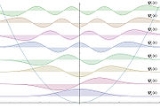
The first eight solutions (n = 0 to 7) are shown on the right. The functions are the Hermite polynomials
Hermite polynomials

In mathematics, the Hermite polynomials are a classical orthogonal polynomial polynomial sequence that arise in probability, such as the Edgeworth series; in combinatorics, as an example of an Appell sequence, obeying the umbral calculus; and in physics, where they give rise to the eigenstates of the quantum harmonic oscillator....
:

They should not be confused with the Hamiltonian, which is also denoted by H. The corresponding energy levels are

.

This energy spectrum is noteworthy for three reasons. Firstly, the energies are "quantized", and may only take the discrete values of times 1/2, 3/2, 5/2, and so forth. This is a feature of many quantum mechanical systems. In the following section on ladder operators, we will engage in a more detailed examination of this phenomenon. Secondly, the lowest achievable energy is not zero, but , which is called the "ground state energy" or zero-point energy
Zero-point energy

In physics, the zero-point energy is the lowest possible energy that a quantum mechanical physical system may have and is the energy of the ground state....
. In the ground state, according to quantum mechanics, an oscillator performs null oscillations and its average kinetic energy is positive. It is not obvious that this is significant, because normally the zero of energy is not a physically meaningful quantity, only differences in energies. Nevertheless, the ground state energy has many implications, particularly in quantum gravity
Quantum gravity

Quantum gravity is the field of theoretical physics attempting to unify quantum mechanics, which describes three of the Fundamental interaction , with general relativity, the theory of the fourth fundamental force: Gravitation....
. The final reason is that the energy levels are equally spaced, unlike the Bohr model
Bohr model

In atomic physics, the Bohr model created by Niels Bohr depicts the atom as a small, positively charged atomic nucleus surrounded by electrons that travel in circular orbits around the nucleus—similar in structure to the solar system, but with electrostatic forces providing attraction, rather than gravity....
 or the particle in a box
Particle in a box

In physics, the particle in a box is a problem consisting of a single particle inside of an infinitely deep potential well, from which it cannot escape, and which loses no energy when it collides with the walls of the box....
.

Note that the ground state probability density is concentrated at the origin. This means the particle spends most of its time at the bottom of the potential well, as we would expect for a state with little energy. As the energy increases, the probability density becomes concentrated at the "classical turning points", where the state's energy coincides with the potential energy. This is consistent with the classical harmonic oscillator, in which the particle spends most of its time (and is therefore most likely to be found) at the turning points, where it is the slowest. The correspondence principle
Correspondence principle

In physics, the correspondence principle is a quantitative tool, applied in the old quantum theory as well as in Quantum mechanics, according to Jammer explicitly formulated by Niels Bohr for the first time in 1920, but used by him already in 1913 when developing the Bohr model of an atom....
 is thus satisfied.

Ladder operator method

The spectral method solution, though straightforward, is rather tedious. The "ladder operator" method, due to Paul Dirac
Paul Dirac

Paul Adrien Maurice Dirac, Order of Merit , Royal Society was a United Kingdom theoretical physicist. Dirac made fundamental contributions to the early development of both quantum mechanics and quantum electrodynamics....
, allows us to extract the energy eigenvalues without directly solving the differential equation. Furthermore, it is readily generalizable to more complicated problems, notably in quantum field theory
Quantum field theory

Quantum field theory or QFT provides a theoretical framework for constructing quantum mechanics models of systems classically described by field or of Many-body problem....
. Following this approach, we define the operators a and its adjoint
Adjoint

In mathematics, the term adjoint applies in several situations. Several of these share a similar formalism: if A is adjoint to B, then there is typically some formula of the type...
 a

The operator a is not Hermitian since it and its adjoint a are not equal.

The operator a and a have properties as below:

We can also define a number operator N which has the following property:

In deriving the form of a, we have used the fact that the operators x and p, which represent observables, are Hermitian. These observable operators can be expressed as a linear combination of the ladder operators as

The x and p operators obey the following identity, known as the canonical commutation relation
Canonical commutation relation

In physics, the canonical commutation relation is the relation between canonical conjugate quantities , for example:between the position and momentum in the direction of a point particle in one dimension, where is the so-called commutator of and , is the imaginary unit and is the reduced Planck's constant ....
:

.

The square brackets in this equation are a commonly-used notational device, known as the commutator
Commutator

In mathematics, the commutator gives an indication of the extent to which a certain binary operation fails to be commutative. There are different definitions used in group theory and ring theory....
, defined as

.

Using the above, we can prove the identities

.

Now, let denote an energy eigenstate with energy E. The inner product of any ket
Bra-ket notation

Bra-ket notation is a standard notation for describing quantum states in the theory of quantum mechanics composed of bracket and vertical bars....
 with itself must be non-negative, so

.

Expressing aa in terms of the Hamiltonian:

,

so that . Note that when is the zero ket (i.e. a ket with length zero), the inequality is saturated, so that . It is straightforward to check that there exists a state satisfying this condition; it is the ground (n = 0) state given in the preceding section.

Using the above identities, we can now show that the commutation relations of a and a with H are:

.

Thus, provided is not the zero ket,

.

Similarly, we can show that

.

In other words, a acts on an eigenstate of energy E to produce, up to a multiplicative constant, another eigenstate of energy , and a acts on an eigenstate of energy E to produce an eigenstate of energy . For this reason, a is called a "lowering operator", and a a "raising operator". The two operators together are called ladder operators. In quantum field theory, a and a are alternatively called "annihilation" and "creation" operators because they destroy and create particles, which correspond to our quanta of energy.

Given any energy eigenstate, we can act on it with the lowering operator, a, to produce another eigenstate with -less energy. By repeated application of the lowering operator, it seems that we can produce energy eigenstates down to E = −8. However, this would contradict our earlier requirement that . Therefore, there must be a ground-state energy eigenstate, which we label (not to be confused with the zero ket), such that

.

In this case, subsequent applications of the lowering operator will just produce zero kets, instead of additional energy eigenstates. Furthermore, we have shown above that

Finally, by acting on with the raising operator and multiplying by suitable normalization factors, we can produce an infinite set of energy eigenstates , such that

which matches the energy spectrum which we gave in the preceding section.

This method can also be used to quickly find the ground state wave function of the quantum harmonic oscillator. Indeed becomes

so that

After normalization this leads to the following position space representation of the ground state wave function.

Natural length and energy scales

The quantum harmonic oscillator possesses natural scales for length and energy, which can be used to simplify the problem. These can be found by nondimensionalization
Nondimensionalization

Nondimensionalization is the partial or full removal of Units of measurements from a mathematical equation by a suitable substitution of variables....
. The result is that if we measure energy in units of and distance in units of , then the Schrödinger equation becomes:

,

and the energy eigenfunctions and eigenvalues become

where are the Hermite polynomials
Hermite polynomials

In mathematics, the Hermite polynomials are a classical orthogonal polynomial polynomial sequence that arise in probability, such as the Edgeworth series; in combinatorics, as an example of an Appell sequence, obeying the umbral calculus; and in physics, where they give rise to the eigenstates of the quantum harmonic oscillator....
.

To avoid confusion, we will not adopt these natural units in this article. However, they frequently come in handy when performing calculations.

Example: diatomic molecules


In diatomic molecules, the natural frequency can be found by: where   is the angular frequency,
k is the bond force constant, and
is the reduced mass
Reduced mass

Reduced mass is the "effective" inertial mass appearing in the two-body problem of Newtonian mechanics. This is a quantity with the Units_of_measurement of mass, which allows the two-body problem to be solved as if it were a one-body problem....
.

N-dimensional harmonic oscillator

The one-dimensional harmonic oscillator is readily generalizable to N dimensions, where N = 1, 2, 3, ... . In one dimension, the position of the particle was specified by a single coordinate
Coordinate system

In mathematics and its applications, a coordinate system is a system for assigning an n-tuple of numbers or scalar to each Point in an n-dimensional space....
, x. In N dimensions, this is replaced by N position coordinates, which we label x1, ..., xN. Corresponding to each position coordinate is a momentum; we label these p1, ..., pN. The canonical commutation relations between these operators are

.

The Hamiltonian for this system is

.

As the form of this Hamiltonian makes clear, the N-dimensional harmonic oscillator is exactly analogous to N independent one-dimensional harmonic oscillators with the same mass and spring constant. In this case, the quantities x1, ..., xN would refer to the positions of each of the N particles. This is a happy property of the r2 potential, which allows the potential energy to be separated into terms depending on one coordinate each.

This observation makes the solution straightforward. For a particular set of quantum numbers the energy eigenfunctions for the N-dimensional oscillator are expressed in terms of the 1-dimensional eigenfunctions as:

In the ladder operator method, we define N sets of ladder operators,

.

By a procedure analogous to the one-dimensional case, we can then show that each of the ai and ai operators lower and raise the energy by ?? respectively. The Hamiltonian is

This Hamiltonian is invariant under the dynamic symmetry group U(N) (the unitary group in N dimensions), defined by

where is an element in the defining matrix representation of U(N).

The energy levels of the system are

.

As in the one-dimensional case, the energy is quantized. The ground state energy is N times the one-dimensional energy, as we would expect using the analogy to N independent one-dimensional oscillators. There is one further difference: in the one-dimensional case, each energy level corresponds to a unique quantum state. In N-dimensions, except for the ground state, the energy levels are degenerate, meaning there are several states with the same energy.

The degeneracy can be calculated relatively easily. As an example, consider the 3-dimensional case: Define n = n1 + n2 + n3. All states with the same n will have the same energy. For a given n, we choose a particular n1. Then n2 + n3 = n − n1. There are n − n1 + 1 possible groups . n2 can take on the values 0 to n − n1, and for each n2 the value of n3 is fixed. The degree of degeneracy therefore is:

Formula for general N and n [gn being the dimension of the symmetric irreducible nth power representation of the unitary group U(N)]:

The special case N = 3, given above, follows directly from this general equation.

Example: 3D isotropic harmonic oscillator

The Schrödinger equation of a spherically-symmetric three-dimensional harmonic oscillator can be solved explicitly by separation of variables, see this article
Particle in a spherically symmetric potential

In quantum mechanics, the particle in a spherically symmetric potential describes the dynamics of a particle in a potential which has spherical symmetry....
 for the present case. This procedure is analogous to the separation performed in the hydrogen-like atom
Hydrogen-like atom

A hydrogen-like atom is an atom with one electron and thus is isoelectronic with hydrogen. Except for the hydrogen atom itself these atoms carry the positive charge e, where Z is the atomic number of the atom....
 problem, but with the spherically symmetric potential
Particle in a spherically symmetric potential

In quantum mechanics, the particle in a spherically symmetric potential describes the dynamics of a particle in a potential which has spherical symmetry....
where is the mass of the problem. Because m will be used below for the magnetic quantum number, mass is indicated by , instead of m, as earlier in this article.

The solution reads where is a normalization constant. are generalized Laguerre polynomials
Laguerre polynomials

In mathematics, the Laguerre polynomials, named after Edmond Laguerre ,are the canonical solutions of Laguerre's equation:which is a second-order linear differential equation....
. The order k of the polynomial is a non-negative integer. is a spherical harmonic function
Spherical harmonics

In mathematics, the spherical harmonics are the angular portion of an orthogonal set of solutions to Laplace's equation represented in a system of spherical coordinates....
. is the reduced Planck constant
Planck constant

The Planck constant , also called Planck's constant, is a physical constant used to describe the sizes of quantum in quantum mechanics. It is named after Max Planck, one of the founders of quantum theory....
: .

The energy eigenvalue is The energy is usually described by the single quantum number
Quantum number

Quantum numbers describe values of conserved numbers in the dynamics of the quantum system. They often describe specifically the energies of electrons in atoms, but other possibilities include angular momentum, Spin etc....


Because k is a non-negative integer, for every even n we have and for every odd n we have . The magnetic quantum number m is an integer satisfying , so for every n and l there are 2l+1 different quantum state
Quantum state

In quantum physics, a quantum State is a mathematical object that fully describes a Quantum system. One typically imagines some experimental apparatus and procedure which "prepares" this quantum state; the mathematical object then reflects the setup of the apparatus....
s, labeled by m. Thus, the degeneracy at level n is where the sum starts from 0 or 1, according to whether n is even or odd. This result is in accordance with the dimension formula above.

Coupled harmonic oscillators

In this problem, we consider N equal masses which are connected to their neighbors by springs, in the limit of large N. The masses form a linear chain in one dimension, or a regular lattice in two or three dimensions.

As in the previous section, we denote the positions of the masses by x1, x2, ..., as measured from their equilibrium positions (i.e. xk = 0 if particle k is at its equilibrium position.) In two or more dimensions, the xs are vector
Vector space

File:Vector addition ans scaling.pngA vector space is a mathematical structure formed by a collection of vectors: objects that may be Vector addition together and Scalar multiplication by numbers, called scalar s in this context....
 quantities. The Hamiltonian of the total system is

The potential energy is summed over "nearest-neighbor" pairs, so there is one term for each spring.

Remarkably, there exists a coordinate transformation to turn this problem into a set of independent harmonic oscillators, each of which corresponds to a particular collective distortion of the lattice. These distortions display some particle-like properties, and are called phonon
Phonon

In physics, a phonon is a quantum mode of vibration occurring in a rigid crystal structure, such as the atomic lattice of a solid. The study of phonons is an important part of solid state physics, because phonons play a major role in many of the physical properties of solids, including a material's thermal conductivity and electrical conduc...
s. Phonons occur in the ionic lattices of many solid
Solid

A solid object is in the states of matter characterized by resistance to deformation and changes of volume. In other words, it has high values both of Young's modulus and of shear modulus; this contrasts e.g....
s, and are extremely important for understanding many of the phenomena studied in solid state physics.

See also

  • Gas in a harmonic trap
    Gas in a harmonic trap

    The results of the quantum harmonic oscillator can be used to look at the equilibrium situation for a quantum ideal gas in a harmonic trap, which is a harmonic potential containing a large number particles that do not interact with each other except for instantaneous thermalizing collisions....
  • Creation and annihilation operators
    Creation and annihilation operators

    In physics, an annihilation operator is an operator that lowers the number of particles in a given state by one.A creation operator is an operator that increases the number of particles in a given state by one, and it is the adjoint of the annihilation operator....
  • Coherent state
    Coherent state

    In quantum mechanics a coherent state is a specific kind of quantum state of the quantum harmonic oscillator whose dynamics most closely resemble the oscillating behaviour of a classical harmonic oscillator system....
  • Morse potential
    Morse potential

    The Morse potential, named after physicist Philip M. Morse, is a convenient model for the potential energy of a diatomic molecule. It is a better approximation for the oscillation structure of the molecule than the quantum harmonic oscillator because it explicitly includes the effects of bond breaking, such as the existence of unbound state...
  • Hooke's atom
    Hooke's atom

    Hooke's atom, also known as harmonium, refers to an artificial helium-like atom where the Coulomb's law electron-nucleus interaction potential is...


External links

  • Calculation using a noncommutative free monoid: /