

Putting-Out system

Encyclopedia
The putting-out system was a means of subcontracting work. It was also known as the workshop system. In putting-out, work was contracted by a central agent to subcontractors who completed the work in their own facilities, usually their own homes.
It was used in the English textile industry, in small farms, and lock-making trades as late as the 19th century. Historian David A. Hounshell
writes,
All of the processes were carried out under different cottage roofs. It was replaced by inside contracting
and the factory system
.
The domestic system was a popular system of cloth production in Europe
. It was also used in various other industries, including the manufacture of wrought iron
ironware such as pins, pots, and pans for ironmongers.
It existed as early as the 15th century but was most prominent in the 17th and 18th centuries. It served as a way for entrepreneurs to bypass the guild system
, which was thought to be cumbersome and inflexible. Workers would work from home, manufacturing
individual articles from raw material
s, then bring them to a central place of business, such as a marketplace
or a larger town, to be assembled and sold. The raw materials were often provided by the merchant
, who received the finished product, hence the synonymous term putting-out system. The advantages of this system were that workers involved could work at their own speed while at home or their home and children working in the system were better treated than they would have been in the factory system, although the homes were polluted by the toxins from the raw materials. As the woman of a family usually worked at home, someone was often there to look after any children. The domestic system is often cited as one of the causes of the rise of the nuclear family
in Europe as the large amount of profits gained by common people made them less dependent on their extended family. These considerable sums of money also led to a much wealthier peasantry with more furniture, higher quality food, and better clothing than they had had before. It was mostly centralized in Western Europe
and did not take a strong hold in Eastern Europe
.
Of course, the acquisition of profit largely depended on which part of the putting-out system one was associated with. If one was a worker in the London textiles industry, for example, the cost of hiring sewing equipment and purchasing thread often precluded the worker from eating on a regular basis. Likewise the fourteen hour days lead to many untimely deaths.
The development of this trend is often considered to be a form of proto-industrialization
and remained prominent until the Industrial Revolution
of the 19th century.
At that point, it underwent name and geographical changes. However, bar some technological advancements, the putting-out system has not changed in essential practice. Contemporary examples can be found in China, India and South America, and are not limited to the textiles industry.
—primarily manufacturing
—which includes many producers, working from their homes
, typically part time
. The term originally referred to home workers who were engaged in a task such as sewing
, lace-making or household manufacturing. Some industries which are usually operated from large centralized factories were cottage industries before the Industrial Revolution
. Business operators would travel around, buying raw material
s, delivering them to people who would work on them, and then collecting the finished goods to sell, or typically to ship to another market. One of the factors which allowed the Industrial Revolution to take place in Western Europe
was the presence of these business people who had the ability to expand the scale of their operations. Cottage industries were very common in the time when a large proportion of the population was engaged in agriculture, because the farmer
s (and their families) often had both the time and the desire to earn additional income during the part of the year (winter) when there was little farming work to do.
The use of the term has expanded, and is used to refer to any event which allows a large number of people to work part time. For example, eBay
is said to have spawned a cottage industry of people who buy surplus merchandise, and sell it on their auction system.
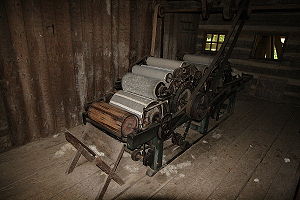
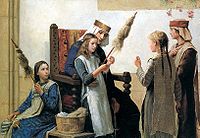
 A cottage is a farmhouse usually in rural areas. A cottage industry is a small self-help industry that is carried out in the home, community centre, parish hall or some other convenient place. Such industries are evident in handicrafts, catering, tailoring, dressmaking, beauty culture, retailing of dry goods, pottery and furniture making on a small scale.
Cottage industries developed mainly out of the need for an additional source of income, because of the need to use one's spare time gainfully and because of the relative ease of acquiring the necessary raw materials to set up such industries.
It was used in the English textile industry, in small farms, and lock-making trades as late as the 19th century. Historian David A. Hounshell
David A. Hounshell
David Allen Hounshell is the David M. Roderick Professor of Technology and Social Change in the Department of Social and Decision Sciences, Department of History, and the Department of Engineering and Public Policy at Carnegie Mellon University....
writes,
All of the processes were carried out under different cottage roofs. It was replaced by inside contracting
Inside contracting
Inside contracting is the practice of hiring contractors who work inside the proprietor's factory. It replaced the putting out system, where contractors worked in their own facilities. Inside contracting was the system favored by the Springfield and Harper's Ferry Armories...
and the factory system
Factory system
The factory system was a method of manufacturing first adopted in England at the beginning of the Industrial Revolution in the 1750s and later spread abroad. Fundamentally, each worker created a separate part of the total assembly of a product, thus increasing the efficiency of factories. Workers,...
.
The domestic system was a popular system of cloth production in Europe
Europe
Europe is, by convention, one of the world's seven continents. Comprising the westernmost peninsula of Eurasia, Europe is generally 'divided' from Asia to its east by the watershed divides of the Ural and Caucasus Mountains, the Ural River, the Caspian and Black Seas, and the waterways connecting...
. It was also used in various other industries, including the manufacture of wrought iron
Wrought iron
thumb|The [[Eiffel tower]] is constructed from [[puddle iron]], a form of wrought ironWrought iron is an iron alloy with a very low carbon...
ironware such as pins, pots, and pans for ironmongers.
It existed as early as the 15th century but was most prominent in the 17th and 18th centuries. It served as a way for entrepreneurs to bypass the guild system
Guild
A guild is an association of craftsmen in a particular trade. The earliest types of guild were formed as confraternities of workers. They were organized in a manner something between a trade union, a cartel, and a secret society...
, which was thought to be cumbersome and inflexible. Workers would work from home, manufacturing
Manufacturing
Manufacturing is the use of machines, tools and labor to produce goods for use or sale. The term may refer to a range of human activity, from handicraft to high tech, but is most commonly applied to industrial production, in which raw materials are transformed into finished goods on a large scale...
individual articles from raw material
Raw material
A raw material or feedstock is the basic material from which a product is manufactured or made, frequently used with an extended meaning. For example, the term is used to denote material that came from nature and is in an unprocessed or minimally processed state. Latex, iron ore, logs, and crude...
s, then bring them to a central place of business, such as a marketplace
Marketplace
A marketplace is the space, actual, virtual or metaphorical, in which a market operates. The term is also used in a trademark law context to denote the actual consumer environment, ie. the 'real world' in which products and services are provided and consumed.-Marketplaces and street markets:A...
or a larger town, to be assembled and sold. The raw materials were often provided by the merchant
Merchant
A merchant is a businessperson who trades in commodities that were produced by others, in order to earn a profit.Merchants can be one of two types:# A wholesale merchant operates in the chain between producer and retail merchant...
, who received the finished product, hence the synonymous term putting-out system. The advantages of this system were that workers involved could work at their own speed while at home or their home and children working in the system were better treated than they would have been in the factory system, although the homes were polluted by the toxins from the raw materials. As the woman of a family usually worked at home, someone was often there to look after any children. The domestic system is often cited as one of the causes of the rise of the nuclear family
Nuclear family
Nuclear family is a term used to define a family group consisting of a father and mother and their children. This is in contrast to the smaller single-parent family, and to the larger extended family. Nuclear families typically center on a married couple, but not always; the nuclear family may have...
in Europe as the large amount of profits gained by common people made them less dependent on their extended family. These considerable sums of money also led to a much wealthier peasantry with more furniture, higher quality food, and better clothing than they had had before. It was mostly centralized in Western Europe
Western Europe
Western Europe is a loose term for the collection of countries in the western most region of the European continents, though this definition is context-dependent and carries cultural and political connotations. One definition describes Western Europe as a geographic entity—the region lying in the...
and did not take a strong hold in Eastern Europe
Eastern Europe
Eastern Europe is the eastern part of Europe. The term has widely disparate geopolitical, geographical, cultural and socioeconomic readings, which makes it highly context-dependent and even volatile, and there are "almost as many definitions of Eastern Europe as there are scholars of the region"...
.
Of course, the acquisition of profit largely depended on which part of the putting-out system one was associated with. If one was a worker in the London textiles industry, for example, the cost of hiring sewing equipment and purchasing thread often precluded the worker from eating on a regular basis. Likewise the fourteen hour days lead to many untimely deaths.
The development of this trend is often considered to be a form of proto-industrialization
Proto-industrialization
Proto-industrialisation is a phase in the development of modern industrial economies that preceded, and created conditions for, the establishment of fully industrial societies...
and remained prominent until the Industrial Revolution
Industrial Revolution
The Industrial Revolution was a period from the 18th to the 19th century where major changes in agriculture, manufacturing, mining, transportation, and technology had a profound effect on the social, economic and cultural conditions of the times...
of the 19th century.
At that point, it underwent name and geographical changes. However, bar some technological advancements, the putting-out system has not changed in essential practice. Contemporary examples can be found in China, India and South America, and are not limited to the textiles industry.
Cottage industry
A cottage industry is an industryIndustry
Industry refers to the production of an economic good or service within an economy.-Industrial sectors:There are four key industrial economic sectors: the primary sector, largely raw material extraction industries such as mining and farming; the secondary sector, involving refining, construction,...
—primarily manufacturing
Manufacturing
Manufacturing is the use of machines, tools and labor to produce goods for use or sale. The term may refer to a range of human activity, from handicraft to high tech, but is most commonly applied to industrial production, in which raw materials are transformed into finished goods on a large scale...
—which includes many producers, working from their homes
House
A house is a building or structure that has the ability to be occupied for dwelling by human beings or other creatures. The term house includes many kinds of different dwellings ranging from rudimentary huts of nomadic tribes to free standing individual structures...
, typically part time
Part time
A part-time job is a form of employment that carries fewer hours per week than a full-time job. Workers are considered to be part time if they commonly work fewer than 30 or 35 hours per week...
. The term originally referred to home workers who were engaged in a task such as sewing
Sewing
Sewing is the craft of fastening or attaching objects using stitches made with a needle and thread. Sewing is one of the oldest of the textile arts, arising in the Paleolithic era...
, lace-making or household manufacturing. Some industries which are usually operated from large centralized factories were cottage industries before the Industrial Revolution
Industrial Revolution
The Industrial Revolution was a period from the 18th to the 19th century where major changes in agriculture, manufacturing, mining, transportation, and technology had a profound effect on the social, economic and cultural conditions of the times...
. Business operators would travel around, buying raw material
Raw material
A raw material or feedstock is the basic material from which a product is manufactured or made, frequently used with an extended meaning. For example, the term is used to denote material that came from nature and is in an unprocessed or minimally processed state. Latex, iron ore, logs, and crude...
s, delivering them to people who would work on them, and then collecting the finished goods to sell, or typically to ship to another market. One of the factors which allowed the Industrial Revolution to take place in Western Europe
Europe
Europe is, by convention, one of the world's seven continents. Comprising the westernmost peninsula of Eurasia, Europe is generally 'divided' from Asia to its east by the watershed divides of the Ural and Caucasus Mountains, the Ural River, the Caspian and Black Seas, and the waterways connecting...
was the presence of these business people who had the ability to expand the scale of their operations. Cottage industries were very common in the time when a large proportion of the population was engaged in agriculture, because the farmer
Farmer
A farmer is a person engaged in agriculture, who raises living organisms for food or raw materials, generally including livestock husbandry and growing crops, such as produce and grain...
s (and their families) often had both the time and the desire to earn additional income during the part of the year (winter) when there was little farming work to do.
The use of the term has expanded, and is used to refer to any event which allows a large number of people to work part time. For example, eBay
EBay
eBay Inc. is an American internet consumer-to-consumer corporation that manages eBay.com, an online auction and shopping website in which people and businesses buy and sell a broad variety of goods and services worldwide...
is said to have spawned a cottage industry of people who buy surplus merchandise, and sell it on their auction system.
History of cottage industries
Cottage industries developed mainly out of the need for an additional source of income, because of the need to use one's spare time gainfully and because of the relative ease of acquiring the necessary raw materials to set up such industries.
See also
- Inside contractingInside contractingInside contracting is the practice of hiring contractors who work inside the proprietor's factory. It replaced the putting out system, where contractors worked in their own facilities. Inside contracting was the system favored by the Springfield and Harper's Ferry Armories...
- Factory systemFactory systemThe factory system was a method of manufacturing first adopted in England at the beginning of the Industrial Revolution in the 1750s and later spread abroad. Fundamentally, each worker created a separate part of the total assembly of a product, thus increasing the efficiency of factories. Workers,...
- TonyaTonya (Japan), called toiya outside of Edo, were trade brokers in Japan, primarily wholesalers, warehouse managers, and shipment managers; the term applies equally to the traders themselves and to their shops or warehouses...
- Japanese putting-out system