

Proteales

Encyclopedia
Proteales is the botanical name
of an order
of flowering plants. Such an order has been recognized by almost all taxonomists.
, of 2003, also recognizes this order, and places it in the clade eudicots
with this circumscription:
with "+ ..." = optionally separate family (that may be split off from the preceding family).
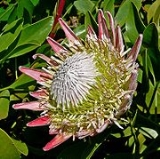
Well-known members of Proteales include the protea
s of South Africa, the banksia
s and macadamia
s of Australia, the London plane
, and the sacred lotus. The origins of the order are clearly ancient, with evidence of diversification in the mid Cretaceous
, over 100 million years ago. Of interest are the current family distributions, with the Proteaceae a mostly southern hemisphere family while Platanaceae and Nelumbonaceae northern hemisphere.
, of 1998, which firmly did accept family Platanaceae as separate, using this circumscription of the order:
, of 1981, recognized such an order and placed it in subclass Rosidae
in class Magnoliopsida
[=dicotyledons]. It used this circumscription:
and Thorne system (1992)
recognized such an order and placed it in superorder Proteanae in subclass Magnoliidae
[=dicotyledons]. These systems used this circumscription:
, in its update of 1964, also recognized this order and placed it in subclass Archichlamydeae of class Dicotyledoneae. It used this circumscription:
, last revised in 1935, also recognized this order and placed it in the Monochlamydeae in subclass Choripetalae of class Dicotyledones. It used this circumscription:
Botanical name
A botanical name is a formal scientific name conforming to the International Code of Botanical Nomenclature and, if it concerns a plant cultigen, the additional cultivar and/or Group epithets must conform to the International Code of Nomenclature for Cultivated Plants...
of an order
Order (biology)
In scientific classification used in biology, the order is# a taxonomic rank used in the classification of organisms. Other well-known ranks are life, domain, kingdom, phylum, class, family, genus, and species, with order fitting in between class and family...
of flowering plants. Such an order has been recognized by almost all taxonomists.
Families
The APG II systemAPG II system
The APG II system of plant classification is the second, now obsolete, version of a modern, mostly molecular-based, system of plant taxonomy that was published in April 2003 by the Angiosperm Phylogeny Group. It was a revision of the first APG system, published in 1998, and was superseded in 2009...
, of 2003, also recognizes this order, and places it in the clade eudicots
Eudicots
Eudicots and Eudicotyledons are botanical terms introduced by Doyle & Hotton to refer to a monophyletic group of flowering plants that had been called tricolpates or non-Magnoliid dicots by previous authors...
with this circumscription:
- order Proteales
- family Nelumbonaceae
- family ProteaceaeProteaceaeProteaceae is a family of flowering plants distributed in the Southern Hemisphere. The family comprises about 80 genera with about 1600 species. Together with the Platanaceae and Nelumbonaceae they make up the order Proteales. Well known genera include Protea, Banksia, Embothrium, Grevillea,...
[+ family PlatanaceaePlatanaceaePlatanaceae is a family of flowering plants. It has been recognized by almost all taxonomists, and is sometimes called the "plane-tree family"....
]
with "+ ..." = optionally separate family (that may be split off from the preceding family).
Well-known members of Proteales include the protea
Protea
Protea is both the botanical name and the English common name of a genus of flowering plants, sometimes also called sugarbushes.-Etymology:...
s of South Africa, the banksia
Banksia
Banksia is a genus of around 170 species in the plant family Proteaceae. These Australian wildflowers and popular garden plants are easily recognised by their characteristic flower spikes and fruiting "cones" and heads. When it comes to size, banksias range from prostrate woody shrubs to trees up...
s and macadamia
Macadamia
Macadamia is a genus of nine species of flowering plants in the family Proteaceae, with a disjunct distribution native to eastern Australia , New Caledonia and Sulawesi in Indonesia ....
s of Australia, the London plane
London Plane
Platanus × acerifolia, the London plane, London planetree, or hybrid plane, is a tree in the genus Platanus. It is usually thought to be a hybrid of Platanus orientalis and the Platanus occidentalis . Some authorities think that it may be a cultivar of P...
, and the sacred lotus. The origins of the order are clearly ancient, with evidence of diversification in the mid Cretaceous
Cretaceous
The Cretaceous , derived from the Latin "creta" , usually abbreviated K for its German translation Kreide , is a geologic period and system from circa to million years ago. In the geologic timescale, the Cretaceous follows the Jurassic period and is followed by the Paleogene period of the...
, over 100 million years ago. Of interest are the current family distributions, with the Proteaceae a mostly southern hemisphere family while Platanaceae and Nelumbonaceae northern hemisphere.
Classification
This represents a slight change from the APG systemAPG system
The APG system of plant classification is the first, now obsolete, version of a modern, mostly molecular-based, system of plant taxonomy that was published in 1998 by the Angiosperm Phylogeny Group. It was superseded in 2003 by a revision, the APG II system, and then in 2009 by a further...
, of 1998, which firmly did accept family Platanaceae as separate, using this circumscription of the order:
- order Proteales
- family Nelumbonaceae
- family Platanaceae
- family Proteaceae
Cronquist
The Cronquist systemCronquist system
The Cronquist system is a taxonomic classification system of flowering plants. It was developed by Arthur Cronquist in his texts An Integrated System of Classification of Flowering Plants and The Evolution and Classification of Flowering Plants .Cronquist's system places flowering plants into two...
, of 1981, recognized such an order and placed it in subclass Rosidae
Rosidae
Under the International Code of Botanical Nomenclature , Rosidae is a botanical name at the rank of subclass. Circumscription of the subclass will vary with the taxonomic system being used; the only requirement being that it includes the family Rosaceae....
in class Magnoliopsida
Magnoliopsida
Magnoliopsida is a valid botanical name for a class of flowering plants. By definition the class will include the family Magnoliaceae, but its circumscription can otherwise vary, being more inclusive or less inclusive depending upon the classification system being discussed.-Cronquist and...
[=dicotyledons]. It used this circumscription:
- order Proteales
- family ElaeagnaceaeElaeagnaceaeElaeagnaceae, the oleaster family, is a plant family of the order Rosales comprising small trees and shrubs, native to temperate regions of the Northern Hemisphere, south into tropical Asia and Australia. The family has 45-50 species in three genera....
- family Proteaceae
Dahlgren & Thorne
The Dahlgren systemDahlgren system
One of the modern systems of plant taxonomy, the Dahlgren system was published by monocot specialist Rolf Dahlgren. His wife Gertrud Dahlgren carried on after his death.According to the extensive listing by Professor Reveal One of the modern systems of plant taxonomy, the Dahlgren system was...
and Thorne system (1992)
Thorne system (1992)
A modern system of plant taxonomy, the Thorne system of plant classification was drawn up by the botanist Robert F. Thorne . He replaced it in 2000 with a new system. These two systems were published in:...
recognized such an order and placed it in superorder Proteanae in subclass Magnoliidae
Magnoliidae
Magnoliids are a group of about 9,000 species of flowering plants, including magnolias, nutmeg, bay laurel, cinnamon, avocado, black pepper, and many others. They are characterized by trimerous flowers, pollen with one pore, and usually branching-veined leaves.-Classification:Traditionally,...
[=dicotyledons]. These systems used this circumscription:
- order Proteales
- family Proteaceae
Engler
The Engler systemEngler system
One of the prime systems of plant taxonomy, the Engler system was devised by Adolf Engler.According to Engler, Syllabus der Pflanzenfamilien the main groups of plants are:* I. divisio Schizophyta* II. divisio Phytosarcodina...
, in its update of 1964, also recognized this order and placed it in subclass Archichlamydeae of class Dicotyledoneae. It used this circumscription:
- order Proteales
- family Proteaceae
Wettstein
The Wettstein systemWettstein system
A system of plant taxonomy, the Wettstein system recognised the following main groups, according to* I. phylum Schizophyta*::: 1. classis Schizophyceae*::: 2. classis Schizomycetes* II. phylum Monadophyta* III. phylum Myxophyta...
, last revised in 1935, also recognized this order and placed it in the Monochlamydeae in subclass Choripetalae of class Dicotyledones. It used this circumscription:
- order Proteales
- family Proteaceae