

Proteaceae

Encyclopedia
Proteaceae is a family
of flowering plants distributed in the Southern Hemisphere
. The family comprises about 80 genera
with about 1600 species
. Together with the Platanaceae
and Nelumbonaceae they make up the order Proteales
. Well known genera include Protea
, Banksia
, Embothrium
, Grevillea
, Hakea
, Dryandra
and Macadamia
. Species such as the New South Wales Waratah (Telopea speciosissima
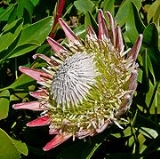
), King Protea (Protea cynaroides), and various species of Banksia, Grevillea, and Leucadendron are popular cut flowers, while the nuts of Macadamia integrifolia
are widely commercially grown and consumed.
, a deity that was able to change between many forms. This is an appropriate image, seeing as the family is known for its astonishing variety and diversity of flowers and leaves.
in particular providing one of the most striking examples of adaptive radiation
in plants. This variability makes it impossible to provide a simple, diagnostic identification key for the family, although individual genera may be easily identified.
s or shrub
s, except for some Stirlingia
species that are herb
s. They are evergreen
, with leaves that vary greatly in size, shape and margin.
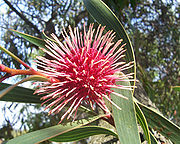
. In many genera, the most obvious feature is the large and often very showy inflorescence
s, consisting of many small flower
s densely packed into a compact head or spike. Even this character, however, does not occur in all Proteaceae: Adenanthos
species, for example, have solitary flowers. In most Proteaceae species the pollination mechanism is highly specialised. It usually involves the use of a "pollen-presenter", an area on the style-end that presents the pollen
to the pollinator.
Proteaceae flower parts occur in fours, but the four tepal
s are fused into a long narrow tube with a closed cup at the top, and the filaments of the four stamen
s are fused to the tepals, in such a way that the anthers are enclosed within the cup. The pistil initially passes along the inside of the perianth tube, so that the stigma too is enclosed within the cup. As the flower develops, the pistil grows rapidly. Since the stigma is trapped, the style must bend to elongate, and eventually it bends so far that it splits the perianth along one seam. The style continues to grow until anthesis
, when the nectaries begin to produce nectar. At this time, the perianth splits into its component tepals, the cup splits apart, and the pistil is released to spring more or less upright.
Just before anthesis, the anthers release their pollen
, depositing it onto the stigma, which in many cases has an enlarged fleshy area specifically for the deposition of its own pollen. Nectar-feeders are unlikely to come into contact with the anthers themselves, but can hardly avoid contacting the stigma; thus the stigma functions as a pollen-presenter
, ensuring that nectar-feeders act as pollinators. The down side of this pollination strategy is that the probability of self-fertilisation is greatly increased; many Proteaceae counter this with strategies such as protandry, self-incompatibility, or preferential abortion of selfed seed.
 Proteaceae are mainly a southern hemisphere family, with its main centres of diversity in Australia and South Africa
. It also occurs in Central Africa, South
and Central America
, India
, eastern and south-eastern Asia
, and Oceania
. Only two species are known from New Zealand although fossil pollen evidence suggests there were more previously.
It is a good example of a Gondwana
n family, with taxa occurring on virtually every land mass considered a remnant of the ancient supercontinent
Gondwana. The family and sub-families are thought to have diversified well before the fragmentation of Gondwana, implying that all of them are well over 90 million years old. Evidence for this includes an abundance of proteaceous pollen
found in the Cretaceous
coal
deposits of the South Island
of New Zealand
. It is thought to have achieved its present distribution largely by continental drift
rather than dispersal across ocean gaps.
Many of the Proteaceae have specialised proteoid root
s. Proteoid roots are masses of lateral roots and hairs forming a radial absorptive suface, produced in the leaf litter layer during seasonal growth, and usually shriveling at the end of the growth season. They are an adaptation to growth in poor phosphorus deficient soils, greatly increasing the plants access to scarce water and nutrients by exuding carboxylates that mobilise previously unavailable phosphorus. They also increasing the root's absorption surface but this is a minor feature as it also increases competition for nutrients against its own root clusters. However, this adaptation leaves them highly vulnerable to dieback caused by the Phytophthora cinnamomi
water mould
, and generally intolerant of fertilization
. Due to these specialized proteoid roots, the Proteaceae are one of few flowering plant families that do not form symbioses with arbuscular mycorrhiza
l fungi.
s, sunbird
s and honeyeater
s. Some produce berries, attracting further bird species.
Many species are fire-adapted, meaning that they have strategies for surviving fires that sweep through their habitat. Some are resprouter
s, and have a thick rootstock buried in the ground that shoots up new stems after a fire, and others are reseeders, meaning that the adult plants are killed by the fire but disperse their seeds, which are stimulated by the smoke to take root and grow. The heat was previously thought to have stimulated growth but it has now been found that it is in fact the chemicals in the smoke.
, the Proteaceae family is a fairly large one, with around eighty genera, but less than two thousand species. It is recognised by virtually all taxonomists
. Firmly established under classical Linnaean taxonomy
, it is also recognised by the cladistics
-based APG
and APG II
systems. It is placed in the order Proteales
, whose placement has itself varied.
The framework for classification of the genera within Proteaceae was laid by L. A. S. Johnson
and Barbara Briggs
in their influential 1975 monograph "On the Proteaceae: the evolution and classification of a southern family
". Their classification has been refined somewhat over the ensuing three decades, most notably by Peter Weston
and Nigel Barker
in 2006. Proteaceae is now divided into five subfamilies: Bellendenoideae, Persoonioideae
, Symphionematoideae, Proteoideae
and Grevilleoideae
. The full arrangement, according to Weston and Barker, is as follows:
.jpg)
 Many Proteaceae species are cultivated by the nursery
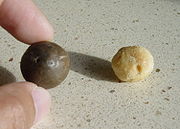
industry, as barrier plants and for their prominent and distinctive flowers and foliage. Some species are of importance to the cut flower industry
, especially some Banksia
and Protea
species. Two species of the genus Macadamia
are grown commercially for edible nuts. Gevuina avellana
(Chilean hazelnut) tree is cultivated for its nuts in Chile
and New Zealand
, which are edible, and are used in pharmaceutical industry for skin treatment because of its moisturizing properties and as ingredient in sunscreen
s.
The most valuable species as ornamental are the southernmost trees because they can give to landscapes an exotic tropical appearance in temperate climates; the following Chilean-Argentinian species are good examples of this: Lomatia ferruginea
(Fuinque), Lomatia hirsuta
(Radal) have been introduced to Western Europe
and Western United States
. Embothrium coccineum
(Chilean firetree or Notro) is very valued because of its deep red flowers in the British Isles and is found as north as Faroe Islands
at 62° North Latitude.
Sugarbushes (Protea
), pincushions (Leucospermum
) and conebushes (Leucadendron
), as well as others like pagodas (Mimetes
), Aulax
and blushing brides (Serruria
), comprise one of the three main plant groups of fynbos
, which forms part of the Cape Floral Kingdom, the smallest but richest plant kingdom for its size and the only kingdom contained within a single country. The other main groups of plants in fynbos are the Ericaceae
and the Restionaceae
. South African proteas are thus widely cultivated due to their many varied forms and unusual flowers. They are popular in South Africa for their beauty and their usefulness in the wildlife garden for attracting birds and useful insects.
Among banksia
s, many of which grow in Mediterranean and maritime climates, the huge majority of them are shrubs, only few reach tree sizes and they are appreciated because of their height and among taller species are outstanding: B. integrifolia
with its subspecies B. integrifolia subsp. monticola
is remarkable for having the tallest banksia trees and for withstanding more frosts than all banksias, B. seminuda
, B. littoralis
, B. serrata
; those that can be considered little trees or big shrubs: B. grandis
, B. prionotes
, B. marginata
, B. coccinea
and B. speciosa
, and are planted in parks, gardens and even streets, the rest of species of this genus consisting of around 170 are only shrubs, even some of them are valued because of their flowers.
Another, smaller species grown in several parts of the world is Telopea speciosissima
(Waratah), from the mountains of New South Wales
, Australia
. Some species in temperate climates are cultivated more locally in Australia because of their beauty: Persoonia pinifolia
(Pine-leaved Geebung) is very appreciated for its vivid yellow flowers and its grape-like fruits. Adenanthos sericeus
(Woolly Bush) is planted for its showy soft leaves and its little, and red or orange flowers. Hicksbeachia pinnatifolia
(red bauple nut) is commonly planted for its foliage and edible nuts.
Family (biology)
In biological classification, family is* a taxonomic rank. Other well-known ranks are life, domain, kingdom, phylum, class, order, genus, and species, with family fitting between order and genus. As for the other well-known ranks, there is the option of an immediately lower rank, indicated by the...
of flowering plants distributed in the Southern Hemisphere
Southern Hemisphere
The Southern Hemisphere is the part of Earth that lies south of the equator. The word hemisphere literally means 'half ball' or "half sphere"...
. The family comprises about 80 genera
Genus
In biology, a genus is a low-level taxonomic rank used in the biological classification of living and fossil organisms, which is an example of definition by genus and differentia...
with about 1600 species
Species
In biology, a species is one of the basic units of biological classification and a taxonomic rank. A species is often defined as a group of organisms capable of interbreeding and producing fertile offspring. While in many cases this definition is adequate, more precise or differing measures are...
. Together with the Platanaceae
Platanaceae
Platanaceae is a family of flowering plants. It has been recognized by almost all taxonomists, and is sometimes called the "plane-tree family"....
and Nelumbonaceae they make up the order Proteales
Proteales
Proteales is the botanical name of an order of flowering plants. Such an order has been recognized by almost all taxonomists.-Families:The APG II system, of 2003, also recognizes this order, and places it in the clade eudicots with this circumscription:...
. Well known genera include Protea
Protea
Protea is both the botanical name and the English common name of a genus of flowering plants, sometimes also called sugarbushes.-Etymology:...
, Banksia
Banksia
Banksia is a genus of around 170 species in the plant family Proteaceae. These Australian wildflowers and popular garden plants are easily recognised by their characteristic flower spikes and fruiting "cones" and heads. When it comes to size, banksias range from prostrate woody shrubs to trees up...
, Embothrium
Embothrium
Embothrium is a genus of two to eight species in the plant family Proteaceae, native to southern South America, in Chile and adjacent western Argentina and southern Peru; the genus occurs as far south as Tierra del Fuego...
, Grevillea
Grevillea
Grevillea is a diverse genus of about 360 species of evergreen flowering plants in the protea family Proteaceae, native to Australia, New Guinea, New Caledonia, and Sulawesi. It was named in honour of Charles Francis Greville. The species range from prostrate shrubs less than 0.5 m tall to trees...
, Hakea
Hakea
Hakea is a genus of 149 species of shrubs and small trees in the Proteaceae, native to Australia. They are found throughout the country, with the highest species diversity being found in the south west of Western Australia....
, Dryandra
Dryandra
Banksia ser. Dryandra is a series of 94 species of shrub to small tree in the plant genus Banksia. It was considered a separate genus named Dryandra until early 2007, when it was merged into Banksia on the basis of extensive molecular and morphological evidence that Banksia was paraphyletic with...
and Macadamia
Macadamia
Macadamia is a genus of nine species of flowering plants in the family Proteaceae, with a disjunct distribution native to eastern Australia , New Caledonia and Sulawesi in Indonesia ....
. Species such as the New South Wales Waratah (Telopea speciosissima
Telopea speciosissima
Telopea speciosissima, commonly known as the New South Wales waratah or simply waratah, is a large shrub in the plant family Proteaceae. It is endemic to New South Wales in Australia and is the floral emblem of that state...
), King Protea (Protea cynaroides), and various species of Banksia, Grevillea, and Leucadendron are popular cut flowers, while the nuts of Macadamia integrifolia
Macadamia integrifolia
Macadamia integrifolia is a tree in the Proteaceae family, native to Queensland in Australia. Common names include Macadamia Nut, Bauple Nut, Queensland Nut or Nut Oak....
are widely commercially grown and consumed.
Etymology
The name Proteaceae as well as the genus Protea derive from the name of the Greek god ProteusProteus
In Greek mythology, Proteus is an early sea-god, one of several deities whom Homer calls the "Old Man of the Sea", whose name suggests the "first" , as protogonos is the "primordial" or the "firstborn". He became the son of Poseidon in the Olympian theogony In Greek mythology, Proteus (Πρωτεύς)...
, a deity that was able to change between many forms. This is an appropriate image, seeing as the family is known for its astonishing variety and diversity of flowers and leaves.
Description
Many genera of Proteaceae are highly variable, with BanksiaBanksia
Banksia is a genus of around 170 species in the plant family Proteaceae. These Australian wildflowers and popular garden plants are easily recognised by their characteristic flower spikes and fruiting "cones" and heads. When it comes to size, banksias range from prostrate woody shrubs to trees up...
in particular providing one of the most striking examples of adaptive radiation
Adaptive radiation
In evolutionary biology, adaptive radiation is the evolution of ecological and phenotypic diversity within a rapidly multiplying lineage. Starting with a recent single ancestor, this process results in the speciation and phenotypic adaptation of an array of species exhibiting different...
in plants. This variability makes it impossible to provide a simple, diagnostic identification key for the family, although individual genera may be easily identified.
Growth Habit
Proteaceae are generally treeTree
A tree is a perennial woody plant. It is most often defined as a woody plant that has many secondary branches supported clear of the ground on a single main stem or trunk with clear apical dominance. A minimum height specification at maturity is cited by some authors, varying from 3 m to...
s or shrub
Shrub
A shrub or bush is distinguished from a tree by its multiple stems and shorter height, usually under 5–6 m tall. A large number of plants may become either shrubs or trees, depending on the growing conditions they experience...
s, except for some Stirlingia
Stirlingia
Stirlingia, commonly known as Blueboy, is a genus of 7 species in the family Proteaceae, all of which are endemic to Western Australia.-Description:...
species that are herb
Herb
Except in botanical usage, an herb is "any plant with leaves, seeds, or flowers used for flavoring, food, medicine, or perfume" or "a part of such a plant as used in cooking"...
s. They are evergreen
Evergreen
In botany, an evergreen plant is a plant that has leaves in all seasons. This contrasts with deciduous plants, which completely lose their foliage during the winter or dry season.There are many different kinds of evergreen plants, both trees and shrubs...
, with leaves that vary greatly in size, shape and margin.
Flower
Generally speaking, the diagnostic feature of Proteaceae is the unusual flower, or more accurately inflorescenceInflorescence
An inflorescence is a group or cluster of flowers arranged on a stem that is composed of a main branch or a complicated arrangement of branches. Strictly, it is the part of the shoot of seed plants where flowers are formed and which is accordingly modified...
. In many genera, the most obvious feature is the large and often very showy inflorescence
Inflorescence
An inflorescence is a group or cluster of flowers arranged on a stem that is composed of a main branch or a complicated arrangement of branches. Strictly, it is the part of the shoot of seed plants where flowers are formed and which is accordingly modified...
s, consisting of many small flower
Flower
A flower, sometimes known as a bloom or blossom, is the reproductive structure found in flowering plants . The biological function of a flower is to effect reproduction, usually by providing a mechanism for the union of sperm with eggs...
s densely packed into a compact head or spike. Even this character, however, does not occur in all Proteaceae: Adenanthos
Adenanthos
Adenanthos is an genus of Australian native shrubs in the flowering plant family Proteaceae. Variable in habit and leaf shape, it is the only Proteaceae genus in which solitary flowers is the norm. It was discovered in 1791, and formally published by Jacques Labillardière in 1805. There are now 33...
species, for example, have solitary flowers. In most Proteaceae species the pollination mechanism is highly specialised. It usually involves the use of a "pollen-presenter", an area on the style-end that presents the pollen
Pollen
Pollen is a fine to coarse powder containing the microgametophytes of seed plants, which produce the male gametes . Pollen grains have a hard coat that protects the sperm cells during the process of their movement from the stamens to the pistil of flowering plants or from the male cone to the...
to the pollinator.
Proteaceae flower parts occur in fours, but the four tepal
Tepal
Tepals are elements of the perianth, or outer part of a flower, which include the petals or sepals. The term tepal is more often applied specifically when all segments of the perianth are of similar shape and color, or undifferentiated, which is called perigone...
s are fused into a long narrow tube with a closed cup at the top, and the filaments of the four stamen
Stamen
The stamen is the pollen producing reproductive organ of a flower...
s are fused to the tepals, in such a way that the anthers are enclosed within the cup. The pistil initially passes along the inside of the perianth tube, so that the stigma too is enclosed within the cup. As the flower develops, the pistil grows rapidly. Since the stigma is trapped, the style must bend to elongate, and eventually it bends so far that it splits the perianth along one seam. The style continues to grow until anthesis
Anthesis
Anthesis is the period during which a flower is fully open and functional. It may also refer to the onset of that period.The onset of anthesis is spectacular in some species. In Banksia species, for example, anthesis involves the extension of the style far beyond the upper perianth parts...
, when the nectaries begin to produce nectar. At this time, the perianth splits into its component tepals, the cup splits apart, and the pistil is released to spring more or less upright.
Just before anthesis, the anthers release their pollen
Pollen
Pollen is a fine to coarse powder containing the microgametophytes of seed plants, which produce the male gametes . Pollen grains have a hard coat that protects the sperm cells during the process of their movement from the stamens to the pistil of flowering plants or from the male cone to the...
, depositing it onto the stigma, which in many cases has an enlarged fleshy area specifically for the deposition of its own pollen. Nectar-feeders are unlikely to come into contact with the anthers themselves, but can hardly avoid contacting the stigma; thus the stigma functions as a pollen-presenter
Pollen-presenter
A pollen-presenter is an area on the tip of the pistil in flowers of plants of the family Proteaceae. In this family, the anthers are difficult of access for potential pollination vectors such as bees, birds and nectariferous mammals....
, ensuring that nectar-feeders act as pollinators. The down side of this pollination strategy is that the probability of self-fertilisation is greatly increased; many Proteaceae counter this with strategies such as protandry, self-incompatibility, or preferential abortion of selfed seed.
Distribution and ecology
South Africa
The Republic of South Africa is a country in southern Africa. Located at the southern tip of Africa, it is divided into nine provinces, with of coastline on the Atlantic and Indian oceans...
. It also occurs in Central Africa, South
South America
South America is a continent situated in the Western Hemisphere, mostly in the Southern Hemisphere, with a relatively small portion in the Northern Hemisphere. The continent is also considered a subcontinent of the Americas. It is bordered on the west by the Pacific Ocean and on the north and east...
and Central America
Central America
Central America is the central geographic region of the Americas. It is the southernmost, isthmian portion of the North American continent, which connects with South America on the southeast. When considered part of the unified continental model, it is considered a subcontinent...
, India
India
India , officially the Republic of India , is a country in South Asia. It is the seventh-largest country by geographical area, the second-most populous country with over 1.2 billion people, and the most populous democracy in the world...
, eastern and south-eastern Asia
Asia
Asia is the world's largest and most populous continent, located primarily in the eastern and northern hemispheres. It covers 8.7% of the Earth's total surface area and with approximately 3.879 billion people, it hosts 60% of the world's current human population...
, and Oceania
Oceania
Oceania is a region centered on the islands of the tropical Pacific Ocean. Conceptions of what constitutes Oceania range from the coral atolls and volcanic islands of the South Pacific to the entire insular region between Asia and the Americas, including Australasia and the Malay Archipelago...
. Only two species are known from New Zealand although fossil pollen evidence suggests there were more previously.
It is a good example of a Gondwana
Gondwana
In paleogeography, Gondwana , originally Gondwanaland, was the southernmost of two supercontinents that later became parts of the Pangaea supercontinent. It existed from approximately 510 to 180 million years ago . Gondwana is believed to have sutured between ca. 570 and 510 Mya,...
n family, with taxa occurring on virtually every land mass considered a remnant of the ancient supercontinent
Supercontinent
In geology, a supercontinent is a landmass comprising more than one continental core, or craton. The assembly of cratons and accreted terranes that form Eurasia qualifies as a supercontinent today.-History:...
Gondwana. The family and sub-families are thought to have diversified well before the fragmentation of Gondwana, implying that all of them are well over 90 million years old. Evidence for this includes an abundance of proteaceous pollen
Pollen
Pollen is a fine to coarse powder containing the microgametophytes of seed plants, which produce the male gametes . Pollen grains have a hard coat that protects the sperm cells during the process of their movement from the stamens to the pistil of flowering plants or from the male cone to the...
found in the Cretaceous
Cretaceous
The Cretaceous , derived from the Latin "creta" , usually abbreviated K for its German translation Kreide , is a geologic period and system from circa to million years ago. In the geologic timescale, the Cretaceous follows the Jurassic period and is followed by the Paleogene period of the...
coal
Coal
Coal is a combustible black or brownish-black sedimentary rock usually occurring in rock strata in layers or veins called coal beds or coal seams. The harder forms, such as anthracite coal, can be regarded as metamorphic rock because of later exposure to elevated temperature and pressure...
deposits of the South Island
South Island
The South Island is the larger of the two major islands of New Zealand, the other being the more populous North Island. It is bordered to the north by Cook Strait, to the west by the Tasman Sea, to the south and east by the Pacific Ocean...
of New Zealand
New Zealand
New Zealand is an island country in the south-western Pacific Ocean comprising two main landmasses and numerous smaller islands. The country is situated some east of Australia across the Tasman Sea, and roughly south of the Pacific island nations of New Caledonia, Fiji, and Tonga...
. It is thought to have achieved its present distribution largely by continental drift
Continental drift
Continental drift is the movement of the Earth's continents relative to each other. The hypothesis that continents 'drift' was first put forward by Abraham Ortelius in 1596 and was fully developed by Alfred Wegener in 1912...
rather than dispersal across ocean gaps.
Many of the Proteaceae have specialised proteoid root
Proteoid root
Proteoid roots, also known as cluster roots, are plant roots that form clusters of closely spaced short lateral rootlets. They may form a two to five centimetre thick mat just beneath the leaf litter. They enhance nutrient uptake, possibly by chemically modifying the soil environment to improve...
s. Proteoid roots are masses of lateral roots and hairs forming a radial absorptive suface, produced in the leaf litter layer during seasonal growth, and usually shriveling at the end of the growth season. They are an adaptation to growth in poor phosphorus deficient soils, greatly increasing the plants access to scarce water and nutrients by exuding carboxylates that mobilise previously unavailable phosphorus. They also increasing the root's absorption surface but this is a minor feature as it also increases competition for nutrients against its own root clusters. However, this adaptation leaves them highly vulnerable to dieback caused by the Phytophthora cinnamomi
Phytophthora cinnamomi
Phytophthora cinnamomi is a soil-borne water mould that produces an infection which causes a condition in plants called root rot or dieback. The plant pathogen is one of the world's most invasive species and is present in over 70 countries from around the world.- Life cycle and effects on plants :P...
water mould
Water mould
Oömycota or oömycetes form a distinct phylogenetic lineage of fungus-like eukaryotic microorganisms . They are filamentous, microscopic, absorptive organisms that reproduce both sexually and asexually...
, and generally intolerant of fertilization
Fertilizer
Fertilizer is any organic or inorganic material of natural or synthetic origin that is added to a soil to supply one or more plant nutrients essential to the growth of plants. A recent assessment found that about 40 to 60% of crop yields are attributable to commercial fertilizer use...
. Due to these specialized proteoid roots, the Proteaceae are one of few flowering plant families that do not form symbioses with arbuscular mycorrhiza
Arbuscular mycorrhiza
An arbuscular mycorrhiza is a type of mycorrhiza in which the fungus penetrates the cortical cells of the roots of a vascular plant....
l fungi.
Ecology
Because of their large inflorescences, the Proteaceae are highly attractive to both a large variety of insects, their attendant predators such as birds and lizards, and nectarivorous birds such as sugarbirdSugarbird
The sugarbirds are a small family, Promeropidae, of passerine birds which are restricted to southern Africa. The two species of sugarbird make up one of only two bird families restricted entirely to southern Africa, the other being the rock-jumpers Chaetopidae...
s, sunbird
Sunbird
The sunbirds and spiderhunters are a family, Nectariniidae, of very small passerine birds. There are 132 species in 15 genera. The family is distributed throughout Africa, southern Asia and just reaches northern Australia. Most sunbirds feed largely on nectar, but also take insects and spiders,...
s and honeyeater
Honeyeater
The honeyeaters are a large and diverse family of small to medium sized birds most common in Australia and New Guinea, but also found in New Zealand, the Pacific islands as far east as Samoa and Tonga, and the islands to the north and west of New Guinea known as Wallacea...
s. Some produce berries, attracting further bird species.
Many species are fire-adapted, meaning that they have strategies for surviving fires that sweep through their habitat. Some are resprouter
Resprouter
Resprouters are plant species that are able to survive fire by the activation of dormant vegetative buds to produce regrowth.Plants may resprout by means of lignotubers at the base or epicormic buds on the trunk or major branches....
s, and have a thick rootstock buried in the ground that shoots up new stems after a fire, and others are reseeders, meaning that the adult plants are killed by the fire but disperse their seeds, which are stimulated by the smoke to take root and grow. The heat was previously thought to have stimulated growth but it has now been found that it is in fact the chemicals in the smoke.
Taxonomy
First described by French botanist Antoine Laurent de JussieuAntoine Laurent de Jussieu
Antoine Laurent de Jussieu was a French botanist, notable as the first to propose a natural classification of flowering plants; much of his system remains in use today.-Life:...
, the Proteaceae family is a fairly large one, with around eighty genera, but less than two thousand species. It is recognised by virtually all taxonomists
Taxonomy
Taxonomy is the science of identifying and naming species, and arranging them into a classification. The field of taxonomy, sometimes referred to as "biological taxonomy", revolves around the description and use of taxonomic units, known as taxa...
. Firmly established under classical Linnaean taxonomy
Linnaean taxonomy
Linnaean taxonomy can mean either of two related concepts:# the particular form of biological classification set up by Carl Linnaeus, as set forth in his Systema Naturæ and subsequent works...
, it is also recognised by the cladistics
Cladistics
Cladistics is a method of classifying species of organisms into groups called clades, which consist of an ancestor organism and all its descendants . For example, birds, dinosaurs, crocodiles, and all descendants of their most recent common ancestor form a clade...
-based APG
APG system
The APG system of plant classification is the first, now obsolete, version of a modern, mostly molecular-based, system of plant taxonomy that was published in 1998 by the Angiosperm Phylogeny Group. It was superseded in 2003 by a revision, the APG II system, and then in 2009 by a further...
and APG II
APG II system
The APG II system of plant classification is the second, now obsolete, version of a modern, mostly molecular-based, system of plant taxonomy that was published in April 2003 by the Angiosperm Phylogeny Group. It was a revision of the first APG system, published in 1998, and was superseded in 2009...
systems. It is placed in the order Proteales
Proteales
Proteales is the botanical name of an order of flowering plants. Such an order has been recognized by almost all taxonomists.-Families:The APG II system, of 2003, also recognizes this order, and places it in the clade eudicots with this circumscription:...
, whose placement has itself varied.
The framework for classification of the genera within Proteaceae was laid by L. A. S. Johnson
Lawrence Alexander Sidney Johnson
Lawrence Alexander Sidney Johnson, known as Lawrie Johnson, was an Australian taxonomic botanist. He worked at the Royal Botanic Gardens, Sydney, for the whole of his professional career, as a botanist , Director and Honorary Research Associate .Alone or in collaboration with colleagues, he...
and Barbara Briggs
Barbara G. Briggs
Barbara Gillian Briggs is one of the foremost Australian botanists. The IK lists 205 names of plants which have been published or co-published by her. She was one of the botanists in the Angiosperm Phylogeny Group, of the APG system....
in their influential 1975 monograph "On the Proteaceae: the evolution and classification of a southern family
On the Proteaceae: the evolution and classification of a southern family
On the Proteaceae: the evolution and classification of a southern family is a highly influential monograph on the evolution, biogeography and taxonomy of the flowering plant family Proteaceae. Authored by L. A. S...
". Their classification has been refined somewhat over the ensuing three decades, most notably by Peter Weston
Peter Weston
Peter Weston is a British science fiction fan. Now retired, he lives in Birmingham, UK.Weston's made many contributions in fan writing, fanzine editing, convention-running and in local science fiction clubs. His 1960s pseudonym "Malcolm Edwards" caused some confusion several years later, when a...
and Nigel Barker
Nigel Barker
Nigel Barker is an English author, spokesperson, filmmaker, fashion photographer and former model. He is best known for his participation as a judge and photographer on the reality show America's Next Top Model.-Early life:...
in 2006. Proteaceae is now divided into five subfamilies: Bellendenoideae, Persoonioideae
Persoonioideae
The Persoonioideae are a subfamily of closely releted genera within the large and diverse Proteaceae family and incorporates such genera as Persoonia, Acidonia, Toronia and Placospermum....
, Symphionematoideae, Proteoideae
Proteoideae
Proteoideae is one of five subfamilies of the flowering plant family Proteaceae. The greatest diversity of Proteoideae is in Africa, but there are also many species in Australia; a few species occur in South America, New Caledonia, and elsewhere.-Taxonomy:...
and Grevilleoideae
Grevilleoideae
Grevilleoideae is a subfamily of the Proteaceae family of flowering plants. Mainly restricted to the southern hemisphere, it contains around 44 genera and about 950 species. Genera include Banksia, Grevillea and Macadamia.-Description:...
. The full arrangement, according to Weston and Barker, is as follows:
- Family Proteaceae
- Subfamily Bellendenoideae
-
-
- BellendenaBellendenaBellendena montana, commonly known as Mountain Rocket is a species of multi-stemmed shrub in the plant family Proteaceae. It is endemic to high-altitude parts of Tasmania, Australia. It is the sole member of the genus Bellendena, which is in turn the sole member of subfamily Bellendenoideae...
- Bellendena
-
-
- Subfamily PersoonioideaePersoonioideaeThe Persoonioideae are a subfamily of closely releted genera within the large and diverse Proteaceae family and incorporates such genera as Persoonia, Acidonia, Toronia and Placospermum....
- Tribe Placospermeae
-
- Placospermum
-
- Tribe Persoonieae
-
- Toronia — Garnieria — AcidoniaAcidoniaAcidonia microcarpa is a species of shrub in the plant family Proteaceae. It is endemic to the south coast of the Southwest Botanic Province of Western Australia....
— PersooniaPersooniaPersoonia is a genus of 98 species of shrubs and small trees in the tribe Persoonioideae in the large and diverse plant family Proteaceae. In the eastern states of Australia, they are commonly known as Geebungs, while in Western Australia and South Australia they go by the common name Snottygobbles...
- Toronia — Garnieria — Acidonia
-
- Tribe Placospermeae
- Subfamily Symphionematoideae
-
-
- Agastachys — SymphionemaSymphionemaSymphionema is a genus of two species of small shrubs in the protea family Proteaceae. Both species are endemic to New South Wales in Australia.Species*Symphionema montanum R.Br.*Symphionema paludosum R.Br....
- Agastachys — Symphionema
-
-
- Subfamily ProteoideaeProteoideaeProteoideae is one of five subfamilies of the flowering plant family Proteaceae. The greatest diversity of Proteoideae is in Africa, but there are also many species in Australia; a few species occur in South America, New Caledonia, and elsewhere.-Taxonomy:...
- incertae sedisIncertae sedis, is a term used to define a taxonomic group where its broader relationships are unknown or undefined. Uncertainty at specific taxonomic levels is attributed by , , and similar terms.-Examples:*The fossil plant Paradinandra suecica could not be assigned to any...
-
- EidotheaEidotheaEidothea is a genus of two species of rainforest tree in New South Wales and Queensland in eastern Australia, which belongs to the plant family Proteaceae, which also includes more familiar members such as the waratahs, grevilleas, banksias, macadamias and proteas...
— BeaupreaBeaupreaBeauprea is a genus of plant in family Proteaceae. It contains the following species :* Beauprea congesta, Virot* Beauprea crassifolia, Virot...
— Beaupreopsis — Dilobeia — Cenarrhenes — FranklandiaFranklandiaFranklandia is a genus of small shrubs in family Proteaceae, referred to as the Lanoline Bushes. It is endemic to Southwest Australia.Franklandia are heathland shrubs found on white or grey sands. They possess a lignotuber, allowing them to recover from bushfire. Several erect branches emerge from...
- Eidothea
-
- Tribe Conospermeae
- Subtribe Stirlingiinae
- StirlingiaStirlingiaStirlingia, commonly known as Blueboy, is a genus of 7 species in the family Proteaceae, all of which are endemic to Western Australia.-Description:...
- Stirlingia
- Subtribe Conosperminae
- ConospermumConospermumConospermum is a genus of 53 species in the family Proteaceae endemic to Australia. They are fairly widespread over the continent. They aren't particularly well-known to horticulture but some of the New South Wales species are known as smoke bushes....
— SynapheaSynapheaSynaphea is a genus of flowering plants in the family Proteaceae. The genus is endemic to Western Australia.The name was first published in 1810, devised by Robert Brown from the Greek for union or connection, describing an anomaly in the structure of the flower.Species include:*Synaphea acutiloba...
- Conospermum
- Subtribe Stirlingiinae
- Tribe Petrophileae
-
- PetrophilePetrophilePetrophile is a genus of evergreen shrubs, in the protea family Proteaceae, which are endemic to Australia. Commonly known as Conebushes, they typically have prickly, divided foliage and produce prominently-displayed pink, yellow or cream flowers followed by grey, conical fruits...
— AulaxAulaxAulax This South African protea family genus of just 3 species of evergreen shrubs is unusual among the many South African Proteaceae in having male and female flowers on separate plants. The bushes have fine needle-like foliage. In spring and summer female plants produce funnel-shaped...
- Petrophile
-
- Tribe Proteeae
- Tribe Leucadendreae
- Subtribe Isopogoninae
- IsopogonIsopogonIsopogon is a genus of 35 species of mainly low-growing and prostrate perennial shrubs in the family Proteaceae endemic to Australia. They are found throughout Australia, though Western Australia has the greatest variety with 27 of the 35 species found there...
- Isopogon
- Subtribe Adenanthinae
- AdenanthosAdenanthosAdenanthos is an genus of Australian native shrubs in the flowering plant family Proteaceae. Variable in habit and leaf shape, it is the only Proteaceae genus in which solitary flowers is the norm. It was discovered in 1791, and formally published by Jacques Labillardière in 1805. There are now 33...
- Adenanthos
- Subtribe Leucadendrinae
- LeucadendronLeucadendronLeucadendron is a genus of about 80 species of flowering plants in the family Proteaceae, endemic to South Africa, where they are a prominent part of the fynbos ecoregion and vegetation type.-Description:...
— SerruriaSerruriaSerruria is a genus of flowering plants in the family Proteaceae, endemic to South Africa.Species include:...
— Paranomus — Vexatorella — Sorocephalus — Spatalla — LeucospermumLeucospermumLeucospermum is a genus of about 50 species of flowering plants in the family Proteaceae, native to Zimbabwe and South Africa, where they occupy a variety of habitats, including scrub, forest, and mountain slopes.They are evergreen shrubs growing to 0.5-5 m tall...
— MimetesMimetesMimetes is a genus of plants in the large family Proteaceae. This genus, as with other proteas, is popular with nectivorous birds such as the Cape Sugarbird and several sunbird species.It contains the following species :...
— Diastella — OrothamnusOrothamnusOrothamnus or 'Marsh Rose' is a monotypic fynbos genus in the family Proteaceae occurring in the Kogelberg and Kleinrivier Mountains of Hottentots-Holland in the Western Cape Province of South Africa...
- Leucadendron
- Subtribe Isopogoninae
- incertae sedis
- Subfamily GrevilleoideaeGrevilleoideaeGrevilleoideae is a subfamily of the Proteaceae family of flowering plants. Mainly restricted to the southern hemisphere, it contains around 44 genera and about 950 species. Genera include Banksia, Grevillea and Macadamia.-Description:...
- incertae sedisIncertae sedis, is a term used to define a taxonomic group where its broader relationships are unknown or undefined. Uncertainty at specific taxonomic levels is attributed by , , and similar terms.-Examples:*The fossil plant Paradinandra suecica could not be assigned to any...
-
- Sphalmium — CarnarvoniaCarnarvoniaCarnarvonia is an arthropod of uncertain affinities, known from the Middle Cambrian Burgess Shale. Its bivalved carapace bears the imprints of its veins....
- Sphalmium — Carnarvonia
-
- Tribe Roupaleae
- incertae sedisIncertae sedis, is a term used to define a taxonomic group where its broader relationships are unknown or undefined. Uncertainty at specific taxonomic levels is attributed by , , and similar terms.-Examples:*The fossil plant Paradinandra suecica could not be assigned to any...
- Megahertzia — KnightiaKnightia (plant)Knightia is a small genus of the family Proteaceae. There are two species, K. excelsa found in New Zealand and K. deplanchei found in New Caledonia. The Plant List regards the genus, including three other species Knightia is a small genus of the family Proteaceae. There are two species, K. excelsa...
— Eucarpha — TriuniaTriuniaTriunia are medium to tall shrubs or small trees found as understorey plants in rainforests of northeastern Australia. They are members of the Proteaceae family. They are notable for their poisonous fleshy fruits or drupes. Only one species, T. youngiana, is commonly seen in cultivation.-Triunia...
- Megahertzia — Knightia
- Subtribe Roupalinae
- RoupalaRoupalaRoupala is a genus of plant in family Proteaceae. It contains the following species :* Roupala brachybotrys, I.M. Johnst.* Roupala loxensis, I.M. Johnst.* Roupala pinnata, Diels...
— Neorites — OritesOritesThe genus Orites consists of 9 species, 7 endemic to Australia and 2 in South America; 1 each in the Chilean Andes and 1 in Bolivia.Species include:...
- Roupala
- Subtribe Lambertiinae
- LambertiaLambertiaLambertia is a genus of flowering plants, belonging to the family Proteacea. It is endemic to Australia.The genus was named in 1798 by Sir James Edward Smith in honour of English botanist Aylmer Bourke Lambert....
— XylomelumXylomelumXylomelum is a genus of six species in the plant family Proteaceae. They are native to Australia, growing in the form of tall shrubs and trees...
- Lambertia
- Subtribe Heliciinae
- HeliciaHeliciaHelicia is a genus of plant in family Proteaceae. It contains the following species :* Helicia acutifolia, Sleumer* Helicia albiflora, Sleumer* Helicia amplifolia, Sleumer* Helicia australasica, F.Muell....
— Hollandaea
- Helicia
- Subtribe Floydiinae
- Darlingia — FloydiaFloydiaFloydia is a monotypic species of tree in the family Proteaceae native to Australia. It is a somewhat rare tree found only growing in the rainforests of southeastern Queensland and northern New South Wales...
- Darlingia — Floydia
- incertae sedis
- Tribe Banksieae
- Subtribe Musgraveinae
- MusgraveaMusgraveaMusgravea is a genus of rainforest tree from north-eastern Queensland.It was published in 1890 by Ferdinand von Mueller, and named in honour of Sir Anthony Musgrave, Governor of Queensland from 1883 to 1888. Together with its closest relative Austromuellera, it lies within the subtribe Musgraveinae...
— AustromuelleraAustromuelleraAustromuellera is a small genus of 2 species of rainforest tree from Northern Queensland. It was named in honour of Ferdinand von Mueller by Cyril Tenison White in 1930....
- Musgravea
- Subtribe Banksiinae
- BanksiaBanksiaBanksia is a genus of around 170 species in the plant family Proteaceae. These Australian wildflowers and popular garden plants are easily recognised by their characteristic flower spikes and fruiting "cones" and heads. When it comes to size, banksias range from prostrate woody shrubs to trees up...
— DryandraDryandraBanksia ser. Dryandra is a series of 94 species of shrub to small tree in the plant genus Banksia. It was considered a separate genus named Dryandra until early 2007, when it was merged into Banksia on the basis of extensive molecular and morphological evidence that Banksia was paraphyletic with...
- Banksia
- Subtribe Musgraveinae
- Tribe Embothrieae
- Subtribe Lomatiinae
- LomatiaLomatiaLomatia is a genus of 12 species of evergreen flowering plants in the protea family Proteaceae. Within the family, they have been placed, alone, in their own subtribe, Lomatiinae according to Johnson & Briggs 1975 classification of the family and subsequently in Flora of Australia .The genus has a...
- Lomatia
- Subtribe Embothriinae
- EmbothriumEmbothriumEmbothrium is a genus of two to eight species in the plant family Proteaceae, native to southern South America, in Chile and adjacent western Argentina and southern Peru; the genus occurs as far south as Tierra del Fuego...
— OreocallisOreocallisOreocallis is a genus in the family Proteaceae. There is only one species, O. grandiflora. This plant is native to mountainous regions in Peru and Ecuador in South America....
— AlloxylonAlloxylonAlloxylon is a genus of five species in the Proteaceae family of mainly small to medium-sized trees. They are native to the eastern coast of Australia, with one species, A. brachycarpum found in New Guinea and the Aru Islands. The genus is a relatively new creation, being split off from Oreocallis...
— Telopea
- Embothrium
- Subtribe Stenocarpinae
- StenocarpusStenocarpusStenocarpus is a genus of around 25 species of woody trees or shrubs of the family Proteaceae, occurring in rainforests of Eastern and monsoonal areas of Northern and North-Western Australia with 2 extending into New Guinea and the Aru Islands, with the greatest diversity occurring in New...
— Strangea
- Stenocarpus
- Subtribe Hakeinae
- Opisthiolepis — BuckinghamiaBuckinghamiaBuckinghamia is a small genus of flowering plants, belonging to the family Proteaceae. It is endemic to rainforest areas in northern Queensland in Australia....
— HakeaHakeaHakea is a genus of 149 species of shrubs and small trees in the Proteaceae, native to Australia. They are found throughout the country, with the highest species diversity being found in the south west of Western Australia....
— GrevilleaGrevilleaGrevillea is a diverse genus of about 360 species of evergreen flowering plants in the protea family Proteaceae, native to Australia, New Guinea, New Caledonia, and Sulawesi. It was named in honour of Charles Francis Greville. The species range from prostrate shrubs less than 0.5 m tall to trees...
— Finschia
- Opisthiolepis — Buckinghamia
- Subtribe Lomatiinae
- Tribe Macadamieae
- Subtribe Macadamiinae
- MacadamiaMacadamiaMacadamia is a genus of nine species of flowering plants in the family Proteaceae, with a disjunct distribution native to eastern Australia , New Caledonia and Sulawesi in Indonesia ....
— Panopsis — BrabejumBrabejumBrabejum A genus of a single species of evergreen tree, Brabejum stellatifolium, restricted in the wild of South Africa's Western Cape Province, where it grows in thickets along banks of streams. The plant is of botanical interest as being Africa's only member of the large grevilleoid subfamily...
- Macadamia
- Subtribe Malagasiinae
- Malagasia — Catalepidia
- Subtribe Virotiinae
- VirotiaVirotiaVirotia is a genus of six species of flowering plants in the family Proteaceae. The genus is endemic to New Caledonia.The species, all previously included in the genus Macadamia, are as follows:...
— AthertoniaAthertoniaAthertonia is a monotypic genus of medium-sized tree in the family Proteaceae. Athertonia diversifolia is native to the Atherton Tableland region of Far North Queensland in Australia. It is known as the Atherton Oak due to the shape of its immature leaves which resemble those of the English oak...
— HeliciopsisHeliciopsisHeliciopsis is a genus of plant in family Proteaceae. It contains the following species :* Heliciopsis cockburnii, Kochummen* Heliciopsis lanceolata, Sleumer...
- Virotia
- Subtribe Gevuininae
- CardwelliaCardwelliaCardwellia is a monotypic genus in the family Proteaceae. The single species, Cardwellia sublimis , is a tree that is endemic to Queensland in Australia. Other common names include Bull Oak, Golden Spanglewood, Lacewood, Oak and Oongaary. The compound leaves have up to 17 leaflets...
— Sleumerodendron — EuplassaEuplassaEuplassa is a genus of plant in family Proteaceae. It contains the following species :* Euplassa isernii, Cuatrec.* Euplassa occidentalis, I.M.Johnst....
— Gevuina — BleasdaleaBleasdaleaBleasdalea is a genus of flowering plants in the family Proteaceae.The genus comprises two species which are native to north-east Australia and New Guinea:*Bleasdalea bleasdalei*Bleasdalea papuana Domin...
— HicksbeachiaHicksbeachiaHicksbeachia is a genus of two species of trees in the family Proteaceae. They are native to northern New South Wales and southeastern Queensland. They are commonly known as red bopple nut or beef nut due to the bright red colour of their fruits.Species...
— KermadeciaKermadeciaKermadecia is a genus of flowering plants in family Proteaceae. The genus comprises four species, all endemic to New Caledonia as follows:*Kermadecia elliptica Brongn. & Gris*Kermadecia pronyensis Guillaumin...
— Turrillia
- Cardwellia
- Subtribe Macadamiinae
- incertae sedis
- Subfamily Bellendenoideae
Cultivation and uses
Nursery (horticulture)
A nursery is a place where plants are propagated and grown to usable size. They include retail nurseries which sell to the general public, wholesale nurseries which sell only to businesses such as other nurseries and to commercial gardeners, and private nurseries which supply the needs of...
industry, as barrier plants and for their prominent and distinctive flowers and foliage. Some species are of importance to the cut flower industry
Floristry
Floristry is the general term used to describe production, commerce and trade in flowers. It encompasses flower care and handling, floral design or flower arranging, merchandising, and display and flower delivery. Wholesale florists sell bulk flowers and related supplies to professionals in the trade...
, especially some Banksia
Banksia
Banksia is a genus of around 170 species in the plant family Proteaceae. These Australian wildflowers and popular garden plants are easily recognised by their characteristic flower spikes and fruiting "cones" and heads. When it comes to size, banksias range from prostrate woody shrubs to trees up...
and Protea
Protea
Protea is both the botanical name and the English common name of a genus of flowering plants, sometimes also called sugarbushes.-Etymology:...
species. Two species of the genus Macadamia
Macadamia
Macadamia is a genus of nine species of flowering plants in the family Proteaceae, with a disjunct distribution native to eastern Australia , New Caledonia and Sulawesi in Indonesia ....
are grown commercially for edible nuts. Gevuina avellana
Gevuina avellana
Gevuina avellana is an evergreen tree of the family Proteaceae, up to 20 meters tall. It is native to southern Chile and adjacent valleys in Argentina. It is found from sea level to 700 meters above sea level. Its distribution extends from 35° to 44° south latitude...
(Chilean hazelnut) tree is cultivated for its nuts in Chile
Chile
Chile ,officially the Republic of Chile , is a country in South America occupying a long, narrow coastal strip between the Andes mountains to the east and the Pacific Ocean to the west. It borders Peru to the north, Bolivia to the northeast, Argentina to the east, and the Drake Passage in the far...
and New Zealand
New Zealand
New Zealand is an island country in the south-western Pacific Ocean comprising two main landmasses and numerous smaller islands. The country is situated some east of Australia across the Tasman Sea, and roughly south of the Pacific island nations of New Caledonia, Fiji, and Tonga...
, which are edible, and are used in pharmaceutical industry for skin treatment because of its moisturizing properties and as ingredient in sunscreen
Sunscreen
Sunblock is a lotion, spray, gel or other topical product that absorbs or reflects some of the sun's ultraviolet radiation on the skin exposed to sunlight and thus helps protect against sunburn...
s.
The most valuable species as ornamental are the southernmost trees because they can give to landscapes an exotic tropical appearance in temperate climates; the following Chilean-Argentinian species are good examples of this: Lomatia ferruginea
Lomatia ferruginea
Lomatia ferruginea known as Fuinque is a small evergreen tree native to Chile in the Proteaceae family, it grows from Curicó Province to Magallanes...
(Fuinque), Lomatia hirsuta
Lomatia hirsuta
Lomatia hirsuta, known as Radal is a tree native to Chile. It grows from Coquimbo to Chiloe . It grows on a variety of soils and humidity. It grows on poor soils near ravines.-Description:...
(Radal) have been introduced to Western Europe
Europe
Europe is, by convention, one of the world's seven continents. Comprising the westernmost peninsula of Eurasia, Europe is generally 'divided' from Asia to its east by the watershed divides of the Ural and Caucasus Mountains, the Ural River, the Caspian and Black Seas, and the waterways connecting...
and Western United States
United States
The United States of America is a federal constitutional republic comprising fifty states and a federal district...
. Embothrium coccineum
Embothrium coccineum
Chilean firetree, Chilean firebush, Notro in Spanish , is a small evergreen tree in the family Proteaceae. It grows in the temperate forests of Chile and Argentina....
(Chilean firetree or Notro) is very valued because of its deep red flowers in the British Isles and is found as north as Faroe Islands
Faroe Islands
The Faroe Islands are an island group situated between the Norwegian Sea and the North Atlantic Ocean, approximately halfway between Scotland and Iceland. The Faroe Islands are a self-governing territory within the Kingdom of Denmark, along with Denmark proper and Greenland...
at 62° North Latitude.
Sugarbushes (Protea
Protea
Protea is both the botanical name and the English common name of a genus of flowering plants, sometimes also called sugarbushes.-Etymology:...
), pincushions (Leucospermum
Leucospermum
Leucospermum is a genus of about 50 species of flowering plants in the family Proteaceae, native to Zimbabwe and South Africa, where they occupy a variety of habitats, including scrub, forest, and mountain slopes.They are evergreen shrubs growing to 0.5-5 m tall...
) and conebushes (Leucadendron
Leucadendron
Leucadendron is a genus of about 80 species of flowering plants in the family Proteaceae, endemic to South Africa, where they are a prominent part of the fynbos ecoregion and vegetation type.-Description:...
), as well as others like pagodas (Mimetes
Mimetes
Mimetes is a genus of plants in the large family Proteaceae. This genus, as with other proteas, is popular with nectivorous birds such as the Cape Sugarbird and several sunbird species.It contains the following species :...
), Aulax
Aulax
Aulax This South African protea family genus of just 3 species of evergreen shrubs is unusual among the many South African Proteaceae in having male and female flowers on separate plants. The bushes have fine needle-like foliage. In spring and summer female plants produce funnel-shaped...
and blushing brides (Serruria
Serruria
Serruria is a genus of flowering plants in the family Proteaceae, endemic to South Africa.Species include:...
), comprise one of the three main plant groups of fynbos
Fynbos
Fynbos is the natural shrubland or heathland vegetation occurring in a small belt of the Western Cape of South Africa, mainly in winter rainfall coastal and mountainous areas with a Mediterranean climate...
, which forms part of the Cape Floral Kingdom, the smallest but richest plant kingdom for its size and the only kingdom contained within a single country. The other main groups of plants in fynbos are the Ericaceae
Ericaceae
The Ericaceae, commonly known as the heath or heather family, is a group of mostly calcifuge flowering plants. The family is large, with roughly 4000 species spread across 126 genera, making it the 14th most speciose family of flowering plants...
and the Restionaceae
Restionaceae
Restionaceae, also called restiads, is the botanical name for a family of rush-like flowering plants native to the Southern Hemisphere.- Description :...
. South African proteas are thus widely cultivated due to their many varied forms and unusual flowers. They are popular in South Africa for their beauty and their usefulness in the wildlife garden for attracting birds and useful insects.
Among banksia
Banksia
Banksia is a genus of around 170 species in the plant family Proteaceae. These Australian wildflowers and popular garden plants are easily recognised by their characteristic flower spikes and fruiting "cones" and heads. When it comes to size, banksias range from prostrate woody shrubs to trees up...
s, many of which grow in Mediterranean and maritime climates, the huge majority of them are shrubs, only few reach tree sizes and they are appreciated because of their height and among taller species are outstanding: B. integrifolia
Banksia integrifolia
Banksia integrifolia, commonly known as Coast Banksia, is a species of tree that grows along the east coast of Australia. One of the most widely distributed Banksia species, it occurs between Victoria and Central Queensland in a broad range of habitats, from coastal dunes to mountains...
with its subspecies B. integrifolia subsp. monticola
Banksia integrifolia subsp. monticola
Banksia integrifolia subsp. monticola, commonly known as White Mountain Banksia, is a subspecies of Banksia integrifolia. Described in 1994, it occurs in the Blue Mountains in northern New South Wales. It contains the largest recorded Banksia trees.-Description:B. integrifolia subsp. monticola...
is remarkable for having the tallest banksia trees and for withstanding more frosts than all banksias, B. seminuda
Banksia seminuda
Banksia seminuda, commonly known as the River Banksia, is a tree in the plant genus Banksia. It is found in south west Western Australia from Dwellingup to the Broke Inlet east of Denmark . It is often mistaken for and was originally considered a subspecies of the Banksia littoralis...
, B. littoralis
Banksia littoralis
Banksia littoralis, commonly known as the Swamp Banksia, Swamp Oak, Pungura and the Western Swamp Banksia, is a tree in the plant genus Banksia. It is found in south west Western Australia from the south eastern metropolitan area of Perth to the Stirling Range and Albany...
, B. serrata
Banksia serrata
Banksia serrata, commonly known as Old Man Banksia, Saw Banksia, Saw-tooth Banksia and Red Honeysuckle, is a species of woody shrub or tree of the genus Banksia in the Proteaceae family. Native the east coast of Australia, it is found from Queensland through to Victoria with outlying populations on...
; those that can be considered little trees or big shrubs: B. grandis
Banksia grandis
Banksia grandis, commonly known as Bull Banksia, Giant Banksia or Mangite, is a common and distinctive tree in South West Western Australia....
, B. prionotes
Banksia prionotes
Banksia prionotes, commonly known as Acorn Banksia or Orange Banksia, is a species of shrub or tree of the genus Banksia in the family Proteaceae. It is native to the southwest of Western Australia and can reach up to 10 m in height. It can be much smaller in more exposed areas or in the...
, B. marginata
Banksia marginata
Banksia marginata, commonly known as the Silver Banksia, is a species of tree or woody shrub in the plant genus Banksia found throughout much of southeastern Australia. It ranges from the Eyre Peninsula in South Australia, to north of Armidale, New South Wales, and across Tasmania and the islands...
, B. coccinea
Banksia coccinea
Banksia coccinea, commonly known as the Scarlet Banksia, Waratah Banksia or Albany Banksia, is an erect shrub or small tree in the plant genus Banksia...
and B. speciosa
Banksia speciosa
The Showy Banksia is a species of large shrub or small tree in the plant genus Banksia. It reaches up to 8 m in height...
, and are planted in parks, gardens and even streets, the rest of species of this genus consisting of around 170 are only shrubs, even some of them are valued because of their flowers.
Another, smaller species grown in several parts of the world is Telopea speciosissima
Telopea speciosissima
Telopea speciosissima, commonly known as the New South Wales waratah or simply waratah, is a large shrub in the plant family Proteaceae. It is endemic to New South Wales in Australia and is the floral emblem of that state...
(Waratah), from the mountains of New South Wales
New South Wales
New South Wales is a state of :Australia, located in the east of the country. It is bordered by Queensland, Victoria and South Australia to the north, south and west respectively. To the east, the state is bordered by the Tasman Sea, which forms part of the Pacific Ocean. New South Wales...
, Australia
Australia
Australia , officially the Commonwealth of Australia, is a country in the Southern Hemisphere comprising the mainland of the Australian continent, the island of Tasmania, and numerous smaller islands in the Indian and Pacific Oceans. It is the world's sixth-largest country by total area...
. Some species in temperate climates are cultivated more locally in Australia because of their beauty: Persoonia pinifolia
Persoonia pinifolia
Persoonia pinifolia, or Pine-leaved Geebung , is a large shrub which is native to the Sydney region in New South Wales, Australia. It can reach up to 3 metres in both height and width. It has narrow linear leaves to 70 mm long and terminal flower racemes late winter to spring...
(Pine-leaved Geebung) is very appreciated for its vivid yellow flowers and its grape-like fruits. Adenanthos sericeus
Adenanthos sericeus
Adenanthos sericeus, commonly known as Woolly Bush, is a shrub native to the south coast of Western Australia. It has bright red but small and obscure flowers, and very soft, deeply divided, hairy leaves.-Description:...
(Woolly Bush) is planted for its showy soft leaves and its little, and red or orange flowers. Hicksbeachia pinnatifolia
Hicksbeachia pinnatifolia
Hicksbeachia pinnatifolia is a small tree in the family Proteaceae. This rare species is native to subtropical rainforest in New South Wales and Queensland in Australia. Common names include Red Bopple Nut, Monkey Nut, Red Nut, Beef Nut, Rose Nut and Ivory Silky Oak. The tree produces fleshy, red,...
(red bauple nut) is commonly planted for its foliage and edible nuts.