

Platanaceae

Encyclopedia
Platanaceae is a family
of flowering plants. It has been recognized by almost all taxonomists, and is sometimes called the "plane-tree family".
The plane-tree is referenced in Pliny the Younger's letter to Domitius Apollinaris as part of his description of his Tuscan Villa located somewhere in Tuscany in the 1st Century.
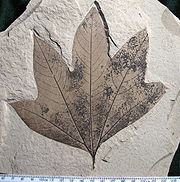 The family consists of only a single living genus Platanus
, of six to ten species of tall trees, native to temperate and subtropical regions of the Northern Hemisphere
. The hybrid London plane
is widely planted in cities worldwide.
The APG II system
of 2003 allows the option of including it in the family Proteaceae
, or treating it as distinct as a segregate family. In as far as APG II accepts the family it is placed in the order Proteales
, in the clade eudicots
. This represents a slight change from the APG system
, of 1998, which did accept this family.
The Cronquist system
of 1981 recognized the family and placed it in order Hamamelidales
, in subclass Hamamelidae [sic] in class Magnoliopsida
(dicotyledons).
The Dahlgren system
and Thorne system (1992)
also recognized this family and placed it in the order Hamamelidales
in superorder Rosanae in subclass Magnoliidae
(dicotyledons).
The Engler system
, in its 1964 update, also recognized the family and placed it in the order Rosales
in subclass Archichlamydeae of class Dicotyledoneae.
The Wettstein system
, last revised in 1935, also recognized the family and placed it in the order Hamamelidales
in the Monochlamydeae in subclass Choripetalae of the class Dicotyledones.
Family (biology)
In biological classification, family is* a taxonomic rank. Other well-known ranks are life, domain, kingdom, phylum, class, order, genus, and species, with family fitting between order and genus. As for the other well-known ranks, there is the option of an immediately lower rank, indicated by the...
of flowering plants. It has been recognized by almost all taxonomists, and is sometimes called the "plane-tree family".
The plane-tree is referenced in Pliny the Younger's letter to Domitius Apollinaris as part of his description of his Tuscan Villa located somewhere in Tuscany in the 1st Century.
Platanus
Platanus is a small genus of trees native to the Northern Hemisphere. They are the sole living members of the family Platanaceae....
, of six to ten species of tall trees, native to temperate and subtropical regions of the Northern Hemisphere
Northern Hemisphere
The Northern Hemisphere is the half of a planet that is north of its equator—the word hemisphere literally means “half sphere”. It is also that half of the celestial sphere north of the celestial equator...
. The hybrid London plane
London Plane
Platanus × acerifolia, the London plane, London planetree, or hybrid plane, is a tree in the genus Platanus. It is usually thought to be a hybrid of Platanus orientalis and the Platanus occidentalis . Some authorities think that it may be a cultivar of P...
is widely planted in cities worldwide.
The APG II system
APG II system
The APG II system of plant classification is the second, now obsolete, version of a modern, mostly molecular-based, system of plant taxonomy that was published in April 2003 by the Angiosperm Phylogeny Group. It was a revision of the first APG system, published in 1998, and was superseded in 2009...
of 2003 allows the option of including it in the family Proteaceae
Proteaceae
Proteaceae is a family of flowering plants distributed in the Southern Hemisphere. The family comprises about 80 genera with about 1600 species. Together with the Platanaceae and Nelumbonaceae they make up the order Proteales. Well known genera include Protea, Banksia, Embothrium, Grevillea,...
, or treating it as distinct as a segregate family. In as far as APG II accepts the family it is placed in the order Proteales
Proteales
Proteales is the botanical name of an order of flowering plants. Such an order has been recognized by almost all taxonomists.-Families:The APG II system, of 2003, also recognizes this order, and places it in the clade eudicots with this circumscription:...
, in the clade eudicots
Eudicots
Eudicots and Eudicotyledons are botanical terms introduced by Doyle & Hotton to refer to a monophyletic group of flowering plants that had been called tricolpates or non-Magnoliid dicots by previous authors...
. This represents a slight change from the APG system
APG system
The APG system of plant classification is the first, now obsolete, version of a modern, mostly molecular-based, system of plant taxonomy that was published in 1998 by the Angiosperm Phylogeny Group. It was superseded in 2003 by a revision, the APG II system, and then in 2009 by a further...
, of 1998, which did accept this family.
The Cronquist system
Cronquist system
The Cronquist system is a taxonomic classification system of flowering plants. It was developed by Arthur Cronquist in his texts An Integrated System of Classification of Flowering Plants and The Evolution and Classification of Flowering Plants .Cronquist's system places flowering plants into two...
of 1981 recognized the family and placed it in order Hamamelidales
Hamamelidales
Hamamelidales is the botanical name of an order of flowering plants. The Cronquist system included the order in subclass Hamamelidae with the circumscription:* order Hamamelidales*: family Hamamelidaceae*: family Cercidiphyllaceae...
, in subclass Hamamelidae [sic] in class Magnoliopsida
Magnoliopsida
Magnoliopsida is a valid botanical name for a class of flowering plants. By definition the class will include the family Magnoliaceae, but its circumscription can otherwise vary, being more inclusive or less inclusive depending upon the classification system being discussed.-Cronquist and...
(dicotyledons).
The Dahlgren system
Dahlgren system
One of the modern systems of plant taxonomy, the Dahlgren system was published by monocot specialist Rolf Dahlgren. His wife Gertrud Dahlgren carried on after his death.According to the extensive listing by Professor Reveal One of the modern systems of plant taxonomy, the Dahlgren system was...
and Thorne system (1992)
Thorne system (1992)
A modern system of plant taxonomy, the Thorne system of plant classification was drawn up by the botanist Robert F. Thorne . He replaced it in 2000 with a new system. These two systems were published in:...
also recognized this family and placed it in the order Hamamelidales
Hamamelidales
Hamamelidales is the botanical name of an order of flowering plants. The Cronquist system included the order in subclass Hamamelidae with the circumscription:* order Hamamelidales*: family Hamamelidaceae*: family Cercidiphyllaceae...
in superorder Rosanae in subclass Magnoliidae
Magnoliidae
Magnoliids are a group of about 9,000 species of flowering plants, including magnolias, nutmeg, bay laurel, cinnamon, avocado, black pepper, and many others. They are characterized by trimerous flowers, pollen with one pore, and usually branching-veined leaves.-Classification:Traditionally,...
(dicotyledons).
The Engler system
Engler system
One of the prime systems of plant taxonomy, the Engler system was devised by Adolf Engler.According to Engler, Syllabus der Pflanzenfamilien the main groups of plants are:* I. divisio Schizophyta* II. divisio Phytosarcodina...
, in its 1964 update, also recognized the family and placed it in the order Rosales
Rosales
Rosales is an order of flowering plants. It is one of the four orders in the nitrogen fixing clade of the fabids and is sister to a clade consisting of Fagales and Cucurbitales. It contains about 7700 species, distributed into about 260 genera. Rosales comprises nine families, the type family...
in subclass Archichlamydeae of class Dicotyledoneae.
The Wettstein system
Wettstein system
A system of plant taxonomy, the Wettstein system recognised the following main groups, according to* I. phylum Schizophyta*::: 1. classis Schizophyceae*::: 2. classis Schizomycetes* II. phylum Monadophyta* III. phylum Myxophyta...
, last revised in 1935, also recognized the family and placed it in the order Hamamelidales
Hamamelidales
Hamamelidales is the botanical name of an order of flowering plants. The Cronquist system included the order in subclass Hamamelidae with the circumscription:* order Hamamelidales*: family Hamamelidaceae*: family Cercidiphyllaceae...
in the Monochlamydeae in subclass Choripetalae of the class Dicotyledones.
External links
- Platanaceae in L. Watson and M.J. Dallwitz (1992 onwards), The families of flowering plants.
- Flora of North America: Platanaceae
- Flora of China: Platanaceae
- NCBI Taxonomy Browser
- links at CSDL