

Properdin

Encyclopedia
Properdin or factor P is a globulin
protein
found in the blood serum
of more complex animal
s. In the complement system, an innate-immunity series of proenzymes dissolved in the circulation, it is also called "Factor P".
inflammation
as well as the engulfing of pathogen
s by phagocyte
s. In addition it is known to help to neutralize some virus
es.
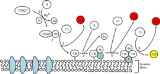
As a component of the alternative pathway for complement activation (otherwise known as the "properdin pathway"), it complexes with another protein, C3b
, to stabilize the alternative C3 convertase (C3bBb) that then cleaves more C3.
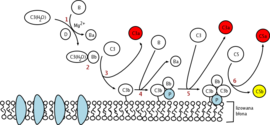 The alternative pathway is not dependent on antibodies. This branch of the complement system is activated by IgA
immune complexes and bacterial endotoxins, polysaccharide
s, and cell wall
s, and results in producing anaphylatoxins, opsonins, chemotactic factors, and the membrane attack complex, all of which help fight pathogens.
of the Institute of Pathology (now the Department of Pathology at Case Western Reserve University
).
is a rare X-linked disease in which properdin is deficient. Affected individuals are susceptible to fulminant meningococcal disease.
Globulin
Globulin is one of the three types of serum proteins, the others being albumin and fibrinogen. Some globulins are produced in the liver, while others are made by the immune system. The term globulin encompasses a heterogeneous group of proteins with typical high molecular weight, and both...
protein
Protein
Proteins are biochemical compounds consisting of one or more polypeptides typically folded into a globular or fibrous form, facilitating a biological function. A polypeptide is a single linear polymer chain of amino acids bonded together by peptide bonds between the carboxyl and amino groups of...
found in the blood serum
Blood plasma
Blood plasma is the straw-colored liquid component of blood in which the blood cells in whole blood are normally suspended. It makes up about 55% of the total blood volume. It is the intravascular fluid part of extracellular fluid...
of more complex animal
Animal
Animals are a major group of multicellular, eukaryotic organisms of the kingdom Animalia or Metazoa. Their body plan eventually becomes fixed as they develop, although some undergo a process of metamorphosis later on in their life. Most animals are motile, meaning they can move spontaneously and...
s. In the complement system, an innate-immunity series of proenzymes dissolved in the circulation, it is also called "Factor P".
Function
It is known that it participates in some specific immune responses. It plays a part in tissueBiological tissue
Tissue is a cellular organizational level intermediate between cells and a complete organism. A tissue is an ensemble of cells, not necessarily identical, but from the same origin, that together carry out a specific function. These are called tissues because of their identical functioning...
inflammation
Inflammation
Inflammation is part of the complex biological response of vascular tissues to harmful stimuli, such as pathogens, damaged cells, or irritants. Inflammation is a protective attempt by the organism to remove the injurious stimuli and to initiate the healing process...
as well as the engulfing of pathogen
Pathogen
A pathogen gignomai "I give birth to") or infectious agent — colloquially, a germ — is a microbe or microorganism such as a virus, bacterium, prion, or fungus that causes disease in its animal or plant host...
s by phagocyte
Phagocyte
Phagocytes are the white blood cells that protect the body by ingesting harmful foreign particles, bacteria, and dead or dying cells. Their name comes from the Greek phagein, "to eat" or "devour", and "-cyte", the suffix in biology denoting "cell", from the Greek kutos, "hollow vessel". They are...
s. In addition it is known to help to neutralize some virus
Virus
A virus is a small infectious agent that can replicate only inside the living cells of organisms. Viruses infect all types of organisms, from animals and plants to bacteria and archaea...
es.
As a component of the alternative pathway for complement activation (otherwise known as the "properdin pathway"), it complexes with another protein, C3b
C3b
C3b is the larger of two elements formed by the cleavage of complement component 3. C3b covalently bonds to microbial cell surfaces within an organism's body. This leads to the production of surface-bound C3 convertase and thus more C3b components. Bound C3b also aids in opsonization of the microbe...
, to stabilize the alternative C3 convertase (C3bBb) that then cleaves more C3.
IGA
Iga or IGA may stand for:-Given name:* a female given name of Polish origin. The name originates from the female given name Jadwiga and stands for gia,or gina in the USA....
immune complexes and bacterial endotoxins, polysaccharide
Polysaccharide
Polysaccharides are long carbohydrate molecules, of repeated monomer units joined together by glycosidic bonds. They range in structure from linear to highly branched. Polysaccharides are often quite heterogeneous, containing slight modifications of the repeating unit. Depending on the structure,...
s, and cell wall
Cell wall
The cell wall is the tough, usually flexible but sometimes fairly rigid layer that surrounds some types of cells. It is located outside the cell membrane and provides these cells with structural support and protection, and also acts as a filtering mechanism. A major function of the cell wall is to...
s, and results in producing anaphylatoxins, opsonins, chemotactic factors, and the membrane attack complex, all of which help fight pathogens.
History
Properdin was discovered in 1954 by Dr. Louis PillemerLouis Pillemer
Louis Pillemer , was an American immunologist, an early investigator of the alternative complement pathway - Biography :...
of the Institute of Pathology (now the Department of Pathology at Case Western Reserve University
Case Western Reserve University
Case Western Reserve University is a private research university located in Cleveland, Ohio, USA...
).
Deficiency
Properdin deficiencyProperdin deficiency
Properdin deficiency is a rare X-linked disease in which properdin, an important complement factor, is deficient. Affected individuals are susceptible to fulminant meningococcal disease.-References:...
is a rare X-linked disease in which properdin is deficient. Affected individuals are susceptible to fulminant meningococcal disease.