


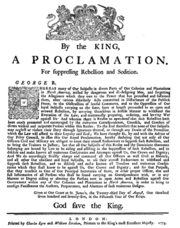
Proclamation of Rebellion

Encyclopedia
George III of the United Kingdom
George III was King of Great Britain and King of Ireland from 25 October 1760 until the union of these two countries on 1 January 1801, after which he was King of the United Kingdom of Great Britain and Ireland until his death...
to the news of the Battle of Bunker Hill
Battle of Bunker Hill
The Battle of Bunker Hill took place on June 17, 1775, mostly on and around Breed's Hill, during the Siege of Boston early in the American Revolutionary War...
at the outset of the American Revolutionary War
American Revolutionary War
The American Revolutionary War , the American War of Independence, or simply the Revolutionary War, began as a war between the Kingdom of Great Britain and thirteen British colonies in North America, and ended in a global war between several European great powers.The war was the result of the...
. Issued August 23, 1775, it declared elements of the American colonies
Thirteen Colonies
The Thirteen Colonies were English and later British colonies established on the Atlantic coast of North America between 1607 and 1733. They declared their independence in the American Revolution and formed the United States of America...
in a state of "open and avowed rebellion
Rebellion
Rebellion, uprising or insurrection, is a refusal of obedience or order. It may, therefore, be seen as encompassing a range of behaviors aimed at destroying or replacing an established authority such as a government or a head of state...
". It ordered officials of the British Empire
British Empire
The British Empire comprised the dominions, colonies, protectorates, mandates and other territories ruled or administered by the United Kingdom. It originated with the overseas colonies and trading posts established by England in the late 16th and early 17th centuries. At its height, it was the...
"to use their utmost endeavours to withstand and suppress such rebellion". The Proclamation also encouraged subjects throughout the Empire, including those in Great Britain, to report anyone carrying on "traitorous correspondence" with the rebels so that they could be punished.
The Second Continental Congress
Second Continental Congress
The Second Continental Congress was a convention of delegates from the Thirteen Colonies that started meeting on May 10, 1775, in Philadelphia, Pennsylvania, soon after warfare in the American Revolutionary War had begun. It succeeded the First Continental Congress, which met briefly during 1774,...
issued a response to the Proclamation on December 6, saying that while they had always been loyal to the king, the British Parliament
Parliament of Great Britain
The Parliament of Great Britain was formed in 1707 following the ratification of the Acts of Union by both the Parliament of England and Parliament of Scotland...
never had any legitimate
Legitimacy (law)
At common law, legitimacy is the status of a child who is born to parents who are legally married to one another; and of a child who is born shortly after the parents' divorce. In canon and in civil law, the offspring of putative marriages have been considered legitimate children...
claim to authority
Authority
The word Authority is derived mainly from the Latin word auctoritas, meaning invention, advice, opinion, influence, or command. In English, the word 'authority' can be used to mean power given by the state or by academic knowledge of an area .-Authority in Philosophy:In...
over them, because the colonies were not democratically represented. Congress argued that it was their duty to continue resisting Parliament's violations of the British Constitution, and that they would retaliate if any supporters in Great Britain were punished for "favouring, aiding, or abetting the cause of American liberty". Congress maintained that they still hoped to avoid the "calamities" of a "civil war".
The Proclamation was written before Colonial Secretary Lord Dartmouth
William Legge, 2nd Earl of Dartmouth
William Legge 2nd Earl of Dartmouth PC, FRS , styled as Viscount Lewisham from 1732 to 1750, was a British statesman who is most remembered for his part in the government before and during the American Revolution....
had been given a copy of the Olive Branch Petition
Olive Branch Petition
The Olive Branch Petition was adopted by the Continental Congress in July 1775 in an attempt to avoid a full-blown war with Great Britain. The petition affirmed American loyalty to Great Britain and entreated the king to prevent further conflict...
from the Continental Congress. Because the king refused to receive the petition, the Proclamation effectively served as an answer to the petition.
On October 26, 1775, King George expanded on the Proclamation in his Speech from the Throne
Speech from the Throne
A speech from the throne is an event in certain monarchies in which the reigning sovereign reads a prepared speech to a complete session of parliament, outlining the government's agenda for the coming session...
at the opening of Parliament. The King insisted that rebellion was being fomented by a "desperate conspiracy" of leaders whose claims of allegiance to him were insincere; what the rebels really wanted, he said, was to create an "independent Empire". The king indicated that he intended to deal with the crisis with armed force, and was even considering "friendly offers of foreign assistance" to suppress the rebellion. A pro-American minority in Parliament warned that the government was driving the colonists towards independence, something that many colonial leaders had insisted they did not desire.
The Proclamation and the Speech from the Throne undermined moderates in the Continental Congress like John Dickinson
John Dickinson (delegate)
John Dickinson was an American lawyer and politician from Philadelphia, Pennsylvania and Wilmington, Delaware. He was a militia officer during the American Revolution, a Continental Congressman from Pennsylvania and Delaware, a delegate to the U.S. Constitutional Convention of 1787, President of...
, who had been arguing that the king would find a way to resolve the dispute between the colonies and Parliament. When it became clear that the king was not inclined to act as a conciliator, colonial attachment to the Empire was weakened, and a movement towards declaring independence became a reality.