

Plioplatecarpus

Encyclopedia
Plioplatecarpus is a genus
of mosasaur
lizard. Like all mosasaurs, it lived in the late Cretaceous
period, about 83.5 million years ago.
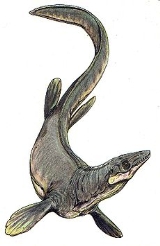
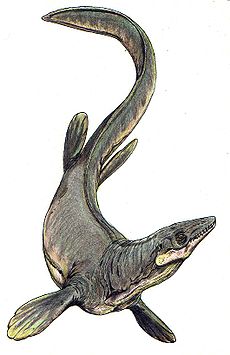 The eyes of Plioplatecarpus are proportionally larger than those of many mosasaur genera, although the skull is relatively short. It has fewer teeth than most mosasaurs, but they are greatly recurved. This suggests that Plioplatecarpus would have hunted relatively small prey that it could grab very precisely.
by paleontologist Louis Dollo
(P. marshi), in 1882. It was relatively incomplete, but more fossil
s would soon turn up. In North America
, Edward Drinker Cope
found another mosasaur in 1869, but had identified it as Mosasaurus
. It would later be reclassified as Plioplatecarpus, as would Cope's Liodon, in 1870. Liodon would be reclassified as Platecarpus
, and later as Prognathodon
. However, some have placed it in the genus Plioplatecarpus.
of Kansas
, Demopolis Chalk
of Alabama
, and also in Mississippi
, North Dakota
, South Dakota
, Canada
, Sweden
, The Netherlands, and, quite recently, Wyoming
. The Wyoming specimen is so far the only one of its kind to be found in the state, and may represent a new species of Plioplatecarpus. It is being prepared at the Tate Geological Museum, and has been named Oomtar.
Genus
In biology, a genus is a low-level taxonomic rank used in the biological classification of living and fossil organisms, which is an example of definition by genus and differentia...
of mosasaur
Mosasaur
Mosasaurs are large extinct marine lizards. The first fossil remains were discovered in a limestone quarry at Maastricht on the Meuse in 1764...
lizard. Like all mosasaurs, it lived in the late Cretaceous
Cretaceous
The Cretaceous , derived from the Latin "creta" , usually abbreviated K for its German translation Kreide , is a geologic period and system from circa to million years ago. In the geologic timescale, the Cretaceous follows the Jurassic period and is followed by the Paleogene period of the...
period, about 83.5 million years ago.
Description
Discovery
Plioplatecarpus was first found in EuropeEurope
Europe is, by convention, one of the world's seven continents. Comprising the westernmost peninsula of Eurasia, Europe is generally 'divided' from Asia to its east by the watershed divides of the Ural and Caucasus Mountains, the Ural River, the Caspian and Black Seas, and the waterways connecting...
by paleontologist Louis Dollo
Louis Dollo
Louis Antoine Marie Joseph Dollo was a French-born Belgian palaeontologist, known for formulating Dollo's law. He graduated as an engineer at École Centrale de Lille in France. In 1878, he supervised the excavation of the famous, multiple Iguanodon find, at Bernissart, Belgium. Recently, the...
(P. marshi), in 1882. It was relatively incomplete, but more fossil
Fossil
Fossils are the preserved remains or traces of animals , plants, and other organisms from the remote past...
s would soon turn up. In North America
North America
North America is a continent wholly within the Northern Hemisphere and almost wholly within the Western Hemisphere. It is also considered a northern subcontinent of the Americas...
, Edward Drinker Cope
Edward Drinker Cope
Edward Drinker Cope was an American paleontologist and comparative anatomist, as well as a noted herpetologist and ichthyologist. Born to a wealthy Quaker family, Cope distinguished himself as a child prodigy interested in science; he published his first scientific paper at the age of nineteen...
found another mosasaur in 1869, but had identified it as Mosasaurus
Mosasaurus
Mosasaurus is a genus of mosasaur, carnivorous, aquatic lizards, somewhat resembling flippered crocodiles, with elongated heavy jaws. The genus existed during the Maastrichtian age of the Cretaceous period , around 70-65 millions years ago in the area of modern Western Europe and North America...
. It would later be reclassified as Plioplatecarpus, as would Cope's Liodon, in 1870. Liodon would be reclassified as Platecarpus
Platecarpus
Platecarpus is an extinct genus of aquatic lizard belonging to the mosasaur family, living around 75 million years ago during the end of the Cretaceous period. Fossils have been found in Belgium and the United States as well as a possible specimen in Africa. Platecarpus probably fed on fish,...
, and later as Prognathodon
Prognathodon
Prognathodon is an extinct genus of marine reptile belonging to the mosasaur family. It had protective bony rings surrounding its eye sockets, indicating it lived in deep water. its fossil remains have been found in the U.S.A , Canada , Belgium, New Zealand, Morocco and The Netherlands...
. However, some have placed it in the genus Plioplatecarpus.
Distribution
Plioplatecarpus has been found in many locations around the world (most mosasaurs were fairly widespread). Plioplatecarpus has been found in the Pierre shalePierre Shale
The Pierre Shale is a geologic formation or series in the Upper Cretaceous which occurs east of the Rocky Mountains in the Great Plains, from North Dakota to New Mexico....
of Kansas
Kansas
Kansas is a US state located in the Midwestern United States. It is named after the Kansas River which flows through it, which in turn was named after the Kansa Native American tribe, which inhabited the area. The tribe's name is often said to mean "people of the wind" or "people of the south...
, Demopolis Chalk
Demopolis Chalk Formation
The Demopolis Chalk Formation is a geological formation in North America, within the U.S. states of Alabama, Mississippi, and Tennessee. The chalk was formed by pelagic sediments deposited along the eastern edge of the Mississippi embayment during the middle Campanian stage of the Late Cretaceous...
of Alabama
Alabama
Alabama is a state located in the southeastern region of the United States. It is bordered by Tennessee to the north, Georgia to the east, Florida and the Gulf of Mexico to the south, and Mississippi to the west. Alabama ranks 30th in total land area and ranks second in the size of its inland...
, and also in Mississippi
Mississippi
Mississippi is a U.S. state located in the Southern United States. Jackson is the state capital and largest city. The name of the state derives from the Mississippi River, which flows along its western boundary, whose name comes from the Ojibwe word misi-ziibi...
, North Dakota
North Dakota
North Dakota is a state located in the Midwestern region of the United States of America, along the Canadian border. The state is bordered by Canada to the north, Minnesota to the east, South Dakota to the south and Montana to the west. North Dakota is the 19th-largest state by area in the U.S....
, South Dakota
South Dakota
South Dakota is a state located in the Midwestern region of the United States. It is named after the Lakota and Dakota Sioux American Indian tribes. Once a part of Dakota Territory, South Dakota became a state on November 2, 1889. The state has an area of and an estimated population of just over...
, Canada
Canada
Canada is a North American country consisting of ten provinces and three territories. Located in the northern part of the continent, it extends from the Atlantic Ocean in the east to the Pacific Ocean in the west, and northward into the Arctic Ocean...
, Sweden
Sweden
Sweden , officially the Kingdom of Sweden , is a Nordic country on the Scandinavian Peninsula in Northern Europe. Sweden borders with Norway and Finland and is connected to Denmark by a bridge-tunnel across the Öresund....
, The Netherlands, and, quite recently, Wyoming
Wyoming
Wyoming is a state in the mountain region of the Western United States. The western two thirds of the state is covered mostly with the mountain ranges and rangelands in the foothills of the Eastern Rocky Mountains, while the eastern third of the state is high elevation prairie known as the High...
. The Wyoming specimen is so far the only one of its kind to be found in the state, and may represent a new species of Plioplatecarpus. It is being prepared at the Tate Geological Museum, and has been named Oomtar.