


Pipe fitting

Encyclopedia
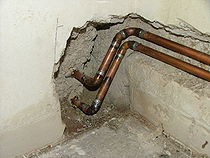
Pipe fitting work is done in many different settings:
HVAC
HVAC
HVAC refers to technology of indoor or automotive environmental comfort. HVAC system design is a major subdiscipline of mechanical engineering, based on the principles of thermodynamics, fluid mechanics, and heat transfer...
, manufacturing
Manufacturing
Manufacturing is the use of machines, tools and labor to produce goods for use or sale. The term may refer to a range of human activity, from handicraft to high tech, but is most commonly applied to industrial production, in which raw materials are transformed into finished goods on a large scale...
, hydraulics
Hydraulics
Hydraulics is a topic in applied science and engineering dealing with the mechanical properties of liquids. Fluid mechanics provides the theoretical foundation for hydraulics, which focuses on the engineering uses of fluid properties. In fluid power, hydraulics is used for the generation, control,...
, refineries, computer chip fab plants, power plant construction and other steam
Steam
Steam is the technical term for water vapor, the gaseous phase of water, which is formed when water boils. In common language it is often used to refer to the visible mist of water droplets formed as this water vapor condenses in the presence of cooler air...
systems. Pipe fitters (sometimes called simply "fitters") are represented in the USA and Canada by the United Association of Journeymen and Apprentices of the Plumbing and Pipe Fitting Industry of the United States and Canada.
Fitters work with a variety of pipe and tubing materials including several types of steel, copper, iron, aluminium, and plastic. Pipe fitting is not plumbing
Plumbing
Plumbing is the system of pipes and drains installed in a building for the distribution of potable drinking water and the removal of waterborne wastes, and the skilled trade of working with pipes, tubing and plumbing fixtures in such systems. A plumber is someone who installs or repairs piping...
; the two are related but separate trades. Pipe fitters who specialize in fire prevention are called Sprinklerfitters, another related, but separate trade.
Materials, techniques, and usages vary from country to country as different nations have different standards to install pipe.
Steel pipe
SteelSteel
Steel is an alloy that consists mostly of iron and has a carbon content between 0.2% and 2.1% by weight, depending on the grade. Carbon is the most common alloying material for iron, but various other alloying elements are used, such as manganese, chromium, vanadium, and tungsten...
pipe (or black iron pipe) was once the most popular choice for supply of water and flammable gases. Steel pipe is still used in many homes and businesses to convey natural gas
Natural gas
Natural gas is a naturally occurring gas mixture consisting primarily of methane, typically with 0–20% higher hydrocarbons . It is found associated with other hydrocarbon fuel, in coal beds, as methane clathrates, and is an important fuel source and a major feedstock for fertilizers.Most natural...
or propane
Propane
Propane is a three-carbon alkane with the molecular formula , normally a gas, but compressible to a transportable liquid. A by-product of natural gas processing and petroleum refining, it is commonly used as a fuel for engines, oxy-gas torches, barbecues, portable stoves, and residential central...
fuel, and is a popular choice in fire sprinkler systems due to its high heat resistance. In commercial buildings, steel pipe is used to convey heating or cooling water to heat exchangers, air handlers, fan coil, variable air volume
Variable air volume
Variable air volume is a type of heating, ventilating, and/or air-conditioning system. The simplest VAV system incorporates one supply duct that, when in cooling mode, distributes approximately supply air...
(VAV) devices, or other HVAC
HVAC
HVAC refers to technology of indoor or automotive environmental comfort. HVAC system design is a major subdiscipline of mechanical engineering, based on the principles of thermodynamics, fluid mechanics, and heat transfer...
equipment.
Steel pipe is sometimes joined using threaded connections, where tapered threads (see National Pipe Thread
National pipe thread
National Pipe Thread Tapered Thread is a U.S. standard for tapered threads used on threaded pipes and fittings. The taper rate for all NPT threads is measured by the change of diameter over distance. The angle between the taper and the center axis of the pipe is 1° 47′ 24″...
) are cut into the end of the tubing segment, sealant is applied in the form of thread sealing compound
Pipe dope
Pipe dope is slang for thread lubricants, thread sealing compounds and anaerobic chemical sealant that is used to make a pipe thread joint leak proof and pressure tight...
or thread seal tape
Thread seal tape
Thread seal tape, or teflon tape can be used in many ways, the most common use in America is to seal things. Thread seal tape — commonly known as "Teflon tape", "PTFE tape", "tape dope", or "plumber's tape"–is a polytetrafluoroethylene film cut to specified widths for use in sealing pipe...
(also known as PTFE or Teflon tape), and it is then threaded into a corresponding threaded fitting using a pipe wrench
Pipe wrench
The pipe wrench is an adjustable wrench used for turning soft iron pipes and fittings with a rounded surface. The design of the adjustable jaw allows it to rock in the frame, such that any forward pressure on the handle tends to pull the jaws tighter together. Teeth angled in the direction of turn...
. Beyond domestic or light commercial settings, steel pipe is often joined by welding
Welding
Welding is a fabrication or sculptural process that joins materials, usually metals or thermoplastics, by causing coalescence. This is often done by melting the workpieces and adding a filler material to form a pool of molten material that cools to become a strong joint, with pressure sometimes...
, or by use of mechanical couplings made by companies such as Victaulic
Victaulic
Victaulic is a developer and producer of mechanical pipe joining systems. Victaulic provides products for Fire Protection, Data Centers, Shipbuilding, Commercial Buildings, Mining, BioFuels, and Industrial Manufacturing....
or Grinnell
Grinnell
- People :* Claudia Kreuzig Grinnell, German expatriate, English professor, poet* Frederick Grinnell - People :* Claudia Kreuzig Grinnell, German expatriate, English professor, poet* Frederick Grinnell - People :* Claudia Kreuzig Grinnell, German expatriate, English professor, poet* Frederick...
that hold the pipe joint together via a groove pressed or cut (a rarely used older practice), into the ends of the pipes.
Other variations of steel pipe include various stainless steel and chrome alloys. In high-pressure situations these are usually joined by TIG
Tig
Tig may refer to:*Tig Notaro, an American stand-up comic*Tig, another name for tag *Alex "Tig" Trager, a character in Sons of AnarchyTIG may refer to:*Tungsten inert gas welding, aka gas tungsten arc welding...
welding.
In Canada, with respect to natural gas (NG) and propane (LP gas), black iron pipe (BIP) is commonly used to connect an appliance to the supply. It must however be marked (either painted yellow or yellow banding attached at certain intervals) and certain restrictions apply to which nominal pipe size (NPS) can be put through walls and buildings. With propane in particular, BIP can be run from an exterior tank (or cylinder) provided it is well protected from the weather, and an anode
Anode
An anode is an electrode through which electric current flows into a polarized electrical device. Mnemonic: ACID ....
-type of protection from corrosion
Corrosion
Corrosion is the disintegration of an engineered material into its constituent atoms due to chemical reactions with its surroundings. In the most common use of the word, this means electrochemical oxidation of metals in reaction with an oxidant such as oxygen...
is in place when the pipe is to be installed underground.
Copper pipe
Copper tubing is most often used for supply of hot and cold water, and as refrigerant line in HVAC systems. There are two basic types of copper tubing, soft copper and rigid copper. Copper tubing is joined using flare connection, compression connection, or solder. Copper offers a high level of resistance to corrosion, but is becoming very costly.Soft copper
Soft (or ductile) copper tubing can be bent easily to travel around obstacles in the path of the tubing. While the work hardening of the drawing process used to size the tubing makes the copper hard/rigid, it is carefully annealedAnnealing (metallurgy)
Annealing, in metallurgy and materials science, is a heat treatment wherein a material is altered, causing changes in its properties such as strength and hardness. It is a process that produces conditions by heating to above the recrystallization temperature, maintaining a suitable temperature, and...
to make it soft again; it is therefore more expensive to produce than non-annealed, rigid copper tubing. It can be joined by any of the three methods used for rigid copper, and it is the only type of copper tubing suitable for flare connections. Soft copper is the most popular choice for refrigerant lines in split-system air conditioners and heat pumps.
Flare connections
Flare connectionsFlare fitting
Flare fittings are a type of compression fitting used with metal tubing, usually soft steel and ductile copper, though other materials are also used. Tube flaring is considered to be a type of forging operation, and is usually a cold working procedure. During assembly, a flare nut is...
require that the end of a tubing section be spread outward in a bell shape using a flare tool. A flare nut then compresses this bell-shaped end onto a male fitting. Flare connections are a labor intensive method of making connections, but are quite reliable over the course of many years.
Rigid copper
Rigid copper is a popular choice for water lines. It is joined using a sweat, compression or crimped/pressed connection. Rigid copper, rigid due to the work hardening of the drawing process, cannot be bent and must use elbow fittings to go around corners or around obstacles. If heated and allowed to slowly cool, called annealingAnnealing (metallurgy)
Annealing, in metallurgy and materials science, is a heat treatment wherein a material is altered, causing changes in its properties such as strength and hardness. It is a process that produces conditions by heating to above the recrystallization temperature, maintaining a suitable temperature, and...
, then rigid copper will become soft and can be bent/formed without cracking.
Soldered connections
Solder fittings are smooth, and easily slip onto the end of a tubing section. The joint is then heated using a torchTorch
A torch is a fire source, usually a rod-shaped piece of wood with a rag soaked in pitch and/or some other flammable material wrapped around one end. Torches were often supported in sconces by brackets high up on walls, to throw light over corridors in stone structures such as castles or crypts...
, and solder is melted into the connection. When the solder cools, it forms a very strong bond which can last for decades. Solder-connected rigid copper is the most popular choice for water supply lines in modern buildings. In situations where many connections must be made at once (such as plumbing of a new building), solder offers much quicker and much less expensive joinery than compression or flare fittings. The term sweating is sometimes used to describe the process of soldering pipes.
Compression connections
Compression fittings use a soft metal or thermoplastic ring (the compression ring or "olive") which is squeezed onto the pipe and into the fitting by a compression nut. The soft metal conforms to the surface of the tubing and the fitting, and creates a seal. Compression connections do not typically have the long life that sweat connections offer, but are advantageous in many cases because they are easy to make using basic tools. A disadvantage in compression connections is that they take longer to make than sweat, and sometimes require retightening over time to stop leaks.Crimped or pressed connections
Crimped or pressed connections use special copper fittings which are permanently attached to rigid copper tubing with a powered crimper. The special fittings, manufactured with sealant already inside, slide over the tubing to be connected. Thousands of pounds-force per square inch of pressure are used to deform the fitting and compress the sealant against the inner copper tubing, creating a water tight seal. The advantages of this method are that it should last as long as the tubing, it takes less time to complete than other methods, it is cleaner in both appearance and the materials used to make the connection, and no open flame is used during the connection process. The disadvantages are that the fittings used are harder to find and cost significantly more than sweat type fittings.Aluminium pipe
AluminiumAluminium
Aluminium or aluminum is a silvery white member of the boron group of chemical elements. It has the symbol Al, and its atomic number is 13. It is not soluble in water under normal circumstances....
is sometimes used due to its low cost, resistance to corrosion and solvents, and its ductility. Aluminium tube is more desirable than steel for the conveyance of flammable solvents, since it cannot create sparks when manipulated. Aluminium tubing can be connected by flare or compression fittings, or it can be welded by the TIG
Tig
Tig may refer to:*Tig Notaro, an American stand-up comic*Tig, another name for tag *Alex "Tig" Trager, a character in Sons of AnarchyTIG may refer to:*Tungsten inert gas welding, aka gas tungsten arc welding...
or heliarc processes.
Glass pipe
Tempered glassGlass
Glass is an amorphous solid material. Glasses are typically brittle and optically transparent.The most familiar type of glass, used for centuries in windows and drinking vessels, is soda-lime glass, composed of about 75% silica plus Na2O, CaO, and several minor additives...
pipes are used for specialized applications, such as corrosive
Corrosive
A corrosive substance is one that will destroy or irreversibly damage another surface or substance with which it comes into contact. The main hazards to people include damage to the eyes, the skin, and the tissue under the skin; inhalation or ingestion of a corrosive substance can damage the...
liquids, medical or laboratory wastes, or pharmaceutical manufacturing. Connections are generally made using specialized gasket or O-ring fittings.
Occupational hazards
Pipe fitters are often exposed to hazardous or dangerous materials, such as asbestosAsbestos
Asbestos is a set of six naturally occurring silicate minerals used commercially for their desirable physical properties. They all have in common their eponymous, asbestiform habit: long, thin fibrous crystals...
, lead
Lead
Lead is a main-group element in the carbon group with the symbol Pb and atomic number 82. Lead is a soft, malleable poor metal. It is also counted as one of the heavy metals. Metallic lead has a bluish-white color after being freshly cut, but it soon tarnishes to a dull grayish color when exposed...
, ammonia
Ammonia
Ammonia is a compound of nitrogen and hydrogen with the formula . It is a colourless gas with a characteristic pungent odour. Ammonia contributes significantly to the nutritional needs of terrestrial organisms by serving as a precursor to food and fertilizers. Ammonia, either directly or...
, steam
Steam
Steam is the technical term for water vapor, the gaseous phase of water, which is formed when water boils. In common language it is often used to refer to the visible mist of water droplets formed as this water vapor condenses in the presence of cooler air...
, flammable gases, various resins and solvent
Solvent
A solvent is a liquid, solid, or gas that dissolves another solid, liquid, or gaseous solute, resulting in a solution that is soluble in a certain volume of solvent at a specified temperature...
s including benzene
Benzene
Benzene is an organic chemical compound. It is composed of 6 carbon atoms in a ring, with 1 hydrogen atom attached to each carbon atom, with the molecular formula C6H6....
, and various refrigerant
Refrigerant
A refrigerant is a substance used in a heat cycle usually including, for enhanced efficiency, a reversible phase change from a liquid to a gas. Traditionally, fluorocarbons, especially chlorofluorocarbons, were used as refrigerants, but they are being phased out because of their ozone depletion...
s. Much progress was made in the 20th century toward eliminating or reducing hazardous materials exposures. Many aspects of hazardous materials are now regulated by law in most countries, including asbestos usage and removal, and refrigerant selection and handling.
Other occupational hazards include exposure to the weather, heavy lifting, crushing hazards, lacerations, and other risks normal to the construction industry.
Scope of work
- BlueprintBlueprintA blueprint is a type of paper-based reproduction usually of a technical drawing, documenting an architecture or an engineering design. More generally, the term "blueprint" has come to be used to refer to any detailed plan....
reading - Detailing
- CADComputer-aided designComputer-aided design , also known as computer-aided design and drafting , is the use of computer technology for the process of design and design-documentation. Computer Aided Drafting describes the process of drafting with a computer...
DrawingMechanical systems drawingMechanical systems drawing is a type of technical drawing that shows information about heating, ventilating, and air conditioning; it is a powerful tool that helps analyze a complex system. These drawings are often a set of detailed drawings used for construction projects; it is a requirement for...
coordinators - Layout
- Supports and hanger Installation
- Pipe threading
- Pipe grinding
- WeldingWeldingWelding is a fabrication or sculptural process that joins materials, usually metals or thermoplastics, by causing coalescence. This is often done by melting the workpieces and adding a filler material to form a pool of molten material that cools to become a strong joint, with pressure sometimes...
(MiGGas metal arc weldingGas metal arc welding , sometimes referred to by its subtypes metal inert gas welding or metal active gas welding, is a semi-automatic or automatic arc welding process in which a continuous and consumable wire electrode and a shielding gas are fed through a welding gun...
, GMAW, TiGGas tungsten arc weldingGas tungsten arc welding , also known as tungsten inert gas welding, is an arc welding process that uses a nonconsumable tungsten electrode to produce the weld...
, SMAWShielded metal arc weldingShielded metal arc welding , also known as manual metal arc welding, flux shielded arc welding or informally as stick welding, is a manual arc welding process that uses a consumable electrode coated in flux to lay the weld...
, OrbitalOrbital weldingOrbital welding is a specialised area of welding whereby the arc is rotated mechanically through 360° around a static workpiece, an object such as a pipe, in a continuous process.-Equipment:...
) - Plasma cuttingPlasma cuttingPlasma cutting is a process that is used to cut steel and other metals of different thicknesses using a plasma torch...
- Mechanical pipe cutting and grooving
- Gas arc cutting
- Rigging
- BrazingBrazingBrazing is a metal-joining process whereby a filler metal is heated above and distributed between two or more close-fitting parts by capillary action. The filler metal is brought slightly above its melting temperature while protected by a suitable atmosphere, usually a flux...
- SolderSolderSolder is a fusible metal alloy used to join together metal workpieces and having a melting point below that of the workpiece.Soft solder is what is most often thought of when solder or soldering are mentioned and it typically has a melting range of . It is commonly used in electronics and...
ing - MiteringMiter jointA miter joint , sometimes shortened to miter, is a joint made by bevelling each of two parts to be joined, usually at a 45° angle, to form a corner, usually a 90° angle...
- Tube bendingTube bendingTube bending is the umbrella term for metal forming processes used to permanently form pipes or tubing. One has to differentiate between form-bound and freeform-bending procedures, as well as between heat supported and cold forming procedures....
- ValveValveA valve is a device that regulates, directs or controls the flow of a fluid by opening, closing, or partially obstructing various passageways. Valves are technically pipe fittings, but are usually discussed as a separate category...
installation and repair - Preparation and installation of medical gas piping
See also
- PipefitterPipefitterA pipefitter is a tradesman who lays out, assembles, fabricates, maintains and repairs mechanical piping systems. Pipefitters usually go through a mix of apprentice and trade school training. Journeyman pipefitters/steamfitters deal with industrial process piping and heating/cooling systems...
- Compression fittings
- Coupling (piping)Coupling (piping)A coupling is a very short length of pipe or tube, with a socket at one or both ends that allows two pipes or tubes to be joined, welded , brazed or soldered together....
- Nipple (plumbing)Nipple (plumbing)In plumbing and piping, a nipple is a fitting, consisting of a short piece ofpipe, usually provided with a male pipe thread at each end, for connecting two other fittings....
- PipePipe (material)A pipe is a tubular section or hollow cylinder, usually but not necessarily of circular cross-section, used mainly to convey substances which can flow — liquids and gases , slurries, powders, masses of small solids...
- Piping and plumbing fittingsPiping and plumbing fittingsFittings are used in pipe and plumbing systems to connect straight pipe or tubing sections, to adapt to different sizes or shapes, and for other purposes, such as regulating or measuring fluid flow...
- PlumbingPlumbingPlumbing is the system of pipes and drains installed in a building for the distribution of potable drinking water and the removal of waterborne wastes, and the skilled trade of working with pipes, tubing and plumbing fixtures in such systems. A plumber is someone who installs or repairs piping...
- Street elbowStreet elbowA street elbow is a type of plumbing or piping fitting intended to join a piece of pipe and another fitting at an angle. The difference between a street elbow and a regular elbow is the nature of the connections on either end.A regular elbow has a female hub or FIP connection on both ends...
- Sweat fitting
- Water pipeWater pipeWater pipes are pipes or tubes, frequently made of polyvinyl chloride , ductile iron, steel, cast iron, polypropylene, polyethylene, or copper, that carry pressurized and treated fresh water to buildings , as well as inside the building.-History:For many centuries, lead was the favoured material...
- ElectrofusionElectrofusionElectrofusion is a method of joining MDPE, HDPE and other plastic pipes with special fittings that have built-in electric heating elements which are used to weld the joint together....
External links
- www.copper.org
- www.coppercanada.ca
- www.pipefittings.com — Information and guide to pipefittings
- www.ua.org — United Association of Journeymen and Apprentices of the Plumbing and Pipe Fitting Industry of the United States and Canada
- GRINNELL Grooved ProductsGrinnell Grooved ProductsGrinnell Mechanical Products, a brand of Tyco International Ltd., manufactures grooved piping and mechanical products. Grinnell Mechanical Products specializes in mechanical, fire, HVAC, commercial, mining, institutional and industrial applications...