

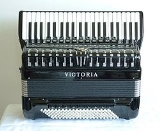
Piano accordion

Encyclopedia
A piano accordion is an accordion
equipped with a right-hand keyboard similar to a piano
or organ
. Its acoustic mechanism is more similar to that of an organ than a piano
, as they are both wind instrument
s, but the term "piano accordion"—coined by Guido Deiro
in 1910—has remained the popular nomenclature. It may be equipped with any of the available systems for the left-hand manual.
In comparison to a piano keyboard, the keys are more rounded, smaller, and lighter to the touch. These go vertically down the side, pointing inward, toward the bellows, making them accessible to only one hand while handling the accordion.Felt
or rubber
is placed under the piano keys to control touch and key noise: it is also used on the pallets to silence notes not sounded by preventing air flow. This material eventually wears with use, resulting in a clacking noise, so has to be replaced to quieten the mechanism.
The bass piano accordion is a variation of a piano accordion without bass buttons and with the piano keyboard in an octave lower. They typically have around 3 octaves.
In the United States, the piano accordion dramatically increased in popularity between 1900-1930 based on its familiarity to students and teachers, and its uniformity, whereby accordion dealers and instructors did not have to support different styles of accordions for many European immigrant groups. The piano keyboard layout was also promoted by the fame of Vaudeville performers Guido Deiro
and his brother Pietro
who premiered the instrument on stage, recordings and radio. After the Deiro's success, popular chromatic button accordionist Pietro Frosini
chose to disguise his accordion's buttons to look like a piano keyboard so as not to appear "old-fashioned." (See Accordion music genres
)
As of 1972 it could be largely said that the piano system dominated the English-Speaking North America
n continent, Scotland
, and certain East European countries, while differing button systems are generally to be found in Scandinavia
, France
, Belgium
and former Soviet countries. The piano accordion is also predominant in Italy
, New Zealand
, and Australia
.
layout, the advantages of using a piano layout on an accordion would be the layout's logical simplicity,One key corresponds to one note, and there are no alternate fingering options. the relative size of the buttons for fast legato flows, and its layout compared to standard notation.With a piano accordion, there is no need to transpose the melody in a piano, organ or harpsichord piece. However, it has a smaller range, is too big to reach notes far apart, such as two octaves, and requires more finger movement to operate.
Accordion
The accordion is a box-shaped musical instrument of the bellows-driven free-reed aerophone family, sometimes referred to as a squeezebox. A person who plays the accordion is called an accordionist....
equipped with a right-hand keyboard similar to a piano
Piano
The piano is a musical instrument played by means of a keyboard. It is one of the most popular instruments in the world. Widely used in classical and jazz music for solo performances, ensemble use, chamber music and accompaniment, the piano is also very popular as an aid to composing and rehearsal...
or organ
Reed organ
A reed organ, also called a parlor organ, pump organ, cabinet organ, cottage organ, is an organ that generates its sounds using free metal reeds...
. Its acoustic mechanism is more similar to that of an organ than a piano
Piano
The piano is a musical instrument played by means of a keyboard. It is one of the most popular instruments in the world. Widely used in classical and jazz music for solo performances, ensemble use, chamber music and accompaniment, the piano is also very popular as an aid to composing and rehearsal...
, as they are both wind instrument
Wind instrument
A wind instrument is a musical instrument that contains some type of resonator , in which a column of air is set into vibration by the player blowing into a mouthpiece set at the end of the resonator. The pitch of the vibration is determined by the length of the tube and by manual modifications of...
s, but the term "piano accordion"—coined by Guido Deiro
Guido Deiro
Count Guido Pietro Deiro was a famous vaudeville star, international recording artist, composer and teacher. He was the first piano-accordionist to appear on big-time vaudeville, records, radio and the screen. Guido usually performed under the stage-name "Deiro"...
in 1910—has remained the popular nomenclature. It may be equipped with any of the available systems for the left-hand manual.
In comparison to a piano keyboard, the keys are more rounded, smaller, and lighter to the touch. These go vertically down the side, pointing inward, toward the bellows, making them accessible to only one hand while handling the accordion.Felt
Felt
Felt is a non-woven cloth that is produced by matting, condensing and pressing woollen fibres. While some types of felt are very soft, some are tough enough to form construction materials. Felt can be of any colour, and made into any shape or size....
or rubber
Rubber
Natural rubber, also called India rubber or caoutchouc, is an elastomer that was originally derived from latex, a milky colloid produced by some plants. The plants would be ‘tapped’, that is, an incision made into the bark of the tree and the sticky, milk colored latex sap collected and refined...
is placed under the piano keys to control touch and key noise: it is also used on the pallets to silence notes not sounded by preventing air flow. This material eventually wears with use, resulting in a clacking noise, so has to be replaced to quieten the mechanism.
The bass piano accordion is a variation of a piano accordion without bass buttons and with the piano keyboard in an octave lower. They typically have around 3 octaves.
History
The first accordion to feature a piano keyboard was probably the instrument introduced in 1852 by Bouton of Paris. Another source claimed the first piano accordion was introduced in 1854 at the Allegemeine Deutsche Industrieausstellung in München. It was showcased by the instrument builder Mattäus Bauer and quickly became a serious competitor to button accordions.In the United States, the piano accordion dramatically increased in popularity between 1900-1930 based on its familiarity to students and teachers, and its uniformity, whereby accordion dealers and instructors did not have to support different styles of accordions for many European immigrant groups. The piano keyboard layout was also promoted by the fame of Vaudeville performers Guido Deiro
Guido Deiro
Count Guido Pietro Deiro was a famous vaudeville star, international recording artist, composer and teacher. He was the first piano-accordionist to appear on big-time vaudeville, records, radio and the screen. Guido usually performed under the stage-name "Deiro"...
and his brother Pietro
Pietro Deiro
Pietro Deiro was one of the most influential accordionists of the first half of the 20th century. Born in Salto Canavese, Italy, the younger brother of Guido Deiro, he emigrated to the United States in 1907 to live with his Uncle Frederico and work in the coal mines of Cle Elum, Washington.Pietro...
who premiered the instrument on stage, recordings and radio. After the Deiro's success, popular chromatic button accordionist Pietro Frosini
Pietro Frosini
Pietro Frosini was one of the first famous "stars of the accordion." He was born in Catania, Sicily, in 1885 and began to play the chromatic button accordion at the age of six...
chose to disguise his accordion's buttons to look like a piano keyboard so as not to appear "old-fashioned." (See Accordion music genres
Accordion music genres
The accordion has traditionally been used to perform folk or ethnic music, popular music, and transcriptions from the operatic and light-classical music repertoire...
)
As of 1972 it could be largely said that the piano system dominated the English-Speaking North America
North America
North America is a continent wholly within the Northern Hemisphere and almost wholly within the Western Hemisphere. It is also considered a northern subcontinent of the Americas...
n continent, Scotland
Scotland
Scotland is a country that is part of the United Kingdom. Occupying the northern third of the island of Great Britain, it shares a border with England to the south and is bounded by the North Sea to the east, the Atlantic Ocean to the north and west, and the North Channel and Irish Sea to the...
, and certain East European countries, while differing button systems are generally to be found in Scandinavia
Scandinavia
Scandinavia is a cultural, historical and ethno-linguistic region in northern Europe that includes the three kingdoms of Denmark, Norway and Sweden, characterized by their common ethno-cultural heritage and language. Modern Norway and Sweden proper are situated on the Scandinavian Peninsula,...
, France
France
The French Republic , The French Republic , The French Republic , (commonly known as France , is a unitary semi-presidential republic in Western Europe with several overseas territories and islands located on other continents and in the Indian, Pacific, and Atlantic oceans. Metropolitan France...
, Belgium
Belgium
Belgium , officially the Kingdom of Belgium, is a federal state in Western Europe. It is a founding member of the European Union and hosts the EU's headquarters, and those of several other major international organisations such as NATO.Belgium is also a member of, or affiliated to, many...
and former Soviet countries. The piano accordion is also predominant in Italy
Italy
Italy , officially the Italian Republic languages]] under the European Charter for Regional or Minority Languages. In each of these, Italy's official name is as follows:;;;;;;;;), is a unitary parliamentary republic in South-Central Europe. To the north it borders France, Switzerland, Austria and...
, New Zealand
New Zealand
New Zealand is an island country in the south-western Pacific Ocean comprising two main landmasses and numerous smaller islands. The country is situated some east of Australia across the Tasman Sea, and roughly south of the Pacific island nations of New Caledonia, Fiji, and Tonga...
, and Australia
Australia
Australia , officially the Commonwealth of Australia, is a country in the Southern Hemisphere comprising the mainland of the Australian continent, the island of Tasmania, and numerous smaller islands in the Indian and Pacific Oceans. It is the world's sixth-largest country by total area...
.
Comparison to chromatic button layout
Compared to a chromatic buttonChromatic button accordion
A chromatic button accordion is a type of button accordion where the melody-side keyboard consists of rows of buttons arranged chromatically. The bass-side keyboard is usually the Stradella system or one of the various free-bass systems. Included among chromatic button accordions are the Russian...
layout, the advantages of using a piano layout on an accordion would be the layout's logical simplicity,One key corresponds to one note, and there are no alternate fingering options. the relative size of the buttons for fast legato flows, and its layout compared to standard notation.With a piano accordion, there is no need to transpose the melody in a piano, organ or harpsichord piece. However, it has a smaller range, is too big to reach notes far apart, such as two octaves, and requires more finger movement to operate.
See also
- List of All Ireland piano accordion champions
- Button accordionButton accordionA button accordion is a type of accordion on which the melody-side keyboard consists of a series of buttons rather than piano-style keys. There exists a wide variation in keyboard systems, tuning, action and construction of these instruments...
- SqueezeboxSqueezeboxThe term Squeezebox is a colloquial expression referring to any musical instrument of the general class of hand-held bellows-driven free reed aerophones such as the accordion and the concertina...