
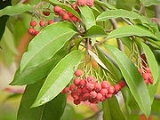
Photinia is a genus of about 40-60 species of small
treeA tree is a perennial woody plant. It is most often defined as a woody plant that has many secondary branches supported clear of the ground on a single main stem or trunk with clear apical dominance. A minimum height specification at maturity is cited by some authors, varying from 3 m to...
s and large
shrubA shrub or bush is distinguished from a tree by its multiple stems and shorter height, usually under 5–6 m tall. A large number of plants may become either shrubs or trees, depending on the growing conditions they experience...
s in the
RosaceaeRosaceae are a medium-sized family of flowering plants, including about 2830 species in 95 genera. The name is derived from the type genus Rosa. Among the largest genera are Alchemilla , Sorbus , Crataegus , Cotoneaster , and Rubus...
family. As interpreted here, they are restricted to warm temperate
AsiaAsia is the world's largest and most populous continent, located primarily in the eastern and northern hemispheres. It covers 8.7% of the Earth's total surface area and with approximately 3.879 billion people, it hosts 60% of the world's current human population...
, from the Himalaya east to
JapanJapan is an island nation in East Asia. Located in the Pacific Ocean, it lies to the east of the Sea of Japan, China, North Korea, South Korea and Russia, stretching from the Sea of Okhotsk in the north to the East China Sea and Taiwan in the south...
and south to
IndiaIndia , officially the Republic of India , is a country in South Asia. It is the seventh-largest country by geographical area, the second-most populous country with over 1.2 billion people, and the most populous democracy in the world...
and
ThailandThailand , officially the Kingdom of Thailand , formerly known as Siam , is a country located at the centre of the Indochina peninsula and Southeast Asia. It is bordered to the north by Burma and Laos, to the east by Laos and Cambodia, to the south by the Gulf of Thailand and Malaysia, and to the...
, but some botanists also include the closely related
North AmericaNorth America is a continent wholly within the Northern Hemisphere and almost wholly within the Western Hemisphere. It is also considered a northern subcontinent of the Americas...
n species
Heteromeles arbutifoliaHeteromeles arbutifolia , and commonly known as Toyon, is a common perennial shrub native to California down to Baja California....
in
Photinia as
Photinia arbutifolia. The genus
StranvaesiaStranvaesia is a genus of flowering plants in the family Rosaceae. Its morphology is so similar to Photinia that it has sometimes been included within that genus, but recent molecular data indicate that the two genera are not related.-Species:...
is so similar in
morphologyIn biology, morphology is a branch of bioscience dealing with the study of the form and structure of organisms and their specific structural features....
to
Photinia that its species have sometimes been included within it, but recent
molecularMolecular biology is the branch of biology that deals with the molecular basis of biological activity. This field overlaps with other areas of biology and chemistry, particularly genetics and biochemistry...
data indicate that the two genera are not related. The genus
Aronia has been included in
Photinia in some classifications, but recent
molecular dataMolecular biology is the branch of biology that deals with the molecular basis of biological activity. This field overlaps with other areas of biology and chemistry, particularly genetics and biochemistry...
confirm that these genera are not closely related. Other close relatives include the firethorns (
Pyracantha),
cotoneasterCotoneaster is a genus of woody plants in the rose family, Rosaceae, native to the Palaearctic region , with a strong concentration of diversity in the genus in the mountains of southwestern China and the Himalayas...
s (
Cotoneaster) and
hawthornCrataegus , commonly called hawthorn or thornapple, is a large genus of shrubs and trees in the rose family, Rosaceae, native to temperate regions of the Northern Hemisphere in Europe, Asia and North America. The name hawthorn was originally applied to the species native to northern Europe,...
s (
Crataegus). The scientific name
Photinia is widely used as the common name. Another name sometimes used is "Christmas berry", but this name is a source of confusion, since it is commonly applied to plants in several genera including
Heteromeles,
Lycium,
SchinusSchinus is a genus of flowering trees and tall shrubs in the sumac family, Anacardiaceae. Members of the genus are commonly known as pepper trees. The Peruvian Pepper Tree is the source of the spice known as pink peppercorns but can become serious invasive species outside their natural habitats...
, and
RuscusRuscus is a genus of six species of flowering plants, native to western and southern Europe , Macaronesia, northwest Africa, and southwestern Asia east to the Caucasus. In the APG III classification system, it is placed in the family Asparagaceae, subfamily Nolinoideae...
.
The name
Photinia continies to be used for several species of small trees in the mountains of Mexico and Central America. These had formerly been included in the genus
Photinia.
Photinias typically grow from 3–15 m tall, with a usually irregular crown of angular branches; the branches are often (not always) thorny. The
leavesA leaf is an organ of a vascular plant, as defined in botanical terms, and in particular in plant morphology. Foliage is a mass noun that refers to leaves as a feature of plants....
are alternate, entire or finely toothed, varying between species from 3–15 cm in length and 1.5–5 cm wide; the majority of species are
evergreenIn botany, an evergreen plant is a plant that has leaves in all seasons. This contrasts with deciduous plants, which completely lose their foliage during the winter or dry season.There are many different kinds of evergreen plants, both trees and shrubs...
but several are
deciduousDeciduous means "falling off at maturity" or "tending to fall off", and is typically used in reference to trees or shrubs that lose their leaves seasonally, and to the shedding of other plant structures such as petals after flowering or fruit when ripe...
. The
flowerA flower, sometimes known as a bloom or blossom, is the reproductive structure found in flowering plants . The biological function of a flower is to effect reproduction, usually by providing a mechanism for the union of sperm with eggs...
s are produced in early summer in dense terminal corymbs; each flower is 5–10 mm diameter, with five rounded white
petalPetals are modified leaves that surround the reproductive parts of flowers. They often are brightly colored or unusually shaped to attract pollinators. Together, all of the petals of a flower are called a corolla. Petals are usually accompanied by another set of special leaves called sepals lying...
s; they have a mild,
hawthornCrataegus , commonly called hawthorn or thornapple, is a large genus of shrubs and trees in the rose family, Rosaceae, native to temperate regions of the Northern Hemisphere in Europe, Asia and North America. The name hawthorn was originally applied to the species native to northern Europe,...
-like scent. The
fruitIn broad terms, a fruit is a structure of a plant that contains its seeds.The term has different meanings dependent on context. In non-technical usage, such as food preparation, fruit normally means the fleshy seed-associated structures of certain plants that are sweet and edible in the raw state,...
is a small
pomeIn botany, a pome is a type of fruit produced by flowering plants in the subfamily Maloideae of the family Rosaceae.A pome is an accessory fruit composed of one or more carpels surrounded by accessory tissue...
, 4–12 mm across, bright red and berry-like, produced large quantities, maturing in the fall and often persisting well into the winter. The fruit are consumed by
birdBirds are feathered, winged, bipedal, endothermic , egg-laying, vertebrate animals. Around 10,000 living species and 188 families makes them the most speciose class of tetrapod vertebrates. They inhabit ecosystems across the globe, from the Arctic to the Antarctic. Extant birds range in size from...
s, including
thrushesThe thrushes, family Turdidae, are a group of passerine birds that occur worldwide.-Characteristics:Thrushes are plump, soft-plumaged, small to medium-sized birds, inhabiting wooded areas, and often feed on the ground or eat small fruit. The smallest thrush may be the Forest Rock-thrush, at and...
,
waxwingThe waxwings form the genus Bombycilla of passerine birds. According to most authorities, this is the only genus placed in the family Bombycillidae.-Description:Waxwings are characterised by soft silky plumage...
s and
starlingStarlings are small to medium-sized passerine birds in the family Sturnidae. The name "Sturnidae" comes from the Latin word for starling, sturnus. Many Asian species, particularly the larger ones, are called mynas, and many African species are known as glossy starlings because of their iridescent...
s; the
seedA seed is a small embryonic plant enclosed in a covering called the seed coat, usually with some stored food. It is the product of the ripened ovule of gymnosperm and angiosperm plants which occurs after fertilization and some growth within the mother plant...
s are dispersed in their droppings.
Photinia species are sometimes used as food plants by the
larvaA larva is a distinct juvenile form many animals undergo before metamorphosis into adults. Animals with indirect development such as insects, amphibians, or cnidarians typically have a larval phase of their life cycle...
e of some
LepidopteraLepidoptera is a large order of insects that includes moths and butterflies . It is one of the most widespread and widely recognizable insect orders in the world, encompassing moths and the three superfamilies of butterflies, skipper butterflies, and moth-butterflies...
species including
Common EmeraldThe Common Emerald is a moth of the family Geometridae. The species is found throughout the Nearctic and Palearctic regions and the Near East. In the British Isles it is not found in Scotland but is a common species elsewhere...
,
Feathered ThornThe Feathered Thorn is a moth of the family Geometridae.-Etymology:The common name Feathered Thorn derives from the very strong feathering on the antennae of the male...
and
Setaceous Hebrew CharacterThe Setaceous Hebrew Character is a moth of the family Noctuidae. It is found in the Palearctic ecozone. It is a common species throughout Europe. It is also found in North America, from coast to coast across Canada and the northern United States to western Alaska. It occurs in the Rocky Mountains...
.
Species

- Photinia anlungensis
Photinia anlungensis is a species in the family Rosaceae.-References and external links:*...
- Photinia arguta (syn. Pourthiaea arguta)
- Photinia beauverdiana (syn. Pourthiaea beauverdiana)
- Photinia beckii
Photinia beckii is a species in the family Rosaceae.-External links:*...
- Photinia benthamiana (syn. Pourthiaea benthamiana)
- Photinia berberidifolia
Photinia berberidifolia is a species in the family Rosaceae....
- Photinia bergerae
- Photinia blinii
- Photinia bodinieri
Photinia bodinieri is a species in the family Rosaceae.-References and external links:*...
- Photinia calleryana (syn. Pourthiaea calleryana)
- Photinia callosa
- Photinia chihsiniana
Photinia chihsiniana is a species in the family Rosaceae.-References and external links:*...
- Photinia chingiana
Photinia chingiana is a species in the family Rosaceae.-References and external links:*...
- Photinia chingshuiensis (syn. Pourthiaea chingshuiensis)
- Photinia crassifolia
Photinia crassifolia is a species in the family Rosaceae.-References and external links:*...
- Photinia fokienensis
- Photinia glabra
Photinia glabra is a species in the family Rosaceae.-References and external links:*...
- Japanese Photinia
- Photinia glomerata
Photinia glomerata is a species in the family Rosaceae.-References and external links:*...
- Photinia hirsuta
- Photinia impressivena
- Photinia integrifolia
Photinia integrifolia is a species in the family Rosaceae.-References and external links:*...
- Photinia komarovii
- Photinia kwangsiensis
Photinia kwangsiensis is a species in the family Rosaceae.-References and external links:*...
- Photinia lanuginosa
Photinia lanuginosa is a species in the family Rosaceae.-References and external links:*...
- Photinia lasiogyna
Photinia lasiogyna is a species of flowering plant in the Rosaceae family. It is endemic to China. It is threatened by habitat loss.-References and external links:*...
- Photinia lasiopetala
Photinia lasiopetala is a species of flowering plant in the Rosaceae family. It is endemic to Taiwan. It is threatened by habitat loss....
- Photinia lochengensis
Photinia lochengensis is a species in the family Rosaceae.-References and external links:*...
- Photinia loriformis
Photinia loriformis is a species in the family Rosaceae. They grow to a height of approximately 3 meters. They are common in China.-References and external links:*...
- Photinia lucida (syn. Pourthiaea lucida)
- Photinia megaphylla
Photinia megaphylla is a species in the family Rosaceae....
- Photinia niitakayamensis
- Photinia obliqua
- Photinia parvifolia (syn. Pourthiaea parvifolia)
- Photinia pilosicalyx
- Photinia podocarpifolia
- Photinia prionophylla
Photinia prionophylla is a species in the family Rosaceae of flowering plants.-References and external links:*...
- Photinia prunifolia
Photinia prunifolia is a species in the family Rosaceae of flowering plants.-References and external links:*...
- Photinia raupingensis
Photinia raupingensis is a species in the family Rosaceae of flowering plants.-References and external links:*...
- Photinia schneideriana
- Photinia serratifolia
Photinia serratifolia , commonly called Chinese photinia is a flowering plant in the Rosaceae family of flowering plants, found in mixed forests of China. Its leaves are toxic due to the presence of cyanogenic glycosides....
(syn. Photinia serrulata)
- Photinia stenophylla
Photinia stenophylla is a species in the family Rosaceae of flowering plants.-References and external links:*...
- Photinia tsaii
- Photinia tushanensis
Photinia tushanensis is a species in the family Rosaceae of flowering plants.-External links:*...
- Photinia villosa (syn. Pourthiaea villosa)
- Photinia zhejiangensis
Photinia zhejiangensis is in the family Rosaceae of flowering plants.-References and external links:*...
A number of species have been moved to the separate genus
StranvaesiaStranvaesia is a genus of flowering plants in the family Rosaceae. Its morphology is so similar to Photinia that it has sometimes been included within that genus, but recent molecular data indicate that the two genera are not related.-Species:...
including
P. amphidoxa,
P. davidiana,
P. nussia, and
P. tomentosa.
Uses
Photinias are very popular
ornamental shrubsOrnamental plants are plants that are grown for decorative purposes in gardens and landscape design projects, as house plants, for cut flowers and specimen display...
, grown for their fruit and foliage. Numerous hybrids and
cultivarA cultivar'Cultivar has two meanings as explained under Formal definition. When used in reference to a taxon, the word does not apply to an individual plant but to all those plants sharing the unique characteristics that define the cultivar. is a plant or group of plants selected for desirable...
s are available; several of the cultivars are selected for their strikingly bright red young leaves in spring and summer. The most widely planted are:
- Photinia × fraseri (P. glabra
Photinia glabra is a species in the family Rosaceae.-References and external links:*...
× P. serratifoliaPhotinia serratifolia , commonly called Chinese photinia is a flowering plant in the Rosaceae family of flowering plants, found in mixed forests of China. Its leaves are toxic due to the presence of cyanogenic glycosides....
) - Red Tip Photinia
- Photinia × fraseri 'Red Robin' - probably the most widely planted of all
- Photinia × fraseri 'Little Red Robin', a plant similar to 'Red Robin', but dwarf in stature with an ultimate height/spread of around 2–3 ft
- Photinia × fraseri 'Camilvy'
- Photinia × fraseri 'Curly Fantasy'
- Photinia × fraseri 'Super Hedger' - a newer hybrid with strong upright growth
- Photinia × fraseri 'Pink Marble' also known as 'Cassini', a new cultivar with rose-pink tinted new growth and a creamy-white variegated margin on the leaves
- Photinia 'Redstart' (Stranvaesia davidiana × P. × fraseri)
- Photinia 'Palette' (parentage unknown)
- Photinia davidiana 'Fructu Luteo' (fruit yellow)
- Photinia davidiana 'Prostrata' (a low-growing form)
Toxicity
Some varieties of Photinia are toxic due to the presence of cyanogenic glycosides in the
vacuoleA vacuole is a membrane-bound organelle which is present in all plant and fungal cells and some protist, animal and bacterial cells. Vacuoles are essentially enclosed compartments which are filled with water containing inorganic and organic molecules including enzymes in solution, though in certain...
s of foliage and fruit cells. When the leaves are chewed these compounds are released and are rapidly converted to
hydrogen cyanide (HCN) which blocks
cellular respirationCellular respiration is the set of the metabolic reactions and processes that take place in the cells of organisms to convert biochemical energy from nutrients into adenosine triphosphate , and then release waste products. The reactions involved in respiration are catabolic reactions that involve...
. The amount of HCN produced varies considerably between
taxa|thumb|270px|[[African elephants]] form a widely-accepted taxon, the [[genus]] LoxodontaA taxon is a group of organisms, which a taxonomist adjudges to be a unit. Usually a taxon is given a name and a rank, although neither is a requirement...
, and is in general greatest in young leaves.
RuminantA ruminant is a mammal of the order Artiodactyla that digests plant-based food by initially softening it within the animal's first compartment of the stomach, principally through bacterial actions, then regurgitating the semi-digested mass, now known as cud, and chewing it again...
s are particularly affected by cyanogenic glycosides because the first stage of their digestive system (the
rumenThe rumen, also known as a paunch, forms the larger part of the reticulorumen, which is the first chamber in the alimentary canal of ruminant animals. It serves as the primary site for microbial fermentation of ingested feed...
) provides better conditions for liberating HCN than the
stomachThe stomach is a muscular, hollow, dilated part of the alimentary canal which functions as an important organ of the digestive tract in some animals, including vertebrates, echinoderms, insects , and molluscs. It is involved in the second phase of digestion, following mastication .The stomach is...
s of
monogastricA monogastric organism has a simple single-chambered stomach, whereas ruminants have a four-chambered complex stomach. Examples of monogastric animals include omnivores such as humans, rats and pigs, carnivores such as dogs and cats, and herbivores such as Horses and rabbits. Herbivores with...
vertebrateVertebrates are animals that are members of the subphylum Vertebrata . Vertebrates are the largest group of chordates, with currently about 58,000 species described. Vertebrates include the jawless fishes, bony fishes, sharks and rays, amphibians, reptiles, mammals, and birds...
s.
External links