

Peterculter

Encyclopedia
Peterculter , also known as Culter, is a suburb of Aberdeen
, Scotland
approximately eight miles inland from Aberdeen city centre. Peterculter is situated along the northern banks of the River Dee
in the vicinity of the confluences with Crynoch Burn
and Leuchar Burn
. Although originally a separate entity, following the 1996 Scottish council boundary changes
it is now part of the City of Aberdeen.
The latter part of the name is said to be derived from the Gaelic
compound word "Cul-tir", which signifies the back part of the country, and would correctly apply to a considerable portion of the land on both sides of the Dee.
.
King William the Lion
bestowed the church of Kulter, “iuxta Abirdene”, upon the Abbey
and monks of St Mary of Kelso
, about 1165–1199. The gift was afterwards confirmed by Mathew, Bishop of Aberdeen, within whose diocese the church was situated.
Alan of Soltre, chaplain, who had probably been an ecclesiastic of the hospital, or monastery of Soutra, in Lothian
, was presented by the Abbot of Kelso, to the vicarage of the church of Culter, 1239–1240.
In 1287–1288, an agreement was made between the Abbot and Convent of Kelso and the brotherhood of the Knights of Jerusalem, regarding the Templars’ lands of Blairs and Kincolsi (Kincousie), on the south side of the Dee, by which a chapel, erected by the Templars at their house of Culter, was recognised as a church, with parochial rights, for the inhabitants of the said lands. It was this agreement that changed the existing parish of Culter into two separate parishes with two separate names, the other being Maryculter
.
.jpg) Situated high up on the steep, rocky bank of the Culter Burn near the western exit of the village is a colourful and well-tended kilted wooden figure holding a broadsword and targe
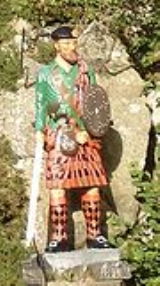
Situated high up on the steep, rocky bank of the Culter Burn near the western exit of the village is a colourful and well-tended kilted wooden figure holding a broadsword and targe
(shield) that represents Rob Roy Macgregor
, who according to local legend leapt across the stream at that point to escape pursuing Hanoverian troops. (Given the width of the stream there, the story - which has its local variants in many different parts of Scotland - is unlikely to have much basis in fact, but that merely adds to its charm.) The original version of the statue is thought to have been a modified ship's figurehead.
Due to its proximity to Aberdeen City and being only around thirty miles from the Cairngorm National Park, Culter is a logical base for tourists. In the town itself there are chances of many local walks
, including its connection to the Deeside Way
at the site of the former Culter railway station
.
For sport, there is Peterculter Golf Club and Culter Sports Centre. Each year, on the last Saturday in May is the Culter Gala, in the main playing field
of the village; This event attracts hundreds of people.
The Richmond Arms has a front public bar and a lounge bar. The public bar is the most traditional of those found in the village, with clientele of all ages. Snack food is available. The lounge bar is busy mainly with functions and at weekends and now boasts 3-D television for sporting events.
The Old Bank Bar is a modern bar with good facilities. Snack type food is available. This bar is very busy at weekends, also with a varied customer base. Lumphanan regulars are known to frequent.
The Ploughman caters generally to a younger crowd. Food is available from the kitchen both in the bar and at the restaurant. Servings are not so large, typical pub food.
All the public houses have pool and darts played there, with teams from each represented in local leagues. Competitions are also played at each bar periodically where there is usually an open invite.
Each public house generally charges the same amount for drinks, with the Richmond Arms perhaps being the least expensive by a small amount.
Aberdeen
Aberdeen is Scotland's third most populous city, one of Scotland's 32 local government council areas and the United Kingdom's 25th most populous city, with an official population estimate of ....
, Scotland
Scotland
Scotland is a country that is part of the United Kingdom. Occupying the northern third of the island of Great Britain, it shares a border with England to the south and is bounded by the North Sea to the east, the Atlantic Ocean to the north and west, and the North Channel and Irish Sea to the...
approximately eight miles inland from Aberdeen city centre. Peterculter is situated along the northern banks of the River Dee
River Dee, Aberdeenshire
The River Dee is a river in Aberdeenshire, Scotland. It rises in the Cairngorms and flows through Strathdee to reach the North Sea at Aberdeen...
in the vicinity of the confluences with Crynoch Burn
Crynoch Burn
Crynoch Burn is a stream in Aberdeenshire that is tributary to the River Dee. This stream rises somewhat above Netherley and flows near Netherley House; and thence into the Red Moss, a significant natural bog habitat; thence near the historic Lairhillock Inn; and finally by the village of...
and Leuchar Burn
Leuchar Burn
Leuchar Burn is a stream that rises in the Loch of Skene, in Aberdeenshire, Scotland Initially near the headwaters Leuchar Burn flows in a southerly course; as it approaches the Royal Deeside, the watercourse rotates to the southeast, ultimately forming a boundary between Aberdeenshire and...
. Although originally a separate entity, following the 1996 Scottish council boundary changes
Local Government etc. (Scotland) Act 1994
The Local Government etc. Act 1994 is an Act of the Parliament of the United Kingdom which created the current local government structure of 32 unitary authorities covering the whole of Scotland....
it is now part of the City of Aberdeen.
The latter part of the name is said to be derived from the Gaelic
Scottish Gaelic language
Scottish Gaelic is a Celtic language native to Scotland. A member of the Goidelic branch of the Celtic languages, Scottish Gaelic, like Modern Irish and Manx, developed out of Middle Irish, and thus descends ultimately from Primitive Irish....
compound word "Cul-tir", which signifies the back part of the country, and would correctly apply to a considerable portion of the land on both sides of the Dee.
History
Approximately one mile south west of the Peterculter, near Peterculter Golf Club is the site of the Roman marching camp at NormandykesNormandykes
Normandykes is the site of a Roman marching camp to the southwest of Peterculter, Aberdeenshire, Scotland. The near-rectangular site, measuring approximately , covers about of the summit and eastern slopes of a hill overlooking the River Dee and the B9077 road further south. Aerial photographs...
.
King William the Lion
William I of Scotland
William the Lion , sometimes styled William I, also known by the nickname Garbh, "the Rough", reigned as King of the Scots from 1165 to 1214...
bestowed the church of Kulter, “iuxta Abirdene”, upon the Abbey
Kelso Abbey
Kelso Abbey is what remains of a Scottish abbey founded in the 12th century by a community of Tironensian monks first brought to Scotland in the reign of Alexander I. It occupies ground overlooking the confluence of the Tweed and Teviot waters, the site of what was once the Royal Burgh of Roxburgh...
and monks of St Mary of Kelso
Kelso, Scotland
Kelso is a market town and civil parish in the Scottish Borders area of Scotland. It lies where the rivers Tweed and Teviot have their confluence...
, about 1165–1199. The gift was afterwards confirmed by Mathew, Bishop of Aberdeen, within whose diocese the church was situated.
Alan of Soltre, chaplain, who had probably been an ecclesiastic of the hospital, or monastery of Soutra, in Lothian
Lothian
Lothian forms a traditional region of Scotland, lying between the southern shore of the Firth of Forth and the Lammermuir Hills....
, was presented by the Abbot of Kelso, to the vicarage of the church of Culter, 1239–1240.
In 1287–1288, an agreement was made between the Abbot and Convent of Kelso and the brotherhood of the Knights of Jerusalem, regarding the Templars’ lands of Blairs and Kincolsi (Kincousie), on the south side of the Dee, by which a chapel, erected by the Templars at their house of Culter, was recognised as a church, with parochial rights, for the inhabitants of the said lands. It was this agreement that changed the existing parish of Culter into two separate parishes with two separate names, the other being Maryculter
Maryculter
Maryculter or Kirkton of Maryculter is a village in the Lower Deeside area of Aberdeenshire, Scotland. The River Dee separates it from the town of Peterculter, and the B979 road runs through Maryculter. There are two hotels: The Old Mill Inn, a former coaching inn that dates back 200 years, and...
.
Attractions
Targe
Targe was a general word for shield in late Old English. Its diminutive, target, came to mean an object to be aimed at in the 18th century....
(shield) that represents Rob Roy Macgregor
Robert Roy MacGregor
Robert Roy MacGregor , usually known simply as Rob Roy or alternately Red MacGregor, was a famous Scottish folk hero and outlaw of the early 18th century, who is sometimes known as the Scottish Robin Hood. Rob Roy is anglicised from the Scottish Gaelic Raibeart Ruadh, or Red Robert...
, who according to local legend leapt across the stream at that point to escape pursuing Hanoverian troops. (Given the width of the stream there, the story - which has its local variants in many different parts of Scotland - is unlikely to have much basis in fact, but that merely adds to its charm.) The original version of the statue is thought to have been a modified ship's figurehead.
Due to its proximity to Aberdeen City and being only around thirty miles from the Cairngorm National Park, Culter is a logical base for tourists. In the town itself there are chances of many local walks
Hike
Hike may refer to:* Hiking, walking lengthy distances in the countryside or wilderness* Hiking , moving a sailor's body weight as far to windward as possible, in order to counteract the force of the wind pushing sideways against the boat's sails* Alternative spelling for Heka , an Egyptian god*...
, including its connection to the Deeside Way
Deeside Way
The Deeside Way , is a pathway that travels along the bed of the now removed Deeside Railway, along the north bank of the River Dee in Aberdeenshire.While in operation, the railway was used by the British Royal Family during travel to their Scottish retreat at Balmoral,...
at the site of the former Culter railway station
Culter railway station
Culter railway station was a railway station near Peterculter, Aberdeenshire. It was, with the rest of the Royal Deeside Line, a victim of the Beeching Axe in the mid-1960s. Today, what remain are most of the station platform and a few bridges along the rail trail.-Previous services:...
.
For sport, there is Peterculter Golf Club and Culter Sports Centre. Each year, on the last Saturday in May is the Culter Gala, in the main playing field
Playing field
A playing field is a field used for playing sports or games. They are generally outdoors, but many large structures exist to enclose playing fields from bad weather. Generally, playing fields are wide expanses of grass, dirt or sand without many obstructions...
of the village; This event attracts hundreds of people.
Public Houses
There are three public houses in Peterculter. The Richmond Arms (known as Jimmy Blacks or Blacks Bar), The Old Bank Bar (on the site of a former Clydesdale Bank branch) and The Ploughman (with no significant history).The Richmond Arms has a front public bar and a lounge bar. The public bar is the most traditional of those found in the village, with clientele of all ages. Snack food is available. The lounge bar is busy mainly with functions and at weekends and now boasts 3-D television for sporting events.
The Old Bank Bar is a modern bar with good facilities. Snack type food is available. This bar is very busy at weekends, also with a varied customer base. Lumphanan regulars are known to frequent.
The Ploughman caters generally to a younger crowd. Food is available from the kitchen both in the bar and at the restaurant. Servings are not so large, typical pub food.
All the public houses have pool and darts played there, with teams from each represented in local leagues. Competitions are also played at each bar periodically where there is usually an open invite.
Each public house generally charges the same amount for drinks, with the Richmond Arms perhaps being the least expensive by a small amount.