

Peter Oliver

Encyclopedia
England
England is a country that is part of the United Kingdom. It shares land borders with Scotland to the north and Wales to the west; the Irish Sea is to the north west, the Celtic Sea to the south west, with the North Sea to the east and the English Channel to the south separating it from continental...
miniaturist.
Born in Isleworth
Isleworth
Isleworth is a small town of Saxon origin sited within the London Borough of Hounslow in west London, England. It lies immediately east of the town of Hounslow and west of the River Thames and its tributary the River Crane. Isleworth's original area of settlement, alongside the Thames, is known as...
, Middlesex
Middlesex
Middlesex is one of the historic counties of England and the second smallest by area. The low-lying county contained the wealthy and politically independent City of London on its southern boundary and was dominated by it from a very early time...
, he was the eldest son of Isaac Oliver
Isaac Oliver
Isaac Oliver was a French-born English portrait miniature painter.-Life and work:Born in Rouen, he moved to London in 1568 with his Huguenot parents Peter and Epiphany Oliver to escape the Wars of Religion in France...
, probably by his first wife; and to him Isaac Oliver left his finished and unfinished drawings, with the hope that he would live to exercise the art of his father. The younger sons of the artist appear to have been under age at the time of his death, and were probably therefore sons by a later wife than the mother of Peter Oliver. He resided at Isleworth
Isleworth
Isleworth is a small town of Saxon origin sited within the London Borough of Hounslow in west London, England. It lies immediately east of the town of Hounslow and west of the River Thames and its tributary the River Crane. Isleworth's original area of settlement, alongside the Thames, is known as...
, and was buried beside his father at St Annes, Blackfriars.
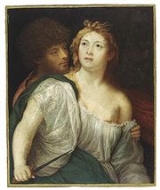
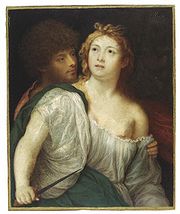
He was even more eminent in miniature painting than his father, and is specially remarkable for a series of copies in watercolor he made after celebrated pictures by old masters. Most of these were done by the desire of the king, and seven of them still remain at Windsor Castle
Windsor Castle
Windsor Castle is a medieval castle and royal residence in Windsor in the English county of Berkshire, notable for its long association with the British royal family and its architecture. The original castle was built after the Norman invasion by William the Conqueror. Since the time of Henry I it...
. A great many of Oliver's works were purchased by Charles II
Charles II of England
Charles II was monarch of the three kingdoms of England, Scotland, and Ireland.Charles II's father, King Charles I, was executed at Whitehall on 30 January 1649, at the climax of the English Civil War...
from his widow; several of his drawings are in existence, and a leaf from his pocket-book in the collection of the earl of Derby
Earl of Derby
Earl of Derby is a title in the Peerage of England. The title was first adopted by Robert de Ferrers, 1st Earl of Derby under a creation of 1139. It continued with the Ferrers family until the 6th Earl forfeited his property toward the end of the reign of Henry III and died in 1279...
. His most important work is the group of the three grandsons of Anthony Browne, 1st Viscount Montague with their servant, now belonging to the marquess of Exeter
Marquess of Exeter
Marquess of Exeter is a title that has been created twice, once in the Peerage of England and once in the Peerage of the United Kingdom. The first creation came in the Peerage of England in 1525 for Henry Courtenay, 2nd Earl of Devon...
; and there are fine miniatures by him at Welbeck Abbey
Welbeck Abbey
Welbeck Abbey near Clumber Park in North Nottinghamshire was the principal abbey of the Premonstratensian order in England and later the principal residence of the Dukes of Portland.-Monastic period:...
, Montagu House
Montagu House
Montagu House or Montague House may refer to:in England*Montagu House, Bloomsbury, the first home of the British Museum, also known as Montague House*Montagu House, Portman Square, built for Elizabeth Montagu on Portman Square...
, Sherborne Castle
Sherborne Castle
Sherborne Castle is a 16th-century Tudor mansion southeast of Sherborne in Dorset, England. The park formed only a small part of the Digby estate.-Old castle:Sherborne Old Castle is the ruin of a 12th-century castle in the grounds of the mansion...
, Minley Manor
Minley Manor
Minley Manor is a Grade 2 listed country manor house, built in the French style by Henry Clutton in the 1860s with further additions in the 1880s. The Manor is situated 2 miles north of junction 4A of the M3 between Farnborough and Yateley in Hampshire, England and is situated in 38 hectares of...
, Belvoir Castle
Belvoir Castle
Belvoir Castle is a stately home in the English county of Leicestershire, overlooking the Vale of Belvoir . It is a Grade I listed building....
and in the private collection of Queen Wilhelmina
Wilhelmina of the Netherlands
Wilhelmina was Queen regnant of the Kingdom of the Netherlands from 1890 to 1948. She ruled the Netherlands for fifty-eight years, longer than any other Dutch monarch. Her reign saw World War I and World War II, the economic crisis of 1933, and the decline of the Netherlands as a major colonial...
.
External links
- Lee, Sidney (Ed). Peter Oliver (Dictionary of national biography, volume 42, p149).
- Miniatures by Peter Oliver (National Portrait Gallery, London)