

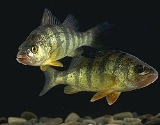
Perch

Encyclopedia
Perch is a common name for fish
of the genus Perca, freshwater gamefish belonging to the family Percidae
. The perch, of which there are three species in different geographical areas, lend their name to a large order of vertebrate
s: the Perciformes, from the Greek
perke meaning spotted, and the Latin
forma meaning shape. Many species of freshwater gamefish more or less resemble perch, but belong to a different genera. In fact, the exclusively salt water dwelling red drum is often referred to as a red perch, even though by definition perch are freshwater fish. Though many fish are referred to as perch as a common name, to be considered a true perch the fish must be of the family Percidae.
The type species
for this genus is the European perch
, Perca fluviatilis.
s, and two lidless eye
s. On the posterior sides are the opercula, which protect the gill
s. Also there is the lateral line system which is sensitive to vibrations in the water. They have a pair of pectoral and pelvic fins. There are two dorsal fins, the first one spiny and the second soft. These two fins can be separate or joined. There is also an anal fin, which is also considered spiny, and a caudal fin. The cloaca
lies directly behind the anal fin. All perciform fish share this general morphology.
and are considered very good to eat; the commercial catch for them has always been in high demand. This has also led to considerable misuse of the term "perch" in the restaurant business in the United States
, such as "ocean perch" (rose fish) and "rock perch" (a small bass
). Many restaurants will strive to correctly advertise the offering as "yellow lake perch", or the slightly more ambiguous "lake perch". "White perch
", though similarly popular, is a completely different species common in New England
, and not a member of the family Percidae.
; Perch are notorious for swallowing the hook, and will need aid of a disgorger or forceps for unhooking. In many parts of the world they are also a favorite species among ice fishermen. They will take a variety of baits, including minnows, worms, maggots, bread, pieces of raw bacon, and softshell crayfish.
Perch grow to around 5 lb (2.3 kg) or more, but the most common fish to be caught are around 1 lb (0.45359237 kg) or less, and anything over 2 lb (0.90718474 kg) is considered a prize catch. The British record perch is 6lb, beating the previous one by 1 oz (28.3 g).
Other species commonly called perch include:
For other perch not in the Perca genus, see Perch (disambiguation)
.
Fish
Fish are a paraphyletic group of organisms that consist of all gill-bearing aquatic vertebrate animals that lack limbs with digits. Included in this definition are the living hagfish, lampreys, and cartilaginous and bony fish, as well as various extinct related groups...
of the genus Perca, freshwater gamefish belonging to the family Percidae
Percidae
The Percidae are a family of perciform fish found in fresh and brackish waters of the Northern Hemisphere. The family contains about 200 species in ten genera...
. The perch, of which there are three species in different geographical areas, lend their name to a large order of vertebrate
Vertebrate
Vertebrates are animals that are members of the subphylum Vertebrata . Vertebrates are the largest group of chordates, with currently about 58,000 species described. Vertebrates include the jawless fishes, bony fishes, sharks and rays, amphibians, reptiles, mammals, and birds...
s: the Perciformes, from the Greek
Greek language
Greek is an independent branch of the Indo-European family of languages. Native to the southern Balkans, it has the longest documented history of any Indo-European language, spanning 34 centuries of written records. Its writing system has been the Greek alphabet for the majority of its history;...
perke meaning spotted, and the Latin
Latin
Latin is an Italic language originally spoken in Latium and Ancient Rome. It, along with most European languages, is a descendant of the ancient Proto-Indo-European language. Although it is considered a dead language, a number of scholars and members of the Christian clergy speak it fluently, and...
forma meaning shape. Many species of freshwater gamefish more or less resemble perch, but belong to a different genera. In fact, the exclusively salt water dwelling red drum is often referred to as a red perch, even though by definition perch are freshwater fish. Though many fish are referred to as perch as a common name, to be considered a true perch the fish must be of the family Percidae.
The type species
Type species
In biological nomenclature, a type species is both a concept and a practical system which is used in the classification and nomenclature of animals and plants. The value of a "type species" lies in the fact that it makes clear what is meant by a particular genus name. A type species is the species...
for this genus is the European perch
European perch
The European perch, Perca fluviatilis, is a predatory species of perch found in Europe and Asia. In some areas it is known as the redfin perch or English perch, and it is often known simply as perch. The species is a popular quarry for anglers and has been widely introduced beyond its native area,...
, Perca fluviatilis.
Anatomy
The general body type of a perch includes a somewhat long, rounded stature. True perch have "rough" or ctenoid scales. On the anterior side of the head are the maxilla and lower mandible for the mouth, a pair of nostrilNostril
A nostril is one of the two channels of the nose, from the point where they bifurcate to the external opening. In birds and mammals, they contain branched bones or cartilages called turbinates, whose function is to warm air on inhalation and remove moisture on exhalation...
s, and two lidless eye
Eye
Eyes are organs that detect light and convert it into electro-chemical impulses in neurons. The simplest photoreceptors in conscious vision connect light to movement...
s. On the posterior sides are the opercula, which protect the gill
Gill
A gill is a respiratory organ found in many aquatic organisms that extracts dissolved oxygen from water, afterward excreting carbon dioxide. The gills of some species such as hermit crabs have adapted to allow respiration on land provided they are kept moist...
s. Also there is the lateral line system which is sensitive to vibrations in the water. They have a pair of pectoral and pelvic fins. There are two dorsal fins, the first one spiny and the second soft. These two fins can be separate or joined. There is also an anal fin, which is also considered spiny, and a caudal fin. The cloaca
Cloaca
In zoological anatomy, a cloaca is the posterior opening that serves as the only such opening for the intestinal, reproductive, and urinary tracts of certain animal species...
lies directly behind the anal fin. All perciform fish share this general morphology.
Habits
Perch are carnivorous fish that are most commonly found in small ponds, lakes, streams, or rivers. These fish like to feed on smaller fish, shellfish, or insect larvae, but can be caught with nearly any bait. They commonly spawn during the spring, when the females lay strings of eggs in covered areas such as near branches or underwater plants.Perch as a food fish
Perch are a popular species of panfishPanfish
A panfish, also spelled pan-fish or pan fish, is an edible game fish that usually doesn't outgrow the size of a frying pan. The term is also commonly used by anglers to refer to any small catch that will fit in a pan, but is large enough to be legal. However its definition and usage varies with...
and are considered very good to eat; the commercial catch for them has always been in high demand. This has also led to considerable misuse of the term "perch" in the restaurant business in the United States
United States
The United States of America is a federal constitutional republic comprising fifty states and a federal district...
, such as "ocean perch" (rose fish) and "rock perch" (a small bass
Bass (fish)
Bass is a name shared by many different species of popular gamefish. The term encompasses both freshwater and marine species. All belong to the large order Perciformes, or perch-like fishes, and in fact the word bass comes from Middle English bars, meaning "perch."-Types of basses:*The temperate...
). Many restaurants will strive to correctly advertise the offering as "yellow lake perch", or the slightly more ambiguous "lake perch". "White perch
White perch
The white perch, Morone americana, is not a true perch but is, rather, a fish of the temperate bass family, Moronidae, notable as a food and game fish in eastern North America.The name "white perch" is sometimes erroneously applied to the white crappie....
", though similarly popular, is a completely different species common in New England
New England
New England is a region in the northeastern corner of the United States consisting of the six states of Maine, New Hampshire, Vermont, Massachusetts, Rhode Island, and Connecticut...
, and not a member of the family Percidae.
Angling
Perch are sought after by fishermen both for sport and for food. They can be caught with a variety of methods, but the two best methods are perhaps float fishing and lure fishing. The best way is to use a small hook and cast into the weeds just before the drop off. When fishing with a float, the angler will want to have a disgorgerDisgorger
A disgorger is used in coarse fishing to remove a fish hook from deep inside the mouth of a fish that is not possible to reach using fingers alone. It is typically made of plastic or metal and is used on smaller fish...
; Perch are notorious for swallowing the hook, and will need aid of a disgorger or forceps for unhooking. In many parts of the world they are also a favorite species among ice fishermen. They will take a variety of baits, including minnows, worms, maggots, bread, pieces of raw bacon, and softshell crayfish.
Perch grow to around 5 lb (2.3 kg) or more, but the most common fish to be caught are around 1 lb (0.45359237 kg) or less, and anything over 2 lb (0.90718474 kg) is considered a prize catch. The British record perch is 6lb, beating the previous one by 1 oz (28.3 g).
Species
Most authorities recognize three species within the perch genus:- The European perchEuropean perchThe European perch, Perca fluviatilis, is a predatory species of perch found in Europe and Asia. In some areas it is known as the redfin perch or English perch, and it is often known simply as perch. The species is a popular quarry for anglers and has been widely introduced beyond its native area,...
(Perca fluviatilis) is found in EuropeEuropeEurope is, by convention, one of the world's seven continents. Comprising the westernmost peninsula of Eurasia, Europe is generally 'divided' from Asia to its east by the watershed divides of the Ural and Caucasus Mountains, the Ural River, the Caspian and Black Seas, and the waterways connecting...
and AsiaAsiaAsia is the world's largest and most populous continent, located primarily in the eastern and northern hemispheres. It covers 8.7% of the Earth's total surface area and with approximately 3.879 billion people, it hosts 60% of the world's current human population...
. This species is typically greenish in color with dark vertical bars on its sides with a red or orange coloring in the tips of its fins. The European perch has been successfully introduced in New ZealandNew ZealandNew Zealand is an island country in the south-western Pacific Ocean comprising two main landmasses and numerous smaller islands. The country is situated some east of Australia across the Tasman Sea, and roughly south of the Pacific island nations of New Caledonia, Fiji, and Tonga...
and AustraliaAustraliaAustralia , officially the Commonwealth of Australia, is a country in the Southern Hemisphere comprising the mainland of the Australian continent, the island of Tasmania, and numerous smaller islands in the Indian and Pacific Oceans. It is the world's sixth-largest country by total area...
where it is known as the redfin perch or English perch. In Australia they have bred into larger specimens, but the species rarely grows larger than about six pounds.
- The Balkhash perchBalkhash perchThe Balkhash perch is a species of perch found in Kazakhstan, , Uzbekistan, and China. It is very similar to the European perch, and grows to a comparable size.-References:...
(Perca schrenkii) is found in KazakhstanKazakhstanKazakhstan , officially the Republic of Kazakhstan, is a transcontinental country in Central Asia and Eastern Europe. Ranked as the ninth largest country in the world, it is also the world's largest landlocked country; its territory of is greater than Western Europe...
, (in Lake BalkhashLake BalkhashLake Balkhash is one of the largest lakes in Asia and 12th largest continental lake in the world. It is located in southeastern Kazakhstan, in Central Asia, and belongs to an endorheic basin shared by Kazakhstan and China, with a small part in Kyrgyzstan. The basin drains into the lake via seven...
and Lake AlakolLake AlakolAlakol Lake is a lake located in the Almaty and Shyghyz provinces, east central Kazakhstan. Its elevation is 347 m above sea levelThe lake is the northwest extension of the region known as the Dzhungarian Gate , a narrow valley connects the southern uplands of Kazakhstan with arid northwest...
), UzbekistanUzbekistanUzbekistan , officially the Republic of Uzbekistan is a doubly landlocked country in Central Asia and one of the six independent Turkic states. It shares borders with Kazakhstan to the west and to the north, Kyrgyzstan and Tajikistan to the east, and Afghanistan and Turkmenistan to the south....
, and ChinaChinaChinese civilization may refer to:* China for more general discussion of the country.* Chinese culture* Greater China, the transnational community of ethnic Chinese.* History of China* Sinosphere, the area historically affected by Chinese culture...
. It is very similar to the European perch, and grows to a comparable size.
- The yellow perchYellow perchThe yellow perch is a species of perch found in the United States and Canada, where it is often referred to by the shortform perch. Yellow perch look similar to the European perch, but are paler and more yellowish, with less red in the fins. They have six to eight dark, vertical bars on their sides...
(Perca flavescens), smaller and paler than the European perchEuropean perchThe European perch, Perca fluviatilis, is a predatory species of perch found in Europe and Asia. In some areas it is known as the redfin perch or English perch, and it is often known simply as perch. The species is a popular quarry for anglers and has been widely introduced beyond its native area,...
, is found in the United StatesUnited StatesThe United States of America is a federal constitutional republic comprising fifty states and a federal district...
and CanadaCanadaCanada is a North American country consisting of ten provinces and three territories. Located in the northern part of the continent, it extends from the Atlantic Ocean in the east to the Pacific Ocean in the west, and northward into the Arctic Ocean...
. In northern areas, it is sometimes referred to as the lake perch. This species is prized for its food quality and has often been raised in hatcheries and introduced into areas in which it is not native. Yellow perch are almost identical in appearance to European perch but have a more yellow coloring. These fish typically only reach a size of about fifteen inches and two and a quarter pounds.
Other species commonly called perch include:
- The golden perchGolden perchThe golden perch, Macquaria ambigua, is an Australian native freshwater fish, primarily of the Murray-Darling river system. It is not a true perch of the genus Perca....
(Macquaria ambigua), native to Australia, is usually found west of the Great Dividing Range through the Murray Darling river system. This species grows up to 22 kg (48.5 lb) and 60 cm (23.6 in).
- The silver perchSilver PerchSilver perch is a medium sized freshwater fish endemic to the Murray-Darling river system in south-eastern Australia. The scientific name comes from an aboriginal name for the species recorded by Major Mitchell on his 1832 expedition. It is not a perch, being a grunter in the family Terapontidae...
(Bidyanus bidyanus), native to Australia, is usually found in the Murray River, though has been recorded north in the Darling River. It is slightly larger than the golden perch.
- The spangled perch (LeiopotheraponLeiopotheraponLeiopotherapon is a genus of fish in the Terapontidae family.It contains the following species:* fortesque grunter * large-scale grunter...
unicolor), is found throughout Australian waters, from pure freshwater to sea water, though mostly fresh water. It is considerably smaller than the silver perch and golden perch; grows up to 500 g (17.6 oz) and 30 cm (11.8 in).
- The pikeperch, more commonly referred to as the walleye, is a larger species found in North America.
For other perch not in the Perca genus, see Perch (disambiguation)
Perch (disambiguation)
Perch may refer to:*Perch , a surname *The USS Perch, multiple ships with the name*Perch , antique unit of measure of length, area or volume, depending on context, used in medieval France and the British Isles...
.