

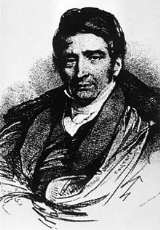
Pellegrino Rossi

Encyclopedia

Italian people
The Italian people are an ethnic group that share a common Italian culture, ancestry and speak the Italian language as a mother tongue. Within Italy, Italians are defined by citizenship, regardless of ancestry or country of residence , and are distinguished from people...
economist, politician and jurist. He was an important figure of the July Monarchy
July Monarchy
The July Monarchy , officially the Kingdom of France , was a period of liberal constitutional monarchy in France under King Louis-Philippe starting with the July Revolution of 1830 and ending with the Revolution of 1848...
in France, and the Minister of Justice in the government of the Papal States
Papal States
The Papal State, State of the Church, or Pontifical States were among the major historical states of Italy from roughly the 6th century until the Italian peninsula was unified in 1861 by the Kingdom of Piedmont-Sardinia .The Papal States comprised territories under...
, under Pope Pius IX
Pope Pius IX
Blessed Pope Pius IX , born Giovanni Maria Mastai-Ferretti, was the longest-reigning elected Pope in the history of the Catholic Church, serving from 16 June 1846 until his death, a period of nearly 32 years. During his pontificate, he convened the First Vatican Council in 1869, which decreed papal...
.
Biography
Rossi was born in CarraraCarrara
Carrara is a city and comune in the province of Massa-Carrara , notable for the white or blue-grey marble quarried there. It is on the Carrione River, some west-northwest of Florence....
, Tuscany
Tuscany
Tuscany is a region in Italy. It has an area of about 23,000 square kilometres and a population of about 3.75 million inhabitants. The regional capital is Florence ....
. Educated at the University of Pisa
University of Pisa
The University of Pisa , located in Pisa, Tuscany, is one of the oldest universities in Italy. It was formally founded on September 3, 1343 by an edict of Pope Clement VI, although there had been lectures on law in Pisa since the 11th century...
and the University of Bologna
University of Bologna
The Alma Mater Studiorum - University of Bologna is the oldest continually operating university in the world, the word 'universitas' being first used by this institution at its foundation. The true date of its founding is uncertain, but believed by most accounts to have been 1088...
, he became professor of law at the latter in 1812. In 1815 he gave his support to Joachim Murat
Joachim Murat
Joachim-Napoléon Murat , Marshal of France and Grand Admiral or Admiral of France, 1st Prince Murat, was Grand Duke of Berg from 1806 to 1808 and then King of Naples from 1808 to 1815...
and his Neapolitan
Kingdom of Naples
The Kingdom of Naples, comprising the southern part of the Italian peninsula, was the remainder of the old Kingdom of Sicily after secession of the island of Sicily as a result of the Sicilian Vespers rebellion of 1282. Known to contemporaries as the Kingdom of Sicily, it is dubbed Kingdom of...
anti-Austrian
Austrian Empire
The Austrian Empire was a modern era successor empire, which was centered on what is today's Austria and which officially lasted from 1804 to 1867. It was followed by the Empire of Austria-Hungary, whose proclamation was a diplomatic move that elevated Hungary's status within the Austrian Empire...
expedition: after the latter's fall, he escaped to France, and then proceeded to Geneva
Canton of Geneva
The Republic and Canton of Geneva is the French speaking westernmost canton or state of Switzerland, surrounded on almost all sides by France. As is the case in several other Swiss cantons The Republic and Canton of Geneva is the French speaking westernmost canton or state of Switzerland,...
, where he began teaching a course of jurisprudence
Jurisprudence
Jurisprudence is the theory and philosophy of law. Scholars of jurisprudence, or legal theorists , hope to obtain a deeper understanding of the nature of law, of legal reasoning, legal systems and of legal institutions...
applied to Roman law
Roman law
Roman law is the legal system of ancient Rome, and the legal developments which occurred before the 7th century AD — when the Roman–Byzantine state adopted Greek as the language of government. The development of Roman law comprises more than a thousand years of jurisprudence — from the Twelve...
, the success of which gained him the unusual honour of naturalization
Naturalization
Naturalization is the acquisition of citizenship and nationality by somebody who was not a citizen of that country at the time of birth....
as a citizen of Geneva. In 1820 he was elected as a deputy to the cantonal council
Cantons of Switzerland
The 26 cantons of Switzerland are the member states of the federal state of Switzerland. Each canton was a fully sovereign state with its own borders, army and currency from the Treaty of Westphalia until the establishment of the Swiss federal state in 1848...
, and was a member of the diet of 1832; Rossi was entrusted with the task of drawing up a revised constitution, which was known as the Pacte Rossi. This was rejected by a majority of the diet, a result which deeply affected Rossi, and made him accept the invitation of François Guizot
François Guizot
François Pierre Guillaume Guizot was a French historian, orator, and statesman. Guizot was a dominant figure in French politics prior to the Revolution of 1848, a conservative liberal who opposed the attempt by King Charles X to usurp legislative power, and worked to sustain a constitutional...
to settle in France.
Here he was appointed in 1833 to the chair of political economy
Political economy
Political economy originally was the term for studying production, buying, and selling, and their relations with law, custom, and government, as well as with the distribution of national income and wealth, including through the budget process. Political economy originated in moral philosophy...
in the Collège de France
Collège de France
The Collège de France is a higher education and research establishment located in Paris, France, in the 5th arrondissement, or Latin Quarter, across the street from the historical campus of La Sorbonne at the intersection of Rue Saint-Jacques and Rue des Écoles...
, vacated by the death of Jean-Baptiste Say
Jean-Baptiste Say
Jean-Baptiste Say was a French economist and businessman. He had classically liberal views and argued in favor of competition, free trade, and lifting restraints on business...
. He was naturalized as a French citizen in 1834, and in the same year became professor of constitutional law
Constitutional law
Constitutional law is the body of law which defines the relationship of different entities within a state, namely, the executive, the legislature and the judiciary....
in the faculty of law of the Paris University
University of Paris
The University of Paris was a university located in Paris, France and one of the earliest to be established in Europe. It was founded in the mid 12th century, and officially recognized as a university probably between 1160 and 1250...
. In 1836 he was elected a member of the Academy of Political and Moral Sciences
Academy of Political and Moral Sciences
The Académie des sciences morales et politiques is a French learned society. It is one of the five academies of the Institut de France.The académie was founded in 1795, suppressed in 1803, and reestablished in 1832 through the appeal of Guizot to King Louis Philippe New International Encyclopedia...
, was raised to the French peerage
Peerage of France
The Peerage of France was a distinction within the French nobility which appeared in the Middle Ages. It was abolished in 1789 during the French Revolution, but it reappeared in 1814 at the time of the Bourbon Restoration which followed the fall of the First French Empire...
in 1839, and in 1843 became dean
Dean (education)
In academic administration, a dean is a person with significant authority over a specific academic unit, or over a specific area of concern, or both...
of the faculty of law.
In 1845 he was sent to Rome by Guizot to discuss the question of the Jesuits, being finally appointed ambassador of France for the Papal States. The revolution of 1848
Revolutions of 1848 in the Italian states
The 1848 revolutions in the Italian states were organized revolts in the states of Italy led by intellectuals and agitators who desired a liberal government. As Italian nationalists they sought to eliminate reactionary Austrian control...
severed his connection with France, and he remained at Rome and became Minister of the Interior under Pius IX. Rossi's program of liberal reforms
Liberalism
Liberalism is the belief in the importance of liberty and equal rights. Liberals espouse a wide array of views depending on their understanding of these principles, but generally, liberals support ideas such as constitutionalism, liberal democracy, free and fair elections, human rights,...
, however, never took off. He was also very unpopular owing to his otherwise conservative
Conservatism
Conservatism is a political and social philosophy that promotes the maintenance of traditional institutions and supports, at the most, minimal and gradual change in society. Some conservatives seek to preserve things as they are, emphasizing stability and continuity, while others oppose modernism...
views.
His assassination took place on the stairs at the opening of the Parliament in the "Palazzo della Cancelleria" on 15 November 1848 by a stab wound to the neck. This was one of the causes of the flight from Rome of Pope Pius IX and the beginning of the series of events that led to the proclamation of the Roman Republic
Roman Republic (19th century)
The Roman Republic was a state declared on February 9, 1849, when the government of Papal States was temporarily substituted by a republican government due to Pope Pius IX's flight to Gaeta. The republic was led by Carlo Armellini, Giuseppe Mazzini and Aurelio Saffi...
.
The city of Carrara erected a statue in honour of Pellegrino Rossi.
Selected works
- Cours d'économie politique (1838–54)
- Traité de droit pénal (1829)
- Cours de droit constitutionnel (1866–67)
- Melanges d'économie politique, d'histoire et de philosophie (1857, 2 volumes)