
The
United States Department of Labor is a
CabinetThe Cabinet of the United States is composed of the most senior appointed officers of the executive branch of the federal government of the United States, which are generally the heads of the federal executive departments...
department of the
United StatesThe United States of America is a federal constitutional republic comprising fifty states and a federal district...
government responsible for occupational safety, wage and hour standards, unemployment insurance benefits, re-employment services, and some economic statistics. Many
U.S. stateA U.S. state is any one of the 50 federated states of the United States of America that share sovereignty with the federal government. Because of this shared sovereignty, an American is a citizen both of the federal entity and of his or her state of domicile. Four states use the official title of...
s also have such departments. The department is headed by the
United States Secretary of LaborThe United States Secretary of Labor is the head of the Department of Labor who exercises control over the department and enforces and suggests laws involving unions, the workplace, and all other issues involving any form of business-person controversies....
.
Hilda SolisHilda Lucia Solis is the 25th United States Secretary of Labor, serving in the Obama administration. She is a member of the Democratic Party and served in the United States House of Representatives from 2001 to 2009, representing the 31st and 32nd congressional districts of California that include...
is the current Secretary of Labor.
Seth HarrisSeth D. Harris is the 11th United States Deputy Secretary of Labor. Nominated by Barack Obama in February 2009, Harris was confirmed unanimously by the U.S. Senate in May 2009...
is the current
Deputy Secretary of LaborUnited States Deputy Secretary of Labor is the second-highest-ranking official in the United States Department of Labor. In the United States federal government, the Deputy Secretary oversees the day-to-day operation of the Department of Labor, and may act as Secretary of Labor during the absence...
.
The purpose of the Department of Labor (DOL) is to foster, promote, and develop the welfare of the wage earners, job seekers, and retirees of the United States; improve working conditions; advance opportunities for profitable employment; and assure work-related benefits and rights. In carrying out this mission, the Department of Labor administers and enforces more than 180 federal laws. These mandates and the regulations that implement them cover many workplace activities for about 10 million employers and 125 million workers.
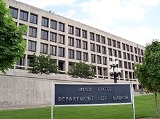
The Department’s headquarters is housed in the
Frances Perkins BuildingThe Frances Perkins Building is the Washington, D.C. headquarters of the United States Department of Labor. It is located at 200 Constitution Avenue NW and runs alongside Interstate 395. The structure is named after Frances Perkins, the U.S. Secretary of Labor from 1933–1945 and the first female...
, named in honor of
Frances PerkinsFrances Perkins , born Fannie Coralie Perkins, was the U.S. Secretary of Labor from 1933 to 1945, and the first woman appointed to the U.S. Cabinet. As a loyal supporter of her friend, Franklin D. Roosevelt, she helped pull the labor movement into the New Deal coalition...
, the Secretary of Labor from 1933–1945 and the first female cabinet secretary in U.S. history.
History
The U.S. Congress first established a
Bureau of Labor in 1888 under the
Department of the InteriorThe United States Department of the Interior is the United States federal executive department of the U.S. government responsible for the management and conservation of most federal land and natural resources, and the administration of programs relating to Native Americans, Alaska Natives, Native...
. Later, the Bureau of Labor became an independent Department of Labor but lacked executive rank. It became a bureau again within the
Department of Commerce and LaborThe United States Department of Commerce and Labor was a short-lived Cabinet department of the United States government, which was concerned with Business.It was created on February 14, 1903...
, which was established February 15, 1903.
PresidentThe President of the United States of America is the head of state and head of government of the United States. The president leads the executive branch of the federal government and is the commander-in-chief of the United States Armed Forces....
William Howard TaftWilliam Howard Taft was the 27th President of the United States and later the tenth Chief Justice of the United States...
signed the March 4, 1913, bill establishing the Department of Labor as a Cabinet-level Department.
PresidentThe President of the United States of America is the head of state and head of government of the United States. The president leads the executive branch of the federal government and is the commander-in-chief of the United States Armed Forces....
Lyndon Johnson asked Congress to consider the idea of reuniting Commerce and Labor. He argued that the two departments had similar goals and that they would have more efficient channels of communication in a single department. However, Congress never acted on it.
In the 1970s, following the
Civil Rights MovementThe civil rights movement was a worldwide political movement for equality before the law occurring between approximately 1950 and 1980. In many situations it took the form of campaigns of civil resistance aimed at achieving change by nonviolent forms of resistance. In some situations it was...
, the Labor Department under Secretary
George P. ShultzGeorge Pratt Shultz is an American economist, statesman, and businessman. He served as the United States Secretary of Labor from 1969 to 1970, as the U.S. Secretary of the Treasury from 1972 to 1974, and as the U.S. Secretary of State from 1982 to 1989...
was instrumental in promoting racial diversity in unions.
During the John F. Kennedy Administration, planning was undertaken to consolidate most of the department's offices, then scattered around more than 20 locations. Construction on the "New Labor Building" began in the middle 1960s and finished in 1975. It was named in honor of Perkins in 1980.
During 2010, a local of the
American Federation of Government EmployeesThe American Federation of Government Employees is an American labor union representing over 625,000 employees of the federal government, about 5,000 employees of the District of Columbia, and a few hundred private sector employees, mostly in and around federal facilities...
stated their unhappiness that a longstanding flextime program reduced under the
George W. Bush administrationThe presidency of George W. Bush began on January 20, 2001, when he was inaugurated as the 43rd President of the United States of America. The oldest son of former president George H. W. Bush, George W...
had not been restored under the Obama administration. Department officials said the program was modern and fair and that it was part of ongoing contract negotiations with the local.
In August 2010, the
Partnership for Public ServiceThe Partnership for Public Service is a nonprofit, nonpartisan organization based in Washington, D.C. whose mission is to inspire a new generation of civil servants and transform the way government works....
ranked the Department of Labor 23rd out of 31 large agencies in its annual "Best Places to Work in the Federal Government" list.
In December 2010, Department of Labor Secretary
Hilda SolisHilda Lucia Solis is the 25th United States Secretary of Labor, serving in the Obama administration. She is a member of the Democratic Party and served in the United States House of Representatives from 2001 to 2009, representing the 31st and 32nd congressional districts of California that include...
was named the Chair of the United States Interagency Council on Homelessness, of which Labor has been a member since its beginnings in 1987.
In July 2011, the Department was rocked by the resignation of
Ray JeffersonRaymond Jefferson was the Assistant Secretary for Veterans' Employment and Training Service between August 10, 2009 and July 25, 2011 during the administration of President Barack Obama. Prior to joining the Department of Labor, Jefferson worked as Leadership Consultant with McKinsey & Company in...
, Assistant Secretary for
VETSThe United States Office of the Assistant Secretary for Veterans' Employment and Training was established by Secretary's Order No. 5-81 in December 1981....
, in a contracting scandal.
DOL Agencies
- Administrative Review Board
In April 1996, the Secretary of Labor established the Administrative Review Board to succeed the former Board of Service Contract Appeals, Wage Appeals Board, and Office of Administrative Appeals. The Board consists of a maximum of five Members, one of whom is designated the Chair...
(ARB)
- Benefits Review Board
The Department of Labor's Benefits Review Board was created in 1972, by the United States Congress, to review and issue decisions on appeals of workers’ compensation claims arising under the Longshore and Harbor Workers’ Compensation Act and the Black Lung Benefits amendments to the Federal Coal...
(BRB)
- Bureau of International Labor Affairs
The Bureau of International Labor Affairs is an operating unit of the United States Department of Labor which manages the Department's international responsibilities. According to its mission statement:...
(ILAB)
- Bureau of Labor Statistics
The Bureau of Labor Statistics is a unit of the United States Department of Labor. It is the principal fact-finding agency for the U.S. government in the broad field of labor economics and statistics. The BLS is a governmental statistical agency that collects, processes, analyzes, and...
(BLS)
- Center for Faith-Based and Neighborhood Partnerships (CFBNP)
- Employee Benefits Security Administration
The Employee Benefits Security Administration is an agency of the United States Department of Labor responsible for administering, regulating and enforcing the provisions of Title I of the Employee Retirement Income Security Act of 1974 . At the time of its name change in February 2003, EBSA was...
(EBSA)
- Employees' Compensation Appeals Board
The Employees' Compensation Appeals Board was created in 1946 by statute to hear appeals taken from determinations and awards under the Federal Employees' Compensation Act with respect to claims of federal employees injured in the course of their employment...
(ECAB)
- Ombudsman for the Energy Employees Occupational Illness Compensation Program (EEOMBD)
- Employment and Training Administration
The mission of the Employment and Training Administration , as part of the U.S. Department of Labor, is to contribute to the more efficient and effective functioning of the U.S. labor market by providing high quality job training, employment, labor market information, and income maintenance...
(ETA)
- Mine Safety and Health Administration
The Mine Safety and Health Administration is an agency of the United States Department of Labor which administers the provisions of the Federal Mine Safety and Health Act of 1977 to enforce compliance with mandatory safety and health standards as a means to eliminate fatal accidents, to reduce...
(MSHA)
- Occupational Safety and Health Administration
The United States Occupational Safety and Health Administration is an agency of the United States Department of Labor. It was created by Congress of the United States under the Occupational Safety and Health Act, signed by President Richard M. Nixon, on December 29, 1970...
(OSHA)
- Office of Federal Contract Compliance Programs (OFCCP)
- Office of Inspector General (OIG)
- Office of Labor-Management Standards (OLMS)
- Office of Workers' Compensation Programs
The Office of Workers' Compensation Programs administers four major disability compensation programs which provide wage replacement benefits, medical treatment, vocational rehabilitation and other benefits to certain workers or their dependents who experience work-related injury or occupational...
(OWCP)
- Veterans' Employment and Training Service
The United States Office of the Assistant Secretary for Veterans' Employment and Training was established by Secretary's Order No. 5-81 in December 1981....
(VETS)
- Wage and Hour Division
The Wage and Hour Division of the United States Department of Labor is the federal office responsible for enforcing federal labor laws. The Division was formed with the enactment of the Fair Labor Standards Act of 1938...
(WHD)
- Women's Bureau
The United States Women's Bureau is an agency of the United States government within the United States Department of Labor. The WB was established by Congress in 1920 and continues its responsibility to carry out Public Law 66-259; 29 U.S.C...
(WB)
- Office of Administrative Law Judges (OALJ)
- Office of Congressional & Intergovernmental Affairs (OCIA)
- Office of the Assistant Secretary for Administration and Management (OASAM)
- Office of the Assistant Secretary for Policy (OASP)
- Office of the Chief Financial Officer (OCFO)
- Office of the Chief Information Officer (OCIO)
- Office of Disability Employment Policy (ODEP)
- Office of Public Engagement (OPE)
- Office of the Solicitor (SOL)
- Office of the Secretary (OSEC)
Related legislation
- 1931 - Davis-Bacon Act
The Davis–Bacon Act of 1931 is a United States federal law which established the requirement for paying prevailing wages on public works projects...
- 1938 - Fair Labor Standards Act
The Fair Labor Standards Act of 1938 is a federal statute of the United States. The FLSA established a national minimum wage, guaranteed 'time-and-a-half' for overtime in certain jobs, and prohibited most employment of minors in "oppressive child labor," a term that is defined in the statute...
- 1946 - Employment Act
The Employment Act of 1946 ch. 33, section 2, 60 Stat. 23, codified as , is a United States federal law. Its main purpose was to lay the responsibility of economic stability of inflation and unemployment onto the federal government...
PL 79-304
- 1949 - Fair Labor Standards Amendment PL 81-393
- 1953 - Small Business Act PL 83-163
- 1954 - Internal Revenue Code
The Internal Revenue Code is the domestic portion of Federal statutory tax law in the United States, published in various volumes of the United States Statutes at Large, and separately as Title 26 of the United States Code...
PL 83-591
- 1955 - Fair Labor Standards Amendment PL 84-381
- 1958 - Small Business Administration extension PL 85-536
- 1961 - Fair Labor Standards Amendment PL 87-30
- 1961 - Area Redevelopment Act PL 87-27
- 1962 - Manpower Development and Training Act PL 87-415
- 1962 - Public Welfare Amendments PL 87-543
- 1963 - Amendments to National Defense Education Act PL 88-210
- 1964 - Economic Opportunity Act PL 88-452
- 1965 - Vocational Rehabilitation Act amended PL 89-333
- 1966 - Fair Labor Standards Amendment PL 89-601
- 1967 - Executive Order 11246
Executive Order 11246, signed by President Lyndon B. Johnson on September 24, 1965 required Equal Employment Opportunity. The Order "prohibits federal contractors and federally assisted construction contractors and subcontractors, who do over $10,000 in Government business in one year from...
- 1973 - Comprehensive Employment and Training Act
The Comprehensive Employment and Training Act is a United States federal law enacted in 1973 to train workers and provide them with jobs in the public service....
PL 93-203
- 1973 - Section 503 of the Rehabilitation Act PL 93-112
- 1974 - Fair Labor Standards Amendment PL 93-259
- 1974 - Vietnam Era Veterans' Readjustment Assistance Act
The Vietnam Era Veterans' Readjustment Assistance Act of 1974 is an Act of Congress in reference to Vietnam era veterans, disabled veterans, and any veterans who served active duty time during a war event that qualifies for a campaign badge.-Overview:The law requires that employers with Federal...
PL 92-540
- 1974 - Employee Retirement Income Security Act
The Employee Retirement Income Security Act of 1974 is an American federal statute that establishes minimum standards for pension plans in private industry and provides for extensive rules on the federal income tax effects of transactions associated with employee benefit plans...
of 1974 (ERISA) Pub.L. 93-406
- 1975 - Revenue Adjustment Act (Earned Income Tax Credit
The United States federal earned income tax credit or earned income credit is a refundable tax credit primarily for individuals and families who have low to moderate earned income. Greater tax credit is given to those who also have qualifying children...
) PL 94-12, 164
- 1976 - Overhaul of vocational education
Vocational education or vocational education and training is an education that prepares trainees for jobs that are based on manual or practical activities, traditionally non-academic, and totally related to a specific trade, occupation, or vocation...
programs PL 94-482
- 1976 - Social Security Act Amendments (Aid to Day Care Centers) PL 94-401
- 1977 - Fair Labor Standards Amendment PL 95-151
- 1978 - Full Employment and Balanced Growth Act PL 95-523
- 1981 - Budget Reconciliation Act PL 97-35
- 1982 - Job Training Partnership Act PL 97-300
- 1986 - Migrant and Seasonal Agricultural Workers Protection Act
The Migrant and Seasonal Agricultural Workers Protection Act repealed and replaced the Farm Labor Contractor Registration Act The Migrant and Seasonal Agricultural Workers Protection Act (MSPA) (P.L. 97-470) (January 14, 1983) repealed and replaced the Farm Labor Contractor Registration Act The...
PL 99-603
- 1988 - Family Support Act
The Family Support Act was a federal law created by the United States government in 1988. An Associated Press article said that the law "required teen mothers who receive public assistance to remain in high school and, in some cases, to live with their parents." The Act focused on lowering the...
PL 100-485
- 1989 - Fair Labor Standards Amendment PL 101-157
- 1990 - Omnibus Budget Reconciliation Act PL 101-508
- 1993 - Omnibus Budget Reconciliation and Bankruptcy Act PL 103-66
- 1996 - Small Business Job Protection Act of 1996
The Small Business Job Protection Act of 1996 is a United States federal law. Rep. Bill Archer sponsored the bill and it was signed into law on August 20, 1996 by President Bill Clinton.The stated intent of the bill is:...
PL 104-188
- 1996 - Personal Responsibility and Work Opportunity Act
The Personal Responsibility and Work Opportunity Reconciliation Act of 1996 is a United States federal law considered to be a fundamental shift in both the method and goal of federal cash assistance to the poor. The bill added a workforce development component to welfare legislation, encouraging...
PL 104-193
- 1996 - Veterans Employment Opportunities Act PL 105-339
- 1998 - Workforce Investment Act
Further reading
- John Lombardi, Labor's Voice in the Cabinet: A History of the Department of Labor from Its Origins to 1921. New York: Columbia University Press, 1942.
External links
See also
- Equal Employment Opportunity Commission
The U.S. Equal Employment Opportunity Commission is an independent federal law enforcement agency that enforces laws against workplace discrimination. The EEOC investigates discrimination complaints based on an individual's race, color, national origin, religion, sex, age, perceived intelligence,...
- National Labor Relations Board
The National Labor Relations Board is an independent agency of the United States government charged with conducting elections for labor union representation and with investigating and remedying unfair labor practices. Unfair labor practices may involve union-related situations or instances of...
- Ticket to Work
The American Social Security Administration’s Ticket to Work program is part of the Ticket to Work and Work Incentives Improvement Act of 1999...