

PFPP

Encyclopedia
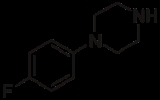
para-Fluorophenylpiperazine (pFPP, 4-FPP; Fluoperazine, Flipiperazine) is a piperazine
derivative with mildly psychedelic
and euphoriant
effects. It has been sold as an ingredient in legal recreational drugs known as "Party pills
", initially in New Zealand
and subsequently in other countries around the world.
pFPP has been found in vitro
to act mainly as a 5-HT1A receptor agonist
, with some additionally affinity for the 5-HT2A and 5-HT2C receptors. It has also been shown to inhibit
the reuptake
of serotonin
and norepinephrine
, and to possibly induce their release
.
pFPP was originally discovered as a metabolite
of the hypnotic antihistamine niaprazine
in 1982, but was rediscovered in 2003 as a potential recreational drug, and sold as an ingredient in "Party pills" in New Zealand, under brand names such as "The Big Grin", "Mashed", and "Extreme Beans". Subsequently it has continued to be used as an ingredient in black market "ecstasy" pills around the world.
pFPP has little stimulant effects, with its subjective effects derived mainly from its action as a 5-HT1A receptor agonist. pFPP is active at doses between 20–150 mg, but higher doses cause a range of side effects such as migraine
headache
s, muscle aches, anxiety
, nausea
, and vomiting
. Metabolic studies have shown pFPP to be an inhibitor of various Cytochrome P450 enzymes in the liver which may contribute to its side effect profile.
Based on the recommendation of the EACD, the New Zealand government has passed legislation which placed BZP, along with a number of other piperazine derivatives into Class C of the New Zealand Misuse of Drugs Act 1975. A ban was intended to come into effect in New Zealand on December 18 2007, but the law change did not go through until the following year, and the sale of BZP and the other listed piperazines became illegal in New Zealand as of 1st of April 2008. An amnesty for possession and usage of these drugs remained until October 2008, at which point they became completely illegal.
Piperazine
Piperazine is an organic compound that consists of a six-membered ring containing two opposing nitrogen atoms. Piperazine exists as small alkaline deliquescent crystals with a saline taste....
derivative with mildly psychedelic
Psychedelic drug
A psychedelic substance is a psychoactive drug whose primary action is to alter cognition and perception. Psychedelics are part of a wider class of psychoactive drugs known as hallucinogens, a class that also includes related substances such as dissociatives and deliriants...
and euphoriant
Euphoriant
A euphoriant is a type of psychoactive drug which tends to induce feelings of euphoria, the effects of which may include relaxation, anxiolysis, stress relief, mood lift, pleasure, and a rush although these effects are not necessary for a drug to be a euphoriant. Many euphoriants are notorious for...
effects. It has been sold as an ingredient in legal recreational drugs known as "Party pills
Party pills
Party pills, also known as "herbal highs", "pep pills" "dance pills" and "natural power", is a colloquialism for a type of recreational drug whose main ingredient was originally benzylpiperazine , but has now expanded to a wide range of compounds with a variety of effects...
", initially in New Zealand
New Zealand
New Zealand is an island country in the south-western Pacific Ocean comprising two main landmasses and numerous smaller islands. The country is situated some east of Australia across the Tasman Sea, and roughly south of the Pacific island nations of New Caledonia, Fiji, and Tonga...
and subsequently in other countries around the world.
pFPP has been found in vitro
In vitro
In vitro refers to studies in experimental biology that are conducted using components of an organism that have been isolated from their usual biological context in order to permit a more detailed or more convenient analysis than can be done with whole organisms. Colloquially, these experiments...
to act mainly as a 5-HT1A receptor agonist
Agonist
An agonist is a chemical that binds to a receptor of a cell and triggers a response by that cell. Agonists often mimic the action of a naturally occurring substance...
, with some additionally affinity for the 5-HT2A and 5-HT2C receptors. It has also been shown to inhibit
Reuptake inhibitor
A reuptake inhibitor , also known as a transporter blocker, is a drug that inhibits the plasmalemmal transporter-mediated reuptake of a neurotransmitter from the synapse into the pre-synaptic neuron, leading to an increase in the extracellular concentrations of the neurotransmitter and therefore an...
the reuptake
Reuptake
Reuptake, or re-uptake, is the reabsorption of a neurotransmitter by a neurotransmitter transporter of a pre-synaptic neuron after it has performed its function of transmitting a neural impulse....
of serotonin
Serotonin
Serotonin or 5-hydroxytryptamine is a monoamine neurotransmitter. Biochemically derived from tryptophan, serotonin is primarily found in the gastrointestinal tract, platelets, and in the central nervous system of animals including humans...
and norepinephrine
Norepinephrine
Norepinephrine is the US name for noradrenaline , a catecholamine with multiple roles including as a hormone and a neurotransmitter...
, and to possibly induce their release
Releasing agent
A releasing agent , or simply releaser, is a drug that induces the release of a neurotransmitter from the presynaptic neuron into the synapse, leading to an increase in the extracellular concentrations of the neurotransmitter. Many drugs use neurotransmitter release to exert their psychological and...
.
pFPP was originally discovered as a metabolite
Metabolite
Metabolites are the intermediates and products of metabolism. The term metabolite is usually restricted to small molecules. A primary metabolite is directly involved in normal growth, development, and reproduction. Alcohol is an example of a primary metabolite produced in large-scale by industrial...
of the hypnotic antihistamine niaprazine
Niaprazine
Niaprazine is a sedative-hypnotic drug of the phenylpiperazine class. It has been used in the treatment of sleep disturbances since the early 1970s in several European countries, including France, Italy, and Luxembourg...
in 1982, but was rediscovered in 2003 as a potential recreational drug, and sold as an ingredient in "Party pills" in New Zealand, under brand names such as "The Big Grin", "Mashed", and "Extreme Beans". Subsequently it has continued to be used as an ingredient in black market "ecstasy" pills around the world.
pFPP has little stimulant effects, with its subjective effects derived mainly from its action as a 5-HT1A receptor agonist. pFPP is active at doses between 20–150 mg, but higher doses cause a range of side effects such as migraine
Migraine
Migraine is a chronic neurological disorder characterized by moderate to severe headaches, and nausea...
headache
Headache
A headache or cephalalgia is pain anywhere in the region of the head or neck. It can be a symptom of a number of different conditions of the head and neck. The brain tissue itself is not sensitive to pain because it lacks pain receptors. Rather, the pain is caused by disturbance of the...
s, muscle aches, anxiety
Anxiety
Anxiety is a psychological and physiological state characterized by somatic, emotional, cognitive, and behavioral components. The root meaning of the word anxiety is 'to vex or trouble'; in either presence or absence of psychological stress, anxiety can create feelings of fear, worry, uneasiness,...
, nausea
Nausea
Nausea , is a sensation of unease and discomfort in the upper stomach with an involuntary urge to vomit. It often, but not always, precedes vomiting...
, and vomiting
Vomiting
Vomiting is the forceful expulsion of the contents of one's stomach through the mouth and sometimes the nose...
. Metabolic studies have shown pFPP to be an inhibitor of various Cytochrome P450 enzymes in the liver which may contribute to its side effect profile.
Based on the recommendation of the EACD, the New Zealand government has passed legislation which placed BZP, along with a number of other piperazine derivatives into Class C of the New Zealand Misuse of Drugs Act 1975. A ban was intended to come into effect in New Zealand on December 18 2007, but the law change did not go through until the following year, and the sale of BZP and the other listed piperazines became illegal in New Zealand as of 1st of April 2008. An amnesty for possession and usage of these drugs remained until October 2008, at which point they became completely illegal.
See also
- 1-Benzylpiperazine (BZP)
- 1-Methyl-4-benzylpiperazine1-Methyl-4-benzylpiperazineMBZP is a stimulant drug which is a derivative of benzylpiperazine. MBZP has been sold as an ingredient in legal recreational drugs known as "Party pills", initially in New Zealand and subsequently in other countries around the world.The effects of MBZP are very similar to those of BZP, but the...
(MBZP) - 1,4-Dibenzylpiperazine (DBZP)
- 3-Chlorophenylpiperazine1-(3-Chlorophenyl)piperazinemeta-Chlorophenylpiperazine is a psychoactive drug of the phenylpiperazine class. It was initially developed in the late-1970s and used in scientific research before being sold as a designer drug in the mid-2000s...
(mCPP) - 3-Trifluoromethylphenylpiperazine (TFMPP)
- 3,4-Methylenedioxy-1-benzylpiperazine (MDBZP)
- 4-Bromo-2,5-dimethoxy-1-benzylpiperazine (2C-B-BZP)
- 4-MethoxyphenylpiperazineMeOPPpara-Methoxyphenylpiperazine is a piperazine derivative with stimulant effects which has been sold as an ingredient in "Party pills", initially in New Zealand and subsequently in other countries around the world.MeOPP has been found in vitro to inhibit the reuptake and induce the release of the...
(MeOPP)