
All Topics  
Agonist


   Email Print
   Bookmark   Link


Agonist


An agonist is a term used to describe a type of ligand
Ligand (biochemistry)

In biochemistry, a ligand is a Chemical substance that is able to bind to and form a Complex with a biomolecule to serve a biological purpose....
 or drug
Drug

A drug, broadly speaking, is any chemical substance that, when absorbed into the body of a living organism, alters normal bodily function....
 that binds and alters the activity of a receptor
Receptor (biochemistry)

In biochemistry, a receptor is a protein molecule, embedded in either the plasma membrane or cytoplasm of a cell, to which a mobile signaling molecule may attach....
. The ability to alter the activity of a receptor, also known as the agonist's efficacy
Efficacy

Efficacy is the capacity to produce an effect.It is these conditions that distinguish efficacy from the related concept of effectiveness, which relates to change under real-life conditions....
 is a property that distinguishes it from antagonists
Receptor antagonist

A receptor antagonist is a type of receptor ligand or drug that does not provoke a biological response itself upon binding to a Receptor , but blocks or dampens agonist-mediated responses....
, a type of receptor ligand which also binds a receptor but which does not alter the activity of the receptor.


Discussion
Ask a question about 'Agonist'
Start a new discussion about 'Agonist'
Answer questions from other users
Full Discussion Forum


Recent Posts


Encyclopedia


Agonist
An agonist is a term used to describe a type of ligand
Ligand (biochemistry)

In biochemistry, a ligand is a Chemical substance that is able to bind to and form a Complex with a biomolecule to serve a biological purpose....
 or drug
Drug

A drug, broadly speaking, is any chemical substance that, when absorbed into the body of a living organism, alters normal bodily function....
 that binds and alters the activity of a receptor
Receptor (biochemistry)

In biochemistry, a receptor is a protein molecule, embedded in either the plasma membrane or cytoplasm of a cell, to which a mobile signaling molecule may attach....
. The ability to alter the activity of a receptor, also known as the agonist's efficacy
Efficacy

Efficacy is the capacity to produce an effect.It is these conditions that distinguish efficacy from the related concept of effectiveness, which relates to change under real-life conditions....
 is a property that distinguishes it from antagonists
Receptor antagonist

A receptor antagonist is a type of receptor ligand or drug that does not provoke a biological response itself upon binding to a Receptor , but blocks or dampens agonist-mediated responses....
, a type of receptor ligand which also binds a receptor but which does not alter the activity of the receptor. The efficacy
Efficacy

Efficacy is the capacity to produce an effect.It is these conditions that distinguish efficacy from the related concept of effectiveness, which relates to change under real-life conditions....
 of an agonist may be positive, causing an increase in the receptor's activity or negative causing a decrease in the receptor's activity.

Types

Full agonists bind (have affinity
Dissociation constant

In chemistry and biochemistry, a dissociation constant is a specific type of equilibrium constant that measures the propensity of a larger object to separate reversibly into smaller components, as...
 for) and activate a receptor, displaying full efficacy
Efficacy

Efficacy is the capacity to produce an effect.It is these conditions that distinguish efficacy from the related concept of effectiveness, which relates to change under real-life conditions....
 at that receptor. One example of a drug that acts as a full agonist is isoproterenol
Isoproterenol

Isoprenaline or isoproterenol is a sympathomimetic beta adrenergic agonist medication.It is structurally similar to epinephrine but acts selectively on beta receptors, activating ?1 and ?2 receptors equally....
 which mimics the action of adrenaline
Epinephrine

Epinephrine is a hormone and neurotransmitter.Epinephrine increases the "fight or flight" response of the Sympathetic nervous system of the autonomic nervous system....
 at ß adrenoreceptor
Adrenergic receptor

The adrenergic receptors are a class of G protein-coupled receptors that are targets of the catecholamines. Adrenergic Receptor s specifically bind and are activated by their endogenous ligands, the catecholamines adrenaline and noradrenaline ....
s. Another example is morphine, which mimics the actions of endorphin
Endorphin

Endorphins are endogenous opioid polypeptide compounds. They are produced by the pituitary gland and the hypothalamus in vertebrates during strenuous exercise, excitement, pain, and orgasm, and they resemble the opiates in their abilities to produce analgesia and a sense of well-being....
s at µ-opioid receptors throughout the central nervous system
Central nervous system

The central nervous system is the part of the nervous system that functions to coordinate the activity of all parts of the bodies of multicellular organisms....
.

Partial agonist
Partial agonist

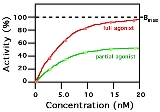
Partial agonists bind and activate a given receptor, but have only partial efficacy#Pharmacology at the receptor relative to a full agonist. They may also be considered ligands which display both agonistic and antagonistic effects - when both a full agonist and partial agonist are present, the partial agonist actually acts as a competitive...
s
(such as buspirone
Buspirone

Buspirone is an anxiolytic agent and a serotonin receptor agonist belonging to the azaspirodecanedione class of compounds. Its structure is unrelated to those of the benzodiazepines, but it has an efficacy comparable to diazepam in treating generalized anxiety disorder....
, aripiprazole
Aripiprazole

Aripiprazole was approved by the Food and Drug Administration on November 15, 2002 for the treatment of schizophrenia, the sixth atypical antipsychotic medication of its kind....
, buprenorphine
Buprenorphine

Buprenorphine is a semi-synthetic opiate with agonist and receptor antagonist actions. Buprenorphine hydrochloride was first marketed in the 1980s by Reckitt & Colman as an analgesic, available generally as Temgesic 0.2 mg sublingual tablets, and as Buprenex in a 0.3 mg/ml injectable formulation....
, or norclozapine
Clozapine

Clozapine is an antipsychotic and benzodiazepine medication used in the treatment of schizophrenia. The first of the atypical antipsychotics to be developed, it was first introduced in Europe in 1971, but was voluntarily withdrawn by the manufacturer in 1975 after it was shown to cause agranulocytosis that led to death in some patients....
) also bind and activate a given receptor, but have only partial efficacy
Efficacy

Efficacy is the capacity to produce an effect.It is these conditions that distinguish efficacy from the related concept of effectiveness, which relates to change under real-life conditions....
 at the receptor relative to a full agonist. One study of benzodiazepine active sedative hypnotics found that partial agonists have just under half the strength of full agonists. Partial agonists such as abecarnil
Abecarnil

Abecarnil is an anxiolytic drug from the beta-Carboline family. It is one of a relatively recently developed class of medicines known as the nonbenzodiazepines, which have similar effects to the older benzodiazepine group, but with quite different chemical structures....
 have demonstrated a reduced rate and reduced severity of dependence and withdrawal syndromes.

An inverse agonist
Inverse agonist

In pharmacology, an inverse agonist is an agent which binds to the same receptor binding-site as an agonist for that receptor and reverses Receptor #Constitutive activity of receptors....
 is an agent which binds to the same receptor binding-site as an agonist for that receptor and reverses constitutive activity of receptors. Inverse agonists exert the opposite pharmacological effect of a receptor agonist.

A co-agonist works with other co-agonists to produce the desired effect together. NMDA receptor activation requires the binding of both of its glutamate and glycine co-agonists. An antagonist
Receptor antagonist

A receptor antagonist is a type of receptor ligand or drug that does not provoke a biological response itself upon binding to a Receptor , but blocks or dampens agonist-mediated responses....
 blocks a receptor from activation by agonists.

A selective agonist is selective for one certain type of receptor. It can additionally be of any of the aforementioned types.

A physiological agonist
Physiological agonism and antagonism

Physiological agonism and antagonism is the mechanism of substances to induce the same ultimate effects in the body as other substances, as if they were receptor agonists or receptor antagonist, but without binding to the same receptor ....
 is a substance that creates the same bodily responses, but does not bind to the same receptor.

Receptors can be activated or inactivated either by endogenous
Endogenous

The word endogenous means "arising from within", the opposite of exogenous....
 (such as hormone
Hormone

Hormones are chemicals released by cells that affect cells in other parts of the body. Only a small amount of hormone is required to alter cell metabolism....
s and neurotransmitter
Neurotransmitter

Neurotransmitters are chemistry which relay, amplify and modulate signals between a neuron and another cell . Neurotransmitters are packaged into vesicles that cluster beneath the membrane on the presynaptic side of a synapse, and are released into the synaptic cleft, where they bind to receptors in the membrane on the postsynaptic side of...
s) or exogenous
Exogenous

Exogenous refers to an action or object coming from outside a system. It is the opposite of endogenous, something generated from within the system....
  (such as drugs
Medication

A pharmaceutical drug, also referred to as medicine or medicament, can be loosely defined as any substance intended for use in the diagnosis, cure, mitigation, treatment, or prevention of disease....
) agonists and antagonists, resulting in stimulating or inhibiting a biological response. To see how an agonist may activate a receptor see this

New findings that broaden the conventional definition of pharmacology demonstrate that ligands can concurrently behave as agonist and antagonists at the same receptor, depending on effector pathways. Terms that describe this phenomenon are "functional selectivity
Functional Selectivity

Functional selectivity is the ligand-dependent selectivity for certain signal transduction pathways in one and the same receptor . This can be present when a receptor has several possible signal transduction pathways....
" or "protean agonism".

Activity


Potency

The potency
Potency

Potency may refer to:*Virility*Potency , a measure of the activity of a drug in a biological system*In biology, Stem cell#Potency definitions is a measure of the differentiation potential of stem cells...
 of an agonist is usually defined by its EC50 value. This can be calculated for a given agonist by determining the concentration of agonist needed to elicit half of the maximum biological response of the agonist. Elucidating an EC50 value is useful for comparing the potency of drugs with similar efficacies
Efficacy

Efficacy is the capacity to produce an effect.It is these conditions that distinguish efficacy from the related concept of effectiveness, which relates to change under real-life conditions....
 producing physiologically similar effects. The lower the EC50, the greater the potency of the agonist the lower the concentration of drug that is required to elicit the maximum biological response

Therapeutic index

When a drug is used therapeutically, it is important to understand the margin of safety that exists between the dose needed for the desired effect and the dose that produces unwanted and possibly dangerous side effects. This relationship, termed the therapeutic index
Therapeutic index

The therapeutic index , is a comparison of the amount of a therapeutic agent that causes the therapeutic effect to the amount that causes toxic effects....
, is defined as the ratio LD50:ED50
Effective dose

An effective dose in pharmacology is the amount of medication that produces a therapeutic response in 50% of the people taking it, sometimes also called ED-50....
. In general, the narrower this margin, the more likely it is that the drug will produce unwanted effects. The therapeutic index has many limitations, notably the fact that LD50 cannot be measured in humans and, when measured in animals, is a poor guide to the likelihood of unwanted effects in humans. Nevertheless, the therapeutic index emphasizes the importance of the margin of safety, as distinct from the potency, in determining the usefulness of a drug.

Etymology

From the Greek
Ancient greek language

#REDIRECT Ancient Greek...
 a????st?? (agonistes), contestant; champion; rival < a??? (agon), contest, combat; exertion, struggle < a?? (ago), I lead, lead towards, conduct; drive

See also

  • Receptor theory
    Receptor theory

    Receptor theory is the application of receptor models to explain drug behaviour. Pharmacological receptor models had preceded accurate knowledge of receptor for many years....
  • Functional selectivity
    Functional Selectivity

    Functional selectivity is the ligand-dependent selectivity for certain signal transduction pathways in one and the same receptor . This can be present when a receptor has several possible signal transduction pathways....
  • Inverse agonist
    Inverse agonist

    In pharmacology, an inverse agonist is an agent which binds to the same receptor binding-site as an agonist for that receptor and reverses Receptor #Constitutive activity of receptors....
  • Receptor antagonist
    Receptor antagonist

    A receptor antagonist is a type of receptor ligand or drug that does not provoke a biological response itself upon binding to a Receptor , but blocks or dampens agonist-mediated responses....
  • Excitatory postsynaptic potential
    Excitatory postsynaptic potential

    In neuroscience, an excitatory postsynaptic potential is a temporary depolarization of postsynaptic membrane potential caused by the flow of positively charged ions into the postsynaptic cell as a result of opening of ligand-sensitive channels....
  • Allosteric modulator
    Allosteric regulation

    In biochemistry, allosteric regulation is the regulation of an enzyme or other protein by binding an Effector molecule at the protein's allosteric site ....
  • Intrinsic activity
    Efficacy

    Efficacy is the capacity to produce an effect.It is these conditions that distinguish efficacy from the related concept of effectiveness, which relates to change under real-life conditions....
  • Dose response curve