


Oxeye daisy

Encyclopedia
Leucanthemum vulgare, the oxeye daisy, (syn.
Chrysanthemum leucanthemum), is a widespread flowering plant
native to Europe
and the temperate regions of Asia
. It is one of a number of Asteraceae
family plants to be called a 'daisy,' and has the vernacular names common daisy, dog daisy, margarite, moon daisy, and ox-eye daisy.
Leucanthemum vulgare is a typical grassland
perennial wildflower
, growing in a variety of plant communities including meadows and field
s, under scrub
and open-canopy forests, and in disturbed areas.
herb
2 feet (61 cm) high by 1 foot (0.3048 m) wide. The stem is mostly unbranched and sprouts laterally from a creeping rhizomatous
rootstock
.
The leaves
are dark green on both sides. The basal and middle leaves are petiolate, obovate to spoon-shaped, and serrate to dentate. The upper leaves are shorter, sessile, and borne along the stem.
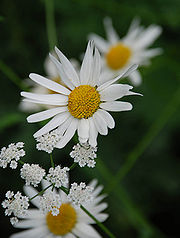
Leucanthemum vulgare blooms from late spring to autumn. The small flower head, not larger than 5 centimetres (2 in), consists of about 20 white ray floret
s that surround a yellow disc, growing on the end of 1 to 3 ft (30.5 to 91.4 cm) tall stem
s. The plant produces an abundant number of flat seed
s, without pappus
, that remain viable in the soil for 2 to 3 years. It also spreads vegetatively by rhizome
s.
 Food
Food
The un-opened flower bud
s can be marinated and used in a similar way to caper
s.
Cultivation
Leucanthemum vulgare is widely cultivated and available as a perennial
flowering ornamental plant
for gardens and designed meadow landscape
s. It thrives in a wide range of conditions and can grow in sun to partial shade, and prefers damp soil
s. There are cultivar
s, such as 'May Queen' which begins blooming in early spring.
In North Carolina
it is planted as a roadside wildflower by the state highway department.
via gardens into natural area
s in parts of the United States
, Australia
, and New Zealand
, where it is now a common weed
. In some habitat
s it is an invasive species
forming dense colonies displacing native plant
s and modifying existing communities, and classified as a noxious weed. It is difficult to control or eradicate, since a new plant can regenerate from rhizome fragments.
Oxeye daisy is a host for several viral diseases affecting crops.
" (effeuiller la marguerite in French) is associated with this flower.
Synonym (taxonomy)
In scientific nomenclature, a synonym is a scientific name that is or was used for a taxon of organisms that also goes by a different scientific name. For example, Linnaeus was the first to give a scientific name to the Norway spruce, which he called Pinus abies...
Chrysanthemum leucanthemum), is a widespread flowering plant
Flowering plant
The flowering plants , also known as Angiospermae or Magnoliophyta, are the most diverse group of land plants. Angiosperms are seed-producing plants like the gymnosperms and can be distinguished from the gymnosperms by a series of synapomorphies...
native to Europe
Europe
Europe is, by convention, one of the world's seven continents. Comprising the westernmost peninsula of Eurasia, Europe is generally 'divided' from Asia to its east by the watershed divides of the Ural and Caucasus Mountains, the Ural River, the Caspian and Black Seas, and the waterways connecting...
and the temperate regions of Asia
Asia
Asia is the world's largest and most populous continent, located primarily in the eastern and northern hemispheres. It covers 8.7% of the Earth's total surface area and with approximately 3.879 billion people, it hosts 60% of the world's current human population...
. It is one of a number of Asteraceae
Asteraceae
The Asteraceae or Compositae , is an exceedingly large and widespread family of vascular plants. The group has more than 22,750 currently accepted species, spread across 1620 genera and 12 subfamilies...
family plants to be called a 'daisy,' and has the vernacular names common daisy, dog daisy, margarite, moon daisy, and ox-eye daisy.
Leucanthemum vulgare is a typical grassland
Grassland
Grasslands are areas where the vegetation is dominated by grasses and other herbaceous plants . However, sedge and rush families can also be found. Grasslands occur naturally on all continents except Antarctica...
perennial wildflower
Wildflower
A wildflower is a flower that grows wild, meaning it was not intentionally seeded or planted. Yet "wildflower" meadows of a few mixed species are sold in seed packets. The term "wildflower" has been made vague by commercial seedsmen who are interested in selling more flowers or seeds more...
, growing in a variety of plant communities including meadows and field
Field (agriculture)
In agriculture, the word field refers generally to an area of land enclosed or otherwise and used for agricultural purposes such as:* Cultivating crops* Usage as a paddock or, generally, an enclosure of livestock...
s, under scrub
Shrubland
Shrubland, scrubland, scrub or brush is a plant community characterized by vegetation dominated by shrubs, often also including grasses, herbs, and geophytes. Shrubland may either occur naturally or be the result of human activity...
and open-canopy forests, and in disturbed areas.
Description
Leucanthemum vulgare is a perennialPerennial plant
A perennial plant or simply perennial is a plant that lives for more than two years. The term is often used to differentiate a plant from shorter lived annuals and biennials. The term is sometimes misused by commercial gardeners or horticulturalists to describe only herbaceous perennials...
herb
Herb
Except in botanical usage, an herb is "any plant with leaves, seeds, or flowers used for flavoring, food, medicine, or perfume" or "a part of such a plant as used in cooking"...
2 feet (61 cm) high by 1 foot (0.3048 m) wide. The stem is mostly unbranched and sprouts laterally from a creeping rhizomatous
Rhizome
In botany and dendrology, a rhizome is a characteristically horizontal stem of a plant that is usually found underground, often sending out roots and shoots from its nodes...
rootstock
Rootstock
A rootstock is a plant, and sometimes just the stump, which already has an established, healthy root system, used for grafting a cutting or budding from another plant. The tree part being grafted onto the rootstock is usually called the scion...
.
The leaves
Leaf
A leaf is an organ of a vascular plant, as defined in botanical terms, and in particular in plant morphology. Foliage is a mass noun that refers to leaves as a feature of plants....
are dark green on both sides. The basal and middle leaves are petiolate, obovate to spoon-shaped, and serrate to dentate. The upper leaves are shorter, sessile, and borne along the stem.
Leucanthemum vulgare blooms from late spring to autumn. The small flower head, not larger than 5 centimetres (2 in), consists of about 20 white ray floret
Flower
A flower, sometimes known as a bloom or blossom, is the reproductive structure found in flowering plants . The biological function of a flower is to effect reproduction, usually by providing a mechanism for the union of sperm with eggs...
s that surround a yellow disc, growing on the end of 1 to 3 ft (30.5 to 91.4 cm) tall stem
Plant stem
A stem is one of two main structural axes of a vascular plant. The stem is normally divided into nodes and internodes, the nodes hold buds which grow into one or more leaves, inflorescence , conifer cones, roots, other stems etc. The internodes distance one node from another...
s. The plant produces an abundant number of flat seed
Seed
A seed is a small embryonic plant enclosed in a covering called the seed coat, usually with some stored food. It is the product of the ripened ovule of gymnosperm and angiosperm plants which occurs after fertilization and some growth within the mother plant...
s, without pappus
Pappus (flower structure)
The pappus is the modified calyx, the part of an individual disk, ray or ligule floret surrounding the base of the corolla, in flower heads of the plant family Asteraceae. The pappus may be composed of bristles , awns, scales, or may be absent. In some species, the pappus is too small to see...
, that remain viable in the soil for 2 to 3 years. It also spreads vegetatively by rhizome
Rhizome
In botany and dendrology, a rhizome is a characteristically horizontal stem of a plant that is usually found underground, often sending out roots and shoots from its nodes...
s.
Uses
The un-opened flower bud
Bud
In botany, a bud is an undeveloped or embryonic shoot and normally occurs in the axil of a leaf or at the tip of the stem. Once formed, a bud may remain for some time in a dormant condition, or it may form a shoot immediately. Buds may be specialized to develop flowers or short shoots, or may have...
s can be marinated and used in a similar way to caper
Caper
Capparis spinosa, the caper bush, is a perennial winter-deciduous species that bears rounded, fleshy leaves and large white to pinkish-white flowers. A caper is also the pickled bud of this plant...
s.
Cultivation
Leucanthemum vulgare is widely cultivated and available as a perennial
Perennial plant
A perennial plant or simply perennial is a plant that lives for more than two years. The term is often used to differentiate a plant from shorter lived annuals and biennials. The term is sometimes misused by commercial gardeners or horticulturalists to describe only herbaceous perennials...
flowering ornamental plant
Ornamental plant
Ornamental plants are plants that are grown for decorative purposes in gardens and landscape design projects, as house plants, for cut flowers and specimen display...
for gardens and designed meadow landscape
Designed landscape
A designed landscape is an area of land which has been modified by people for primarily aesthetic effect. The term is used by historians to denote various types of site, such as gardens, parks, cemeteries, and estates. Such sites are often protected for their historic or artistic value...
s. It thrives in a wide range of conditions and can grow in sun to partial shade, and prefers damp soil
Soil
Soil is a natural body consisting of layers of mineral constituents of variable thicknesses, which differ from the parent materials in their morphological, physical, chemical, and mineralogical characteristics...
s. There are cultivar
Cultivar
A cultivar'Cultivar has two meanings as explained under Formal definition. When used in reference to a taxon, the word does not apply to an individual plant but to all those plants sharing the unique characteristics that define the cultivar. is a plant or group of plants selected for desirable...
s, such as 'May Queen' which begins blooming in early spring.
In North Carolina
North Carolina
North Carolina is a state located in the southeastern United States. The state borders South Carolina and Georgia to the south, Tennessee to the west and Virginia to the north. North Carolina contains 100 counties. Its capital is Raleigh, and its largest city is Charlotte...
it is planted as a roadside wildflower by the state highway department.
Invasive species
Leucanthemum vulgare has became an introduced speciesIntroduced species
An introduced species — or neozoon, alien, exotic, non-indigenous, or non-native species, or simply an introduction, is a species living outside its indigenous or native distributional range, and has arrived in an ecosystem or plant community by human activity, either deliberate or accidental...
via gardens into natural area
Natural environment
The natural environment encompasses all living and non-living things occurring naturally on Earth or some region thereof. It is an environment that encompasses the interaction of all living species....
s in parts of the United States
United States
The United States of America is a federal constitutional republic comprising fifty states and a federal district...
, Australia
Australia
Australia , officially the Commonwealth of Australia, is a country in the Southern Hemisphere comprising the mainland of the Australian continent, the island of Tasmania, and numerous smaller islands in the Indian and Pacific Oceans. It is the world's sixth-largest country by total area...
, and New Zealand
New Zealand
New Zealand is an island country in the south-western Pacific Ocean comprising two main landmasses and numerous smaller islands. The country is situated some east of Australia across the Tasman Sea, and roughly south of the Pacific island nations of New Caledonia, Fiji, and Tonga...
, where it is now a common weed
Weed
A weed in a general sense is a plant that is considered by the user of the term to be a nuisance, and normally applied to unwanted plants in human-controlled settings, especially farm fields and gardens, but also lawns, parks, woods, and other areas. More specifically, the term is often used to...
. In some habitat
Habitat
* Habitat , a place where a species lives and grows*Human habitat, a place where humans live, work or play** Space habitat, a space station intended as a permanent settlement...
s it is an invasive species
Invasive species
"Invasive species", or invasive exotics, is a nomenclature term and categorization phrase used for flora and fauna, and for specific restoration-preservation processes in native habitats, with several definitions....
forming dense colonies displacing native plant
Native plant
Native plant is a term to describe plants endemic or naturalized to a given area in geologic time.This includes plants that have developed, occur naturally, or existed for many years in an area...
s and modifying existing communities, and classified as a noxious weed. It is difficult to control or eradicate, since a new plant can regenerate from rhizome fragments.
Oxeye daisy is a host for several viral diseases affecting crops.
Popular culture
The prose game "He loves me, he loves me notHe Loves Me... He Loves Me Not
He Loves Me, He Loves Me Not or She Loves Me, She Loves Me Not is a game of French origin, in which one person seeks to determine whether the object of their affection returns that affection or not....
" (effeuiller la marguerite in French) is associated with this flower.
See also
- Buphthalmum salicifolium - Yellow oxeye daisyBuphthalmum salicifoliumYellow oxeye daisy is a species of ornamental plant.It stands 30 to 60 cm high and blooms between May and September. The species may be mistaken for Inula salicina, which has narrower ligules; or for Arnica montana. It ideally needs lime soil though other soil types may be used....
- Argyranthemum frutescens - Marguerite daisyArgyranthemum frutescensArgyranthemum frutescens, the marguerite and marguerite daisy, is a perennial forb known for its flowers. It is native to the Canary Islands in Macaronesia.-Cultivation:...