
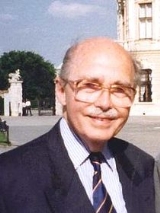
Otto von Habsburg also known by his royal name as
Archduke Otto of Austria, was the last
Crown Prince of Austria-Hungary from 1916 until the dissolution of the empire in 1918, a realm which comprised modern-day
AustriaAustria , officially the Republic of Austria , is a landlocked country of roughly 8.4 million people in Central Europe. It is bordered by the Czech Republic and Germany to the north, Slovakia and Hungary to the east, Slovenia and Italy to the south, and Switzerland and Liechtenstein to the...
,
HungaryHungary , officially the Republic of Hungary , is a landlocked country in Central Europe. It is situated in the Carpathian Basin and is bordered by Slovakia to the north, Ukraine and Romania to the east, Serbia and Croatia to the south, Slovenia to the southwest and Austria to the west. The...
,
Bosnia and HerzegovinaBosnia and Herzegovina , sometimes called Bosnia-Herzegovina or simply Bosnia, is a country in Southern Europe, on the Balkan Peninsula. Bordered by Croatia to the north, west and south, Serbia to the east, and Montenegro to the southeast, Bosnia and Herzegovina is almost landlocked, except for the...
,
CroatiaCroatia , officially the Republic of Croatia , is a unitary democratic parliamentary republic in Europe at the crossroads of the Mitteleuropa, the Balkans, and the Mediterranean. Its capital and largest city is Zagreb. The country is divided into 20 counties and the city of Zagreb. Croatia covers ...
, the
Czech RepublicThe Czech Republic is a landlocked country in Central Europe. The country is bordered by Poland to the northeast, Slovakia to the east, Austria to the south, and Germany to the west and northwest....
,
SlovakiaThe Slovak Republic is a landlocked state in Central Europe. It has a population of over five million and an area of about . Slovakia is bordered by the Czech Republic and Austria to the west, Poland to the north, Ukraine to the east and Hungary to the south...
,
SloveniaSlovenia , officially the Republic of Slovenia , is a country in Central and Southeastern Europe touching the Alps and bordering the Mediterranean. Slovenia borders Italy to the west, Croatia to the south and east, Hungary to the northeast, and Austria to the north, and also has a small portion of...
, and parts of
ItalyItaly , officially the Italian Republic languages]] under the European Charter for Regional or Minority Languages. In each of these, Italy's official name is as follows:;;;;;;;;), is a unitary parliamentary republic in South-Central Europe. To the north it borders France, Switzerland, Austria and...
,
MontenegroMontenegro Montenegrin: Crna Gora Црна Гора , meaning "Black Mountain") is a country located in Southeastern Europe. It has a coast on the Adriatic Sea to the south-west and is bordered by Croatia to the west, Bosnia and Herzegovina to the northwest, Serbia to the northeast and Albania to the...
,
PolandPoland , officially the Republic of Poland , is a country in Central Europe bordered by Germany to the west; the Czech Republic and Slovakia to the south; Ukraine, Belarus and Lithuania to the east; and the Baltic Sea and Kaliningrad Oblast, a Russian exclave, to the north...
,
RomaniaRomania is a country located at the crossroads of Central and Southeastern Europe, on the Lower Danube, within and outside the Carpathian arch, bordering on the Black Sea...
,
SerbiaSerbia , officially the Republic of Serbia , is a landlocked country located at the crossroads of Central and Southeast Europe, covering the southern part of the Carpathian basin and the central part of the Balkans...
and
UkraineUkraine is a country in Eastern Europe. It has an area of 603,628 km², making it the second largest contiguous country on the European continent, after Russia...
. He remained the
Crown Prince of HungaryThe King of Hungary was the head of state of the Kingdom of Hungary from 1000 to 1918.The style of title "Apostolic King" was confirmed by Pope Clement XIII in 1758 and used afterwards by all the Kings of Hungary, so after this date the kings are referred to as "Apostolic King of...
until also the deposition of the Habsburgs in Hungary in 1921. He subsequently became the
pretenderA pretender is one who claims entitlement to an unavailable position of honour or rank. Most often it refers to a former monarch, or descendant thereof, whose throne is occupied or claimed by a rival, or has been abolished....
to the former thrones, Head of the Imperial House of Habsburg, and
SovereignA sovereign is the supreme lawmaking authority within its jurisdiction.Sovereign may also refer to:*Monarch, the sovereign of a monarchy*Sovereign Bank, banking institution in the United States*Sovereign...
of the
Order of the Golden FleeceThe Order of the Golden Fleece is an order of chivalry founded in Bruges by Philip III, Duke of Burgundy in 1430, to celebrate his marriage to the Portuguese princess Infanta Isabella of Portugal, daughter of King John I of Portugal. It evolved as one of the most prestigious orders in Europe...
in 1922. He resigned as Sovereign of the Golden Fleece in 2000 and as head of the Imperial House in 2007.
The eldest son of Charles I, the last
Emperor of AustriaThe Emperor of Austria was a hereditary imperial title and position proclaimed in 1804 by the Holy Roman Emperor Francis II, a member of the House of Habsburg-Lorraine, and continually held by him and his heirs until the last emperor relinquished power in 1918. The emperors retained the title of...
and
King of HungaryThe King of Hungary was the head of state of the Kingdom of Hungary from 1000 to 1918.The style of title "Apostolic King" was confirmed by Pope Clement XIII in 1758 and used afterwards by all the Kings of Hungary, so after this date the kings are referred to as "Apostolic King of...
, and his wife,
Zita of Bourbon-ParmaPrincess Zita of Bourbon-Parma was the wife of Emperor Charles of Austria...
, Otto was born as third in line to the thrones, as
His Imperial and Royal Highness Archduke and Prince Imperial Otto of Austria, Prince Royal of Hungary, Croatia and Bohemia. With his father's accession to the thrones in 1916, he was himself likely to become the Emperor. As his father never abdicated, Otto was considered by himself, his family and Austro-Hungarian legitimists to be the rightful Emperor-King from 1922. Had the dual monarchy still existed, he might have had an 89-year reign.
Otto was active on the Austrian and European political stage from the 1930s, both by promoting the cause of Habsburg restoration and as an early proponent of
European integrationEuropean integration is the process of industrial, political, legal, economic integration of states wholly or partially in Europe...
—being thoroughly disgusted with
nationalismNationalism is a political ideology that involves a strong identification of a group of individuals with a political entity defined in national terms, i.e. a nation. In the 'modernist' image of the nation, it is nationalism that creates national identity. There are various definitions for what...
—and a fierce opponent of
NazismNazism, the common short form name of National Socialism was the ideology and practice of the Nazi Party and of Nazi Germany...
and
communismCommunism is a social, political and economic ideology that aims at the establishment of a classless, moneyless, revolutionary and stateless socialist society structured upon common ownership of the means of production...
. He has been described as one of the leaders of the Austrian anti-Nazi resistance. After the 1938
AnschlussThe Anschluss , also known as the ', was the occupation and annexation of Austria into Nazi Germany in 1938....
, monarchists were severely persecuted in Austria, and—sentenced to death by the Nazis—Otto fled to the United States, with a visa issued by
Aristides de Sousa MendesAristides de Sousa Mendes do Amaral e Abranches, GCC, OL was a Portuguese diplomat. He ignored and defied the orders of his own government for the safety of war refugees fleeing from invading German military forces in the early years of World War II...
.
Otto von Habsburg was Vice President (1957–1973) and President (1973–2004) of the
International Paneuropean UnionThe International Paneuropean Union claims to be the oldest European unification movement and is also referred to as the Paneuropean Movement and the Pan-Europa Movement...
, and served as a
Member of the European ParliamentA Member of the European Parliament is a person who has been elected to the European Parliament. The name of MEPs differ in different languages, with terms such as europarliamentarian or eurodeputy being common in Romance language-speaking areas.When the European Parliament was first established,...
for the
Christian Social Union of BavariaThe Christian Social Union in Bavaria is a Christian democratic and conservative political party in Germany. It operates only in the state of Bavaria, while its sister party, the Christian Democratic Union , operates in the other 15 states of Germany...
(CSU) 1979–1999. In 1961,
Francisco FrancoFrancisco Franco y Bahamonde was a Spanish general, dictator and head of state of Spain from October 1936 , and de facto regent of the nominally restored Kingdom of Spain from 1947 until his death in November, 1975...
offered him the crown of
SpainSpain , officially the Kingdom of Spain languages]] under the European Charter for Regional or Minority Languages. In each of these, Spain's official name is as follows:;;;;;;), is a country and member state of the European Union located in southwestern Europe on the Iberian Peninsula...
, but he declined on account of the Habsburg dynasty's long absence from the Spanish throne, and recommended
Juan CarlosJuan Carlos I |Italy]]) is the reigning King of Spain.On 22 November 1975, two days after the death of General Francisco Franco, Juan Carlos was designated king according to the law of succession promulgated by Franco. Spain had no monarch for 38 years in 1969 when Franco named Juan Carlos as the...
. As a newly elected Member of the European Parliament in 1979, Otto had an empty chair set up for the countries on the other side of the Iron Curtain in the European Parliament, and took a strong interest in the countries behind the Iron Curtain during his tenure. Otto von Habsburg played a central role in the
revolutions of 1989The Revolutions of 1989 were the revolutions which overthrew the communist regimes in various Central and Eastern European countries.The events began in Poland in 1989, and continued in Hungary, East Germany, Bulgaria, Czechoslovakia and...
, as a co-initiator of the
Pan-European PicnicThe Pan-European Picnic was a peace demonstration held on the Austrian-Hungarian border near the town of Sopron on 19 August 1989, an important event in political developments which led to the fall of the Iron Curtain and the reunification of Germany...
. Later he would be a strong supporter of the EU membership of central and eastern European countries. A noted intellectual, he has published several books on historical and political affairs. Otto has been described as one of the "architects of the European idea and of European integration" together with
Robert SchumanRobert Schuman was a noted Luxembourgish-born French statesman. Schuman was a Christian Democrat and an independent political thinker and activist...
,
Konrad AdenauerKonrad Hermann Joseph Adenauer was a German statesman. He was the chancellor of the West Germany from 1949 to 1963. He is widely recognised as a person who led his country from the ruins of World War II to a powerful and prosperous nation that had forged close relations with old enemies France,...
, and
Alcide De GasperiAlcide De Gasperi was an Italian statesman and politician and founder of the Christian Democratic Party. From 1945 to 1953 he was the prime minister of eight successive coalition governments. His eight-year rule remains a landmark of political longevity for a leader in modern Italian politics...
.
Otto was exiled in 1918 and grew up mostly in Spain. His devout Catholic mother raised him according to the old curriculum of Austria-Hungary, preparing him to become a
CatholicThe word catholic comes from the Greek phrase , meaning "on the whole," "according to the whole" or "in general", and is a combination of the Greek words meaning "about" and meaning "whole"...
monarchA monarch is the person who heads a monarchy. This is a form of government in which a state or polity is ruled or controlled by an individual who typically inherits the throne by birth and occasionally rules for life or until abdication...
. During his life in exile, he lived in
SwitzerlandSwitzerland name of one of the Swiss cantons. ; ; ; or ), in its full name the Swiss Confederation , is a federal republic consisting of 26 cantons, with Bern as the seat of the federal authorities. The country is situated in Western Europe,Or Central Europe depending on the definition....
,
MadeiraMadeira is a Portuguese archipelago that lies between and , just under 400 km north of Tenerife, Canary Islands, in the north Atlantic Ocean and an outermost region of the European Union...
, Spain,
BelgiumBelgium , officially the Kingdom of Belgium, is a federal state in Western Europe. It is a founding member of the European Union and hosts the EU's headquarters, and those of several other major international organisations such as NATO.Belgium is also a member of, or affiliated to, many...
,
FranceThe French Republic , The French Republic , The French Republic , (commonly known as France , is a unitary semi-presidential republic in Western Europe with several overseas territories and islands located on other continents and in the Indian, Pacific, and Atlantic oceans. Metropolitan France...
, the
United StatesThe United States of America is a federal constitutional republic comprising fifty states and a federal district...
, and from 1954 until his death, finally in
BavariaBavaria, formally the Free State of Bavaria is a state of Germany, located in the southeast of Germany. With an area of , it is the largest state by area, forming almost 20% of the total land area of Germany...
(
GermanyGermany , officially the Federal Republic of Germany , is a federal parliamentary republic in Europe. The country consists of 16 states while the capital and largest city is Berlin. Germany covers an area of 357,021 km2 and has a largely temperate seasonal climate...
), in the residence
Villa Austria. At the time of his death, he was a citizen of Germany, Austria, Hungary and Croatia, having earlier been
statelessStatelessness is a legal concept describing the lack of any nationality. It is the absence of a recognized link between an individual and any state....
de jure and
de facto and possessed passports of
MonacoMonaco , officially the Principality of Monaco , is a sovereign city state on the French Riviera. It is bordered on three sides by its neighbour, France, and its centre is about from Italy. Its area is with a population of 35,986 as of 2011 and is the most densely populated country in the...
, the Order of Malta, and
SpainSpain , officially the Kingdom of Spain languages]] under the European Charter for Regional or Minority Languages. In each of these, Spain's official name is as follows:;;;;;;), is a country and member state of the European Union located in southwestern Europe on the Iberian Peninsula...
.
His funeralOn 4 July 2011, Otto von Habsburg, also known as Otto of Austria, former head of the House of Habsburg and Sovereign of the Order of the Golden Fleece and former Crown Prince and, by pretence, Emperor-King , of Austria-Hungary—or formally, of Austria, Hungary and Bohemia, of Dalmatia, Croatia,...
took place at St. Stephen's Cathedral in
ViennaVienna is the capital and largest city of the Republic of Austria and one of the nine states of Austria. Vienna is Austria's primary city, with a population of about 1.723 million , and is by far the largest city in Austria, as well as its cultural, economic, and political centre...
on 16 July 2011; he was entombed in the Imperial Crypt in Vienna and
his heart buriedHeart-burial is a type of burial in which the heart is interred apart from the body. This is a very ancient practice, and the special reverence shown towards the heart is doubtless due to its early association with the soul, affections, courage and conscience of man.In medieval Europe heart-burial...
in
Pannonhalma ArchabbeyThe Benedictine Pannonhalma Archabbey is the most notable landmark in Pannonhalma and one of the oldest historical monuments in Hungary, founded in the year 996. It is located near the town, on top of a hill...
in Hungary.
Early life
Otto was born at Villa Wartholz in
Reichenau an der RaxReichenau an der Rax is a market town in the Austrian state of Lower Austria, situated at the foot of the Rax mountain range on the Schwarza river, a headstream of the Leitha.-History:Reichenau castle was first mentioned in a 1256 deed...
,
Austria-HungaryAustria-Hungary , more formally known as the Kingdoms and Lands Represented in the Imperial Council and the Lands of the Holy Hungarian Crown of Saint Stephen, was a constitutional monarchic union between the crowns of the Austrian Empire and the Kingdom of Hungary in...
. He was baptised
Franz Joseph Otto Robert Maria Anton Karl Max Heinrich Sixtus Xavier Felix Renatus Ludwig Gaetan Pius Ignatius on 25 November 1912 at Villa Wartholz by the Prince-Archbishop of Vienna, Cardinal
Franz Xaver NaglFranz Xaver Nagl S.T.D. was a Cardinal of the Roman Catholic Church and Archbishop of Vienna.Nagl was born in Vienna, Austria, as the son of Leopold Nagl, a doorman, and Barbara Kloiber...
. His godfather was the Emperor
Franz Joseph I of AustriaFranz Joseph I or Francis Joseph I was Emperor of Austria, King of Bohemia, King of Croatia, Apostolic King of Hungary, King of Galicia and Lodomeria and Grand Duke of Cracow from 1848 until his death in 1916.In the December of 1848, Emperor Ferdinand I of Austria abdicated the throne as part of...
(represented by
Archduke Franz Ferdinand of AustriaFranz Ferdinand was an Archduke of Austria-Este, Austro-Hungarian and Royal Prince of Hungary and of Bohemia, and from 1889 until his death, heir presumptive to the Austro-Hungarian throne. His assassination in Sarajevo precipitated Austria-Hungary's declaration of war against Serbia...
); his godmother was his grandmother
Infanta Maria Antonia of PortugalInfanta Maria Antónia of Portugal was a Portuguese infanta, the seventh and last child of Miguel I of Portugal and Adelaide of Löwenstein-Wertheim-Rosenberg.-Infanta of...
.
In November 1916, Otto became Crown Prince of
Austria, Hungary and BohemiaAustria-Hungary , more formally known as the Kingdoms and Lands Represented in the Imperial Council and the Lands of the Holy Hungarian Crown of Saint Stephen, was a constitutional monarchic union between the crowns of the Austrian Empire and the Kingdom of Hungary in...
when his father, Archduke Charles, acceded to the throne. However, in 1918, at the end of the First World War, the monarchies were abolished, the Republics of
AustriaThe Republic of Austria encompasses the period of Austrian history following the signing of the Treaty of Saint-Germain-en-Laye of September 1919, the settlement after the end of World War I which put an end to the Republic of German Austria, continuing up to World War II...
and
HungaryThe Hungarian People's Republic was an independent republic proclaimed after the collapse of Austria-Hungary in 1918...
founded instead, and the family was forced into exile in Madeira. Hungary did become a kingdom again, but Charles was never to regain the throne. Instead,
Miklós HorthyMiklós Horthy de Nagybánya was the Regent of the Kingdom of Hungary during the interwar years and throughout most of World War II, serving from 1 March 1920 to 15 October 1944. Horthy was styled "His Serene Highness the Regent of the Kingdom of Hungary" .Admiral Horthy was an officer of the...
ruled as regent until 1944, in a kingdom without a king.
He spoke
GermanGerman is a West Germanic language, related to and classified alongside English and Dutch. With an estimated 90 – 98 million native speakers, German is one of the world's major languages and is the most widely-spoken first language in the European Union....
,
HungarianHungarian is a Uralic language, part of the Ugric group. With some 14 million speakers, it is one of the most widely spoken non-Indo-European languages in Europe....
,
CroatianCroatian is the collective name for the standard language and dialects spoken by Croats, principally in Croatia, Bosnia and Herzegovina, the Serbian province of Vojvodina and other neighbouring countries...
,
EnglishEnglish is a West Germanic language that arose in the Anglo-Saxon kingdoms of England and spread into what was to become south-east Scotland under the influence of the Anglian medieval kingdom of Northumbria...
,
SpanishSpanish , also known as Castilian , is a Romance language in the Ibero-Romance group that evolved from several languages and dialects in central-northern Iberia around the 9th century and gradually spread with the expansion of the Kingdom of Castile into central and southern Iberia during the...
,
FrenchFrench is a Romance language spoken as a first language in France, the Romandy region in Switzerland, Wallonia and Brussels in Belgium, Monaco, the regions of Quebec and Acadia in Canada, and by various communities elsewhere. Second-language speakers of French are distributed throughout many parts...
and
LatinLatin is an Italic language originally spoken in Latium and Ancient Rome. It, along with most European languages, is a descendant of the ancient Proto-Indo-European language. Although it is considered a dead language, a number of scholars and members of the Christian clergy speak it fluently, and...
fluently. In later life, he would write some 40 books in German, Hungarian, French and Spanish. His mother made him learn many languages because she believed he one day might rule over many lands.
Years in exile
Otto's family spent the subsequent years in Switzerland, and on the Portuguese island of
MadeiraMadeira is a Portuguese archipelago that lies between and , just under 400 km north of Tenerife, Canary Islands, in the north Atlantic Ocean and an outermost region of the European Union...
, where Charles died prematurely in 1922, leaving the 9-year-old Otto
pretenderA pretender is one who claims entitlement to an unavailable position of honour or rank. Most often it refers to a former monarch, or descendant thereof, whose throne is occupied or claimed by a rival, or has been abolished....
to the throne. On his father's deathbed, his mother, then-Empress Dowager Zita, told the 9-year old, "your father is now sleeping the eternal sleep—you are now Emperor and King". The family eventually relocated to the
BasqueThe Basque Country is an autonomous community of northern Spain. It includes the Basque provinces of Álava, Biscay and Gipuzkoa, also called Historical Territories....
town of
Lekeitio Lekeitio is a town and municipality located in the province of Biscay, in the Spanish Autonomous Community of Basque Country, 53 km northeast from Bilbao. The municipality has 7,293 inhabitants and is one of the most important fishing ports of the Basque coast...
, where 40 Spanish
grandeeGrandee is the word used to render in English the Iberic high aristocratic title Grande , used by the Spanish nobility; Portuguese nobility, and Brazilian nobility....
s bought them a villa. Meanwhile, the Austrian parliament had officially expelled the Habsburg dynasty and confiscated all the official property (
Habsburg LawThe Habsburg Law was a law originally passed by the Constituting National Assembly of German Austria, one of the successor states of dismantled Austria-Hungary, on April 3, 1919, which legally dethroned the House of Habsburg-Lorraine as...
of 3 April 1919).
In 1935, he graduated with a
PhDDoctor of Philosophy, abbreviated as Ph.D., PhD, D.Phil., or DPhil , in English-speaking countries, is a postgraduate academic degree awarded by universities...
degree in Political and Social Sciences from the University of Louvain in
BelgiumBelgium , officially the Kingdom of Belgium, is a federal state in Western Europe. It is a founding member of the European Union and hosts the EU's headquarters, and those of several other major international organisations such as NATO.Belgium is also a member of, or affiliated to, many...
. From his father's death throughout the remainder of his time in exile, Otto considered himself the rightful emperor of Austria and stated this on many occasions. In 1937 he wrote,
“I know very well that the overwhelming majority of the Austrian population would like me to assume the heritage of the peace emperor, my beloved father, rather earlier than later. (...) The [Austrian] people have never cast a vote in favor of the republic. They have remained silent as long as they were exhausted from the long fight, and taken by surprise by the audacity of the revolutionaries of 1918 and 1919. They shook off their resignation when they realized that the revolution had raped their right to life and freedom. (...) Such trust places a heavy burden on me. I accept it readily. God willing, the hour of reunion between the Duke and the people will arrive soon.”
He continued to enjoy considerable public support in Austria; from 1931 to 1938, 1,603 Austrian municipalities named Otto an honorary citizen.
World War II
Otto strongly opposed the
AnschlussThe Anschluss , also known as the ', was the occupation and annexation of Austria into Nazi Germany in 1938....
of Austria to Nazi Germany. In 1938 he requested Austrian Chancellor
Kurt SchuschniggKurt Alois Josef Johann Schuschnigg was Chancellor of the First Austrian Republic, following the assassination of his predecessor, Dr. Engelbert Dollfuss, in July 1934, until Germany’s invasion of Austria, , in March 1938...
to resist the Nazis and supported an international intervention, and offered to return from exile to take over the reins of government in order to repel Hitler. According to Gerald Warner, "Austrian Jews were among the strongest supporters of a Habsburg restoration, since they believed the dynasty would give the nation sufficient resolve to stand up to the Third Reich".
Following the German annexation of Austria, Otto was sentenced to death by the Nazis. As ordered by
Adolf HitlerAdolf Hitler was an Austrian-born German politician and the leader of the National Socialist German Workers Party , commonly referred to as the Nazi Party). He was Chancellor of Germany from 1933 to 1945, and head of state from 1934 to 1945...
, his personal property and that of the House of Habsburg were confiscated and not given back after the war. The so-called "
Habsburg LawThe Habsburg Law was a law originally passed by the Constituting National Assembly of German Austria, one of the successor states of dismantled Austria-Hungary, on April 3, 1919, which legally dethroned the House of Habsburg-Lorraine as...
", which had previously been repealed, was reintroduced by the fiercely
republicanRepublicanism is the ideology of governing a nation as a republic, where the head of state is appointed by means other than heredity, often elections. The exact meaning of republicanism varies depending on the cultural and historical context...
and anti-monarchist Nazis. The leaders of the Austrian legitimist movement, i.e. supporters of Otto, were arrested by the Nazis and largely executed (
Stefan ZweigStefan Zweig was an Austrian novelist, playwright, journalist and biographer. At the height of his literary career, in the 1920s and 1930s, he was one of the most famous writers in the world.- Biography :...
's novella
The Royal GameThe Royal Game is a novella by Austrian author Stefan Zweig first published in 1942, after the author's death by suicide...
is based on these events). Otto's cousins
Max, Duke of HohenbergMaximilian, Duke of Hohenberg was the eldest son of Archduke Franz Ferdinand of Austria-Hungary, and his morganatic wife Sophie, Duchess of Hohenberg...
, and Prince Ernst of Hohenberg were arrested in
ViennaVienna is the capital and largest city of the Republic of Austria and one of the nine states of Austria. Vienna is Austria's primary city, with a population of about 1.723 million , and is by far the largest city in Austria, as well as its cultural, economic, and political centre...
by the
GestapoThe Gestapo was the official secret police of Nazi Germany. Beginning on 20 April 1934, it was under the administration of the SS leader Heinrich Himmler in his position as Chief of German Police...
and sent to
Dachau concentration camp where they remained throughout the Nazi rule. Otto was involved in helping around 15,000 Austrians, including thousands of Austrian Jews, flee the country at the beginning of the Second World War.
Rudolf HessRudolf Walter Richard Hess was a prominent Nazi politician who was Adolf Hitler's deputy in the Nazi Party during the 1930s and early 1940s...
ordered that Otto was to be executed immediately if caught. After the
German invasion of FranceIn the Second World War, the Battle of France was the German invasion of France and the Low Countries, beginning on 10 May 1940, which ended the Phoney War. The battle consisted of two main operations. In the first, Fall Gelb , German armoured units pushed through the Ardennes, to cut off and...
the family left the French capital and fled to Portugal with a visa issued by
Aristides de Sousa MendesAristides de Sousa Mendes do Amaral e Abranches, GCC, OL was a Portuguese diplomat. He ignored and defied the orders of his own government for the safety of war refugees fleeing from invading German military forces in the early years of World War II...
, the Portuguese consul in
BordeauxBordeaux is a port city on the Garonne River in the Gironde department in southwestern France.The Bordeaux-Arcachon-Libourne metropolitan area, has a population of 1,010,000 and constitutes the sixth-largest urban area in France. It is the capital of the Aquitaine region, as well as the prefecture...
. For his own safety, he left the European continent and lived from 1940 to 1944 in
Washington, D.C.Washington, D.C., formally the District of Columbia and commonly referred to as Washington, "the District", or simply D.C., is the capital of the United States. On July 16, 1790, the United States Congress approved the creation of a permanent national capital as permitted by the U.S. Constitution....
In his war-time exile in the United States, he worked to stop or limit the bombing campaign against Austria. In the United States, he initiated the Austrian Day and was able to get Austria included in a postage stamp series on "Occupied Nations". He obtained the support of
Winston ChurchillSir Winston Leonard Spencer-Churchill, was a predominantly Conservative British politician and statesman known for his leadership of the United Kingdom during the Second World War. He is widely regarded as one of the greatest wartime leaders of the century and served as Prime Minister twice...
for a conservative "Danube Federation", in effect a restoration of Austria-Hungary, but
Joseph StalinJoseph Vissarionovich Stalin was the Premier of the Soviet Union from 6 May 1941 to 5 March 1953. He was among the Bolshevik revolutionaries who brought about the October Revolution and had held the position of first General Secretary of the Communist Party of the Soviet Union's Central Committee...
put an end to these plans. He lobbied for the recognition of an Austrian government-in-exile, for the rights of the German-speaking population of
South TyrolSouth Tyrol , also known by its Italian name Alto Adige, is an autonomous province in northern Italy. It is one of the two autonomous provinces that make up the autonomous region of Trentino-Alto Adige/Südtirol. The province has an area of and a total population of more than 500,000 inhabitants...
, against the deportation of the German-speaking inhabitants of
BohemiaBohemia is a historical region in central Europe, occupying the western two-thirds of the traditional Czech Lands. It is located in the contemporary Czech Republic with its capital in Prague...
and eastern Europe, and against letting Stalin rule Eastern Europe.
In 1941,
Adolf HitlerAdolf Hitler was an Austrian-born German politician and the leader of the National Socialist German Workers Party , commonly referred to as the Nazi Party). He was Chancellor of Germany from 1933 to 1945, and head of state from 1934 to 1945...
personally revoked the citizenship of Otto, his mother, and his siblings, and the imperial-royal family found themselves
statelessStatelessness is a legal concept describing the lack of any nationality. It is the absence of a recognized link between an individual and any state....
.
After World War II
At the end of the war, Otto returned to Europe and lived for some years in France and Spain.
In 1949, he ennobled several people, granting them Austrian noble titles, although not recognized by the Austrian republic. As he did not possess a passport and was effectively stateless, he was given a passport of the Principality of Monaco, thanks to the intervention of
Charles de GaulleCharles André Joseph Marie de Gaulle was a French general and statesman who led the Free French Forces during World War II. He later founded the French Fifth Republic in 1958 and served as its first President from 1959 to 1969....
in 1946. As a Knight of Malta, the Order also issued him a diplomatic passport. Later, he was also given a Spanish diplomatic passport.
On 8 May 1956, Otto was recognized as an Austrian citizen by the provincial government of
Lower AustriaLower Austria is the northeasternmost state of the nine states in Austria. The capital of Lower Austria since 1986 is Sankt Pölten, the most recently designated capital town in Austria. The capital of Lower Austria had formerly been Vienna, even though Vienna is not officially part of Lower Austria...
. The Austrian Interior Ministry approved this declaration of Citizenship, but on the conditon that he accept the name Dr. Otto Habsburg-Lothringen, on 8 February 1957. But this only entiled him to a passport "valid in every country but Austria". Otto had already submitted a written statement, on 21 February 1958, that he and his family would renounce all privileges formerly entitled a member of the House of Habsburg, but this first declaration did not satisfy the requirements of the
Habsburg LawThe Habsburg Law was a law originally passed by the Constituting National Assembly of German Austria, one of the successor states of dismantled Austria-Hungary, on April 3, 1919, which legally dethroned the House of Habsburg-Lorraine as...
. He officially declared his loyalty to the Republic of Austria on 5 June 1961. His second and formal renunciation of Habsburg privilege, on 31 May 1961, was eventually ruled satistfactory and in compliance with the Habsburg Law in 1963. His wife and he were then issued a Certified Proof of Citizenship on 20 July 1965. The Interior Ministry granted him an Austrian passport on 1 June 1966. The legal proceedings that forbade him entry to the country were now at an end. He traveled to
Innsbruck- Main sights :- Buildings :*Golden Roof*Kaiserliche Hofburg *Hofkirche with the cenotaph of Maximilian I, Holy Roman Emperor*Altes Landhaus...
,
TyrolTyrol is an historical region in Western Central Europe. The term has its origin in the former County of Tyrol, and today can be referred to different regions and entities.- Prehistory :...
, Austria, for the first time since his exile, to visit the grave of
Archduke Eugen of AustriaArchduke Eugen Ferdinand Pius Bernhard Felix Maria of Austria-Teschen was an Archduke of Austria and a Prince of Hungary and Bohemia...
, on 31 October 1966. Later, he visited
ViennaVienna is the capital and largest city of the Republic of Austria and one of the nine states of Austria. Vienna is Austria's primary city, with a population of about 1.723 million , and is by far the largest city in Austria, as well as its cultural, economic, and political centre...
on 5 July 1967.
Political career
In a declaration dated 31 May 1961, Otto renounced all claims to the Austrian throne and proclaimed himself "a loyal citizen of the republic", a move that he made only after much hesitation and certainly "for purely practical reasons". In a 2007 interview on the occasion of his approaching 95th birthday, Otto stated:
- "This was such an infamy
Infamy, in common usage, is notoriety gained from a negative incident or reputation . The word stems from the Latin infamia, antonym of fama ....
, I'd rather never have signed it. They demanded that I abstain from politics. I would not have dreamed of complying. Once you have tasted the opium of politics, you never get rid of it."
The Habsburg Law of 3 April 1919 stated that Charles' descendants could only return to Austria if they renounced their royal claims and accepted the status of private citizens. The Austrian administrative court found on 24 May 1963 that Otto's statement was sufficient to meet this requirement. However, several elements in the country, particularly the
SocialistsThe Social Democratic Party of Austria is one of the oldest political parties in Austria. The SPÖ is one of the two major parties in Austria, and has ties to trade unions and the Austrian Chamber of Labour. The SPÖ is among the few mainstream European social-democratic parties that have preserved...
, were ill-disposed to welcoming back the heir of the deposed dynasty. This touched off political infighting and civil unrest that almost precipitated a crisis of state, and later became known as the "Habsburg Crisis." It was only on 1 June 1966, after the
People's PartyThe Austrian People's Party is a Christian democratic and conservative political party in Austria. A successor to the Christian Social Party of the late 19th and early 20th centuries, it is similar to the Christian Democratic Union of Germany in terms of ideology...
won an outright majority in the national election, that Otto was issued an Austrian passport, and was finally able to visit his home country again on 31 October 1966 for the first time in 48 years.
An early advocate of a
unified EuropeEuropean integration is the process of industrial, political, legal, economic integration of states wholly or partially in Europe...
, Otto was president of the
International Paneuropean UnionThe International Paneuropean Union claims to be the oldest European unification movement and is also referred to as the Paneuropean Movement and the Pan-Europa Movement...
from 1973 to 2004. He served from 1979 until 1999 as a Member of the
European ParliamentThe European Parliament is the directly elected parliamentary institution of the European Union . Together with the Council of the European Union and the Commission, it exercises the legislative function of the EU and it has been described as one of the most powerful legislatures in the world...
for the conservative
Christian Social Union of BavariaThe Christian Social Union in Bavaria is a Christian democratic and conservative political party in Germany. It operates only in the state of Bavaria, while its sister party, the Christian Democratic Union , operates in the other 15 states of Germany...
(CSU) party, eventually becoming the senior member of the European Parliament. He was also a member of the
Mont Pelerin SocietyThe Mont Pelerin Society is an international organization composed of economists , philosophers, historians, intellectuals, business leaders, and others who favour classical liberalism...
. He was a major supporter of the expansion of the
European UnionThe European Union is an economic and political union of 27 independent member states which are located primarily in Europe. The EU traces its origins from the European Coal and Steel Community and the European Economic Community , formed by six countries in 1958...
from the beginning and especially of the acceptance of Hungary, Slovenia and Croatia. During his time in the European Parliament, he was involved in a fracas initiated by fellow
MEPA Member of the European Parliament is a person who has been elected to the European Parliament. The name of MEPs differ in different languages, with terms such as europarliamentarian or eurodeputy being common in Romance language-speaking areas.When the European Parliament was first established,...
Ian PaisleyIan Richard Kyle Paisley, Baron Bannside, PC is a politician and church minister in Northern Ireland. As the leader of the Democratic Unionist Party , he and Sinn Féin's Martin McGuinness were elected First Minister and deputy First Minister respectively on 8 May 2007.In addition to co-founding...
. In 1988,
Pope John Paul IIBlessed Pope John Paul II , born Karol Józef Wojtyła , reigned as Pope of the Catholic Church and Sovereign of Vatican City from 16 October 1978 until his death on 2 April 2005, at of age. His was the second-longest documented pontificate, which lasted ; only Pope Pius IX ...
had just begun a speech to the Parliament, and Protestant Paisley shouted at the Pope, "I denounce you as the
AntichristThe term or title antichrist, in Christian theology, refers to a leader who fulfills Biblical prophecies concerning an adversary of Christ, while resembling him in a deceptive manner...
!", holding a poster reading "Pope John Paul II Antichrist". Otto snatched Paisley's banner and, along with other MEPs, helped eject him from the chamber.
He was one of the men instrumental in organising the so called
Pan-European PicnicThe Pan-European Picnic was a peace demonstration held on the Austrian-Hungarian border near the town of Sopron on 19 August 1989, an important event in political developments which led to the fall of the Iron Curtain and the reunification of Germany...
at the Hungary-Austria border on 19 August 1989. This event is considered a milestone in the collapse of Communist dictatorships in Europe.
He was reportedly a patron of the
Three Faiths ForumThe Three Faiths Forum is one of the UK’s leading interfaith organisations. For 14 years it has worked to encourage harmony and confront prejudice...
, a group which aims to encourage friendship, goodwill and understanding amongst people of the three monotheistic faiths of
ChristianityChristianity is a monotheistic religion based on the life and teachings of Jesus as presented in canonical gospels and other New Testament writings...
,
JudaismJudaism ) is the "religion, philosophy, and way of life" of the Jewish people...
and
IslamIslam . The most common are and . : Arabic pronunciation varies regionally. The first vowel ranges from ~~. The second vowel ranges from ~~~...
in the
United KingdomThe United Kingdom of Great Britain and Northern IrelandIn the United Kingdom and Dependencies, other languages have been officially recognised as legitimate autochthonous languages under the European Charter for Regional or Minority Languages...
and elsewhere.
In December 2006, he observed that, "The catastrophe of 11 September 2001 struck the
United StatesThe United States of America is a federal constitutional republic comprising fifty states and a federal district...
more profoundly than any of us, whence a certain mutual incomprehension. Until then, the United States felt itself secure, persuaded of its power to bombard any enemy, without anyone being able to strike back. That sentiment vanished in an instant. Americans understand viscerally for the first time the risks they face."
On 5 July 2007, Otto von Habsburg received the Freedom of the
City of LondonThe City of London is a small area within Greater London, England. It is the historic core of London around which the modern conurbation grew and has held city status since time immemorial. The City’s boundaries have remained almost unchanged since the Middle Ages, and it is now only a tiny part of...
from the hands of Sir Gavyn Arthur, a former
Lord Mayor of LondonThe Right Honourable Lord Mayor of London is the legal title for the Mayor of the City of London Corporation. The Lord Mayor of London is to be distinguished from the Mayor of London; the former is an officer only of the City of London, while the Mayor of London is the Mayor of Greater London and...
.
He was known as a supporter of the rights of
refugeeA refugee is a person who outside her country of origin or habitual residence because she has suffered persecution on account of race, religion, nationality, political opinion, or because she is a member of a persecuted 'social group'. Such a person may be referred to as an 'asylum seeker' until...
s and displaced people in Europe, notably of the ethnic Germans displaced from Bohemia where he was once the Crown Prince. He was a jury member of the
Franz Werfel Human Rights AwardThe Franz Werfel Human Rights Award is an international human rights award in Europe. It is awarded to individuals or groups who, through political, artistic, philosophical or practical work, have opposed breaches of human rights by genocide, ethnic cleansing and the deliberate destruction of...
. He also held
Francisco FrancoFrancisco Franco y Bahamonde was a Spanish general, dictator and head of state of Spain from October 1936 , and de facto regent of the nominally restored Kingdom of Spain from 1947 until his death in November, 1975...
in a high regard and praised him for helping refugees, stating that he was "a dictator of the south American type, not totalitarian like Hitler or Stalin".
In 2002, he was named the first ever honorary member of the European People's Party group.
On the 2008 anniversary of the
AnschlussThe Anschluss , also known as the ', was the occupation and annexation of Austria into Nazi Germany in 1938....
, Otto von Habsburg made a very controversial statement, as part of his "1938 Remembrance Day" address before Parliament that "there is no country in Europe that has a better claim to be a victim of the Nazis than Austria". The context of this statement left little room for the media to interpret it in a better light. Although his speech received an ovation, the Habsburgs were once again distanced from the popular opinion of the Austrian people, as demonstrated in public protest, media criticism and disapproval voiced by Austrian politicians.
SPÖ- Technology :SPO: Microsoft SharePoint Online, Microsoft Cloud Computing, Office 365. See Microsoft Online Services-Economics:* Secondary Public Offering, an equity capital market instrument...
Defence MinisterA defence minister is a person in a cabinet position in charge of a Ministry of Defence, which regulates the armed forces in some sovereign nations...
Norbert DarabosNorbert Darabos is an Austrian politician. Since 11 January 2007, he is Minister of National Defence first in the Gusenbauer cabinet, then in the Faymann cabinet. He is a member of the Social Democratic Party of Austria . Darabos is part of the ethnic minority of the Burgenland Croats...
was quoted as saying that the remarks were "unacceptable", "a veritable democratic-political scandal" and that he had "insulted the victims of National Socialism". Otto von Habsburg was also quoted as saying that "a discussion as to whether Austria was an accomplice or a victim is an outrage".
ÖVPOVP is a three-letter abbreviation that may refer to:*The Office of the Vice President of the United States*The Office of the Vice President of the Philippines*OVP , a light sub-machine gun developed in Italy...
military spokesman Walter Murauer defended Otto's statement at the timeMurauer claimed that there was "another reality behind the mass of people who listened to Hitler on the
HeldenplatzThe Heldenplatz is a historical plaza in Vienna. Many important actions took place here, most notably Adolf Hitler's announcement of the Anschluss of Austria to the German Reich in 1938.-The Plaza:...
". Meaning the "thousands in the resistance and thousands in prison waiting to be transported to
DachauDachau is a town in Upper Bavaria, in the southern part of Germany. It is a major district town—a Große Kreisstadt—of the administrative region of Upper Bavaria, about 20 km north-west of Munich. It is now a popular residential area for people working in Munich with roughly 40,000 inhabitants...
" near
MunichMunich The city's motto is "" . Before 2006, it was "Weltstadt mit Herz" . Its native name, , is derived from the Old High German Munichen, meaning "by the monks' place". The city's name derives from the monks of the Benedictine order who founded the city; hence the monk depicted on the city's coat...
. Murauer also recalled that Engelbert Dollfuß had been the only head of government in Europe to have been murdered by the Nazis. Murauer advised Darabos "to avoid populist pot-shots against an honourable European of the highest calibre."
His son, Karl von Habsburg, also defended his father's words, in a 2011 statment, stating that "there were guilty parties in practically every country".
Death and funeral
After the death of his wife,
ReginaRegina, Crown Princess of Austria, Hungary and Bohemia , was a member of the House of Wettin....
in 2010, Otto stopped appearing in public. He died at the age of 98 on Monday, 4 July 2011, at his home in
PöckingPöcking is a municipality in the district of Starnberg in Bavaria in Germany. Duchess Elisabeth in Bavaria, consort of Emperor Franz Josef I of Austria-Hungary, grew up here in the Possenhofen Castle as daughter of Duke Max in Bavaria and Princess Ludovika of Bavaria. Otto von Habsburg, Crown...
, Germany. His spokeswoman reported that he died "peacefully and without pain in his sleep". He was survived by his younger brother,
FelixArchduke Felix of Austria was the last surviving child of the last Austrian Emperor Charles I and a member of the House of Habsburg-Lorraine...
, as well as 7 children, 22 grandchildren and 2 great-grandchildren.
On 5 July, his body was laid in repose in the Church of St. Ulrich near his home in Pöcking, Bavaria, and a massive 13-day period of mourning started in several countries formerly part of Austria-Hungary. Otto's coffin was draped with the
Habsburg flagThe Habsburg flag consists of two equal bands of black and yellow, and was used in the Habsburg Empire and is also the house flag of the House of Habsburg...
decorated with the imperial–royal coats of arms of Austria and Hungary in addition to the Habsburg family coat of arms.
In line with the Habsburg family tradition, Otto von Habsburg was buried in the family's crypt in
ViennaVienna is the capital and largest city of the Republic of Austria and one of the nine states of Austria. Vienna is Austria's primary city, with a population of about 1.723 million , and is by far the largest city in Austria, as well as its cultural, economic, and political centre...
, while his
heart was buriedHeart-burial is a type of burial in which the heart is interred apart from the body. This is a very ancient practice, and the special reverence shown towards the heart is doubtless due to its early association with the soul, affections, courage and conscience of man.In medieval Europe heart-burial...
in a monastery in
PannonhalmaThe Benedictine Pannonhalma Archabbey is the most notable landmark in Pannonhalma and one of the oldest historical monuments in Hungary, founded in the year 996. It is located near the town, on top of a hill...
, Hungary.
Family
He was married to Princess Regina of Saxe-Meiningen from 1951 until her death in 2010. At the time of his death, he left seven children, 23 grandchildren and 2 great-grandchildren (as of 2011):
- Andrea von Habsburg (born 1953). Married Hereditary Count Karl Eugen von Neipperg. They have three sons, two daughters and two grandchildren.
- Monika von Habsburg (born 1954). Married Luis María Gonzaga Gonzaga de Casanova-Cárdenas y Barón, Duke of Santangelo, Marquess of Elche, Count of Lodosa and Grandee of Spain, who is a descendant of Infanta Luisa Teresa of Spain, Duchess of Sessa and sister of Francis, King-Consort of Spain.
- Michaela von Habsburg, born on 13 September 1954 (age 57). Monika's twin sister. Married firstly Eric Alba Teran d'Antin, and secondly Count Hubertus of Kageneck. She has two sons and a daughter from her first marriage. Twice divorced.
- Gabriela von Habsburg
Gabriela von Habsburg, , also known as Archduchess Gabriela of Austria, is the Ambassador of Georgia to Germany since 2009. She is best known as the granddaughter of Charles I, the last Emperor of Austria...
, born on 14 October 1956 (age 55)
Married Christian Meister in 1978, divorced in 1997.
- Walburga von Habsburg, born on 5 October 1958 (age 53)
Married Count Archibald Douglas
- Karl von Habsburg, born on 11 January 1961 (age 51) -
Married Baroness Francesca Thyssen-Bornemisza, born on 7 June 1958 (age 53)
- Georg von Habsburg, born on 16 December 1964 (age 47)
Married Duchess Eilika of OldenburgDuchess Eilika of Oldenburg is the wife of Georg von Habsburg, the third in the line of succession to the titular Austro-Hungarian throne. She is currently 794th in line for the British throne. She is a daughter of Duke Johann of Oldenburg and his wife Countess Ilka of Ortenburg...
, born on 22 August 1972 (age 39)
Otto lived in retirement at the
Villa Austria in
PöckingPöcking is a municipality in the district of Starnberg in Bavaria in Germany. Duchess Elisabeth in Bavaria, consort of Emperor Franz Josef I of Austria-Hungary, grew up here in the Possenhofen Castle as daughter of Duke Max in Bavaria and Princess Ludovika of Bavaria. Otto von Habsburg, Crown...
bei
StarnbergThe city of Starnberg is in Bavaria, Germany, some 30 km south-west of Munich. It lies at the north end of Lake Starnberg, in the heart of the "Five Lakes Country", and serves as capital of the district of Starnberg...
,
StarnbergStarnberg is a Kreis in the southern part of Bavaria, Germany. Neighboring districts are Fürstenfeldbruck, Munich, Bad Tölz-Wolfratshausen, Weilheim-Schongau and Landsberg....
, near the lake Starnberger See,
Upper BavariaUpper Bavaria is one of the seven administrative regions of Bavaria, Germany.- Geography :Upper Bavaria is located in the southern portion of Bavaria, and is centered around the city of Munich. It is subdivided into four regions : Ingolstadt, Munich, Bayerisches Oberland , and Südostoberbayern...
, Bavaria, Germany.
Titles and styles
- 20 November 1912 – 21 November 1916: His Imperial and Royal Highness Archduke and Prince Imperial Otto of Austria, Prince Royal of Hungary, Croatia and Bohemia
- 21 November 1916 – 12 November 1918: His Imperial and Royal Highness The Crown Prince of Austria, Hungary, Croatia and Bohemia
- 12 November 1918 – 4 July 2011: His Imperial and Royal Highness Crown Prince Otto of Austria, Hungary, Croatia and Bohemia
Titles of
pretenceA pretender is one who claims entitlement to an unavailable position of honour or rank. Most often it refers to a former monarch, or descendant thereof, whose throne is occupied or claimed by a rival, or has been abolished....
from
1 April 1922
- By the Grace of God
By the Grace of God is an introductory part of the full styles of a monarch taken to be ruling by divine right, not a title in its own right....
Emperor of AustriaThe Emperor of Austria was a hereditary imperial title and position proclaimed in 1804 by the Holy Roman Emperor Francis II, a member of the House of Habsburg-Lorraine, and continually held by him and his heirs until the last emperor relinquished power in 1918. The emperors retained the title of...
; King of HungaryThe King of Hungary was the head of state of the Kingdom of Hungary from 1000 to 1918.The style of title "Apostolic King" was confirmed by Pope Clement XIII in 1758 and used afterwards by all the Kings of Hungary, so after this date the kings are referred to as "Apostolic King of...
and BohemiaThe Kingdom of Bohemia was a country located in the region of Bohemia in Central Europe, most of whose territory is currently located in the modern-day Czech Republic. The King was Elector of Holy Roman Empire until its dissolution in 1806, whereupon it became part of the Austrian Empire, and...
, DalmatiaThe Kingdom of Dalmatia was an administrative division of the Habsburg Monarchy from 1815 to 1918. Its capital was Zadar.-History:...
, Croatia, Slavonia, Galicia and LodomeriaThe Kingdom of Galicia and Lodomeria was a crownland of the Habsburg Monarchy, the Austrian Empire, and Austria–Hungary from 1772 to 1918 .This historical region in eastern Central Europe is currently divided between Poland and Ukraine...
; King of JerusalemThis is a list of kings of Jerusalem, from 1099 to 1291, as well as claimants to the title up to the present day.-Kings of Jerusalem :...
etc.; Archduke of AustriaThe Archduchy of Austria , one of the most important states within the Holy Roman Empire, was the nucleus of the Habsburg Monarchy and the predecessor of the Austrian Empire...
; Grand Duke of TuscanyThe Grand Duchy of Tuscany was a central Italian monarchy that existed, with interruptions, from 1569 to 1859, replacing the Duchy of Florence. The grand duchy's capital was Florence...
and Cracow; Duke of Lorraine, SalzburgThe Duchy of Salzburg was a Cisleithanian Kronland of the Austrian Empire and Austria-Hungary from 1849–1918. Its capital was Salzburg, while other towns in the duchy included Zell am See and Gastein....
, StyriaThe history of Styria concerns the region roughly corresponding to the modern Austrian state of Styria and the Slovene region of Styria from its settlement by Germans and Slavs in the Dark Ages until the present...
, CarinthiaThe Duchy of Carinthia was a duchy located in southern Austria and parts of northern Slovenia. It was separated from the Duchy of Bavaria in 976, then the first newly created Imperial State beside the original German stem duchies....
, CarniolaThe Duchy of Carniola was an administrative unit of the Holy Roman Empire and the Habsburg Monarchy from 1364 to 1918. Its capital was Ljubljana...
and Bukowina; Grand Prince of Transylvania, Margrave of Moravia; Duke of Silesia, Modena, Parma, PiacenzaThe Duchy of Parma was created in 1545 from that part of the Duchy of Milan south of the Po River, as a fief for Pope Paul III's illegitimate son, Pier Luigi Farnese, centered on the city of Parma....
, GuastallaThe Duchy of Guastalla was an Italian state which existed between 1621 to 1748. It was bordered by the Duchy of Modena and Reggio and the Po River to the north, on the opposite bank of the Duchy of Mantua.-History:...
, Auschwitz and ZatorThe Duchy of Zator was one of many Duchies of Silesia.It was split off the Duchy of Oświęcim, when after eleven years of joint rule the sons of Duke Casimir I in 1445 finally divided the lands among themselves, whereby his eldest son Wenceslaus received the territory around the town of Zator...
, Teschen, FriuliThe Duchy of Friuli was one of the great territorial Lombard duchies, the first to be established. It was an important buffer between the Lombard kingdom of Italy and the Slavs...
, DubrovnikDubrovnik is a Croatian city on the Adriatic Sea coast, positioned at the terminal end of the Isthmus of Dubrovnik. It is one of the most prominent tourist destinations on the Adriatic, a seaport and the centre of Dubrovnik-Neretva county. Its total population is 42,641...
and ZadarZadar is a city in Croatia on the Adriatic Sea. It is the centre of Zadar county and the wider northern Dalmatian region. Population of the city is 75,082 citizens...
; Princely Count of Habsburg and TyrolThe County of Tyrol, Princely County from 1504, was a State of the Holy Roman Empire, from 1814 a province of the Austrian Empire and from 1867 a Cisleithanian crown land of Austria-Hungary...
, of Kyburg, Gorizia and GradiscaThe County of Gorizia and Gradisca was a Habsburg county in Central Europe, in what is now a multilingual border area of Italy and Slovenia. It was named for its two major urban centers, Gorizia and Gradisca d'Isonzo.-Province of the Habsburg Empire:...
; Prince of Trent-Places:* Trento in northern Italy, site of the Council of Trent* Trent, Dorset, England, United Kingdom* Trent, Germany, a municipality on the island of Rügen* Trent, California, USA* Trent, Kentucky, USA* Trent, South Dakota, USA* Trent, Texas, USA...
and BrixenBrixen is the name of two cities in the Alps:*Brixen, South Tyrol, Italy*Brixen im Thale, Tyrol, AustriaBrixen may also refer to:*Bishopric of Brixen, the former north-Italian state....
; Margrave of UpperUpper Lusatia is a region a biggest part of which belongs to Saxony, a small eastern part belongs to Poland, the northern part to Brandenburg. In Saxony, Upper Lusatia comprises roughly the districts of Bautzen and Görlitz , in Brandenburg the southern part of district Oberspreewald-Lausitz...
and Lower Lusatia and IstriaThe Margravate of Istria was originally a Carolingian frontier march covering the Istrian peninsula and surrounding territory conquered by Charlemagne's son Pepin of Italy in 789...
; Count of HohenemsHohenems is a town in the westernmost Austrian state of Vorarlberg, in the Dornbirn district. It lies in the middle of the Austrian part of the Rhine valley. With a population of 15,200 it is the fifth largest municipality in Vorarlberg...
, Feldkirch- Schools :* Bundesgymnasium und Bundesrealgymnasium Feldkirch * Bundeshandelsakademie und Bundeshandelsschule Feldkirch* Bundesoberstufenrealgymnasium und Bundesrealgymnasium Schillerstrasse...
, Bregenz, SonnenburgWaldburg-Sonnenburg was a County located in southeastern Baden-Württemberg, Germany, located around Sonnenburg, Tyrol. Waldburg-Sonnenburg was a partition of Waldburg and was annexed by the Archduchy of Austria in 1511....
etc.; Lord of TriesteTrieste is a city and seaport in northeastern Italy. It is situated towards the end of a narrow strip of land lying between the Adriatic Sea and Italy's border with Slovenia, which lies almost immediately south and east of the city...
, KotorKotor is a coastal city in Montenegro. It is located in a secluded part of the Gulf of Kotor. The city has a population of 13,510 and is the administrative center of the municipality....
and the Windic MarchThe Windic march or marca Vindica was a province of the Holy Roman Empire in the Middle Ages, corresponding more or less to modern Lower Carniola in Slovenia. In Medieval German language, the term "Windisch" was a common name for some Slavic peoples The Windic march or marca Vindica was a...
, Grand Voivod of the Voivodeship of Serbia etc. etc.
Official in Austria
- 20 November 1912 – 21 November 1916: His Imperial and Royal Highness Archduke and Prince Imperial Otto of Austria, Prince Royal of Hungary, Croatia and Bohemia
- 21 November 1916 – 12 November 1918: His Imperial and Royal Highness The Crown Prince of Austria, Hungary, Croatia and Bohemia
- 12 November 1918–1919: Otto Kaiserlicher Prinz, Erzherzog von Österreich, Königlicher Prinz von Ungarn
- 1919–1941 (citizenship revoked by Adolf Hitler in 1941): Herr Otto Habsburg-Lothringen
- (1941–1965 Otto did not have citizenship in any country, but he had a passport of Monaco from 1946 as His Imperial and Royal Highness Otto von Habsburg, plus a passport of the Order of Malta and a diplomatic passport of Spain under the same name)
- 1965–4 July 2011: Doktor Otto Habsburg-Lothringen
Official in Germany
- 12 November 1918 – 4 July 2011: Otto Kaiserlicher Prinz Erzherzog von Österreich Königlicher Prinz von Ungarn
Ancestry
Habsburg/Austrian orders and awards
- Order of the Golden Fleece
The Order of the Golden Fleece is an order of chivalry founded in Bruges by Philip III, Duke of Burgundy in 1430, to celebrate his marriage to the Portuguese princess Infanta Isabella of Portugal, daughter of King John I of Portugal. It evolved as one of the most prestigious orders in Europe...
(Austrian Branch)
- Sovereign
A sovereign is the supreme lawmaking authority within its jurisdiction.Sovereign may also refer to:*Monarch, the sovereign of a monarchy*Sovereign Bank, banking institution in the United States*Sovereign...
(1922–2000)
- Knight (1916)
- Grand Cross of the Royal Hungarian Order of Saint Stephen
The Royal Hungarian Order of Saint StephenThe Order of Saint Stephen of Hungary, the royal Hungarian order, founded in 1764 by the empress Maria Theresa of Austria, consisted of the grand master , 20 knights grand cross, 30 knights commanders and 50 knights...
- Grand Cross of the Imperial Austrian Order of Leopold
The Imperial Austrian Order of Leopold was founded by Franz I of Austria on 8 January 1808. The order's statutes stipulated only three grades: Grand Cross, Commander and Knight. During the war, in common with the other Austro-Hungarian decorations Crossed Swords were instituted to reward bravery in...
- Badge of the Tyrolean Nobility Register
Other dynastic orders
House of Bourbon-Two SiciliesThe House of Bourbon-Two Sicilies is a cadet Italian branch of the House of Bourbon. It is thus descended from the Capetian dynasty in male line...
: Grand Cross of the Order of Saint Januarius
House of BraganzaThe Most Serene House of Braganza , an important Portuguese noble family, ruled the Kingdom of Portugal and its colonial Empire, from 1640 to 1910...
: Knight Grand Cross of the
Order of the Immaculate Conception of Vila ViçosaThe Order of the Immaculate Conception of Vila Viçosa is an dynastic order of knighthood of the House of Braganza, the former Portuguese Royal Family...
House of SavoyThe House of Savoy was formed in the early 11th century in the historical Savoy region. Through gradual expansion, it grew from ruling a small county in that region to eventually rule the Kingdom of Italy from 1861 until the end of World War II, king of Croatia and King of Armenia...
: Knight of the
Order of the Most Holy AnnunciationThe Supreme Order of the Most Holy Annunciation is an order of chivalry, or knighthood, originating in mediæval Italy. It eventually was the pinnacle of the honours system in the Kingdom of Italy, which ceased to be a national order when the kingdom became a republic in 1946...
House of Wittelsbach: Grand Cross of the
Order of Saint HubertThe Bavarian Order of Saint Hubert was founded in 1444 or 1445 by Gerhard V, Duke of Jülich and Count of Ravensberg. He sought to commemorate his victory over the House of Egmond at the Battle of Linnich on 3 November, which is Saint Hubert's day....
Governmental orders and awards
: Bearer of the
Bavarian Order of MeritThe Bavarian Order of Merit is the order of merit of the Free State of Bavaria. It is awarded by the Minister-President of Bavaria as a "recognition of outstanding contributions to the Free State of Bavaria and the Bavarian people"....
(1978): Grand Cross of the
Grand Order of King Dmitar ZvonimirThe Grand Order of King Dmitar Zvonimir , or more fully the Grand Order of King Dmitar Zvonimir with sash and Morning Star , is an order of the Republic of Croatia. It ranks fourth in the Croatian order of precedence after the Grand Order of King Petar Krešimir IV...
(1996): 1st Class of the
Order of the Cross of Terra MarianaThe Order of the Cross of Terra Mariana was instituted in 1995 to honour the independence of the Estonian state. The Order of the Cross of Terra Mariana is bestowed upon the President of the Republic. Presidents of the Republic who have ceased to hold office shall keep the Order of the Cross of...
(1996): Companion of the Order of Liberation: Grand Cross of the Legion of Honour (2009): Grand Cross of the Order of Merit of the Federal Republic of Germany (1987): Grand Cross of the
Order of St. Gregory the GreatThe Pontifical Equestrian Order of St. Gregory the Great , was established on September 1, 1831, by Pope Gregory XVI, seven months after his election.It is one of the five orders of knighthood of the Holy See...
(1980): Grand Cross of the
Order of St. SylvesterThe Pontifical Equestrian Order of St. Sylvester Pope and Martyr , sometimes referred to as the Sylvestrine Order, or the Pontifical Order of Pope St Sylvester, is one of five Orders of Knighthood awarded directly by the Pope as Supreme Pontiff and head of the Catholic Church and as the Head of...
: Grand Cross of the Order of Merit of Hungary (1999): Golden Medal of Liberty: Commander of the Order of Three Stars: Commander of the
Order of the Lithuanian Grand Duke GediminasThe Order of the Lithuanian Grand Duke Gediminas is the Lithuanian Presidential Award which was re-instituted to honour the citizens of Lithuania for outstanding performance in civil and public offices. Foreign nationals may also be awarded this Order. The Order of the Lithuanian Grand Duke...
: Knight of the
Order of the Gold Lion of the House of Nassau: Order of Merit: Commander with Star of the Order of Hilal Quaid Azam (1993): Grand-Commander of the Legion of Honour: Grand Cross of the Order of St. Agatha (2002): Bailiff Grand Cross of Honour and Devotion of the Sovereign Military Order of Malta (1959): Grand Cross of the Order of Charles III (1951): Grand Cross of the Order of Africa: Recipient of the Grand Order of Merit
Non-governmental awards
Teutonic KnightsThe Order of Brothers of the German House of Saint Mary in Jerusalem , commonly the Teutonic Order , is a German medieval military order, in modern times a purely religious Catholic order...
: Honorary Knight of the Teutonic Order: Cross of Honour in Gold of the Chapter of Lilienfeld Paneuropean Union: Special Rank of the European Medal of the Paneuropean Union Germany
Sudetendeutsche LandsmannschaftThe Sudetendeutsche Landsmannschaft is an organization representing Sudeten German refugees from the Sudetenland. Most of them fled to West Germany from Czechoslovakia during the Expulsion of Germans after World War II....
: European Charles Price of the Sudetendeutsche Landsmannschaft Palmetto Guard: Posthumously elected to membership in the Palmetto Guard.
Academic awards
- Medal of the Académie des Sciences Morales et Politiques, Institut de France
The Institut de France is a French learned society, grouping five académies, the most famous of which is the Académie française.The institute, located in Paris, manages approximately 1,000 foundations, as well as museums and chateaux open for visit. It also awards prizes and subsidies, which...
, ParisParis is the capital and largest city in France, situated on the river Seine, in northern France, at the heart of the Île-de-France region...
, FranceThe French Republic , The French Republic , The French Republic , (commonly known as France , is a unitary semi-presidential republic in Western Europe with several overseas territories and islands located on other continents and in the Indian, Pacific, and Atlantic oceans. Metropolitan France...
- Medal of the Academia Mejicana de Derecho Internacional, Mexico
The United Mexican States , commonly known as Mexico , is a federal constitutional republic in North America. It is bordered on the north by the United States; on the south and west by the Pacific Ocean; on the southeast by Guatemala, Belize, and the Caribbean Sea; and on the east by the Gulf of...
- Medal of the Royal Moroccan Academy, Morocco
Morocco , officially the Kingdom of Morocco , is a country located in North Africa. It has a population of more than 32 million and an area of 710,850 km², and also primarily administers the disputed region of the Western Sahara...
- Medal of the Academia da Cultura Portuguesa, Lisbon
Lisbon is the capital city and largest city of Portugal with a population of 545,245 within its administrative limits on a land area of . The urban area of Lisbon extends beyond the administrative city limits with a population of 3 million on an area of , making it the 9th most populous urban...
, PortugalPortugal , officially the Portuguese Republic is a country situated in southwestern Europe on the Iberian Peninsula. Portugal is the westernmost country of Europe, and is bordered by the Atlantic Ocean to the West and South and by Spain to the North and East. The Atlantic archipelagos of the...
- Medal of the Real Academia de Ciencias Morales y Políticas, Madrid
Madrid is the capital and largest city of Spain. The population of the city is roughly 3.3 million and the entire population of the Madrid metropolitan area is calculated to be 6.271 million. It is the third largest city in the European Union, after London and Berlin, and its metropolitan...
, SpainSpain , officially the Kingdom of Spain languages]] under the European Charter for Regional or Minority Languages. In each of these, Spain's official name is as follows:;;;;;;), is a country and member state of the European Union located in southwestern Europe on the Iberian Peninsula...
- Honorary Professor
Honorary titles in academia may be conferred on persons in recognition of contributions by a non-employee or by an employee beyond regular duties...
of the University of Bogota, ColombiaColombia, officially the Republic of Colombia , is a unitary constitutional republic comprising thirty-two departments. The country is located in northwestern South America, bordered to the east by Venezuela and Brazil; to the south by Ecuador and Peru; to the north by the Caribbean Sea; to the...
- Honorary Fellow of the University of Jerusalem, Israel
The State of Israel is a parliamentary republic located in the Middle East, along the eastern shore of the Mediterranean Sea...
- Honorary Member
Honorary titles in academia may be conferred on persons in recognition of contributions by a non-employee or by an employee beyond regular duties...
of the Instituto de Estudios da Marinha, PortugalPortugal , officially the Portuguese Republic is a country situated in southwestern Europe on the Iberian Peninsula. Portugal is the westernmost country of Europe, and is bordered by the Atlantic Ocean to the West and South and by Spain to the North and East. The Atlantic archipelagos of the...
- Honorary Senator
Honorary titles in academia may be conferred on persons in recognition of contributions by a non-employee or by an employee beyond regular duties...
of the University of MariborThe University of Maribor is the second university in Slovenia, established in 1975. It currently has 17 faculties.-History:The university's roots reach back to 1859, when a theological seminary was established with the encouragement of Maribor bishop and patriot Anton Martin Slomšek...
, SloveniaSlovenia , officially the Republic of Slovenia , is a country in Central and Southeastern Europe touching the Alps and bordering the Mediterranean. Slovenia borders Italy to the west, Croatia to the south and east, Hungary to the northeast, and Austria to the north, and also has a small portion of...
- Honorary Doctor of the University of Osijek
The Josip Juraj Strossmayer University of Osijek is a university located in Osijek, Croatia. It was founded in 1975 and is organized in 11 faculties.-History:...
, CroatiaCroatia , officially the Republic of Croatia , is a unitary democratic parliamentary republic in Europe at the crossroads of the Mitteleuropa, the Balkans, and the Mediterranean. Its capital and largest city is Zagreb. The country is divided into 20 counties and the city of Zagreb. Croatia covers ...
- Honorary Doctor of the University of Nancy, Lorraine
Lorraine is one of the 27 régions of France. The administrative region has two cities of equal importance, Metz and Nancy. Metz is considered to be the official capital since that is where the regional parliament is situated...
, FranceThe French Republic , The French Republic , The French Republic , (commonly known as France , is a unitary semi-presidential republic in Western Europe with several overseas territories and islands located on other continents and in the Indian, Pacific, and Atlantic oceans. Metropolitan France...
- Honorary Doctor of the University of Turku
The University of Turku , located in Turku in southwestern Finland, is the second largest university in the country as measured by student enrollment, after University of Helsinki. It was established in 1920 and also has faculties at Rauma, Pori and Salo...
, FinlandFinland , officially the Republic of Finland, is a Nordic country situated in the Fennoscandian region of Northern Europe. It is bordered by Sweden in the west, Norway in the north and Russia in the east, while Estonia lies to its south across the Gulf of Finland.Around 5.4 million people reside...
)
- Honorary Doctor of the University of Budapest
The Eötvös Loránd University or ELTE, founded in 1635, is the largest university in Hungary, located in Budapest.-History:The university was founded in 1635 in Nagyszombat by the archbishop and theologian Péter Pázmány. Leadership was given over to the Jesuits...
, HungaryHungary , officially the Republic of Hungary , is a landlocked country in Central Europe. It is situated in the Carpathian Basin and is bordered by Slovakia to the north, Ukraine and Romania to the east, Serbia and Croatia to the south, Slovenia to the southwest and Austria to the west. The...
- Honorary Doctor of the University of Pécs
The University of Pécs is the Hungarian university with the largest number of students and faculties.-History:...
, HungaryHungary , officially the Republic of Hungary , is a landlocked country in Central Europe. It is situated in the Carpathian Basin and is bordered by Slovakia to the north, Ukraine and Romania to the east, Serbia and Croatia to the south, Slovenia to the southwest and Austria to the west. The...
- Honorary Doctor of the University of Veszprém, Hungary
Hungary , officially the Republic of Hungary , is a landlocked country in Central Europe. It is situated in the Carpathian Basin and is bordered by Slovakia to the north, Ukraine and Romania to the east, Serbia and Croatia to the south, Slovenia to the southwest and Austria to the west. The...
- Honorary Doctor of the University of Jerusalem, Israel
The State of Israel is a parliamentary republic located in the Middle East, along the eastern shore of the Mediterranean Sea...
- Honorary Doctor of the University of Ferrara
The University of Ferrara is the main university of the city of Ferrara in the Emilia-Romagna region of northern Italy. In the years prior to the First World War the University of Ferrara, with more than 500 students, was the best attended of the free universities in Italy...
, ItalyItaly , officially the Italian Republic languages]] under the European Charter for Regional or Minority Languages. In each of these, Italy's official name is as follows:;;;;;;;;), is a unitary parliamentary republic in South-Central Europe. To the north it borders France, Switzerland, Austria and...
- Honorary Doctor of the University of Skopje, Macedonia
Macedonia , officially the Republic of Macedonia , is a country located in the central Balkan peninsula in Southeast Europe. It is one of the successor states of the former Yugoslavia, from which it declared independence in 1991...
- Honorary Doctor of the University of Cincinnati
The University of Cincinnati is a comprehensive public research university in Cincinnati, Ohio, and a part of the University System of Ohio....
, Cincinnati, OhioCincinnati is a city in the U.S. state of Ohio. Cincinnati is the county seat of Hamilton County. Settled in 1788, the city is located to north of the Ohio River at the Ohio-Kentucky border, near Indiana. The population within city limits is 296,943 according to the 2010 census, making it Ohio's...
, USA
- Honorary Doctor of the University of Milwaukee, Wisconsin
Wisconsin is a U.S. state located in the north-central United States and is part of the Midwest. It is bordered by Minnesota to the west, Iowa to the southwest, Illinois to the south, Lake Michigan to the east, Michigan to the northeast, and Lake Superior to the north. Wisconsin's capital is...
, USA
- Honorary Doctor of the University of Tampa
The University of Tampa , is a private, co-educational university in Downtown Tampa, Florida, United States. It is accredited by the Southern Association of Colleges and Schools. In 2006, the University celebrated its 75th anniversary...
, Tampa, FloridaTampa is a city in the U.S. state of Florida. It serves as the county seat for Hillsborough County. Tampa is located on the west coast of Florida. The population of Tampa in 2010 was 335,709....
, USA
- Honorary Doctor of the Chernivtsi University
The Chernivtsi National University is the leading Ukrainian institution for higher education in northern Bukovina, in Chernivtsi, a city in southwest Ukraine....
, UkraineUkraine is a country in Eastern Europe. It has an area of 603,628 km², making it the second largest contiguous country on the European continent, after Russia...
- Honorary Master
An honorary degree or a degree honoris causa is an academic degree for which a university has waived the usual requirements, such as matriculation, residence, study, and the passing of examinations...
in Law and EconomicsThe economic analysis of law is an analysis of law applying methods of economics. Economic concepts are used to explain the effects of laws, to assess which legal rules are economically efficient, and to predict which legal rules will be promulgated.-Relationship to other disciplines and...
of the IMADEC UniversityIMADEC University is a private business and law school located in Vienna, Austria.-History:Founded in 1991 as "International Management Development Consulting", IMADEC offered an MBA programme, which was accredited until January 2005 by FIBAA , a German accreditation agency.In January 2001, IMADEC...
, ViennaVienna is the capital and largest city of the Republic of Austria and one of the nine states of Austria. Vienna is Austria's primary city, with a population of about 1.723 million , and is by far the largest city in Austria, as well as its cultural, economic, and political centre...
, AustriaAustria , officially the Republic of Austria , is a landlocked country of roughly 8.4 million people in Central Europe. It is bordered by the Czech Republic and Germany to the north, Slovakia and Hungary to the east, Slovenia and Italy to the south, and Switzerland and Liechtenstein to the...
External links