

Ostraca House

Encyclopedia
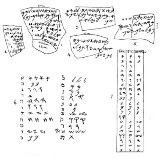
Ostraca of Samaria are Sixty-four legible ostraca which were found in Samaria
. These are written in early Hebrew characters, which very closely resemble those of the Siloam Inscription
, but show a slight development of the cursive script. These ostraca were found in the treasury of the palace of Ahab
,king of Israel
and probably date about his period, 850 B.C. At least they must all date prior to 750 BC, when the palace was destroyed.
s with a smooth surface or a slip would naturally be preferred for writing.
These ostraca are evidently part of a somewhat clumsy method of book-keeping. Either they were a "day-book," notes of daily receipts to be written up in some form of "ledger" afterwards; or they were the sole record kept of the amount of wine and oil received in various years from various places. They may have been written and handed in by the givers, not by the receivers.
All of them began with a date, such as "In the ninth, tenth, or fifteenth year" presumably of the reign of Ahab
. This is followed by the amount and quality of wine or oil received, with the name of the place where it came from and of the giver, such as "in the tenth year wine of Kerm-ha-Tell for a jar of fine oil" where evidently wine was accepted in place of fine oil. "A jar of old wine" and "a jar of fine oil" are the most usual descriptions.
Ostracon No. 2 is a similar document: IN THE TENTH YEAR. To GADDIYAU. FROM AZAH Jars of Old Wine. Abi-ba'al Ahaz .. Sheba' Meriba'al
Ostracon, No. 18 In the tenth year. From Hazeroth to Gaddiyau. A jar of fine oil.
Ostracon, No- 30 In the fifteenth year. From Shemida to Hillez (son of) Gaddiyau. Gera (son of) Hanniab.
Samaria Ostracon, No. 55 In the tenth year. (From the) vineyard of Yehau-eli. A jar of fine oil.
is the only one that can be identified with a text occurring in the Old Testament. In Kerm-ha-Tell, and Kerm-Yahu-'ali, the word Kerm must mean " the village, or vineyard," Tell means "mound". This locality may be the current Tul Karm in Samaria. Six of these place-names occur in the Old Testament as "tribal subdivisions of Manasseh", in Joshua xvii. 2. and Numbers xxvi. 28/:
 The names of the seventeen places occurring on these Ostraca are
The names occurring are :
Most of these names sound very unusual and un-Biblical. In form they recall more strongly names occurring in the Tell-el-Amarna Letters
and the records of Thothmes III
's
conquests in Syria
.
In these personal names unfamiliar as most of them are, we are struck at once with the fact that Ba'al occurs in their formation with as great frequency as Yahveh or Yah appears
in Biblical names of the Kingdom of Judah
. It is significant of the influence of Sidon
ian worship of Ba'al in the Northern Kingdom. Yet, if the syllable "yau" is part of the word
Yahveh, with " h " dropped out, it would appear that in some families the worship of Yahveh is also reflected in the family name.
These lists of names bear clear testimony as to the co-existence of Ba'al worship alongside of the worship of Jehovah in Northern Israel.
On the sherds found, the only years mentioned are the ninth, tenth, fifteenth, and seventeenth, and the only materials are wine and oil.
Akhaz, Sheba9 Elisha, 9Uzza, Ela, Gera, Rafa, and Natan (Nathan), are all Biblical.
As no complete jar seems to have been found, it is impossible to say what the quantities were, nor can we say whether the jar of oil and the jar of wine were equivalent in value. The
inscribed jar-handles of revenue jars found on Ophel appeared for several reasons to belong to jars of no great size, but here again no complete jar was found. No inscribed jar-handles, such as were found at Tel Gezer
and the Ophel
, were found at Samaria.
Samaria
Samaria, or the Shomron is a term used for a mountainous region roughly corresponding to the northern part of the West Bank.- Etymology :...
. These are written in early Hebrew characters, which very closely resemble those of the Siloam Inscription
Siloam inscription
The Siloam inscription or Silwan inscription is a passage of inscribed text found in the Hezekiah tunnel which brings water from the Gihon Spring to the Pool of Siloam, located in the East Jerusalem neighborhood of Silwan. The inscription records the construction of the tunnel in the 8th century...
, but show a slight development of the cursive script. These ostraca were found in the treasury of the palace of Ahab
Ahab
Ahab or Ach'av or Achab in Douay-Rheims was king of Israel and the son and successor of Omri according to the Hebrew Bible. His wife was Jezebel....
,king of Israel
Israel
The State of Israel is a parliamentary republic located in the Middle East, along the eastern shore of the Mediterranean Sea...
and probably date about his period, 850 B.C. At least they must all date prior to 750 BC, when the palace was destroyed.
Description
They are written on fragments of five different types of vessels—large thick amphorae, with a drab or grey surface; large thin amphorae, with a drab or grey surface; jugs of soft brown ware with a reddish slip; basins of the same ware; and bowls of coarse ware with a red or yellow slip, all of these presumably being vessels that were used in receiving and storing the revenue. SherdSherd
In archaeology, a sherd is commonly a historic or prehistoric fragment of pottery, although the term is occasionally used to refer to fragments of stone and glass vessels as well....
s with a smooth surface or a slip would naturally be preferred for writing.
These ostraca are evidently part of a somewhat clumsy method of book-keeping. Either they were a "day-book," notes of daily receipts to be written up in some form of "ledger" afterwards; or they were the sole record kept of the amount of wine and oil received in various years from various places. They may have been written and handed in by the givers, not by the receivers.
All of them began with a date, such as "In the ninth, tenth, or fifteenth year" presumably of the reign of Ahab
Ahab
Ahab or Ach'av or Achab in Douay-Rheims was king of Israel and the son and successor of Omri according to the Hebrew Bible. His wife was Jezebel....
. This is followed by the amount and quality of wine or oil received, with the name of the place where it came from and of the giver, such as "in the tenth year wine of Kerm-ha-Tell for a jar of fine oil" where evidently wine was accepted in place of fine oil. "A jar of old wine" and "a jar of fine oil" are the most usual descriptions.
Examples
Ostracon No. I contains a list of amounts paid in by five people. It reads : IN THE TENTH YEAR. To SHEMARYAU. FROM BEER-YAM Jars of Old Wine. Rage', son of Elisha'...... 'Uzza, son of .. i Eliba, son of i Ba'ala, son of Elisha...... i Yeda 'Yau, son of .. iOstracon No. 2 is a similar document: IN THE TENTH YEAR. To GADDIYAU. FROM AZAH Jars of Old Wine. Abi-ba'al Ahaz .. Sheba' Meriba'al
Ostracon, No. 18 In the tenth year. From Hazeroth to Gaddiyau. A jar of fine oil.
Ostracon, No- 30 In the fifteenth year. From Shemida to Hillez (son of) Gaddiyau. Gera (son of) Hanniab.
Samaria Ostracon, No. 55 In the tenth year. (From the) vineyard of Yehau-eli. A jar of fine oil.
Names of Places
Are the names of the villages or districts, and the other names are those of the peasant farmers who paid their taxes in the form of jars of wine. Of the places mentioned on these Ostraca, ShechemShechem
Shechem was a Canaanite city mentioned in the Amarna letters, and is mentioned in the Hebrew Bible as an Israelite city of the tribe of Manasseh and the first capital of the Kingdom of Israel...
is the only one that can be identified with a text occurring in the Old Testament. In Kerm-ha-Tell, and Kerm-Yahu-'ali, the word Kerm must mean " the village, or vineyard," Tell means "mound". This locality may be the current Tul Karm in Samaria. Six of these place-names occur in the Old Testament as "tribal subdivisions of Manasseh", in Joshua xvii. 2. and Numbers xxvi. 28/:
- Abi-'Ezer,
- Khelek,
- Shechem,
- Shemida',
- No'ah,
- Hoglah.
- Shiftan, may be current village of Shoufa
- Beer-yam
- Azzo, may be current village of Azzon
- Gib, may be current village of Gaba or Jaba'Jaba'Jaba' was a Palestinian Arab village in the District of Haifa. It was depopulated during the 1948 Arab-Israeli War on July 24, 1948 as part of Operation Shoter. It was located 18.5 km south of Haifa....
- Yasot, may be current village of YasidYasidYasid is a Palestinian town in the Nablus Governorate in northern West Bank, located 15 kilometers northeast of Nablus. According to the Palestinian Central Bureau of Statistics , the town had a population of 2,291 inhabitants in mid-year 2006....
- Azat Par'an (?),
- Abi-'ezer,
- Kerm-ha-Tell, may be current town of TulkarmTulkarmTulkarem or Tulkarm is a Palestinian city in the northern Samarian mountain range in the Tulkarm Governorate in the extreme northwestern West Bank adjacent to the Netanya and Haifa districts to the west, the Nablus and Jenin Districts to the east...
- Shemida',
- Kheleq,
- Khoglah,
- No'ah Shekem,
- Shereq.
Names of Royal Officials
These names are preceded by the word " to," indicating that they were the recipients.The names occurring are :
- Ba'alzamar (cf. Baal-saman, Stele of Zakir).
- Akhino'am.
- Shemaryau.
- Gaddiyau.
- Isha Akhimelek—/ Isha, son of Akhimelek.
- Nimshi (?).
- Bedyau (?).
- Akhima.
- Kheles.
- Kheles Gaddiyau—i.e., Kheles, son of Gaddiyau.
- Kheles Afsakh—/.*., Kheles, son of Afsakh.
- Khanan Ba'ara.
- GomerGomerGomer was the son of Japheth in the Hebrew Bible.Gomer may also refer to:*Gomer *GOMER , in medical slang, an undesirable patient*Gomer Press, a printing and publishing company in Wales...
.
- Khanndno 'ana.
- Yeda'yau.
- Yeda'yau Akhimelek—; Yeda'yau son of Akhimelek.
Most of these names sound very unusual and un-Biblical. In form they recall more strongly names occurring in the Tell-el-Amarna Letters
Amarna letters
The Amarna letters are an archive of correspondence on clay tablets, mostly diplomatic, between the Egyptian administration and its representatives in Canaan and Amurru during the New Kingdom...
and the records of Thothmes III
Thutmose III
Thutmose III was the sixth Pharaoh of the Eighteenth Dynasty. During the first twenty-two years of Thutmose's reign he was co-regent with his stepmother, Hatshepsut, who was named the pharaoh...
's
conquests in Syria
Syria
Syria , officially the Syrian Arab Republic , is a country in Western Asia, bordering Lebanon and the Mediterranean Sea to the West, Turkey to the north, Iraq to the east, Jordan to the south, and Israel to the southwest....
.
Names of the Tax Payers
Some of the names of tax-payers on these sherds are :- Names with " son of."
- Rage' Elisha.
- 'Alah Ela.
- Gera Khaimi'ab.
- Ye'ush of Yasheb (?)
- Ba'al combinations
- Ba'ala of El Mettan.
- Ba'ala Elisha.
- Ba'al B(asalme'oni ?)
- Isha Ba'al'azkar.
- Abi-Ba'al.
- Meri-ba'al.
- Ba'ala Za(kar).
- Single.
- Eliba.
- Akhima.
- Akhaz.
- Sheba.
- Qedar of Saq.
- Uzza.
- Kheles of Khaserot.
- Akhzai of Khaserot.
- ' Yau " Combinations.
- Yeda'yau.
- Gera Yauyosheb. (Gera son of Yauyosheb)
- Mafna-yau Natao (son of) of Yasot,
- Abed-yau. (Servant of Yau.)
- Abi-yau. (Child of Yau.)
- Marnayau Gaddiyau. (Marnayau son of Gaddiyau.)
In these personal names unfamiliar as most of them are, we are struck at once with the fact that Ba'al occurs in their formation with as great frequency as Yahveh or Yah appears
in Biblical names of the Kingdom of Judah
Kingdom of Judah
The Kingdom of Judah was a Jewish state established in the Southern Levant during the Iron Age. It is often referred to as the "Southern Kingdom" to distinguish it from the northern Kingdom of Israel....
. It is significant of the influence of Sidon
Sidon
Sidon or Saïda is the third-largest city in Lebanon. It is located in the South Governorate of Lebanon, on the Mediterranean coast, about 40 km north of Tyre and 40 km south of the capital Beirut. In Genesis, Sidon is the son of Canaan the grandson of Noah...
ian worship of Ba'al in the Northern Kingdom. Yet, if the syllable "yau" is part of the word
Yahveh, with " h " dropped out, it would appear that in some families the worship of Yahveh is also reflected in the family name.
These lists of names bear clear testimony as to the co-existence of Ba'al worship alongside of the worship of Jehovah in Northern Israel.
On the sherds found, the only years mentioned are the ninth, tenth, fifteenth, and seventeenth, and the only materials are wine and oil.
Biblical Names
The names Kheles, Akhinoam, Akhimelek, Kha-nan, Ba'ara (female), Gomer (female), Meribaal, are all Biblical, while Gaddiyau and Shemaryau are the northern forms of Gedaiah and Shemariah. Some of the Ba'al combinations are of course, Phoenician—e.g., Ba'alzamar. The names Abiba'al,Akhaz, Sheba9 Elisha, 9Uzza, Ela, Gera, Rafa, and Natan (Nathan), are all Biblical.
As no complete jar seems to have been found, it is impossible to say what the quantities were, nor can we say whether the jar of oil and the jar of wine were equivalent in value. The
inscribed jar-handles of revenue jars found on Ophel appeared for several reasons to belong to jars of no great size, but here again no complete jar was found. No inscribed jar-handles, such as were found at Tel Gezer
Gezer
Gezer was a Canaanite city-state and biblical town in ancient Israel. Tel Gezer , an archaeological site midway between Jerusalem and Tel Aviv, is now an Israeli national park....
and the Ophel
Ophel
The City of David is the oldest settled neighborhood of Jerusalem and a major archaeological site due to recognition as biblical Jerusalem. It is a narrow ridge running south from the Temple Mount. It was a walled city in the Bronze Age and, according to tradition, it is the place where King...
, were found at Samaria.
Sources
- Digging Up Biblical History Recent Archeology In Palestine And Its Bearing On The Old Testament Historical Narratives by J.Garrow Duncan