

Oolong

Encyclopedia
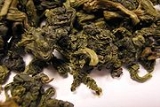
Oolong is a traditional Chinese tea
(Camellia sinensis
) produced through a unique process including withering under the strong sun and oxidation before curling and twisting. Most oolong teas, especially those of fine quality, involve unique tea plant cultivar
s that are exclusively used for particular varieties. The degree of fermentation can range from 8% to 85%, depending on the variety and production style. This tea category is especially popular with tea connoisseurs of south China and Chinese expatriates in Southeast Asia, as is the tea preparation process that originated from this area: gongfu tea-making, or the gongfu tea infusion approach.
In Chinese tea culture
, semi-oxidised oolong teas are collectively grouped as qīngchá . The taste of oolong ranges hugely amongst various subvarieties. It can be sweet and fruity with honey aromas, or woody and thick with roasted aromas, or green and fresh with bouquet aromas, all depending on the horticulture and style of production. Several subvarieties of oolong, including those produced in the Wuyi Mountains
of northern Fujian and in the central mountains of Taiwan
, are among the most famous Chinese teas.
Different varieties of oolong are processed
differently, but the leaves are formed into one of two distinct styles. Some are rolled into long curly leaves, while others are 'wrap-curled' into small beads, each with a tail. The former style is the more traditional of the two.
The name oolong tea came into the English language
from the Chinese
name , meaning "black dragon tea".
According to the "Wuyi" theory, oolong tea first existed in the Wuyi Mountain area. This is evidenced by Qing dynasty poems such as Wuyi Tea Song (Wuyi Chage) and Tea Tale (Chashuo). It was said that oolong tea was named after the part of Wuyi mountain where it was originally produced.
According to the "Anxi
" theory, oolong tea had its origin in the Anxi oolong tea plant, which was discovered by a man named Sulong, Wulong or Wuliang.
Another tale tells of a man named Wu Liang (later corrupted to Wu Long, or Oolong) who discovered oolong tea by accident when he was distracted by a deer after a hard day's tea-picking, and by the time he remembered to return to the tea it had already started to oxidize.

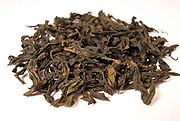 The most famous and expensive oolong teas are made here, and the production is still usually accredited as being organic. Much Shuǐ Xiān
is grown elsewhere in Fujian
.
Some of the better known cliff teas are:
Red Robe Dà Hóng Páo
(大红袍): in Chinese, a highly prized tea and a Sì Dà Míng Cōng
(四大名樅, literally: The Four Great Bushes). This tea is also one of the two oolongs that make it to the list of Chinese famous teas
.
Gold Turtle Shuǐ Jīn Guī
(水金亀): in Chinese, a Si Da Ming Cong.
Iron Monk Arhat Tiě Luóhàn
(鉄羅漢): in Chinese, a Si Da Ming Cong tea
White Comb Bái Jī Guān
(白鸡冠): in Chinese, a Si Da Ming Cong tea. A light tea with light, yellowish leaves.
Cassia Ròu Guì
(肉桂): in Chinese, a dark tea with a spicy
aroma.
Narcissus Shuǐ Xiān
(水仙): in Chinese, a very dark tea, often grown elsewhere.
or Ti Kuan Yin (鐵觀音): in Chinese, this is a tea from Anxi
in South
Fujian
. It is very famous as a 'Chinese famous tea'
and very popular.
Golden Cassia Huángjīn Guì
(黄金桂)
Ti Kuan Yin, which in Chinese means “Iron Goddess.” There was once a poor farmer who was devout and dedicated to maintaining the temple of Kuan Yin, the goddess of mercy. One day, to reward him for his loyalty and commitment to her, she told him that the key to his future was outside the temple. Outside he found a scrungy old bush, which he nursed to a flourishing bloom of greenish leaves. These leaves, of course, are the same as those in my teapot cup.
The name dan cong is often misinterpreted as meaning the tea is all picked from a single bush, grove, or clone. This is not correct. Dan cong is a botanical term that refers to the morphology of the tea plant. Most tea bushes emerge from the ground as a cluster of branches, however, the uncommon dan cong variety emerges as a single trunk that branches off higher up the stem.
in the mid-19th century. Since then, many of the teas which are grown in Fujian province have also been grown in Taiwan. Since the 1970s, the tea industry in Taiwan has expanded at a rapid rate, in line with the rest of Taiwan's economy. Due to high domestic demand and a strong tea culture, most Taiwanese tea is bought and consumed by the Taiwanese.
As the weather in Taiwan is highly variable, tea quality may differ from season to season. Although the island is not particularly large, it is geographically varied, with high, steep mountains rising abruptly from low-lying coastal plains. The different weather patterns, temperatures, altitudes and soil ultimately result in differences in appearance, aroma and flavour of the tea grown in Taiwan. In some mountainous areas, teas have been cultivated at ever higher elevations to produce a unique sweet taste that fetches a premium price.
Dong Ding oolong, Dòngdǐng
(凍頂): The name means Frozen Summit or Ice Peak. Dong Ding is a mountain in Nantou County
, Central Taiwan
. This is a tightly rolled tea with a light, distinctive fragrance.
Oriental Beauty, Dōngfāng Měirén chá
(東方美人茶): The name means Oriental Beauty. Also known as White Tip Oolong Bai Hao Oolong. This tea is tippy (the leaves frequently have white or golden tips), with natural fruity aromas, a bright red appearance and a sweet taste.
Alishan oolong, Ālǐshān chá (阿里山茶): Grown in the Alishan
area of Chiayi County
, this tea has large rolled leaves that have a purple-green appearance when dry. It is grown at an elevation of 1,000 to 1,400 metres. There is only a short period during the growing season when the sun is strong, which results in a sweeter and less astringent brew. It produces a golden yellow tea which has a unique fruity aroma.
Lishan oolong, Líshān (梨山): Grown in the north-central region of Taiwan, this tea is very similar in appearance to Alishan teas, and is often considered to be one of the best teas from Taiwan. It is grown at an elevation above 1,000 metres, with Dayuling, Lishan, and Fusou being the best known regions and teas of Lishan.
Pouchong
, (Bāozhǒng chá) (包種茶): Also romanized as Bāozhǒng, the lightest and most floral oolong, with unrolled leaves of a light green to brown color. Originally grown in Fujian
it is now widely cultivated and produced in Pinglin Township
near Taipei
, Taiwan
.
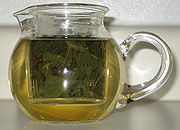 Generally, 3 grams of tea per 200 ml of water, or about two teaspoons of oolong tea per cup, should be used. Oolong teas should be prepared with 200 to 205 °F (93.3 to 96.1 C) water (not boiling) and steeped 3–10 minutes. High quality oolong can be brewed several times from the same leaves and, unlike other teas, it improves with rebrewing: it is common to brew the same leaves three to five times, the third or fourth steeping usually being considered the best.
A widely-used ceremonial method of brewing oolongs in Taiwan and China is called gongfucha
. This method uses a small brewing vessel, such as a gaiwan or Yixing clay teapot
, with more tea than usual for the amount of water used. Multiple short steeps of 20 seconds to 1 minute are performed; the tea is often served in one- to two-ounce tasting cups.
content in a given brew of tea may vary based on the brewing method, variety of tea
, and number of extractions, Oolong tea in general contains caffeine
, albeit less than either black tea
or green tea
.
Tea
Tea is an aromatic beverage prepared by adding cured leaves of the Camellia sinensis plant to hot water. The term also refers to the plant itself. After water, tea is the most widely consumed beverage in the world...
(Camellia sinensis
Camellia sinensis
Camellia sinensis is the species of plant whose leaves and leaf buds are used to produce Chinese tea. It is of the genus Camellia , a genus of flowering plants in the family Theaceae. White tea, green tea, oolong, pu-erh tea and black tea are all harvested from this species, but are processed...
) produced through a unique process including withering under the strong sun and oxidation before curling and twisting. Most oolong teas, especially those of fine quality, involve unique tea plant cultivar
Cultivar
A cultivar'Cultivar has two meanings as explained under Formal definition. When used in reference to a taxon, the word does not apply to an individual plant but to all those plants sharing the unique characteristics that define the cultivar. is a plant or group of plants selected for desirable...
s that are exclusively used for particular varieties. The degree of fermentation can range from 8% to 85%, depending on the variety and production style. This tea category is especially popular with tea connoisseurs of south China and Chinese expatriates in Southeast Asia, as is the tea preparation process that originated from this area: gongfu tea-making, or the gongfu tea infusion approach.
In Chinese tea culture
Chinese tea culture
Chinese tea culture refers to the methods of preparation of tea, the equipment used to make tea and the occasions in which tea is consumed in China. The terms chayi "Art of Tea 茶藝" and "Tea Ceremony" have been used, but the term "Tea Culture茶文化" includes more than just the ceremony...
, semi-oxidised oolong teas are collectively grouped as qīngchá . The taste of oolong ranges hugely amongst various subvarieties. It can be sweet and fruity with honey aromas, or woody and thick with roasted aromas, or green and fresh with bouquet aromas, all depending on the horticulture and style of production. Several subvarieties of oolong, including those produced in the Wuyi Mountains
Wuyi Mountains
The Wuyi Mountains are a mountain range located in the prefecture of Nanping, in the northern border of Fujian province with Jiangxi province, China. The mountains cover an area of 60 km². In 1999, Mount Wuyi entered UNESCO's list of World Heritage Sites, both natural and cultural...
of northern Fujian and in the central mountains of Taiwan
Taiwan
Taiwan , also known, especially in the past, as Formosa , is the largest island of the same-named island group of East Asia in the western Pacific Ocean and located off the southeastern coast of mainland China. The island forms over 99% of the current territory of the Republic of China following...
, are among the most famous Chinese teas.
Different varieties of oolong are processed
Tea processing
Tea processing is the method in which the leaves from the tea plant Camellia sinensis are transformed into the dried leaves for brewing tea. The categories of tea are distinguished by the processing they undergo. In its most general form, tea processing involves different manners and degree of...
differently, but the leaves are formed into one of two distinct styles. Some are rolled into long curly leaves, while others are 'wrap-curled' into small beads, each with a tail. The former style is the more traditional of the two.
The name oolong tea came into the English language
English language
English is a West Germanic language that arose in the Anglo-Saxon kingdoms of England and spread into what was to become south-east Scotland under the influence of the Anglian medieval kingdom of Northumbria...
from the Chinese
Chinese language
The Chinese language is a language or language family consisting of varieties which are mutually intelligible to varying degrees. Originally the indigenous languages spoken by the Han Chinese in China, it forms one of the branches of Sino-Tibetan family of languages...
name , meaning "black dragon tea".
Possible origins
There are three widely accepted explanations of the origin of the Chinese name. According to the "tribute tea" theory, oolong tea came directly from Dragon-Phoenix Tea Cake tribute tea. The term oolong tea replaced the old term when loose tea came into fashion. Since it was dark, long and curly, it was called Black Dragon tea.According to the "Wuyi" theory, oolong tea first existed in the Wuyi Mountain area. This is evidenced by Qing dynasty poems such as Wuyi Tea Song (Wuyi Chage) and Tea Tale (Chashuo). It was said that oolong tea was named after the part of Wuyi mountain where it was originally produced.
According to the "Anxi
Anxi County
is a county in the municipal region of Quanzhou, Fujian Province. It lies adjacent to and directly north of Xiamen.Anxi is well-known for a number of varieties of Oolong tea, the most well-known of which is Tieguanyin ....
" theory, oolong tea had its origin in the Anxi oolong tea plant, which was discovered by a man named Sulong, Wulong or Wuliang.
Another tale tells of a man named Wu Liang (later corrupted to Wu Long, or Oolong) who discovered oolong tea by accident when he was distracted by a deer after a hard day's tea-picking, and by the time he remembered to return to the tea it had already started to oxidize.
Wuyi rock (cliff) tea (武夷岩茶 Wǔyí yán chá) from Fujian province
Shui Hsien tea
Shui Hsien meaning narcissus or water sprite is an Oolong tea from Mount Wuyi, it has a heavy honey fragrance. Cheaper varieties are grown elsewhere in Fujian and have a burnt taste and are very popular with Chinese restaurants. The infused color is very dark brown showing that the tea is a very...
is grown elsewhere in Fujian
Fujian
' , formerly romanised as Fukien or Huguing or Foukien, is a province on the southeast coast of mainland China. Fujian is bordered by Zhejiang to the north, Jiangxi to the west, and Guangdong to the south. Taiwan lies to the east, across the Taiwan Strait...
.
Some of the better known cliff teas are:
Red Robe Dà Hóng Páo
Da Hong Pao tea
Dà Hóng Páo is an important Wuyi Oolong tea. According to legend, the mother of a Ming Dynasty emperor was cured of an illness by a certain tea, and that emperor sent great red robes to clothe the four bushes from which that tea originated...
(大红袍): in Chinese, a highly prized tea and a Sì Dà Míng Cōng
Si Da Ming Cong tea
Si Da Ming Cong refers to four famous Wuyi Oolong tea bushes, namely:* Da Hong Pao* Shui Jin Gui* Tieluohan* Bai Ji Guan...
(四大名樅, literally: The Four Great Bushes). This tea is also one of the two oolongs that make it to the list of Chinese famous teas
China Famous Tea
China's Famous Teas or The Ten Great Chinese Teas is a list of ten notable Chinese teas. Contrary to popular belief, there is no steadfast list...
.
Gold Turtle Shuǐ Jīn Guī
Shui Jin Gui tea
Shui Jin Gui is a very characteristic Wuyi Oolong tea, whose name literally means Golden Marine Turtle. The tea produces a bright green color when steeped and is much greener than most other Wuyi Oolong teas. It is one of the four famous bushes of Wuyi, a Si Da Ming Cong.-References:* Babelcarp on...
(水金亀): in Chinese, a Si Da Ming Cong.
Iron Monk Arhat Tiě Luóhàn
Tieluohan tea
Tieluohan is a Si Da Ming Cong and a light Wuyi tea. Tie Luo Han, all but unknown abroad, is the cultivar responsible for one of the four most famous yan cha, the great "rock teas" grown on cliffs in the Wuyi Shan area of Northern Fujian...
(鉄羅漢): in Chinese, a Si Da Ming Cong tea
White Comb Bái Jī Guān
Bai Ji Guan tea
Bai Ji Guan is a Si Da Ming Cong and a very light Wuyi tea. It is named after a rooster who gave up its life whilst protecting a child.Legend has it that the name of this tea was given by a monk in memorial of a courageous rooster that sacrificed his life while protecting his baby from an eagle...
(白鸡冠): in Chinese, a Si Da Ming Cong tea. A light tea with light, yellowish leaves.
Cassia Ròu Guì
Rou Gui
Rou Gui is a Wuyi Oolong tea; the name literally means Cinnamon. The tea can be difficult to prepare but its distinctive sweet aroma can be brought out up to 7 steepings...
(肉桂): in Chinese, a dark tea with a spicy
Spice
A spice is a dried seed, fruit, root, bark, or vegetative substance used in nutritionally insignificant quantities as a food additive for flavor, color, or as a preservative that kills harmful bacteria or prevents their growth. It may be used to flavour a dish or to hide other flavours...
aroma.
Narcissus Shuǐ Xiān
Shui Hsien tea
Shui Hsien meaning narcissus or water sprite is an Oolong tea from Mount Wuyi, it has a heavy honey fragrance. Cheaper varieties are grown elsewhere in Fujian and have a burnt taste and are very popular with Chinese restaurants. The infused color is very dark brown showing that the tea is a very...
(水仙): in Chinese, a very dark tea, often grown elsewhere.
Fújiàn province
Iron Goddess Guanyin Tiě GuānyīnTieguanyin
Tieguanyin is a premium variety of Chinese oolong tea originated in the 19th century in Anxi in Fujian province. Tieguanyin produced in different areas of Anxi have different gastronomic characteristics...
or Ti Kuan Yin (鐵觀音): in Chinese, this is a tea from Anxi
Anxi County
is a county in the municipal region of Quanzhou, Fujian Province. It lies adjacent to and directly north of Xiamen.Anxi is well-known for a number of varieties of Oolong tea, the most well-known of which is Tieguanyin ....
in South
South
South is a noun, adjective, or adverb indicating direction or geography.South is one of the four cardinal directions or compass points. It is the opposite of north and is perpendicular to east and west.By convention, the bottom side of a map is south....
Fujian
Fujian
' , formerly romanised as Fukien or Huguing or Foukien, is a province on the southeast coast of mainland China. Fujian is bordered by Zhejiang to the north, Jiangxi to the west, and Guangdong to the south. Taiwan lies to the east, across the Taiwan Strait...
. It is very famous as a 'Chinese famous tea'
China Famous Tea
China's Famous Teas or The Ten Great Chinese Teas is a list of ten notable Chinese teas. Contrary to popular belief, there is no steadfast list...
and very popular.
Golden Cassia Huángjīn Guì
Huangjin Gui
Huang Jin Gui is a premium variety of Chinese oolong tea traditionally from Anxi in Fujian province. Named after the yellow golden color of its budding leaves and its unique flowery aroma, said to be reminiscent of Osmanthus....
(黄金桂)
- or Golden Osmanthus is another tea from the AnxiAnxi Countyis a county in the municipal region of Quanzhou, Fujian Province. It lies adjacent to and directly north of Xiamen.Anxi is well-known for a number of varieties of Oolong tea, the most well-known of which is Tieguanyin ....
area of Fujian Province. It resembles Tiě GuānyīnTieguanyinTieguanyin is a premium variety of Chinese oolong tea originated in the 19th century in Anxi in Fujian province. Tieguanyin produced in different areas of Anxi have different gastronomic characteristics...
with a very fragrant flavor.
Ti Kuan Yin, which in Chinese means “Iron Goddess.” There was once a poor farmer who was devout and dedicated to maintaining the temple of Kuan Yin, the goddess of mercy. One day, to reward him for his loyalty and commitment to her, she told him that the key to his future was outside the temple. Outside he found a scrungy old bush, which he nursed to a flourishing bloom of greenish leaves. These leaves, of course, are the same as those in my teapot cup.
Guangdong province
Single Bush Dān Cōng (单枞) : A family of stripe-style oolong teas from Guangdong Province. The doppelganger of teas, Dancong teas are noted for their ability to naturally imitate the flavors and fragrances of various flowers and fruits, such as orange blossom, orchid, grapefruit, almond, ginger flower, etc.The name dan cong is often misinterpreted as meaning the tea is all picked from a single bush, grove, or clone. This is not correct. Dan cong is a botanical term that refers to the morphology of the tea plant. Most tea bushes emerge from the ground as a cluster of branches, however, the uncommon dan cong variety emerges as a single trunk that branches off higher up the stem.
Taiwan
Tea cultivation only began in TaiwanTaiwan
Taiwan , also known, especially in the past, as Formosa , is the largest island of the same-named island group of East Asia in the western Pacific Ocean and located off the southeastern coast of mainland China. The island forms over 99% of the current territory of the Republic of China following...
in the mid-19th century. Since then, many of the teas which are grown in Fujian province have also been grown in Taiwan. Since the 1970s, the tea industry in Taiwan has expanded at a rapid rate, in line with the rest of Taiwan's economy. Due to high domestic demand and a strong tea culture, most Taiwanese tea is bought and consumed by the Taiwanese.
As the weather in Taiwan is highly variable, tea quality may differ from season to season. Although the island is not particularly large, it is geographically varied, with high, steep mountains rising abruptly from low-lying coastal plains. The different weather patterns, temperatures, altitudes and soil ultimately result in differences in appearance, aroma and flavour of the tea grown in Taiwan. In some mountainous areas, teas have been cultivated at ever higher elevations to produce a unique sweet taste that fetches a premium price.
Dong Ding oolong, Dòngdǐng
Dong Ding tea
Dong Ding is an Oolong tea from Taiwan. The original leaves were taken from a much older tea plant in China's Wuyi Mountains in Fujian Province. The name "Dong Ding" means "Frozen Summit", which is the name of the mountain on which the original tea plants taken from the Wuyi Mountains were planted...
(凍頂): The name means Frozen Summit or Ice Peak. Dong Ding is a mountain in Nantou County
Nantou County
Nantou County is the second largest county of Taiwan. It is also the only landlocked county in Taiwan. Its name derives from the Hoanya Taiwanese aboriginal word Ramtau. Nantou County is officially administered as a county of Taiwan....
, Central Taiwan
Taiwan
Taiwan , also known, especially in the past, as Formosa , is the largest island of the same-named island group of East Asia in the western Pacific Ocean and located off the southeastern coast of mainland China. The island forms over 99% of the current territory of the Republic of China following...
. This is a tightly rolled tea with a light, distinctive fragrance.
Oriental Beauty, Dōngfāng Měirén chá
Dong Fang Mei Ren tea
Dong Fang Mei Ren tea , is an Oolong tea produced in Hsinchu, Taiwan. A heavily fermented, non-roasted, tip-type oolong, traditionally known as Oriental Beauty or more recently White Tip Oolong, in Chinese: Bai Hao Oolong tea, Pon Fon Cha, Boast tea, and Champagne Oolong.This tea is a tippy tea,...
(東方美人茶): The name means Oriental Beauty. Also known as White Tip Oolong Bai Hao Oolong. This tea is tippy (the leaves frequently have white or golden tips), with natural fruity aromas, a bright red appearance and a sweet taste.
Alishan oolong, Ālǐshān chá (阿里山茶): Grown in the Alishan
Alishan
The Alishan National Scenic Area is a mountain resort and natural preserve located in the mountains of Chiayi County in Taiwan. It is 415 km² in area. It includes, among other things, mountain wilderness, four villages, waterfalls, high altitude tea plantations, the Alishan Forest Railway ...
area of Chiayi County
Chiayi County
Chiayi County is a county in southwestern Taiwan surrounding but not including Chiayi City. Its historical name in Taiwanese Hokkien derives from Tsirosen in the Formosan languages...
, this tea has large rolled leaves that have a purple-green appearance when dry. It is grown at an elevation of 1,000 to 1,400 metres. There is only a short period during the growing season when the sun is strong, which results in a sweeter and less astringent brew. It produces a golden yellow tea which has a unique fruity aroma.
Lishan oolong, Líshān (梨山): Grown in the north-central region of Taiwan, this tea is very similar in appearance to Alishan teas, and is often considered to be one of the best teas from Taiwan. It is grown at an elevation above 1,000 metres, with Dayuling, Lishan, and Fusou being the best known regions and teas of Lishan.
Pouchong
Pouchong
Pouchong or light oolong, it is a lightly fermented tea , twist shape, with floral notes, and usually not roasted, somewhere between green tea and what is usually considered Oolong tea , though often classified with the latter due to its lack of the sharper green tea flavours...
, (Bāozhǒng chá) (包種茶): Also romanized as Bāozhǒng, the lightest and most floral oolong, with unrolled leaves of a light green to brown color. Originally grown in Fujian
Fujian
' , formerly romanised as Fukien or Huguing or Foukien, is a province on the southeast coast of mainland China. Fujian is bordered by Zhejiang to the north, Jiangxi to the west, and Guangdong to the south. Taiwan lies to the east, across the Taiwan Strait...
it is now widely cultivated and produced in Pinglin Township
Pinglin Township
Pinglin District is a rural district in southeastern New Taipei City in northern Republic of China . It is in the mountain area connecting to the Yilan County on the east coast.-Overview:...
near Taipei
Taipei
Taipei City is the capital of the Republic of China and the central city of the largest metropolitan area of Taiwan. Situated at the northern tip of the island, Taipei is located on the Tamsui River, and is about 25 km southwest of Keelung, its port on the Pacific Ocean...
, Taiwan
Taiwan
Taiwan , also known, especially in the past, as Formosa , is the largest island of the same-named island group of East Asia in the western Pacific Ocean and located off the southeastern coast of mainland China. The island forms over 99% of the current territory of the Republic of China following...
.
Other oolong teas
- Darjeeling oolongDarjeeling tea (oolong)Darjeeling Oolong is a type of tea produced in Darjeeling, India, in the style of Oolong.Darjeeling Oolong has two distinct characters: one is Clonal type and the other is China type. The China type is more similar to Taiwan Oolong and the Clonal type is totally different from it.Darjeeling Oolong...
: Darjeeling teaDarjeeling teaDarjeeling tea is a black tea from the Darjeeling region in West Bengal, India. When properly brewed, it yields a thin-bodied, light-colored infusion with a floral aroma...
made according to Chinese methods. - Vietnam tea (oolong: Vietnamese oolong
- Thai oolong
- Indonesian Oolong TeaIndonesian Oolong TeaThe ' is in Lebak-Banten at west part of Java, Indonesia, near national park Taman Nasional Gunung Halimun Salak , in about 1000 m from sea level. Mild weather and clean water without any pollution are the best environments for these tea plants....
: made in Lebak-Banten, Indonesia - African oolong: made in Malawi and in Kenya
- Nepali oolong
Brewing
A widely-used ceremonial method of brewing oolongs in Taiwan and China is called gongfucha
Gongfu tea ceremony
The gongfu tea ceremony or kungfu tea ceremony , is a commercialized show basing on the tea preparation approach originated probably in Fujian or Guangdong. The original term "Gongfu Cha " literally means "making tea with efforts". Sometimes '功' instead of '工' is used thus 功夫茶...
. This method uses a small brewing vessel, such as a gaiwan or Yixing clay teapot
Yixing clay teapot
Yixing clay teapots Yixing clay teapots Yixing clay teapots (also called Purple Sand are made from Yixing clay. This traditional style commonly used to brew tea originated in China, dating back to the 15th century, and are made from clay produced in the region of the town of Yixing in the...
, with more tea than usual for the amount of water used. Multiple short steeps of 20 seconds to 1 minute are performed; the tea is often served in one- to two-ounce tasting cups.
Caffeine
Though the caffeineCaffeine
Caffeine is a bitter, white crystalline xanthine alkaloid that acts as a stimulant drug. Caffeine is found in varying quantities in the seeds, leaves, and fruit of some plants, where it acts as a natural pesticide that paralyzes and kills certain insects feeding on the plants...
content in a given brew of tea may vary based on the brewing method, variety of tea
Tea
Tea is an aromatic beverage prepared by adding cured leaves of the Camellia sinensis plant to hot water. The term also refers to the plant itself. After water, tea is the most widely consumed beverage in the world...
, and number of extractions, Oolong tea in general contains caffeine
Caffeine
Caffeine is a bitter, white crystalline xanthine alkaloid that acts as a stimulant drug. Caffeine is found in varying quantities in the seeds, leaves, and fruit of some plants, where it acts as a natural pesticide that paralyzes and kills certain insects feeding on the plants...
, albeit less than either black tea
Black tea
Black tea is a variety of tea that is more oxidized than the oolong, green, and white varieties.All four varieties are made from leaves of the shrub Camellia sinensis. Black tea is generally stronger in flavor and contains more caffeine than the less oxidized teas. Two principal varieties of the...
or green tea
Green tea
Green tea is made solely from the leaves of Camellia sinensis that have undergone minimal oxidation during processing. Green tea originates from China and has become associated with many cultures throughout Asia. It has recently become more widespread in the West, where black tea is traditionally...
.
See also
- Chinese tea cultureChinese tea cultureChinese tea culture refers to the methods of preparation of tea, the equipment used to make tea and the occasions in which tea is consumed in China. The terms chayi "Art of Tea 茶藝" and "Tea Ceremony" have been used, but the term "Tea Culture茶文化" includes more than just the ceremony...
- Fujian tea ceremony
- PouchongPouchongPouchong or light oolong, it is a lightly fermented tea , twist shape, with floral notes, and usually not roasted, somewhere between green tea and what is usually considered Oolong tea , though often classified with the latter due to its lack of the sharper green tea flavours...
- Chiuchow cuisineChiuchow cuisineChiuchow cuisine, Teochew cuisine or Chaozhou cuisine or Chaoshan cuisine originates from the Chaoshan region of China in the north-easternmost area of the Guangdong province, which includes the cities of Chaozhou, Shantou and Jieyang...
- Taiwan teas