


Octatonic scale

Encyclopedia
An octatonic scale is any eight-note musical scale
. Among the most famous of these is a scale in which the notes ascend in alternating intervals of a whole step
and a half step
, creating a symmetric scale
. In classical theory, in contradistinction to jazz theory, this scale is commonly simply called the octatonic scale, although there are forty-two other non-enharmonically equivalent, non-transpositionally equivalent eight-tone sets possible. In jazz theory this scale is more particularly called the diminished scale (Campbell 2001, p. 126), or symmetric diminished scale (Hatfield 2005, p. 125), because it can be conceived as a combination of two interlocking diminished seventh chords, just as the augmented scale can be conceived as a combination of two interlocking augmented triads. The earliest systematic treatment of the octatonic scale was Edmond de Polignac's unpublished treatise, "Etude sur les successions alternantes de tons et demi-tons (Et sur la gamme dite majeure-mineure)" from c. 1879 (Kahan 2009), which preceded Vito Frazzi's Scale alternate per pianoforte of 1930 by a full half-century (Sanguinetti 1993). The term octatonic pitch collection was first introduced into English by Arthur Berger
in 1963 (Van den Toorn 1983).
s. A combination of any two, omitting the third, forms an octatonic collection. As there are three diminished-seventh chords that can be omitted, it follows that there are only three distinct (non-transpositionally equivalent) diminished scales in the 12-tone system. Thus Olivier Messiaen
considered it one of the modes of limited transposition
, specifically, the second mode. A given diminished scale has only two modes
: one beginning its ascent with a whole step
between its first two notes, while the other begins its ascent with a half step or semitone
.
Each of the three distinct scales can form differently named scales with the same sequence of tones by starting at a different point in the scale. With alternative starting points listed in parentheses, the three are:
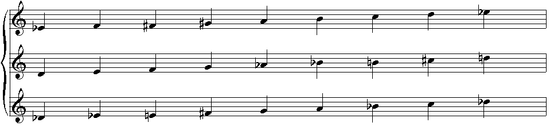 It may also be represented as 0134679t or labeled as set class 8-28 (Schuijer 2008, p.109).
Among the collection's remarkable features is that it is the only collection that can be disassembled into four transpositionally-related pitch pairs in six different ways, each of which features a different interval class (Cohn). For example:
Another remarkable feature of the diminished scale is that it contains first four notes of four minor scales separated by minor thirds. For Example: C, D, Eb, F and (enharmonically) F#, G#, A, B. Also Eb, F, Gb, Ab, and A, B, C, D.
, The Schillinger System of Musical Composition, Vol 1).
Octatonic scales first occurred in Western music as byproducts of a series of minor-third transpositions. Agmon locates one in the music of Scarlatti, from the 1730s. Langlé's 1797 harmony treatise contains a sequential progression with a descending octatonic bass, supporting harmonies that use all and only the notes of an octatonic scale (p. 72, ex. 25.2).
The question of when Western composers first began to select octatonic scales as primary compositional material is difficult to determine. One strong candidate is a recurring theme in Franz Liszt
's Feux Follets, the fifth of his first book of Études d'exécution transcendente
(composed 1826, and twice revised). See descending arpeggiated figures of bars 7 and 8, 10 and 11, 43, 45 through 48, 122, and 124 through 126. In turn, all three distinct octatonic scales are used, respectively containing all, and only, the notes of each of these scales.
Liszt was to become an idol of the Russian school, and starting with Glinka
's opera Ruslan and Lyudmila (first performed 1842) the diminished scale was often used by Russian composers to evoke scenes of magic and exotic mystery. Still, Nikolai Rimsky-Korsakov
claimed the diminished scale as "his discovery" in his My Musical Life (van den Toorn 1983). He certainly used the scale extensively in his opera Kashchey the Immortal, which premiered in 1902. Following that, the scale was extensively used by his student Igor Stravinsky
, particularly in his Russian period ballet
s Petrushka and The Rite of Spring
dating from 1911 and 1913 respectively. Van den Toorn catalogues many octatonic moments in Stravinsky's music, although Tymoczko argues that many of them are byproducts of other syntactic concerns. The scale also may be found with some frequency in music of Claude Debussy
, Maurice Ravel
, Alexander Scriabin
and Béla Bartók
. In Bartók's Bagatelles, Improvisations, Fourth Quartet
, Cantata Profana
, and Improvisations, the octatonic is used with the diatonic, whole tone, and other "abstract pitch formations" (Antokoletz 1984) all "entwined...in a very complex mixture." Mikrokosmos 99, 101, and 109 are octatonic pieces, as is no. 33 of the Forty-Four Duos for two violins. "In each piece, changes of motive and phrase correspond to changes from one of the three octatonic scales to another, and one can easily select a single central and referential form of 8-28 in the context of each complete piece." However, even his larger pieces also feature "sections that are intelligible as 'octatonic music'" (Wilson 1992, p. 26–27).
Post-war composers who make significant use of the scale include Luigi Dallapiccola
, Olivier Messiaen
, Toru Takemitsu
, and George Crumb
. The Progressive Metal
band Dream Theater
also made use of the Octatonic scale in their 2005 song Octavarium
.
's ballet
Petrushka is characterized by the so-called Petrushka chord
, which combines major triads transpositionally related by a tritone. Taruskin's ascription of explanatory power to the chord's status as an octatonic subset has been challenged by Tymoczko.
The Db whole/half (and the C half whole) diminished scale supports two diminished triads, C, Eb, Gb, and Db, Fb, Abb(or G), both of which can be inverted three times to produce four diminished triads as well.
and
This is of particular interest to jazz musicians as it facilitates the creation of chord voicings, especially polychords (eg C/Gb or A/Eb) as expressing a dominant function on B7, F7, Ab7 and Cb7, and upper structure
voicings on dominant seventh chords. The sequence of triads given above is an instance of the neo-Riemannian PR cycle, alternating parallels and relatives.
s," such as: C–E–G–B–C–E–F–A. (Wilson 1992, p. 7)
One of the most important subsets of the alpha collection, the alpha chord (such as E–G–C–E; using the theorist Ernő Lendvaï
's terminology, the C alpha chord) may be considered a mistuned
major chord
or major/minor in first inversion (in this case, C major/minor). (ibid, p. 9)
Musical scale
In music, a scale is a sequence of musical notes in ascending and descending order. Most commonly, especially in the context of the common practice period, the notes of a scale will belong to a single key, thus providing material for or being used to conveniently represent part or all of a musical...
. Among the most famous of these is a scale in which the notes ascend in alternating intervals of a whole step
Major second
In Western music theory, a major second is a musical interval spanning two semitones, and encompassing two adjacent staff positions . For example, the interval from C to D is a major second, as the note D lies two semitones above C, and the two notes are notated on adjacent staff postions...
and a half step
Semitone
A semitone, also called a half step or a half tone, is the smallest musical interval commonly used in Western tonal music, and it is considered the most dissonant when sounded harmonically....
, creating a symmetric scale
Symmetric scale
In music, a symmetric scale is a music scale which equally divides the octave. The concept and term appears to have been introduced by Joseph Schillinger and further developed by Nicolas Slonimsky as part of his famous "Thesaurus of Scales and Melodic Patterns"...
. In classical theory, in contradistinction to jazz theory, this scale is commonly simply called the octatonic scale, although there are forty-two other non-enharmonically equivalent, non-transpositionally equivalent eight-tone sets possible. In jazz theory this scale is more particularly called the diminished scale (Campbell 2001, p. 126), or symmetric diminished scale (Hatfield 2005, p. 125), because it can be conceived as a combination of two interlocking diminished seventh chords, just as the augmented scale can be conceived as a combination of two interlocking augmented triads. The earliest systematic treatment of the octatonic scale was Edmond de Polignac's unpublished treatise, "Etude sur les successions alternantes de tons et demi-tons (Et sur la gamme dite majeure-mineure)" from c. 1879 (Kahan 2009), which preceded Vito Frazzi's Scale alternate per pianoforte of 1930 by a full half-century (Sanguinetti 1993). The term octatonic pitch collection was first introduced into English by Arthur Berger
Arthur Berger
Arthur Victor Berger was an American composer who has been described as a New Mannerist.-Biography:Born in New York City, of Jewish descent, Berger studied as an undergraduate at New York University, during which time he joined the Young Composer's Group, as a graduate student under Walter Piston...
in 1963 (Van den Toorn 1983).
Properties
The twelve tones of the chromatic scale partition into three non-overlapping diminished seventh chordDiminished seventh chord
A diminished seventh chord is a four note chord that comprises a diminished triad plus the interval of a diminished seventh above the root. Thus it is , or enharmonically , of any major scale; for example, C diminished-seventh would be , or enharmonically...
s. A combination of any two, omitting the third, forms an octatonic collection. As there are three diminished-seventh chords that can be omitted, it follows that there are only three distinct (non-transpositionally equivalent) diminished scales in the 12-tone system. Thus Olivier Messiaen
Olivier Messiaen
Olivier Messiaen was a French composer, organist and ornithologist, one of the major composers of the 20th century. His music is rhythmically complex ; harmonically and melodically it is based on modes of limited transposition, which he abstracted from his early compositions and improvisations...
considered it one of the modes of limited transposition
Modes of limited transposition
Modes of limited transposition are musical modes or scales that fulfill specific criteria relating to their symmetry and the repetition of their interval groups...
, specifically, the second mode. A given diminished scale has only two modes
Musical mode
In the theory of Western music since the ninth century, mode generally refers to a type of scale. This usage, still the most common in recent years, reflects a tradition dating to the middle ages, itself inspired by the theory of ancient Greek music.The word encompasses several additional...
: one beginning its ascent with a whole step
Major second
In Western music theory, a major second is a musical interval spanning two semitones, and encompassing two adjacent staff positions . For example, the interval from C to D is a major second, as the note D lies two semitones above C, and the two notes are notated on adjacent staff postions...
between its first two notes, while the other begins its ascent with a half step or semitone
Semitone
A semitone, also called a half step or a half tone, is the smallest musical interval commonly used in Western tonal music, and it is considered the most dissonant when sounded harmonically....
.
Each of the three distinct scales can form differently named scales with the same sequence of tones by starting at a different point in the scale. With alternative starting points listed in parentheses, the three are:
- E diminished (F/G, A, C diminished): E, F, F, G, A, B, C, D, E
- D diminished (F, A, B diminished): D, E, F, G, A, B, B, C, D
- D diminished (E, G, B diminished): D, E, E, F, G, A, B, C, D
Among the collection's remarkable features is that it is the only collection that can be disassembled into four transpositionally-related pitch pairs in six different ways, each of which features a different interval class (Cohn). For example:
- semitone: (C, C), (D, E) (F, G), (A, B)
- whole step: (C, D), (E, F), (G, A), (B, C)
- minor third:(C, E), (F, A), (C, E), (G, B)
- major third:(C, E), (F, B), (E, G), (A, C)
- perfect fourth: (C, F), (B, E), (G, C), (E, A)
- tritone: (C, F), (E, A), (C,G), (E, B)
Another remarkable feature of the diminished scale is that it contains first four notes of four minor scales separated by minor thirds. For Example: C, D, Eb, F and (enharmonically) F#, G#, A, B. Also Eb, F, Gb, Ab, and A, B, C, D.
History
Joseph Schillinger suggests that the scale was formulated already by Persian traditional music in the 7th century AD, where it was called "Zar ef Kend", meaning "string of pearls", the idea being that the two different sizes of intervals were like two different sizes of pearls (see Joseph SchillingerJoseph Schillinger
Joseph Schillinger was a composer, music theorist, and composition teacher. He was born in Kharkiv, Ukraine and died in New York City.-Life and career:...
, The Schillinger System of Musical Composition, Vol 1).
Octatonic scales first occurred in Western music as byproducts of a series of minor-third transpositions. Agmon locates one in the music of Scarlatti, from the 1730s. Langlé's 1797 harmony treatise contains a sequential progression with a descending octatonic bass, supporting harmonies that use all and only the notes of an octatonic scale (p. 72, ex. 25.2).
The question of when Western composers first began to select octatonic scales as primary compositional material is difficult to determine. One strong candidate is a recurring theme in Franz Liszt
Franz Liszt
Franz Liszt ; ), was a 19th-century Hungarian composer, pianist, conductor, and teacher.Liszt became renowned in Europe during the nineteenth century for his virtuosic skill as a pianist. He was said by his contemporaries to have been the most technically advanced pianist of his age...
's Feux Follets, the fifth of his first book of Études d'exécution transcendente
Transcendental Etudes
The Transcendental Etudes , S.139, are a series of twelve compositions for solo piano by Franz Liszt. They were published in 1852 as a revision of a more technically difficult 1837 series, which in turn were the elaboration of a set of studies written in 1826:...
(composed 1826, and twice revised). See descending arpeggiated figures of bars 7 and 8, 10 and 11, 43, 45 through 48, 122, and 124 through 126. In turn, all three distinct octatonic scales are used, respectively containing all, and only, the notes of each of these scales.
Liszt was to become an idol of the Russian school, and starting with Glinka
Mikhail Glinka
Mikhail Ivanovich Glinka , was the first Russian composer to gain wide recognition within his own country, and is often regarded as the father of Russian classical music...
's opera Ruslan and Lyudmila (first performed 1842) the diminished scale was often used by Russian composers to evoke scenes of magic and exotic mystery. Still, Nikolai Rimsky-Korsakov
Nikolai Rimsky-Korsakov
Nikolai Andreyevich Rimsky-Korsakov was a Russian composer, and a member of the group of composers known as The Five.The Five, also known as The Mighty Handful or The Mighty Coterie, refers to a circle of composers who met in Saint Petersburg, Russia, in the years 1856–1870: Mily Balakirev , César...
claimed the diminished scale as "his discovery" in his My Musical Life (van den Toorn 1983). He certainly used the scale extensively in his opera Kashchey the Immortal, which premiered in 1902. Following that, the scale was extensively used by his student Igor Stravinsky
Igor Stravinsky
Igor Fyodorovich Stravinsky ; 6 April 1971) was a Russian, later naturalized French, and then naturalized American composer, pianist, and conductor....
, particularly in his Russian period ballet
Ballet
Ballet is a type of performance dance, that originated in the Italian Renaissance courts of the 15th century, and which was further developed in France and Russia as a concert dance form. The early portions preceded the invention of the proscenium stage and were presented in large chambers with...
s Petrushka and The Rite of Spring
The Rite of Spring
The Rite of Spring, original French title Le sacre du printemps , is a ballet with music by Igor Stravinsky; choreography by Vaslav Nijinsky; and concept, set design and costumes by Nicholas Roerich...
dating from 1911 and 1913 respectively. Van den Toorn catalogues many octatonic moments in Stravinsky's music, although Tymoczko argues that many of them are byproducts of other syntactic concerns. The scale also may be found with some frequency in music of Claude Debussy
Claude Debussy
Claude-Achille Debussy was a French composer. Along with Maurice Ravel, he was one of the most prominent figures working within the field of impressionist music, though he himself intensely disliked the term when applied to his compositions...
, Maurice Ravel
Maurice Ravel
Joseph-Maurice Ravel was a French composer known especially for his melodies, orchestral and instrumental textures and effects...
, Alexander Scriabin
Alexander Scriabin
Alexander Nikolayevich Scriabin was a Russian composer and pianist who initially developed a lyrical and idiosyncratic tonal language inspired by the music of Frédéric Chopin. Quite independent of the innovations of Arnold Schoenberg, Scriabin developed an increasingly atonal musical system,...
and Béla Bartók
Béla Bartók
Béla Viktor János Bartók was a Hungarian composer and pianist. He is considered one of the most important composers of the 20th century and is regarded, along with Liszt, as Hungary's greatest composer...
. In Bartók's Bagatelles, Improvisations, Fourth Quartet
String Quartet No. 4 (Bartók)
The String Quartet No. 4 by Béla Bartók was written from July to September, 1927 in Budapest.The work is in five movements:#Allegro#Prestissimo, con sordino#Non troppo lento#Allegretto pizzicato#Allegro molto...
, Cantata Profana
Cantata Profana
Cantata Profana Sz. 94, is a choral work for tenor, baritone, choir and orchestra by the Hungarian composer Béla Bartók...
, and Improvisations, the octatonic is used with the diatonic, whole tone, and other "abstract pitch formations" (Antokoletz 1984) all "entwined...in a very complex mixture." Mikrokosmos 99, 101, and 109 are octatonic pieces, as is no. 33 of the Forty-Four Duos for two violins. "In each piece, changes of motive and phrase correspond to changes from one of the three octatonic scales to another, and one can easily select a single central and referential form of 8-28 in the context of each complete piece." However, even his larger pieces also feature "sections that are intelligible as 'octatonic music'" (Wilson 1992, p. 26–27).
Post-war composers who make significant use of the scale include Luigi Dallapiccola
Luigi Dallapiccola
Luigi Dallapiccola was an Italian composer known for his lyrical twelve-tone compositions.-Biography:Dallapiccola was born at Pisino d'Istria , to Italian parents....
, Olivier Messiaen
Olivier Messiaen
Olivier Messiaen was a French composer, organist and ornithologist, one of the major composers of the 20th century. His music is rhythmically complex ; harmonically and melodically it is based on modes of limited transposition, which he abstracted from his early compositions and improvisations...
, Toru Takemitsu
Toru Takemitsu
was a Japanese composer and writer on aesthetics and music theory. Largely self-taught, Takemitsu possessed consummate skill in the subtle manipulation of instrumental and orchestral timbre...
, and George Crumb
George Crumb
George Crumb is an American composer of contemporary classical music. He is noted as an explorer of unusual timbres, alternative forms of notation, and extended instrumental and vocal techniques. Examples include seagull effect for the cello , metallic vibrato for the piano George Crumb (born...
. The Progressive Metal
Progressive metal
Progressive metal is a subgenre of heavy metal originating in the United Kingdom and North America in the late 1980s...
band Dream Theater
Dream Theater
Dream Theater is an American progressive metal band formed in 1985 under the name Majesty by John Petrucci, John Myung, and Mike Portnoy while they attended Berklee College of Music in Massachusetts. They subsequently dropped out of their studies to further concentrate on the band that would...
also made use of the Octatonic scale in their 2005 song Octavarium
Octavarium (song)
Octavarium is a song by progressive metal band Dream Theater, from the album of the same name.The song starts with Jordan Rudess using his Haken Continuum and his lap steel guitar, drawing references from Pink Floyd's "Shine On You Crazy Diamond", Tangerine Dream, Marty Friedman's Scenes, and...
.
Jazz
Both the half-whole diminished and its partner mode, the whole-half diminished (with a tone rather than a semitone beginning the pattern) are commonly used in jazz improvisation, frequently under different names. The whole-half diminished scale is commonly used in conjunction with diminished harmony (e.g., the "C dim7" chord) while the half-whole scale is used in dominant harmony (e.g., with a "G79" chord).Petrushka chord
Igor StravinskyIgor Stravinsky
Igor Fyodorovich Stravinsky ; 6 April 1971) was a Russian, later naturalized French, and then naturalized American composer, pianist, and conductor....
's ballet
Ballet
Ballet is a type of performance dance, that originated in the Italian Renaissance courts of the 15th century, and which was further developed in France and Russia as a concert dance form. The early portions preceded the invention of the proscenium stage and were presented in large chambers with...
Petrushka is characterized by the so-called Petrushka chord
Petrushka chord
The Petrushka chord is a recurring polytonic device used in Igor Stravinsky's ballet Petrushka and in later music. These two major triads, C major and F# major - a tritone apart - clash, "horribly with each other," when sounded together and create a dissonant chord.-Structure:The Petrushka chord is...
, which combines major triads transpositionally related by a tritone. Taruskin's ascription of explanatory power to the chord's status as an octatonic subset has been challenged by Tymoczko.
Bitonality
In both of the short works by Bartók mentioned above ("Diminished Fifth" and "Harvest Song") the octatonic collection is partitioned into two (symmetrical) four-note segments (4-10 or 0235) of the natural minor scales a tritone apart. Paul Wilson argues against viewing this as bitonality since "the larger octatonic collection embraces and supports both supposed tonalities." (ibid, p. 27)Triads
As mentioned above in the context of Stravinsky's Petrushka chord, both the C major and F major triads are obtainable from a single permutation of the diminished scale. In fact a unique aspect of the diminished scale when compared to all other octotonic scales is the presence of four major and four minor triads. If one takes the D diminished scale as outlined above, one can produce the following triads:- C major (C E G)
- C minor (C E G)
- E major (E G B)
- E minor (E G B)
- F major (F A C)
- F minor (F A C)
- A major (A C E)
- A minor (A C E)
The Db whole/half (and the C half whole) diminished scale supports two diminished triads, C, Eb, Gb, and Db, Fb, Abb(or G), both of which can be inverted three times to produce four diminished triads as well.
- C dim (C Eb Gb)
- Eb dim (Eb Gb Bbb)
- Gb dim (Gb Bbb C)
- Bbb dim (Bbb C Eb)
and
- Db dim (Db Fb Abb)
- Fb dim (Fb Abb(G) Bb)
- G dim (Abb(G) Bb Db)
- Bb dim (Bb Db Fb)
This is of particular interest to jazz musicians as it facilitates the creation of chord voicings, especially polychords (eg C/Gb or A/Eb) as expressing a dominant function on B7, F7, Ab7 and Cb7, and upper structure
Upper structure
In jazz music, the term upper structure or upper structure triad refers to a voicing approach developed by jazz pianists and arrangers defined by the sounding of a major or minor triad in the uppermost pitches of a more complex harmony....
voicings on dominant seventh chords. The sequence of triads given above is an instance of the neo-Riemannian PR cycle, alternating parallels and relatives.
Alpha chord
The alpha-chord collection is, "a vertically organized statement of the octatonic scale as two diminished seventh chordDiminished seventh chord
A diminished seventh chord is a four note chord that comprises a diminished triad plus the interval of a diminished seventh above the root. Thus it is , or enharmonically , of any major scale; for example, C diminished-seventh would be , or enharmonically...
s," such as: C–E–G–B–C–E–F–A. (Wilson 1992, p. 7)
One of the most important subsets of the alpha collection, the alpha chord (such as E–G–C–E; using the theorist Ernő Lendvaï
Erno Lendvai
Ernő Lendvai was one of the first theorists to write on the appearance of the golden section and Fibonacci series and how these are implemented in Bartók's music...
's terminology, the C alpha chord) may be considered a mistuned
Mistuning
In music mistuning is most generally the action of incorrectly tuning or the state of being out of tune. Mistuning is also the displacement of a pitch a semitone away from its standard position in a stable tonal structure such as the most common perfect fourth or fifth, which mistuned in the...
major chord
Major chord
In music theory, a major chord is a chord having a root, a major third, and a perfect fifth. When a chord has these three notes alone, it is called a major triad...
or major/minor in first inversion (in this case, C major/minor). (ibid, p. 9)
Sources
- Agmon, Eytan (1990). "Equal Divisions of the Octave in a Scarlatti Sonata." In Theory Only 11/5.
- Antokoletz, Elliott (1984). The Music of Béla Bartók: A Study of Tonality and Progression in Twentieth-Century Music. Berkeley and Los Angeles: University of California Press. Cited in Wilson directly above. ISBN 0-520-06747-9.
- Baur, Steven (1999). "Ravel's 'Russian' Period: Octatonicism in His Early Works, 1893–1908." Journal of the American Musicological Society 52.1
- Berger, Arthur (1963). "Problems of Pitch Organization in Stravinsky". Perspectives of New Music II/I (Autumn/Winter).
- Campbell, Gary (2001). Triad Pairs for Jazz: Practice and Application for the Jazz Improvisor. ISBN 0757903576.
- Cohn, Richard (1991). "Bartók's Octatonic Strategies.: A Motivic Approach." "Journal of the American Musicological Society 44.
- Frazzi, Vito (1930). Scale alternate per pianoforte con diteggiature di Ernesto Consolo (Forlivesi).
- Hatfield, Ken (2005). Mel Bay Jazz and the Classical Guitar Theory and Applications. ISBN 0786672366.
- Kahan, Sylvia (2009). In Search of New Scales: Prince Edmond de Polignac, Octatonic Explorer. Rochester, NY: University of Rochester Press. ISBN 978-1-58046-305-8.
- Langlé, Honoré François Marie (1797). Traité d'harmonie et de modulation. Paris: Boyer.
- Sanguinetti, Giorgio (1993). "Il primo studio teorico sulle scale octatoniche: Le 'scale alternate' di Vito Frazzi." Studi Musicali 22.2
- Schuijer, Michiel (2008). Analyzing Atonal Music: Pitch-Class Set Theory and Its Contexts. ISBN 978-1-58046-270-9.
- Tymoczko, Dmitri (2002). "Stravinsky and the Octatonic: A Reconsideration" Music Theory Spectrum 24.1
- Van den Toorn, Pieter (1983). The Music of Igor Stravinsky. New Haven: Yale University Press.
- Wollner, Fritz (1924) "7 mysteries of Stravinsky in Progression" 1924 German international school of music study.
- Wilson, Paul (1992). The Music of Béla Bartók. ISBN 0-300-05111-5. Cited in Wilson (1992).
Further reading
- Taruskin, Richard (Spring 1985). "Chernomor to Kashchei: Harmonic Sorcery; or Stravinsky's 'Angle'", Journal of the American Musicological Society 38:1, p. 74–142.