

Norfolk Terrier

Encyclopedia
The Norfolk Terrier is a British breed
of dog
. Prior to gaining recognition as an independent breed in 1960, it was a variety of the Norwich Terrier
, distinguished from the "prick eared" Norwich by its "drop ears" (or folded ears). Together, the Norfolk and Norwich Terriers are the smallest of the working terrier
s.
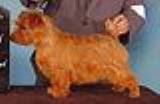
The Norfolk Terrier has a wire-haired coat
which, according to the various national kennel clubs' breed standards, can be "all shades of red, wheaten, black and tan, or grizzle."
They are the smallest of the working terriers. They are active and compact, free moving, with good substance and bone. Good substance means good spring of rib and bone that matches the body such that the dog can be a very agile ratter or earth-dog.
Norfolk terriers are moderately proportioned dogs. A too heavy dog would not be agile. A too refined dog would make it a toy breed. Norfolks generally have more reach and drive and a stronger rear angulation, hence cover more ground than their Norwich cousins. Norfolk have good side gait owed to their balanced angulation front and rear and their slightly longer length of back.
The ideal height is 9 to 10 in (22.9 to 25.4 cm) at the withers and weight is about 11 to 12 lb (5 to 5.4 kg).
 Norfolks are described as fearless, but should not be aggressive despite being capable of defending themselves if need be. They, along with Norwich Terriers and Border Terrier
s, have the softest temperaments of the Terrier Group. Norfolks work in packs and must get along with other dogs.
As companions, they love people and children and do make good pets. Their activity level is generally reflective of the pace of their environment. This breed should not be kept or live outside since they thrive on human contact. Generally, Norfolks are not given to digging but, like any dog, will dig out of boredom when left alone for too long a period. Norfolks can be barkers and are very vocal. They generally cohabit well with other household pets when introduced as a puppy. Outdoors, they are natural hunters with a strong prey drive for small vermin.
Norfolks are self confident and carry themselves with presence and importance, holding their heads and tails erect. A Norfolk that is shy or that carries its tail between its legs is atypical, as is a dog that is hot tempered and aggressive with other dogs; these traits are not the standard. A Norfolk's typical temperament is happy, spirited, and self confident.
s, and incorrect bites (where the teeth do not align with the breed standard, i.e. overshot or undershot). Norfolks most often have shallow hip sockets and many breedlines are dysplastic. There has never been a Norfolk Terrier recognized by the Orthopedic Foundation for Animals (OFA) as having "excellent" rated hips. Therefore responsible breeders are testing for hip dysplasia. Breeders that do not radiograph hips and have them evaluated by either OFA or PennHip, cannot answer questions regarding hip dysplasia in their breeding program.
Norfolks generally have medium to small litters. Responsible breeders only breed healthy dogs who are of good temperament, good pedigree lineage and best reflect the breed standard. The demand for Norfolk is far greater than the supply. The environment in which they are raised directly impacts the temperament of the puppy for its lifetime.
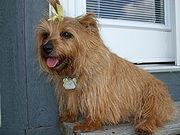 These breeds have a double coat: a harsh, wiry topcoat and a soft, warm undercoat. Ideally, the coat is combed daily with a steel "greyhound" comb, but all that is really necessary for grooming a companion dog is a good combing once a week to remove the loose, dead hairs and prevent matting. As a minimum, the coat is hand stripped once in the Fall and once in the Spring. Clipping or cutting ruins the coat's colours and harsh texture. A Norfolk Terrier can be washed with a dog shampoo when dirty.
sportsmen developed a working terrier of East Anglia
in eastern England
. The Norwich Terrier and later the drop-eared variety now known as the Norfolk Terrier, were believed to have been developed by crossing local terrier-like dogs, small, short-legged Irish Terrier
breeds and the small red terriers used by the Gypsy ratters of Norfolk
(the county in which Norwich
the city exists).
They were first called the Cantab Terrier when they became fashionable for students to keep in their rooms at Cambridge University
in England. Later, they were called the Trumpington Terrier, after a street in the area where the breed was first developed. Then, just prior to World War I
, an Irish horse rider named Frank Jones sold vast quantities of the short-legged terriers to the USA, so they were called the Jones Terriers.
In 1932, the Norwich was granted acceptance into the English Kennel Club
and the first written standard was created. The American Kennel Club
registered the first Norwich Terrier in 1936. In 1964, The Kennel Club reclassified the drop-ear variety as it its own breed, the Norfolk Terrier, and the prick-eared variety retained the name Norwich Terrier. The American Kennel Club and Canadian Kennel Club
both recognized the division of the Norwich Terrier breed in 1979. The Norfolk Terrier was recognized by the United Kennel Club
in 1979. After many generations, these two breeds have developed as two distinct breeds both in physical looks and in temperament. Of note, there is literature that suggests that the Norfolk and Norwich were always two distinct breeds and the original mistake was classifying them as one.
Dog breed
Dog breeds are groups of closely related and visibly similar domestic dogs, which are all of the subspecies Canis lupus familiaris, having characteristic traits that are selected and maintained by humans, bred from a known foundation stock....
of dog
Dog
The domestic dog is a domesticated form of the gray wolf, a member of the Canidae family of the order Carnivora. The term is used for both feral and pet varieties. The dog may have been the first animal to be domesticated, and has been the most widely kept working, hunting, and companion animal in...
. Prior to gaining recognition as an independent breed in 1960, it was a variety of the Norwich Terrier
Norwich Terrier
The Norwich Terrier is a breed of dog. It originates in the United Kingdom and was bred to hunt small vermin or rodents.-Appearance:These terriers are one of the smallest terriers , with prick ears and a double coat, which come in red, tan, wheaten, black and tan, and grizzle.-Temperament:These...
, distinguished from the "prick eared" Norwich by its "drop ears" (or folded ears). Together, the Norfolk and Norwich Terriers are the smallest of the working terrier
Working terrier
A working terrier is a small type of dog which pursues its quarry into the earth. According to the Oxford English Dictionary, the name dates back to at least 1440, derived from early modern French terrier - from the medieval Latin terrarius from the Latin terra .With the growth of popularity of...
s.
Appearance
The Norfolk Terrier has a wire-haired coat
Coat (dog)
The coat of the domestic dog refers to the hair that covers its body. A dog's coat may be a double coat, made up of a soft undercoat and a coarser topcoat, or a single coat, which lacks an undercoat...
which, according to the various national kennel clubs' breed standards, can be "all shades of red, wheaten, black and tan, or grizzle."
They are the smallest of the working terriers. They are active and compact, free moving, with good substance and bone. Good substance means good spring of rib and bone that matches the body such that the dog can be a very agile ratter or earth-dog.
Norfolk terriers are moderately proportioned dogs. A too heavy dog would not be agile. A too refined dog would make it a toy breed. Norfolks generally have more reach and drive and a stronger rear angulation, hence cover more ground than their Norwich cousins. Norfolk have good side gait owed to their balanced angulation front and rear and their slightly longer length of back.
The ideal height is 9 to 10 in (22.9 to 25.4 cm) at the withers and weight is about 11 to 12 lb (5 to 5.4 kg).
Temperament
Border Terrier
The Border Terrier is a small, rough-coated breed of dog of the terrier group. Originally bred as fox and vermin hunters, Border Terriers share ancestry with Dandie Dinmont Terriers and Bedlington Terriers....
s, have the softest temperaments of the Terrier Group. Norfolks work in packs and must get along with other dogs.
As companions, they love people and children and do make good pets. Their activity level is generally reflective of the pace of their environment. This breed should not be kept or live outside since they thrive on human contact. Generally, Norfolks are not given to digging but, like any dog, will dig out of boredom when left alone for too long a period. Norfolks can be barkers and are very vocal. They generally cohabit well with other household pets when introduced as a puppy. Outdoors, they are natural hunters with a strong prey drive for small vermin.
Norfolks are self confident and carry themselves with presence and importance, holding their heads and tails erect. A Norfolk that is shy or that carries its tail between its legs is atypical, as is a dog that is hot tempered and aggressive with other dogs; these traits are not the standard. A Norfolk's typical temperament is happy, spirited, and self confident.
Working style
Norfolks were originally bred as barn dogs to rid the barn of vermin. Some literature suggest that they were also occasionally used on the hunt to bolt animals of equal size from their den. To some extent they are still used in that capacity in continental Europe. Norfolks are pack animals and hence expected to get along with other dogs while working or in the home. As a pack dog, they take turns working their prey. They are fearless and their courage is incredible. Today, of course, they are household companions and must have an agreeable disposition for living with people.Health
The life expectancy of a Norfolk Terrier is 12–15 years, with some growing as old as 19 years. Norfolks do have incidences of mitral valve disease, luxating patellaLuxating patella
Luxating patella is a condition in which the patella, or kneecap, dislocates or moves out of its normal location....
s, and incorrect bites (where the teeth do not align with the breed standard, i.e. overshot or undershot). Norfolks most often have shallow hip sockets and many breedlines are dysplastic. There has never been a Norfolk Terrier recognized by the Orthopedic Foundation for Animals (OFA) as having "excellent" rated hips. Therefore responsible breeders are testing for hip dysplasia. Breeders that do not radiograph hips and have them evaluated by either OFA or PennHip, cannot answer questions regarding hip dysplasia in their breeding program.
Norfolks generally have medium to small litters. Responsible breeders only breed healthy dogs who are of good temperament, good pedigree lineage and best reflect the breed standard. The demand for Norfolk is far greater than the supply. The environment in which they are raised directly impacts the temperament of the puppy for its lifetime.
Grooming
History
In the 1880s, BritishGreat Britain
Great Britain or Britain is an island situated to the northwest of Continental Europe. It is the ninth largest island in the world, and the largest European island, as well as the largest of the British Isles...
sportsmen developed a working terrier of East Anglia
East Anglia
East Anglia is a traditional name for a region of eastern England, named after an ancient Anglo-Saxon kingdom, the Kingdom of the East Angles. The Angles took their name from their homeland Angeln, in northern Germany. East Anglia initially consisted of Norfolk and Suffolk, but upon the marriage of...
in eastern England
England
England is a country that is part of the United Kingdom. It shares land borders with Scotland to the north and Wales to the west; the Irish Sea is to the north west, the Celtic Sea to the south west, with the North Sea to the east and the English Channel to the south separating it from continental...
. The Norwich Terrier and later the drop-eared variety now known as the Norfolk Terrier, were believed to have been developed by crossing local terrier-like dogs, small, short-legged Irish Terrier
Irish Terrier
The Irish Terrier is a dog breed from Ireland, one of many breeds of Terrier.The Irish Terrier is an active and compactly sized dog that is suited for life in both rural and city environments. Its harsh red coat protects it from all kinds of weather....
breeds and the small red terriers used by the Gypsy ratters of Norfolk
Norfolk
Norfolk is a low-lying county in the East of England. It has borders with Lincolnshire to the west, Cambridgeshire to the west and southwest and Suffolk to the south. Its northern and eastern boundaries are the North Sea coast and to the north-west the county is bordered by The Wash. The county...
(the county in which Norwich
Norwich
Norwich is a city in England. It is the regional administrative centre and county town of Norfolk. During the 11th century, Norwich was the largest city in England after London, and one of the most important places in the kingdom...
the city exists).
They were first called the Cantab Terrier when they became fashionable for students to keep in their rooms at Cambridge University
University of Cambridge
The University of Cambridge is a public research university located in Cambridge, United Kingdom. It is the second-oldest university in both the United Kingdom and the English-speaking world , and the seventh-oldest globally...
in England. Later, they were called the Trumpington Terrier, after a street in the area where the breed was first developed. Then, just prior to World War I
World War I
World War I , which was predominantly called the World War or the Great War from its occurrence until 1939, and the First World War or World War I thereafter, was a major war centred in Europe that began on 28 July 1914 and lasted until 11 November 1918...
, an Irish horse rider named Frank Jones sold vast quantities of the short-legged terriers to the USA, so they were called the Jones Terriers.
In 1932, the Norwich was granted acceptance into the English Kennel Club
The Kennel Club
The Kennel Club is a kennel club based in London and Aylesbury, United Kingdom.The Kennel Club registration system divides dogs into seven breed groups. The Kennel Club Groups are: Hound, Working, Terrier, Gundog, Pastoral, Utility and Toy...
and the first written standard was created. The American Kennel Club
American Kennel Club
The American Kennel Club is a registry of purebred dog pedigrees in the United States. Beyond maintaining its pedigree registry, this kennel club also promotes and sanctions events for purebred dogs, including the Westminster Kennel Club Dog Show, an annual event which predates the official...
registered the first Norwich Terrier in 1936. In 1964, The Kennel Club reclassified the drop-ear variety as it its own breed, the Norfolk Terrier, and the prick-eared variety retained the name Norwich Terrier. The American Kennel Club and Canadian Kennel Club
Canadian Kennel Club
The Canadian Kennel Club is the primary registry body for purebred dog pedigrees in Canada. Beyond maintaining the pedigree registry, the C.K.C...
both recognized the division of the Norwich Terrier breed in 1979. The Norfolk Terrier was recognized by the United Kennel Club
United Kennel Club
The United Kennel Club is the second oldest all-breed registry of purebred dog pedigrees in the United States and the second largest in the world. According to the website, the club records 250,000 registrations annually. The UKC is not part of the International Canine Organisation, Fédération...
in 1979. After many generations, these two breeds have developed as two distinct breeds both in physical looks and in temperament. Of note, there is literature that suggests that the Norfolk and Norwich were always two distinct breeds and the original mistake was classifying them as one.