
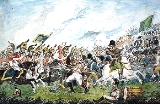
The
Battle of Vinegar Hill was an engagement during the
Irish Rebellion of 1798The Irish Rebellion of 1798 , also known as the United Irishmen Rebellion , was an uprising in 1798, lasting several months, against British rule in Ireland...
on 21 June 1798 when over 15,000 British soldiers launched an attack on Vinegar Hill outside
EnniscorthyEnniscorthy is the second largest town in County Wexford, Ireland. The population of the town and environs is 9538. The Placenames Database of Ireland sheds no light on the origins of the town's name. It may refer either to the "Island of Corthaidh" or the "Island of Rocks". With a history going...
,
County WexfordCounty Wexford is a county in Ireland. It is part of the South-East Region and is also located in the province of Leinster. It is named after the town of Wexford. In pre-Norman times it was part of the Kingdom of Uí Cheinnselaig, whose capital was at Ferns. Wexford County Council is the local...
, the largest camp and headquarters of the Wexford United Irish rebels. It marked a turning point in the
Irish Rebellion of 1798The Irish Rebellion of 1798 , also known as the United Irishmen Rebellion , was an uprising in 1798, lasting several months, against British rule in Ireland...
, as it was the last attempt by the rebels to hold and defend ground against the British military. The battle was actually fought in two locations: on Vinegar Hill itself and in the streets of nearby Enniscorthy.
Preparations
By 18 June, the British had surrounded county Wexford with an estimated 20,000 troops and were ready to pour into Wexford to crush the insurgency. The rebel leadership issued a call to all its fighters to gather at Vinegar Hill to meet the army in one great, decisive battle. The number assembled was estimated at 20,000, but the majority lacked firearms and had to rely on
pikesA pike is a pole weapon, a very long thrusting spear used extensively by infantry both for attacks on enemy foot soldiers and as a counter-measure against cavalry assaults. Unlike many similar weapons, the pike is not intended to be thrown. Pikes were used regularly in European warfare from the...
as their main weapon. The camp also included many thousands of women and children who were staying there for protection against the rampaging military.
The British plan, as formulated by
General LakeGeneral Gerard Lake, 1st Viscount Lake was a British general. He commanded British forces during the Irish Rebellion of 1798 and later served as Commander-in-Chief of the military in British India.-Background:...
, envisaged the complete annihilation of the rebels by encircling the hill and seizing the only escape route to the west, the bridge over the
SlaneyThe Slaney is a river in the southeast of Ireland. It rises on Lugnaquilla Mountain in the western Wicklow Mountains and flows west and then south through counties Wicklow, Carlow and Wexford, before entering St George's Channel in the Irish Sea at Wexford town...
. Lake divided his force into four columns to accomplish this; three columns, under Generals Dundas, Duff and
NeedhamFrancis Needham, 1st Earl of Kilmorey , known as Francis Needham until 1818 and as The Viscount Kilmorey from 1818 to 1822, was an Anglo-Irish soldier and Member of Parliament....
were to assault Vinegar Hill, while the fourth column, under General Johnson, was to storm Enniscorthy and its bridge.
Bombardment of Vinegar Hill
The battle began shortly before dawn with an artillery bombardment of Irish positions on the hill. Advance units quickly moved against rebel outposts under cover of the shelling and moved artillery closer as forward positions were secured. The tightening ring forced the rebels into an ever-shrinking area and increased exposure to the constant shelling, including new experimental delayed-fuse shells resulting in hundreds of dead and injured. At least two mass charges were launched by the rebels which failed to break the lines of the military and the situation on Vinegar Hill soon became desperate for the rebels.
Attack on Enniscorthy
Meanwhile a detachment of light infantry under the command of General Johnson attacked the town of Enniscorthy but met with fierce resistance. Buildings in the town had been fortified, and the initial attack was driven back, with the loss of munitions and men. A second attack commenced with reinforcements including cavalry, which retook the lost cannon and ammunition while also incurring considerable casualties. The Irish rebels were slowly driven out of the town but managed to hold the Slaney bridge and prevent the British from crossing.
Rout and atrocities
When British troops crested the eastern summit of Vinegar Hill, the rebels began to slowly withdraw through a gap in the British lines later known as “Needham's Gap”, so-named because the late arrival of General Needham's troops prevented a total encirclement of the hill. Although the bulk of the rebel army escaped, many were left behind and killed in the rout phase of the battle, from both cavalry and infantry attack, but also from the advanced field guns which were switched to grape shot to maximise casualties.
In addition to conventional casualties, the military were guilty of instances of gang rape of females amongst the rebel camp and in Enniscorthy, rebel wounded were burned to death when soldiers set fire to a building used as a casualty station. The Irish rebels abandoned much of the supplies they had taken from surrounding areas, and thirteen cannon were captured by the British, a number of which had been taken from the British forces previously. Archibald McLaren, an eyewitness, wrote that total Irish rebel casualties totaled about 1200 men.
Aftermath
Meanwhile, the bulk of the rebel force streamed unmolested towards the Three Rocks camp outside
WexfordWexford is the county town of County Wexford, Ireland. It is situated near the southeastern corner of Ireland, close to Rosslare Europort. The town is connected to Dublin via the M11/N11 National Primary Route, and the national rail network...
town and, following the decision to abandon the town, split into two separate columns in a new campaign to spread the rebellion beyond Wexford. One immediately set out to the west, the other northwards towards the
Wicklow MountainsThe Wicklow Mountains form the largest continuous upland area in Ireland. They occupy the whole centre of County Wicklow and stretch outside its borders into Counties Carlow, Wexford and Dublin. Where the mountains extend into County Dublin, they are known locally as the Dublin Mountains...
to link up with General
Joseph Holt'sJoseph Holt was a United Irish general and leader of a large guerrilla force which fought against British troops in County Wicklow from June–October 1798. He was exiled to Australia in 1799 where he worked as a farm manager and eventually returned to Ireland in 1814.-Background:Holt was one of six...
forces.
The defeat was therefore not the immediate crushing blow to the Wexford rebels that it has traditionally been depicted as, but it did alter the course of the fighting as continued resistance now took the form of mobile warfare, raids, and large scale guerilla-type operations.
Primary sources
Secondary sources
- Dickson, Charles. The Wexford Rising in 1798: its causes and course. Tralee, 1955.
- Furlong, Nicholas. Fr. John Murphy of Boolavogue, 1753-98. Dublin, 1991. ISBN 0-906602-18-1.
- Gahan, Daniel. The People's Rising. Wexford 1798. Dublin: Gill & Macmillan Ltd., 1995.
- Kee, Robert. The Green Flag: A History of Irish Nationalism. London, 1972.
- Keogh, Daire & Nicholas Furlong (Editors). The Mighty Wave: The 1798 Rebellion in Wexford. Dublin: Four Courts Press, 1996. ISBN 1-85182-254-2.
External links