


Museum of London

Encyclopedia
The Museum of London documents the history of London
from the Prehistoric to the present day. The museum is located close to the Barbican Centre
, as part of the striking Barbican complex of buildings created in the 1960s and 70s as an innovative approach to re-development within a bomb damaged area of the City. It is a few minutes' walk north of St Paul's Cathedral
, overlooking the remains of the Roman city wall and on the edge of the oldest part of London, known as the City
, now the financial district. It is primarily concerned with the social history of London and its inhabitants throughout history. The museum is a non-departmental public body
.
 The museum was opened in 1976 as part of the Barbican Estate
, using collections previously held by the Corporation at the Guildhall
and also items from other collections, including the London Museum
, which was located in Kensington Palace
. The architects were Philip Powell
and Hidalgo Moya
, who adopted an innovative approach to museum design, whereby the galleries were laid out so that there was only one route through the museum - from the prehistoric period to the modern galleries.
The museum comprises a series of chronological galleries containing original artefacts, models, pictures and diagrams, with a strong emphasis on archaeological discoveries, the built city, urban development and London's social and cultural life, with interactive displays and activities for all ages. Fragments of the Roman London Wall
can be seen just outside the museum. The prehistoric gallery, "London Before London" and the "Medieval London" gallery have already been updated, and in 2008 a refurbished gallery on "War, Plague and Fire" opened, covering the period of the English Civil War
and the Great Fire of London
to 1666.
The museum had a £20 million redevelopment which was completed in May 2010. This is its biggest investment since opening in 1976. The re-design, by London-based architects Wilkinson Eyre
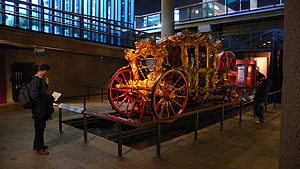
, tell the story of London and Londoners from the Great Fire of 1666 to the present day. The transformation includes four new galleries. The new City Gallery features large street level windows along London Wall
and provides an illuminated showcase for the Lord Mayor's State Coach, which takes to the streets each November for the Lord Mayor's Show
.
The Galleries of Modern London increase the museum's exhibition space by 25 percent and enable the display of 7,000 objects. Star exhibits include a reconstruction of Georgian
and Victorian
Pleasure gardens, the foreboding wooden interior of the Wellclose debtors prison cell, an art deco lift from Selfridges
department store and the puppet stars of BBC
children's TV Andy Pandy
and Bill and Ben
.
The "Expanding City" gallery covers the period 1660s to 1850. "People's City" addresses 1850 to 1940s including a Victorian
walk with displays of shops and public buildings, and sections on the West End
, Suffragettes, World War I
and World War II
, and everyday life.
The new galleries place a renewed emphasis on contemporary London and contemporary collecting. "World City" is the gallery which tells London's story from 1950 to the present day. Fashion looms large here - from formal suits of the 1950s, through to the Mary Quant
dress of the swinging 60s, hippy chic in the 70s and the bondage trousers and ripped T-shirts of the punk
era. Fashion comes right up to date with a pashmina from Alexander McQueen
's 2008 collection.
The museum's new Sackler Hall contains an elliptical LED
curtain where the work of up-and-coming young filmmakers will be screened in a bi-annual Museum of London Film Commission, in association with Film London. The museum's new art gallery "Inspiring London" will display new acquisitions of contemporary prints, paintings and drawings alongside a range of artwork from the museum's existing collection.
The museum is open every day from 10am to 6pm, except 24-26 December. Entry is free.
(formerly Museum in Docklands) was opened in a 19th-century grade I listed warehouse near Canary Wharf
on the Isle of Dogs
. Museum of London Docklands charts the history of London as a port, beginning 2000 years ago with the Roman trading post set up on the banks of the Thames and following London's expansion into the biggest port the world had ever known. In November 2007, it opened the capital's first permanent gallery examining London's involvement in the transatlantic slave trade, "London, Sugar & Slavery".
, which provides archaeological services in London but also does work elsewhere in the UK and abroad. Archaeological findings made by the service and others working in London are archived at the Museum of London Archaeological Archive.
. Prior to this the Museum had been jointly controlled by the City of London and the Department for Culture, Media and Sport
. It is headed by a director.
London
London is the capital city of :England and the :United Kingdom, the largest metropolitan area in the United Kingdom, and the largest urban zone in the European Union by most measures. Located on the River Thames, London has been a major settlement for two millennia, its history going back to its...
from the Prehistoric to the present day. The museum is located close to the Barbican Centre
Barbican Centre
The Barbican Centre is the largest performing arts centre in Europe. Located in the City of London, England, the Centre hosts classical and contemporary music concerts, theatre performances, film screenings and art exhibitions. It also houses a library, three restaurants, and a conservatory...
, as part of the striking Barbican complex of buildings created in the 1960s and 70s as an innovative approach to re-development within a bomb damaged area of the City. It is a few minutes' walk north of St Paul's Cathedral
St Paul's Cathedral
St Paul's Cathedral, London, is a Church of England cathedral and seat of the Bishop of London. Its dedication to Paul the Apostle dates back to the original church on this site, founded in AD 604. St Paul's sits at the top of Ludgate Hill, the highest point in the City of London, and is the mother...
, overlooking the remains of the Roman city wall and on the edge of the oldest part of London, known as the City
City of London
The City of London is a small area within Greater London, England. It is the historic core of London around which the modern conurbation grew and has held city status since time immemorial. The City’s boundaries have remained almost unchanged since the Middle Ages, and it is now only a tiny part of...
, now the financial district. It is primarily concerned with the social history of London and its inhabitants throughout history. The museum is a non-departmental public body
Non-departmental public body
In the United Kingdom, a non-departmental public body —often referred to as a quango—is a classification applied by the Cabinet Office, Treasury, Scottish Government and Northern Ireland Executive to certain types of public bodies...
.
Description
Barbican Estate
The Barbican Estate is a residential estate built during the 1960s and the 1970s in the City of London, in an area once devastated by World War II bombings and today densely populated by financial institutions...
, using collections previously held by the Corporation at the Guildhall
Guildhall, London
The Guildhall is a building in the City of London, off Gresham and Basinghall streets, in the wards of Bassishaw and Cheap. It has been used as a town hall for several hundred years, and is still the ceremonial and administrative centre of the City of London and its Corporation...
and also items from other collections, including the London Museum
London Museum
The London Museum was inaugurated on 21 March 1912 by King George V with Queen Mary and Princess Mary and Prince George at Kensington Palace. It opened for public visitation on 8 April, admitting more than 13.000 visitors during the day. Two years later the collections were removed to Lancaster...
, which was located in Kensington Palace
Kensington Palace
Kensington Palace is a royal residence set in Kensington Gardens in the Royal Borough of Kensington and Chelsea in London, England. It has been a residence of the British Royal Family since the 17th century and is the official London residence of the Duke and Duchess of Cambridge, the Duke and...
. The architects were Philip Powell
Philip Powell (architect)
Sir Arnold Joseph Philip Powell , usually known as Philip Powell, was a ground-breaking English post-war architect.He was educated at Epsom College and then the Architectural Association....
and Hidalgo Moya
Hidalgo Moya
John Hidalgo Moya , sometimes known as Jacko Moya, was a famous American-born architect who worked largely in England. Moya was a native of California where he was born to an English mother and Mexican father but lived in England since he was an infant. He formed the architectural practice Powell &...
, who adopted an innovative approach to museum design, whereby the galleries were laid out so that there was only one route through the museum - from the prehistoric period to the modern galleries.
The museum comprises a series of chronological galleries containing original artefacts, models, pictures and diagrams, with a strong emphasis on archaeological discoveries, the built city, urban development and London's social and cultural life, with interactive displays and activities for all ages. Fragments of the Roman London Wall
London Wall
London Wall was the defensive wall first built by the Romans around Londinium, their strategically important port town on the River Thames in what is now the United Kingdom, and subsequently maintained until the 18th century. It is now the name of a road in the City of London running along part of...
can be seen just outside the museum. The prehistoric gallery, "London Before London" and the "Medieval London" gallery have already been updated, and in 2008 a refurbished gallery on "War, Plague and Fire" opened, covering the period of the English Civil War
English Civil War
The English Civil War was a series of armed conflicts and political machinations between Parliamentarians and Royalists...
and the Great Fire of London
Great Fire of London
The Great Fire of London was a major conflagration that swept through the central parts of the English city of London, from Sunday, 2 September to Wednesday, 5 September 1666. The fire gutted the medieval City of London inside the old Roman City Wall...
to 1666.
The museum had a £20 million redevelopment which was completed in May 2010. This is its biggest investment since opening in 1976. The re-design, by London-based architects Wilkinson Eyre
Wilkinson Eyre
Wilkinson Eyre Architects is an international architecture firm based in London, England. The firm won the Royal Institute of British Architects Stirling Prize two years in a row...
, tell the story of London and Londoners from the Great Fire of 1666 to the present day. The transformation includes four new galleries. The new City Gallery features large street level windows along London Wall
London Wall
London Wall was the defensive wall first built by the Romans around Londinium, their strategically important port town on the River Thames in what is now the United Kingdom, and subsequently maintained until the 18th century. It is now the name of a road in the City of London running along part of...
and provides an illuminated showcase for the Lord Mayor's State Coach, which takes to the streets each November for the Lord Mayor's Show
Lord Mayor's Show
The Lord Mayor's Show is one of the longest established and best known annual events in London which dates back to 1535. The Lord Mayor in question is that of the City of London, the historic centre of London that is now the metropolis's financial district, informally known as the Square Mile...
.
The Galleries of Modern London increase the museum's exhibition space by 25 percent and enable the display of 7,000 objects. Star exhibits include a reconstruction of Georgian
Georgian architecture
Georgian architecture is the name given in most English-speaking countries to the set of architectural styles current between 1720 and 1840. It is eponymous for the first four British monarchs of the House of Hanover—George I of Great Britain, George II of Great Britain, George III of the United...
and Victorian
Victorian era
The Victorian era of British history was the period of Queen Victoria's reign from 20 June 1837 until her death on 22 January 1901. It was a long period of peace, prosperity, refined sensibilities and national self-confidence...
Pleasure gardens, the foreboding wooden interior of the Wellclose debtors prison cell, an art deco lift from Selfridges
Selfridges
Selfridges, AKA Selfridges & Co, is a chain of high end department stores in the United Kingdom. It was founded by Harry Gordon Selfridge. The flagship store in London's Oxford Street is the second largest shop in the UK and was opened on 15 March 1909.More recently, three other stores have been...
department store and the puppet stars of BBC
BBC
The British Broadcasting Corporation is a British public service broadcaster. Its headquarters is at Broadcasting House in the City of Westminster, London. It is the largest broadcaster in the world, with about 23,000 staff...
children's TV Andy Pandy
Andy Pandy
Andy Pandy is a British children's television series that premiered on BBC TV in June or July 1950. The original series of programmes was shown until 1970, when a new series was made. A third series was made in 2002...
and Bill and Ben
Bill and Ben
The names Bill and Ben, when used together, may refer to:*Bill and Ben, The Flower Pot Men children's television show*Bill and Ben, locomotive characters from The Railway Series children's books by Rev. W...
.
The "Expanding City" gallery covers the period 1660s to 1850. "People's City" addresses 1850 to 1940s including a Victorian
Victorian era
The Victorian era of British history was the period of Queen Victoria's reign from 20 June 1837 until her death on 22 January 1901. It was a long period of peace, prosperity, refined sensibilities and national self-confidence...
walk with displays of shops and public buildings, and sections on the West End
West End theatre
West End theatre is a popular term for mainstream professional theatre staged in the large theatres of London's 'Theatreland', the West End. Along with New York's Broadway theatre, West End theatre is usually considered to represent the highest level of commercial theatre in the English speaking...
, Suffragettes, World War I
World War I
World War I , which was predominantly called the World War or the Great War from its occurrence until 1939, and the First World War or World War I thereafter, was a major war centred in Europe that began on 28 July 1914 and lasted until 11 November 1918...
and World War II
World War II
World War II, or the Second World War , was a global conflict lasting from 1939 to 1945, involving most of the world's nations—including all of the great powers—eventually forming two opposing military alliances: the Allies and the Axis...
, and everyday life.
The new galleries place a renewed emphasis on contemporary London and contemporary collecting. "World City" is the gallery which tells London's story from 1950 to the present day. Fashion looms large here - from formal suits of the 1950s, through to the Mary Quant
Mary Quant
Mary Quant OBE FCSD is a British] fashion designer and British fashion icon, who was instrumental in the mod fashion movement. She was one of the designers who took credit for inventing the miniskirt and hot pants. Born in Blackheath, London, to Welsh parents, Quant brought fun and fantasy to...
dress of the swinging 60s, hippy chic in the 70s and the bondage trousers and ripped T-shirts of the punk
Punk fashion
Punk fashion is the clothing, hairstyles, cosmetics, jewelry, and body modifications of the punk subculture. Punk fashion varies widely, ranging from Vivienne Westwood designs to styles modeled on bands like The Exploited. The distinct social dress of other subcultures and art movements, including...
era. Fashion comes right up to date with a pashmina from Alexander McQueen
Alexander McQueen
Lee Alexander McQueen, CBE was a British fashion designer and couturier best known for his in-depth knowledge of bespoke British tailoring, his tendency to juxtapose strength with fragility in his collections, as well as the emotional power and raw energy of his provocative fashion shows...
's 2008 collection.
The museum's new Sackler Hall contains an elliptical LED
LEd
LEd is a TeX/LaTeX editing software working under Microsoft Windows. It is a freeware product....
curtain where the work of up-and-coming young filmmakers will be screened in a bi-annual Museum of London Film Commission, in association with Film London. The museum's new art gallery "Inspiring London" will display new acquisitions of contemporary prints, paintings and drawings alongside a range of artwork from the museum's existing collection.
The museum is open every day from 10am to 6pm, except 24-26 December. Entry is free.
Museum of London Docklands
In 2003, Museum of London DocklandsMuseum in Docklands
The Museum of London Docklands is a museum on the Isle of Dogs, east London that tells the history of London's River Thames and Docklands...
(formerly Museum in Docklands) was opened in a 19th-century grade I listed warehouse near Canary Wharf
Canary Wharf
Canary Wharf is a major business district located in London, United Kingdom. It is one of London's two main financial centres, alongside the traditional City of London, and contains many of the UK's tallest buildings, including the second-tallest , One Canada Square...
on the Isle of Dogs
Isle of Dogs
The Isle of Dogs is a former island in the East End of London that is bounded on three sides by one of the largest meanders in the River Thames.-Etymology:...
. Museum of London Docklands charts the history of London as a port, beginning 2000 years ago with the Roman trading post set up on the banks of the Thames and following London's expansion into the biggest port the world had ever known. In November 2007, it opened the capital's first permanent gallery examining London's involvement in the transatlantic slave trade, "London, Sugar & Slavery".
Museum of London Archaeology
Museum of London includes Museum of London ArchaeologyMuseum of London Archaeology Service
Museum of London Archaeology is a Registered Archaeological Organisation with the Institute of Field Archaeologists and is a self-financing part of the Museum of London Group, providing a wide range of professional archaeological services to clients in London, SE England, the UK and...
, which provides archaeological services in London but also does work elsewhere in the UK and abroad. Archaeological findings made by the service and others working in London are archived at the Museum of London Archaeological Archive.
Structure
Museum of London, Museum of London Docklands and Museum of London Archaeology are all part of the same group. Since 1 April 2008, the Museum has been jointly controlled and funded by the City of London Corporation and the Greater London AuthorityGreater London Authority
The Greater London Authority is the top-tier administrative body for Greater London, England. It consists of a directly elected executive Mayor of London, currently Boris Johnson, and an elected 25-member London Assembly with scrutiny powers...
. Prior to this the Museum had been jointly controlled by the City of London and the Department for Culture, Media and Sport
Department for Culture, Media and Sport
The Department for Culture, Media and Sport is a department of the United Kingdom government, with responsibility for culture and sport in England, and some aspects of the media throughout the whole UK, such as broadcasting and internet....
. It is headed by a director.
List of directors
- Tom HumeTom Hume (museum director)Thomas Andrew Hume CBE was the first director of the Museum of London.Born on 21 June 1917, the only son of the late Thomas Hume of Burnfoot, Oxton and Lillias Dodds, Hume was educated at the Heaton Grammar School in Heaton, Newcastle upon Tyne before attending King's College, Durham University,...
(1972 to 1977) - Max HebditchMax HebditchMax Hebditch, CBE, MA, FSA, FMA, DLitt, was Director of the Museum of London in London, England.Hebditch lives in Taunton and is also a past president of the UK Museums Association. After retiring from the Museum of London, he became honorary curator at the Philpot Museum in Lyme Regis,...
(1977 to 1997) - Simon ThurleySimon ThurleySimon John Thurley, CBE, FRIBA, F.R.Hist.S. is an academic and architectural historian, and the present Chief Executive of English Heritage .-Early life and education:...
(1997 to 2002) - Professor Jack Lohman (2002 to present)
Floor directory
| floor U1 | floor E (Entrance Level) | floor L1 | floor L2 |
|---|---|---|---|
| Activity Space 1 Activity Space 2 Seminar Room e-Learning Studio |
Rotunda Garden Terrace Boardroom Garden Room Terrace Gallery London Wall Bar & Kitchen Lunch Space 450,000 BC - AD 50: London Before London Archaeology in Action AD 50-410: Roman London AD 410-1558: Medieval London 1550s-1660s: War, Plague & Fire New Acquisitions |
Weston Theatre | Modern London 1670s-1850s: Expanding City Modern London 1850s - 1940s: People's City Modern London 1950s - Today: World City Victorian Walk City Gallery Inspiring London The Sackler Hall Linbury Gallery Garden Court |
Transport connections
| Service | Station/Stop | Lines/Routes served | Distance from Museum of London |
|---|---|---|---|
| London Buses | Museum of London | 4 London Buses route 4 London Buses route 4 is a Transport for London contracted bus route in London, England, United Kingdom. The service is currently contracted to Metroline.-History:... , 56 |
|
| London Wall / Museum of London | 100 | ||
| Angel Street | 172 | 220 metres walk | |
| St. Paul's Station | 8 London Buses route 8 London Buses route 8 is a Transport for London contracted bus route in London, England, United Kingdom. The service is currently contracted to Stagecoach London.-History:... , 25 London Buses route 25 London Buses route 25 is a Transport for London contracted bus route in London, United Kingdom. The service is currently contracted to First Capital.-History:... , 56, 242, 521 London Buses route 521 London Buses route 521 is a Transport for London contracted bus route in London, United Kingdom. The service is currently contracted to Go-Ahead London.-History:Service 521 is one of two Red Arrow routes, the other being route 507, that survived into 2009.... |
350 metres walk | |
| London Underground | St. Paul's St. Paul's tube station St. Paul's tube station is a London Underground station in the City of London on the Central Line, between Bank and Chancery Lane stations, and is in Travelcard Zone 1.... |
300 metres walk | |
| Barbican | |
300 metres walk | |
| Moorgate Moorgate station Moorgate station is a central London railway terminus and London Underground station on Moorgate in the City of London; it provides National Rail services by First Capital Connect for Hertford, Welwyn Garden City and Letchworth and also serves the Circle, Hammersmith & City, Metropolitan Lines and... |
|
600 metres walk | |
| National Rail | First Capital Connect First Capital Connect First Capital Connect is a passenger train operating company in England that began operations on the National Rail network on 1 April 2006... |
See also
- Museum of London ArchaeologyMuseum of London Archaeology ServiceMuseum of London Archaeology is a Registered Archaeological Organisation with the Institute of Field Archaeologists and is a self-financing part of the Museum of London Group, providing a wide range of professional archaeological services to clients in London, SE England, the UK and...
- Museum of London DocklandsMuseum in DocklandsThe Museum of London Docklands is a museum on the Isle of Dogs, east London that tells the history of London's River Thames and Docklands...
- London MuseumLondon MuseumThe London Museum was inaugurated on 21 March 1912 by King George V with Queen Mary and Princess Mary and Prince George at Kensington Palace. It opened for public visitation on 8 April, admitting more than 13.000 visitors during the day. Two years later the collections were removed to Lancaster...
External links
- Official website of the Museum of London
- Streetmuseum application for iphone users
- Location map from streetmap.co.uk
- Museum of London on Facebook
- Museum of London on YouTube
- Museum of London on Twitter
- Museum of London Docklands
- Museum of London Archaeology
- 'Behind the scenes' blog provides a sneak peek into the working life of the Museum of London.
- UntoldLondon website - also run from the Museum of London
- Thames Discovery Programme community archaeology project at the Museum of London