


Musa al-Husayni

Encyclopedia
Ottoman Empire
The Ottoman EmpireIt was usually referred to as the "Ottoman Empire", the "Turkish Empire", the "Ottoman Caliphate" or more commonly "Turkey" by its contemporaries...
administration. He belongs to the prominent al-Husayni
Al-Husayni
Husayni is the name of a prominent Palestinian Arab clan formerly based in Jerusalem. Several members of the clan held important political positions such as Mayor and Grand Mufti of Jerusalem and founded and led many Palestinian Arab Islamist groups such as the Holy War Army, the Palestine Arab...
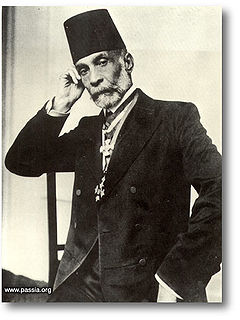
family of northeastern Jerusalem. He was mayor of Jerusalem (1918-1920), chairman of the Palestinian Arab Action Committee and leader of the Palestinian national movement from 1922 until 1934.
Husayni was a graduate from the Istanbul School of Administration and held many administrative positions (among others district Governor of Yemen, 1908) in the Ottoman Empire
Ottoman Empire
The Ottoman EmpireIt was usually referred to as the "Ottoman Empire", the "Turkish Empire", the "Ottoman Caliphate" or more commonly "Turkey" by its contemporaries...
from which he retired on the eve of World War I
World War I
World War I , which was predominantly called the World War or the Great War from its occurrence until 1939, and the First World War or World War I thereafter, was a major war centred in Europe that began on 28 July 1914 and lasted until 11 November 1918...
.
He was elected president of the Arab Executive Committee at the 3rd Congress in Haifa
Haifa
Haifa is the largest city in northern Israel, and the third-largest city in the country, with a population of over 268,000. Another 300,000 people live in towns directly adjacent to the city including the cities of the Krayot, as well as, Tirat Carmel, Daliyat al-Karmel and Nesher...
, 14 December, 1920 and held this position until 1928. He was dismissed from the office of mayor of Jerusalem after his involvement in the 1920 Palestine riots
1920 Palestine riots
The 1920 Palestine riots, or Nabi Musa riots, took place in British Mandate of Palestine April 4–7, 1920 in and around the Old City of Jerusalem....
.
Husayni was head and member of the Palestinian Delegations to London in the 1920-30s. He acted as leader of the demonstration protesting Zionist
Zionism
Zionism is a Jewish political movement that, in its broadest sense, has supported the self-determination of the Jewish people in a sovereign Jewish national homeland. Since the establishment of the State of Israel, the Zionist movement continues primarily to advocate on behalf of the Jewish state...
immigration
Aliyah
Aliyah is the immigration of Jews to the Land of Israel . It is a basic tenet of Zionist ideology. The opposite action, emigration from Israel, is referred to as yerida . The return to the Holy Land has been a Jewish aspiration since the Babylonian exile...
in Jaffa
Jaffa
Jaffa is an ancient port city believed to be one of the oldest in the world. Jaffa was incorporated with Tel Aviv creating the city of Tel Aviv-Yafo, Israel. Jaffa is famous for its association with the biblical story of the prophet Jonah.-Etymology:...
on 27 October, 1933, where he was beaten by the British police which lead to his death on 27 March, 1934..
See also
- Orient HouseOrient HouseOrient House is a building located in East Jerusalem that served as the headquarters of the Palestine Liberation Organization in the 1980s and 1990s. Built in 1897 by Ismail Musa al-Husseini, it has been owned by the Al-Husayni family since...