

1920 Palestine riots

Encyclopedia
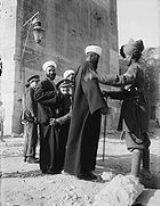
The 1920 Palestine riots, or Nabi Musa riots, took place in British Mandate of Palestine April 4–7, 1920 in and around the Old City of Jerusalem.
The events coincided with and are named after the Christian/Muslim Easter holiday Nabi Musa
and followed rising tensions in Arab-Jewish relations over the implications of Zionist
immigration, tensions which coincided with attacks on outlying Jewish settlements in the Galilee
. Speeches by Arab religious leaders during the festival, in which traditionally large numbers of Muslims gathered for a religious procession, led to a serious outbreak of violent assaults on the city's Jews, with five Jews killed and hundreds wounded.
The British military administration's erratic response failed to contain the rioting, which continued for four days. As a result of the events, trust between the British, Jews, and Arabs eroded. One consequence was that the Jewish community
increased moves towards an autonomous infrastructure and security apparatus parallel to that of the British administration.
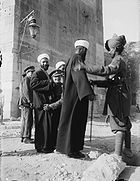 On 5 December 1918, The Eastern Committee of the British Cabinet met to discuss the future of Palestine. Lord Curzon
chaired the meeting. General Smuts
, Lord Balfour
, Lord Robert Cecil
, General Sir Henry Wilson, Chief of the Imperial General Staff, T. E. Lawrence
, and representatives of the Foreign Office, the India Office, the Admiralty, the War Office, and the Treasury were present. Lord Curzon stated:
After Emir
Faisal I expressed support for a Jewish National Home
in Palestine by signing the Faisal-Weizmann Agreement
at the Paris Peace Conference of 1919, and the subsequent breakdown of that agreement led to worsening relations among Arabs, Jews and the British military authorities in Palestine.
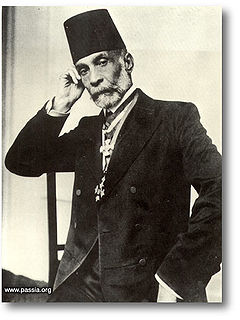 The Faisal-Clemenceau
agreement was to be considered, according to Faisal himself, still-born. Every decision regarding Syria, Palestine and Mesopotamia taken without his active participation would not be recognized by Arabs and would provoke difficulties for which he disclaimed any future responsibility. Between France
and the United Kingdom
, serious disagreements existed over borders, water rights, Zionist claims over areas of French-held Lebanese and Syrian territory, and the rights of Christians
, for whose security in Palestine France had traditional capitulary responsibilities. In Syria, under French authority, pan-Arab nationalists pressed for the "liberation" of Palestine.
From January 1920 onwards, relations between Zionist leaders and the British military administration deteriorated, as the former, led by Chaim Weizmann
, pressed for unconditional immigration, the loosening of wartime restrictions on land purchase and the reduction of Syrians in the administration, in favour of more British and Jewish functionaries, and the latter posed as defenders of the Arab population. A declaration by General Louis Bols
on 18 February, drafted to reassure Arabs, had little effect. Nine days later, Palestinian Arabs in Damascus
held a general congress calling for the unification of the territory with Syria, while Muslims and Christians held peaceful public protest rallies throughout Palestine.
Both occupying powers experienced difficulties with local peasant armed bands ( 'isabat), after Britain had withdrawn its troops from both the Bekaa valley and the Galilee in autumn 1919. By February 1920, these groups, which often operated in liaison with political organisations, began attacking Jewish settlements in the Galilee, such as Metula
, Tel Hai
and Kfar Giladi
.
On March 1, the death at Tel Hai of Joseph Trumpeldor
, who became a symbol of heroism to Zionists and a veteran of the Russo-Japanese War
who mobilized the defence of the settlements, at the hands of a Shiite gang from Southern Lebanon, caused deep concerns among Zionist
leaders, who made numerous requests to the Mandate administration to address the Yishuv
's security and forbid a pro-Syrian public rally. Their fears were largely discounted, however, by the Chief Administrative Officer General Louis Bols
, Governor Sir Ronald Storrs and General Edmund Allenby, despite a warning from the President of the World Zionist Organization
Dr. Chaim Weizmann
that "pogrom
is in the air", supported by assessments available to Storrs.
Weizmann was convinced the British Army identified the Jews with Bolsheviks intent on driving out the local population. Communiqués had been issued about foreseeable troubles between Arabs and Jews (by an administration which had to impose unpopular policies on the Arabs); to Weizmann these were reminiscent of instructions that Russia
n generals had issued on the eve of pogroms. In the meantime, local expectations had been raised to a pitch by the declaration of the Syrian Congress on March 7 of the independence of Syria and Palestine, with Faisal as its king. Preoccupied by the possible menacing reverberations of this announcement, Bols reverted his decision.
Storrs issued a warning to Arab leaders, but his forces included only 188 policemen, among them but eight officers. The Ottoman
Turks had usually deployed thousands of soldiers, and even an artillery piece, to keep order in the narrow streets of Jerusalem during the Nabi Musa procession. Zionist leaders request that the British authorities allow arming of the Jewish defenders to make up for the lack of adequate troops. Although this request was declined, Ze'ev Jabotinsky, together with Pinhas Rutenberg
, led an effort to openly train Jewish volunteers in self-defense, an effort which the Zionist Commission
kept the British informed of. Many of them members of the Maccabi sports club
and some of them veterans of the Jewish Legion
, their month of training largely consisted of calisthenics
and hand to hand combat
with sticks. By the end of March, about 600 were said to be performing military drill daily in Jerusalem. Jabotinsky and Rutenberg also began organising the collection of arms.
Richard Meinertzhagen
, "at once a great antisemite and a great Zionist", chief political officer of the British forces, in an analysis of the atmosphere written at the end of March, identified Palestinian awareness that they would now be dispossessed of their lands by an intellectually and financially superior people, together with Faisal's recent proclamations as king of both Syria and Palestine, as the causes for their constant agitation. However, in the short term, he foresaw no prospect of troubles, and his position was adopted by Herbert Samuels
, who thought the Army was overreacting, in an alarmist fashion, to the Faisal declaration
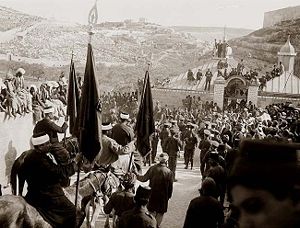 The annual Nabi Musa
spring festival was instituted by the Ottoman Turks to ensure a Muslim presence in Jerusalem during the influx of Christian pilgrims celebrating the Easter
holiday. Arab educator and essayist Khalil al-Sakakini
described how tribes and caravans would come with banners and weapons.
By 10:30 a.m. on April 4, 1920, 60,000–70,000 Arabs had already congregated in the city square, and groups of them had already been attacking Jews in the Old City's alleys for over an hour; the Jews hid. Inflammatory anti-Zionist
rhetoric was being delivered from the balcony of the Arab Club. One inciter was Hajj Amin al-Husayni; his uncle, the mayor
, spoke from the municipal building's balcony.
The editor of the newspaper Suriya al-Janubia
(Southern Syria), Aref al-Aref
, delivered his speech on horseback. The crowd shouted "Independence! Independence!" and "Palestine is our land, the Jews are our dogs!" Arab police joined in applause, and violence started. The Arab mob ransacked the Jewish Quarter of Jerusalem, attacked pedestrians and looted shops and homes. They ripped open their quilts and pillows, sending up clouds of feather
s associated by Jews with the European pogrom
s. The Torath Chaim Yeshiva was raided, and Torah scrolls were torn and thrown on the floor, and the building then set alight. During the next three hours, 160 Jews were wounded.
Khalil al-Sakakini witnessed the eruption of violence in the Old City:
The British response was erratic. After the violence broke out, Ze'ev Jabotinsky met Governor Storrs and suggested deployment of his volunteers, but his request was rejected. Storrs confiscated his pistol
and demanded to know the location of his other weapons, mentioning that Jabotinsky should be arrested for possessing a firearm. Later, Storrs changed his mind and asked for 200 volunteers to report to the police headquarters to be sworn in as deputies. After they arrived and the administering of the oath had begun, orders came to cease and he sent them away. Arab volunteers had also been invited, and were likewise sent away. The army imposed night curfew
on Sunday night and arrested several dozen rioters, but on Monday morning they were allowed to attend morning prayers and were then released. Arabs continued to attack Jews and break into their homes, especially in Arab-majority mixed buildings.
On Monday, as disturbances grew worse, the Old City was sealed off by the army and no one was allowed to exit the area. Martial law
was declared, but looting
, burglary
, rape
, and murder
continued. Several homes were set on fire, and tombstones were shattered. British soldiers found that the majority of illicit weapons were concealed on the bodies of Arab women.
On Monday evening, the soldiers were evacuated from the Old City, a step that was later declared "an error of judgment" by a court inquiry. The Old City's Jews had no training or weapons, and Jabotinsky's men had been concentrated outside the walled-city.
Two of his volunteers entered the Old City's Jewish Quarter disguised as medical personnel to organize self-defense of its residents; they prepared rocks and boiling water, and managed to smuggle some out. One of the volunteers was Nehemia Rabin (Rubitzov), the future father of Yitzhak Rabin
.
Several British soldiers were sent to search Jews for arms at the demand of the Palestinian Arab leadership; the British searched the offices and apartments of the Zionist leadership, including Weizmann's and Jabotinsky's homes. At Jabotinsky's house, they found three rifle
s, two pistols, and 250 rounds of ammunition. Nineteen men were arrested, but not Jabotinsky, who went to the jail of his own volition to insist on his arrest. A military judge released him because he had not been home when the guns were discovered, but he was again arrested a few hours later. Storrs personally ensured that Jabotinsky received clothing from home, a mattress, and food from an adjacent hotel. It took the British authorities four days to put down the riots.
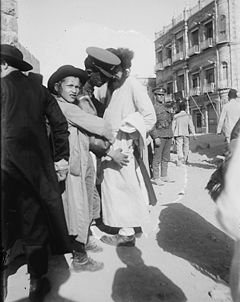
 Four Arabs and five Jews were killed, while wounded were 216 Jews, 18 critically; 23 Arabs, one critically. The majority of the victims were members of the old Yishuv
, non-Zionist or anti-Zionist Orthodox Jews. About 300 Jews from the Old City were evacuated.
The Jewish casualties are identified by the Israeli Government as:
Meinertzhagen claimed, to the Foreign Secretary, Lord Curzon, that a number of anti-Semitic and anti-Zionist officers in the military administration had initiated the riots to prove the Jewish national home policy had no chance of success.
In particular, Meinertzhagen asserted that Allenby's chief of staff, Colonel Bertie Harry Waters-Taylor, had given explicit instructions to Mohammad Amin al-Husayni
on how to demonstrate to the world that Palestinian Arabs would not tolerate Jewish rule. However, Meinertzhagen had his own reason for blaming the riots on his colleagues as only four days before them he had written to the Foreign Office that all was quiet and that no trouble was anticipated. According to Tom Segev
, "In his diary Meinertzhagen sounds like something of a lunatic and is therefore a doubtful source for such a serious charge. But his accusations did represent a general feeling". Allenby subsequently protested to Curzon and Meinertzhagen was ordered out of Palestine.
The Zionist Commission supported Meinertzhagen's claims, noting that Arab milkmen demanded their customers in Meah Shearim pay them on the spot, explaining that they would no longer be serving the Jewish neighbourhood. Christian storekeepers had marked their shops in advance with the sign of the cross so that they would not be mistakenly looted. A previous commission report also accused Storrs of inciting the Arabs, blaming him for sabotaging attempts to purchase the Western Wall
as well. A petition circulated among American citizens and presented to their consul protested that the British had prevented Jews from defending themselves.
After the riots, Storrs visited Menachem Ussishkin, the chairman of the Zionist Commission, to express "regrets for the tragedy that has befallen us",
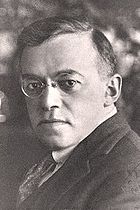
 Jabotinsky was convicted of possessing the pistol that he had handed over to Storrs on the riot's first day, among other things. The primary witness was none other than Ronald Storrs, who said he "did not remember" being told about the self-defence organisation. He was sentenced to 15 years' imprisonment and sent to Egypt
, though the next day he was returned to Acre
. His trial and sentencing created an uproar, and were protested by London
press including The Times
and questioned in the British Parliament
. Even before the editorials appeared, the commander of British forces in Palestine and Egypt, General Congreve, wrote Field Marshal Wilson that Jews were sentenced far more severely than Arabs who had committed worse offences. He reduced Jabotinsky's sentence to a year, and that of the 19 to six months. Over 200 were put on trial, including 39 Jews.
The Palin Commission
(or Palin Court of Inquiry), a committee of inquiry sent to the region in May 1920 by the British authorities, examined the reasons for this trouble. According to A Survey of Palestine, Volume 1:
The court placed the blame for the riots on the Zionists, 'whose impatience to achieve their ultimate goal and indiscretion are largely responsible for this unhappy state of feeling’ and singled out Amin al-Husayni and Ze'ev Jabotinsky in particular. The latter, however, was not, as the Court believed, an exponent of 'Bolshevism', which it thought 'flowed in Zionism's inner heart', but rather fiercely anti-Socialist. They had confused his politics with that of the Socialist-aligned Poalei Zion ('Zionist Workers') party, which it called 'a definite Bolshevist institution.' The document was never published. It was not even signed until July 1920, after the San Remo conference
and replacement of the military administration with a civilian government under Sir Herbert Samuel
.
Some rioters were punished. Musa Kazim al-Husayni
was replaced as mayor by the head of the rival Nashashibi clan. Hajj Amin al-Husayni and Aref al-Aref
were each sentenced to 10 years in absentia, since by then both had fled to Syria
.
One of the most important results of the riot was that legal Jewish immigration to Palestine was halted by the British, a major demand of the Palestinian Arab community. Also, feeling that the British were unwilling to defend them from continuous Arab violence, Palestinian Jews decided to set up an underground self-defense militia, the Haganah
("defense"). Furthermore, the riots prompted the Arab leadership in Palestine to view themselves less as southern Syrian Arabs and more as a unique Palestinian Arab community.
The events coincided with and are named after the Christian/Muslim Easter holiday Nabi Musa
Nabi Musa
Nabi Musa is the name of a site in the Judean desert that popular Palestinian folklore associates with Moses. It is also the name of a seven-day long religious festival that was celebrated annually by Palestinian Muslims, beginning on the Friday before Good Friday in the old Orthodox Greek calendar...
and followed rising tensions in Arab-Jewish relations over the implications of Zionist
Zionism
Zionism is a Jewish political movement that, in its broadest sense, has supported the self-determination of the Jewish people in a sovereign Jewish national homeland. Since the establishment of the State of Israel, the Zionist movement continues primarily to advocate on behalf of the Jewish state...
immigration, tensions which coincided with attacks on outlying Jewish settlements in the Galilee
Galilee
Galilee , is a large region in northern Israel which overlaps with much of the administrative North District of the country. Traditionally divided into Upper Galilee , Lower Galilee , and Western Galilee , extending from Dan to the north, at the base of Mount Hermon, along Mount Lebanon to the...
. Speeches by Arab religious leaders during the festival, in which traditionally large numbers of Muslims gathered for a religious procession, led to a serious outbreak of violent assaults on the city's Jews, with five Jews killed and hundreds wounded.
The British military administration's erratic response failed to contain the rioting, which continued for four days. As a result of the events, trust between the British, Jews, and Arabs eroded. One consequence was that the Jewish community
Yishuv
The Yishuv or Ha-Yishuv is the term referring to the body of Jewish residents in Palestine before the establishment of the State of Israel...
increased moves towards an autonomous infrastructure and security apparatus parallel to that of the British administration.
Prelude
George Curzon, 1st Marquess Curzon of Kedleston
George Nathaniel Curzon, 1st Marquess Curzon of Kedleston, KG, GCSI, GCIE, PC , known as The Lord Curzon of Kedleston between 1898 and 1911 and as The Earl Curzon of Kedleston between 1911 and 1921, was a British Conservative statesman who was Viceroy of India and Foreign Secretary...
chaired the meeting. General Smuts
Jan Smuts
Jan Christiaan Smuts, OM, CH, ED, KC, FRS, PC was a prominent South African and British Commonwealth statesman, military leader and philosopher. In addition to holding various cabinet posts, he served as Prime Minister of the Union of South Africa from 1919 until 1924 and from 1939 until 1948...
, Lord Balfour
Arthur Balfour
Arthur James Balfour, 1st Earl of Balfour, KG, OM, PC, DL was a British Conservative politician and statesman...
, Lord Robert Cecil
Robert Cecil, 1st Viscount Cecil of Chelwood
Edgar Algernon Robert Gascoyne-Cecil, 1st Viscount Cecil of Chelwood CH, PC, QC , known as Lord Robert Cecil from 1868 to 1923, was a lawyer, politician and diplomat in the United Kingdom...
, General Sir Henry Wilson, Chief of the Imperial General Staff, T. E. Lawrence
T. E. Lawrence
Lieutenant Colonel Thomas Edward Lawrence, CB, DSO , known professionally as T. E. Lawrence, was a British Army officer renowned especially for his liaison role during the Arab Revolt against Ottoman Turkish rule of 1916–18...
, and representatives of the Foreign Office, the India Office, the Admiralty, the War Office, and the Treasury were present. Lord Curzon stated:
'The Palestine position is this. If we deal with our commitments, there is first the general pledge to Hussein in October 1915, under which Palestine was included in the areas as to which Great Britain pledged itself that they should be Arab and independent in the future . . . Great Britain and France - Italy subsequently agreeing - committed themselves to an international administration of Palestine in consultation with Russia, who was an ally at that time . . . A new feature was brought into the case in November 1917, when Mr Balfour, with the authority of the War Cabinet, issued his famous declaration to the Zionists that Palestine 'should be the national home of the Jewish people, but that nothing should be done - and this, of course, was a most important proviso - to prejudice the civil and religious rights of the existing non-Jewish communities in Palestine. Those, as far as I know, are the only actual engagements into which we entered with regard to Palestine.
Now, as regards the facts, they are these. First, Palestine has been conquered by the British, with only very insignificant aid from small French and Italian contingents, and it is now being administered by the British. The Zionist declaration of our Government has been followed by a very considerable immigration of Jews. One of the difficulties of the situation arises from the fact that the Zionists have taken full advantage - and are disposed to take even fuller advantage - of the opportunity which was then offered to them. You have only to read, as probably most of us do, their periodical 'Palestine', and, indeed, their pronouncements in the papers, to see that their programme is expanding from day to day. They now talk about a Jewish State. The Arab portion of the population is well-nigh forgotten and is to be ignored. They not only claim the boundaries of the old Palestine, but they claim to spread across the Jordan into the rich countries lying to the east, and, indeed, there seems to be very small limit to the aspirations which they now form. The Zionist programme, and the energy with which it is being carried out, have not unnaturally had the consequence of arousing the keen suspicions of the Arabs. By 'the Arabs' I do not merely mean Feisal and his followers at Damascus, but the so-called Arabs who inhabit the country. There seems, from the telegrams we receive, to be growing up an increasing friction between the two communities, a feeling by the Arabs that we are really behind the Zionists and not behind the Arabs, and altogether a situation which is becoming rather critical . . .'
After Emir
Emir
Emir , meaning "commander", "general", or "prince"; also transliterated as Amir, Aamir or Ameer) is a title of high office, used throughout the Muslim world...
Faisal I expressed support for a Jewish National Home
Balfour Declaration, 1917
The Balfour Declaration of 1917 was a letter from the British Foreign Secretary Arthur James Balfour to Baron Rothschild , a leader of the British Jewish community, for transmission to the Zionist Federation of Great Britain and Ireland.The statement was issued through the efforts of Chaim...
in Palestine by signing the Faisal-Weizmann Agreement
Faisal-Weizmann Agreement
The Faisal–Weizmann Agreement was signed on January 3, 1919, by Emir Feisal , who was for a short time King of the Arab Kingdom of Syria or Greater Syria in 1920, and was King of the Kingdom of Iraq from August 1921 to 1933, and Chaim Weizmann as part of the Paris Peace Conference, 1919 settling...
at the Paris Peace Conference of 1919, and the subsequent breakdown of that agreement led to worsening relations among Arabs, Jews and the British military authorities in Palestine.
Clemenceau
Clemenceau may refer to:* Georges Clemenceau , French physician, journalist and statesman* Clemenceau , a French aircraft carrier* Mount Clemenceau, a mountain in the Canadian Rockies...
agreement was to be considered, according to Faisal himself, still-born. Every decision regarding Syria, Palestine and Mesopotamia taken without his active participation would not be recognized by Arabs and would provoke difficulties for which he disclaimed any future responsibility. Between France
France
The French Republic , The French Republic , The French Republic , (commonly known as France , is a unitary semi-presidential republic in Western Europe with several overseas territories and islands located on other continents and in the Indian, Pacific, and Atlantic oceans. Metropolitan France...
and the United Kingdom
United Kingdom
The United Kingdom of Great Britain and Northern IrelandIn the United Kingdom and Dependencies, other languages have been officially recognised as legitimate autochthonous languages under the European Charter for Regional or Minority Languages...
, serious disagreements existed over borders, water rights, Zionist claims over areas of French-held Lebanese and Syrian territory, and the rights of Christians
Christianity
Christianity is a monotheistic religion based on the life and teachings of Jesus as presented in canonical gospels and other New Testament writings...
, for whose security in Palestine France had traditional capitulary responsibilities. In Syria, under French authority, pan-Arab nationalists pressed for the "liberation" of Palestine.
From January 1920 onwards, relations between Zionist leaders and the British military administration deteriorated, as the former, led by Chaim Weizmann
Chaim Weizmann
Chaim Azriel Weizmann, , was a Zionist leader, President of the Zionist Organization, and the first President of the State of Israel. He was elected on 1 February 1949, and served until his death in 1952....
, pressed for unconditional immigration, the loosening of wartime restrictions on land purchase and the reduction of Syrians in the administration, in favour of more British and Jewish functionaries, and the latter posed as defenders of the Arab population. A declaration by General Louis Bols
Louis Bols
Lieutenant-General Sir Louis Jean Bols KCB, KCMG, DSO was born in Cape Town and educated at Lancing College in England. He was a distinguished British military officer...
on 18 February, drafted to reassure Arabs, had little effect. Nine days later, Palestinian Arabs in Damascus
Damascus
Damascus , commonly known in Syria as Al Sham , and as the City of Jasmine , is the capital and the second largest city of Syria after Aleppo, both are part of the country's 14 governorates. In addition to being one of the oldest continuously inhabited cities in the world, Damascus is a major...
held a general congress calling for the unification of the territory with Syria, while Muslims and Christians held peaceful public protest rallies throughout Palestine.
Both occupying powers experienced difficulties with local peasant armed bands ( 'isabat), after Britain had withdrawn its troops from both the Bekaa valley and the Galilee in autumn 1919. By February 1920, these groups, which often operated in liaison with political organisations, began attacking Jewish settlements in the Galilee, such as Metula
Metula
Metula is a town in the Northern District of Israel. Metula is located between the sites of the Biblical cities of Dan, Abel Bet Maacah, and Ijon, bordering Lebanon.-Early history:...
, Tel Hai
Tel Hai
Tel Hai is the modern name of a settlement in northern Israel, the site of an early battle in the Arab–Israeli conflict, and of a noted monument, tourist attraction, and a college...
and Kfar Giladi
Kfar Giladi
-External links:* * Jewish Agency for Israel*...
.
On March 1, the death at Tel Hai of Joseph Trumpeldor
Joseph Trumpeldor
Joseph Trumpeldor , was an early Zionist activist. He helped organize the Zion Mule Corps and bring Jewish immigrants to the Land of Israel. Trumpeldor died defending the settlement of Tel Hai in 1920 and subsequently became a Zionist national hero...
, who became a symbol of heroism to Zionists and a veteran of the Russo-Japanese War
Russo-Japanese War
The Russo-Japanese War was "the first great war of the 20th century." It grew out of rival imperial ambitions of the Russian Empire and Japanese Empire over Manchuria and Korea...
who mobilized the defence of the settlements, at the hands of a Shiite gang from Southern Lebanon, caused deep concerns among Zionist
Zionism
Zionism is a Jewish political movement that, in its broadest sense, has supported the self-determination of the Jewish people in a sovereign Jewish national homeland. Since the establishment of the State of Israel, the Zionist movement continues primarily to advocate on behalf of the Jewish state...
leaders, who made numerous requests to the Mandate administration to address the Yishuv
Yishuv
The Yishuv or Ha-Yishuv is the term referring to the body of Jewish residents in Palestine before the establishment of the State of Israel...
's security and forbid a pro-Syrian public rally. Their fears were largely discounted, however, by the Chief Administrative Officer General Louis Bols
Louis Bols
Lieutenant-General Sir Louis Jean Bols KCB, KCMG, DSO was born in Cape Town and educated at Lancing College in England. He was a distinguished British military officer...
, Governor Sir Ronald Storrs and General Edmund Allenby, despite a warning from the President of the World Zionist Organization
World Zionist Organization
The World Zionist Organization , or WZO, was founded as the Zionist Organization , or ZO, in 1897 at the First Zionist Congress, held from August 29 to August 31 in Basel, Switzerland...
Dr. Chaim Weizmann
Chaim Weizmann
Chaim Azriel Weizmann, , was a Zionist leader, President of the Zionist Organization, and the first President of the State of Israel. He was elected on 1 February 1949, and served until his death in 1952....
that "pogrom
Pogrom
A pogrom is a form of violent riot, a mob attack directed against a minority group, and characterized by killings and destruction of their homes and properties, businesses, and religious centres...
is in the air", supported by assessments available to Storrs.
Weizmann was convinced the British Army identified the Jews with Bolsheviks intent on driving out the local population. Communiqués had been issued about foreseeable troubles between Arabs and Jews (by an administration which had to impose unpopular policies on the Arabs); to Weizmann these were reminiscent of instructions that Russia
Russia
Russia or , officially known as both Russia and the Russian Federation , is a country in northern Eurasia. It is a federal semi-presidential republic, comprising 83 federal subjects...
n generals had issued on the eve of pogroms. In the meantime, local expectations had been raised to a pitch by the declaration of the Syrian Congress on March 7 of the independence of Syria and Palestine, with Faisal as its king. Preoccupied by the possible menacing reverberations of this announcement, Bols reverted his decision.
Storrs issued a warning to Arab leaders, but his forces included only 188 policemen, among them but eight officers. The Ottoman
Ottoman Empire
The Ottoman EmpireIt was usually referred to as the "Ottoman Empire", the "Turkish Empire", the "Ottoman Caliphate" or more commonly "Turkey" by its contemporaries...
Turks had usually deployed thousands of soldiers, and even an artillery piece, to keep order in the narrow streets of Jerusalem during the Nabi Musa procession. Zionist leaders request that the British authorities allow arming of the Jewish defenders to make up for the lack of adequate troops. Although this request was declined, Ze'ev Jabotinsky, together with Pinhas Rutenberg
Pinhas Rutenberg
Pinhas Rutenberg was a prominent engineer and a businessman, a Russian socialist and a Zionist leader. He played an active role in two Russian revolutions, in 1905 and 1917. During World War I, he was among the founders of the Jewish Legion and of the American Jewish Congress...
, led an effort to openly train Jewish volunteers in self-defense, an effort which the Zionist Commission
Zionist Commission
The Zionist Commission for Palestine was a group chaired by Chaim Weizmann, president of the British Zionist Federation following British promulgation of the pro-Zionist, Balfour Declaration of 1917. The Commission was formed in March 1918 and went to Palestine to study conditions and make their...
kept the British informed of. Many of them members of the Maccabi sports club
Maccabi World Union
The Maccabi World Union is an international Jewish sports organisation spanning 5 continents and more than 50 countries, with some 400,000 members...
and some of them veterans of the Jewish Legion
Jewish Legion
The Jewish Legion was the name for five battalions of Jewish volunteers established as the British Army's 38th through 42nd Battalions of the Royal Fusiliers...
, their month of training largely consisted of calisthenics
Calisthenics
Calisthenics are a form of aerobic exercise consisting of a variety of simple, often rhythmical, movements, generally using multiple equipment or apparatus. They are intended to increase body strength and flexibility with movements such as bending, jumping, swinging, twisting or kicking, using...
and hand to hand combat
Hand to hand combat
Hand-to-hand combat is a lethal or nonlethal physical confrontation between two or more persons at very short range that does not involve the use of firearms or other distance weapons...
with sticks. By the end of March, about 600 were said to be performing military drill daily in Jerusalem. Jabotinsky and Rutenberg also began organising the collection of arms.
Richard Meinertzhagen
Richard Meinertzhagen
Colonel Richard Henry Meinertzhagen CBE DSO was a British soldier, intelligence officer and ornithologist.- Background and youth :Meinertzhagen was born into a socially connected, wealthy British family...
, "at once a great antisemite and a great Zionist", chief political officer of the British forces, in an analysis of the atmosphere written at the end of March, identified Palestinian awareness that they would now be dispossessed of their lands by an intellectually and financially superior people, together with Faisal's recent proclamations as king of both Syria and Palestine, as the causes for their constant agitation. However, in the short term, he foresaw no prospect of troubles, and his position was adopted by Herbert Samuels
Herbert Samuel, 1st Viscount Samuel
Herbert Louis Samuel, 1st Viscount Samuel GCB OM GBE PC was a British politician and diplomat.-Early years:...
, who thought the Army was overreacting, in an alarmist fashion, to the Faisal declaration
April 4–7, 1920 in the Old City
Nabi Musa
Nabi Musa is the name of a site in the Judean desert that popular Palestinian folklore associates with Moses. It is also the name of a seven-day long religious festival that was celebrated annually by Palestinian Muslims, beginning on the Friday before Good Friday in the old Orthodox Greek calendar...
spring festival was instituted by the Ottoman Turks to ensure a Muslim presence in Jerusalem during the influx of Christian pilgrims celebrating the Easter
Easter
Easter is the central feast in the Christian liturgical year. According to the Canonical gospels, Jesus rose from the dead on the third day after his crucifixion. His resurrection is celebrated on Easter Day or Easter Sunday...
holiday. Arab educator and essayist Khalil al-Sakakini
Khalil al-Sakakini
Khalil al-Sakakini was a Palestinian Christian, Arab Orthodox, educator, scholar, poet, and Arab nationalist.-Early life:Khalil Sakakini was born into an Arab Christian family in Jerusalem on January 23, 1878...
described how tribes and caravans would come with banners and weapons.
By 10:30 a.m. on April 4, 1920, 60,000–70,000 Arabs had already congregated in the city square, and groups of them had already been attacking Jews in the Old City's alleys for over an hour; the Jews hid. Inflammatory anti-Zionist
Anti-Zionism
Anti-Zionism is opposition to Zionistic views or opposition to the state of Israel. The term is used to describe various religious, moral and political points of view in opposition to these, but their diversity of motivation and expression is sufficiently different that "anti-Zionism" cannot be...
rhetoric was being delivered from the balcony of the Arab Club. One inciter was Hajj Amin al-Husayni; his uncle, the mayor
Musa al-Husayni
Musa Kazim al-Husayni was nominated to several senior posts in the Ottoman administration. He belongs to the prominent al-Husayni family of northeastern Jerusalem...
, spoke from the municipal building's balcony.
The editor of the newspaper Suriya al-Janubia
Southern Syria (newspaper)
Suriyya al-Janubiyya was the name of a newspaper published in Jerusalem beginning in September 1919 by the lawyer Muhammad Hasan al-Budayri, and edited by Aref al-Aref, with contributions from, amongst others, Haj Amin al-Husayni....
(Southern Syria), Aref al-Aref
Aref al-Aref
Aref al-Aref was a Palestinian journalist, historian and politician who served as mayor of East Jerusalem in the 1950s.-Biography:...
, delivered his speech on horseback. The crowd shouted "Independence! Independence!" and "Palestine is our land, the Jews are our dogs!" Arab police joined in applause, and violence started. The Arab mob ransacked the Jewish Quarter of Jerusalem, attacked pedestrians and looted shops and homes. They ripped open their quilts and pillows, sending up clouds of feather
Feather
Feathers are one of the epidermal growths that form the distinctive outer covering, or plumage, on birds and some non-avian theropod dinosaurs. They are considered the most complex integumentary structures found in vertebrates, and indeed a premier example of a complex evolutionary novelty. They...
s associated by Jews with the European pogrom
Pogrom
A pogrom is a form of violent riot, a mob attack directed against a minority group, and characterized by killings and destruction of their homes and properties, businesses, and religious centres...
s. The Torath Chaim Yeshiva was raided, and Torah scrolls were torn and thrown on the floor, and the building then set alight. During the next three hours, 160 Jews were wounded.
Khalil al-Sakakini witnessed the eruption of violence in the Old City:
- "[A] riot broke out, the people began to run about and stones were thrown at the Jews. The shops were closed and there were screams... I saw a Zionist soldier covered in dust and blood... Afterwards, I saw one Hebronite approach a Jewish shoeshine boy, who hid behind a sack in one of the wall's comers next to Jaffa Gate, and take his box and beat him over the head. He screamed and began to run, his head bleeding and the Hebronite left him and returned to the procession... The riot reached its zenith. All shouted, "MuhammadMuhammadMuhammad |ligature]] at U+FDF4 ;Arabic pronunciation varies regionally; the first vowel ranges from ~~; the second and the last vowel: ~~~. There are dialects which have no stress. In Egypt, it is pronounced not in religious contexts...
's religion was born with the sword"... I immediately walked to the municipal garden... my soul is nauseated and depressed by the madness of humankind."
The British response was erratic. After the violence broke out, Ze'ev Jabotinsky met Governor Storrs and suggested deployment of his volunteers, but his request was rejected. Storrs confiscated his pistol
Pistol
When distinguished as a subset of handguns, a pistol is a handgun with a chamber that is integral with the barrel, as opposed to a revolver, wherein the chamber is separate from the barrel as a revolving cylinder. Typically, pistols have an effective range of about 100 feet.-History:The pistol...
and demanded to know the location of his other weapons, mentioning that Jabotinsky should be arrested for possessing a firearm. Later, Storrs changed his mind and asked for 200 volunteers to report to the police headquarters to be sworn in as deputies. After they arrived and the administering of the oath had begun, orders came to cease and he sent them away. Arab volunteers had also been invited, and were likewise sent away. The army imposed night curfew
Curfew
A curfew is an order specifying a time after which certain regulations apply. Examples:# An order by a government for certain persons to return home daily before a certain time...
on Sunday night and arrested several dozen rioters, but on Monday morning they were allowed to attend morning prayers and were then released. Arabs continued to attack Jews and break into their homes, especially in Arab-majority mixed buildings.
On Monday, as disturbances grew worse, the Old City was sealed off by the army and no one was allowed to exit the area. Martial law
Martial law
Martial law is the imposition of military rule by military authorities over designated regions on an emergency basis— only temporary—when the civilian government or civilian authorities fail to function effectively , when there are extensive riots and protests, or when the disobedience of the law...
was declared, but looting
Looting
Looting —also referred to as sacking, plundering, despoiling, despoliation, and pillaging—is the indiscriminate taking of goods by force as part of a military or political victory, or during a catastrophe, such as during war, natural disaster, or rioting...
, burglary
Burglary
Burglary is a crime, the essence of which is illicit entry into a building for the purposes of committing an offense. Usually that offense will be theft, but most jurisdictions specify others which fall within the ambit of burglary...
, rape
Rape
Rape is a type of sexual assault usually involving sexual intercourse, which is initiated by one or more persons against another person without that person's consent. The act may be carried out by physical force, coercion, abuse of authority or with a person who is incapable of valid consent. The...
, and murder
Murder
Murder is the unlawful killing, with malice aforethought, of another human being, and generally this state of mind distinguishes murder from other forms of unlawful homicide...
continued. Several homes were set on fire, and tombstones were shattered. British soldiers found that the majority of illicit weapons were concealed on the bodies of Arab women.
On Monday evening, the soldiers were evacuated from the Old City, a step that was later declared "an error of judgment" by a court inquiry. The Old City's Jews had no training or weapons, and Jabotinsky's men had been concentrated outside the walled-city.
Two of his volunteers entered the Old City's Jewish Quarter disguised as medical personnel to organize self-defense of its residents; they prepared rocks and boiling water, and managed to smuggle some out. One of the volunteers was Nehemia Rabin (Rubitzov), the future father of Yitzhak Rabin
Yitzhak Rabin
' was an Israeli politician, statesman and general. He was the fifth Prime Minister of Israel, serving two terms in office, 1974–77 and 1992 until his assassination in 1995....
.
Several British soldiers were sent to search Jews for arms at the demand of the Palestinian Arab leadership; the British searched the offices and apartments of the Zionist leadership, including Weizmann's and Jabotinsky's homes. At Jabotinsky's house, they found three rifle
Rifle
A rifle is a firearm designed to be fired from the shoulder, with a barrel that has a helical groove or pattern of grooves cut into the barrel walls. The raised areas of the rifling are called "lands," which make contact with the projectile , imparting spin around an axis corresponding to the...
s, two pistols, and 250 rounds of ammunition. Nineteen men were arrested, but not Jabotinsky, who went to the jail of his own volition to insist on his arrest. A military judge released him because he had not been home when the guns were discovered, but he was again arrested a few hours later. Storrs personally ensured that Jabotinsky received clothing from home, a mattress, and food from an adjacent hotel. It took the British authorities four days to put down the riots.
Aftermath
Old Yishuv
The Old Yishuv refers to the Jewish community that lived in the Land of Israel from the destruction of the Second Temple in 70 CE to the First Aliyah in 1881-82, prior to the onset of Zionist immigration....
, non-Zionist or anti-Zionist Orthodox Jews. About 300 Jews from the Old City were evacuated.
The Jewish casualties are identified by the Israeli Government as:
- Meyer Gani (21), clerk in the Mandatory government
- Matityahu Michal Gross (age unknown), scholar
- Abraham Samuel Haramati Schwartz (35), judge
- Shmuel Eliezer Silberman (69), carpenter
- Yossef Hamedi (age unknown), scholar
Meinertzhagen claimed, to the Foreign Secretary, Lord Curzon, that a number of anti-Semitic and anti-Zionist officers in the military administration had initiated the riots to prove the Jewish national home policy had no chance of success.
In particular, Meinertzhagen asserted that Allenby's chief of staff, Colonel Bertie Harry Waters-Taylor, had given explicit instructions to Mohammad Amin al-Husayni
Mohammad Amin al-Husayni
Haj Mohammed Effendi Amin el-Husseini was a Palestinian Arab nationalist and Muslim leader in the British Mandate of Palestine. From as early as 1920, in order to secure the independence of Palestine as an Arab state he actively opposed Zionism, and was implicated as a leader of a violent riot...
on how to demonstrate to the world that Palestinian Arabs would not tolerate Jewish rule. However, Meinertzhagen had his own reason for blaming the riots on his colleagues as only four days before them he had written to the Foreign Office that all was quiet and that no trouble was anticipated. According to Tom Segev
Tom Segev
Tom Segev is an Israeli historian, author and journalist. He is associated with Israel's so-called New Historians, a group challenging many of the country's traditional narratives.-Early life:Segev was born in Jerusalem in 1945...
, "In his diary Meinertzhagen sounds like something of a lunatic and is therefore a doubtful source for such a serious charge. But his accusations did represent a general feeling". Allenby subsequently protested to Curzon and Meinertzhagen was ordered out of Palestine.
The Zionist Commission supported Meinertzhagen's claims, noting that Arab milkmen demanded their customers in Meah Shearim pay them on the spot, explaining that they would no longer be serving the Jewish neighbourhood. Christian storekeepers had marked their shops in advance with the sign of the cross so that they would not be mistakenly looted. A previous commission report also accused Storrs of inciting the Arabs, blaming him for sabotaging attempts to purchase the Western Wall
Western Wall
The Western Wall, Wailing Wall or Kotel is located in the Old City of Jerusalem at the foot of the western side of the Temple Mount...
as well. A petition circulated among American citizens and presented to their consul protested that the British had prevented Jews from defending themselves.
After the riots, Storrs visited Menachem Ussishkin, the chairman of the Zionist Commission, to express "regrets for the tragedy that has befallen us",
- -Ussishkin asked, "What tragedy?"
- -"I mean the unfortunate events that have occurred here in the recent days", Storrs said.
- -"His excellency means the pogrom", suggested Ussishkin.
- When Storrs hesitated to categorize the events as such, Ussishkin replied,
- -"You Colonel, are an expert on matters of management and I am an expert on the rules of pogroms."
Egypt
Egypt , officially the Arab Republic of Egypt, Arabic: , is a country mainly in North Africa, with the Sinai Peninsula forming a land bridge in Southwest Asia. Egypt is thus a transcontinental country, and a major power in Africa, the Mediterranean Basin, the Middle East and the Muslim world...
, though the next day he was returned to Acre
Acre, Israel
Acre , is a city in the Western Galilee region of northern Israel at the northern extremity of Haifa Bay. Acre is one of the oldest continuously inhabited sites in the country....
. His trial and sentencing created an uproar, and were protested by London
London
London is the capital city of :England and the :United Kingdom, the largest metropolitan area in the United Kingdom, and the largest urban zone in the European Union by most measures. Located on the River Thames, London has been a major settlement for two millennia, its history going back to its...
press including The Times
The Times
The Times is a British daily national newspaper, first published in London in 1785 under the title The Daily Universal Register . The Times and its sister paper The Sunday Times are published by Times Newspapers Limited, a subsidiary since 1981 of News International...
and questioned in the British Parliament
Parliament of England
The Parliament of England was the legislature of the Kingdom of England. In 1066, William of Normandy introduced a feudal system, by which he sought the advice of a council of tenants-in-chief and ecclesiastics before making laws...
. Even before the editorials appeared, the commander of British forces in Palestine and Egypt, General Congreve, wrote Field Marshal Wilson that Jews were sentenced far more severely than Arabs who had committed worse offences. He reduced Jabotinsky's sentence to a year, and that of the 19 to six months. Over 200 were put on trial, including 39 Jews.
The Palin Commission
Palin Report 1920
The Palin Report or Palin Commission of Inquiry examined the rioting in Jerusalem between 4 and 7 April 1920. It foresaw increasing problems between the various parties and the administration.-Commission operations:...
(or Palin Court of Inquiry), a committee of inquiry sent to the region in May 1920 by the British authorities, examined the reasons for this trouble. According to A Survey of Palestine, Volume 1:
Savage attacks were made by Arab rioters in Jerusalem on Jewish lives and property. Five Jews were killed and 211 injured. Order was restored by the intervention of British troops; four Arabs were killed and 21 injured. It was reported by a military commission of inquiry that the reasons for this trouble were:--
Arab disappointment at the non-fulfilment of the promises of independence which they claimed had been given to them during the war. Arab belief that the Balfour Declaration implied a denial of the right of self-determination and their fear that the establishment of a National Home would mean a great increase in Jewish immigration and would lead to their economic and political subjection to the Jews. The aggravation of these sentiments on the one hand by propaganda from outside Palestine associated with the proclamation of the Emir Feisal as King of a re-united Syria and with the growth of Pan-Arab and Pan-Moslem ideas, and on the other hand by the activities of the Zionist Commission supported by the resources and influence of Jews throughout the world.
The court placed the blame for the riots on the Zionists, 'whose impatience to achieve their ultimate goal and indiscretion are largely responsible for this unhappy state of feeling’ and singled out Amin al-Husayni and Ze'ev Jabotinsky in particular. The latter, however, was not, as the Court believed, an exponent of 'Bolshevism', which it thought 'flowed in Zionism's inner heart', but rather fiercely anti-Socialist. They had confused his politics with that of the Socialist-aligned Poalei Zion ('Zionist Workers') party, which it called 'a definite Bolshevist institution.' The document was never published. It was not even signed until July 1920, after the San Remo conference
San Remo conference
The San Remo Conference was an international meeting of the post-World War I Allied Supreme Council, held in Sanremo, Italy, from 19 to 26 April 1920. It was attended by the four Principal Allied Powers of World War I who were represented by the prime ministers of Britain , France and Italy and...
and replacement of the military administration with a civilian government under Sir Herbert Samuel
Herbert Samuel, 1st Viscount Samuel
Herbert Louis Samuel, 1st Viscount Samuel GCB OM GBE PC was a British politician and diplomat.-Early years:...
.
Some rioters were punished. Musa Kazim al-Husayni
Musa al-Husayni
Musa Kazim al-Husayni was nominated to several senior posts in the Ottoman administration. He belongs to the prominent al-Husayni family of northeastern Jerusalem...
was replaced as mayor by the head of the rival Nashashibi clan. Hajj Amin al-Husayni and Aref al-Aref
Aref al-Aref
Aref al-Aref was a Palestinian journalist, historian and politician who served as mayor of East Jerusalem in the 1950s.-Biography:...
were each sentenced to 10 years in absentia, since by then both had fled to Syria
Syria
Syria , officially the Syrian Arab Republic , is a country in Western Asia, bordering Lebanon and the Mediterranean Sea to the West, Turkey to the north, Iraq to the east, Jordan to the south, and Israel to the southwest....
.
One of the most important results of the riot was that legal Jewish immigration to Palestine was halted by the British, a major demand of the Palestinian Arab community. Also, feeling that the British were unwilling to defend them from continuous Arab violence, Palestinian Jews decided to set up an underground self-defense militia, the Haganah
Haganah
Haganah was a Jewish paramilitary organization in what was then the British Mandate of Palestine from 1920 to 1948, which later became the core of the Israel Defense Forces.- Origins :...
("defense"). Furthermore, the riots prompted the Arab leadership in Palestine to view themselves less as southern Syrian Arabs and more as a unique Palestinian Arab community.
See also
- Arab nationalismArab nationalismArab nationalism is a nationalist ideology celebrating the glories of Arab civilization, the language and literature of the Arabs, calling for rejuvenation and political union in the Arab world...
- Palestinian nationalismPalestinian nationalismPalestinian nationalism is the national movement of the Palestinian people. It has roots in Pan-Arabism and other movements rejecting colonialism and calling for national independence. More recently, Palestinian Nationalism is expressed through the Israeli–Palestinian conflict...
- ZionismZionismZionism is a Jewish political movement that, in its broadest sense, has supported the self-determination of the Jewish people in a sovereign Jewish national homeland. Since the establishment of the State of Israel, the Zionist movement continues primarily to advocate on behalf of the Jewish state...
- Anti-ZionismAnti-ZionismAnti-Zionism is opposition to Zionistic views or opposition to the state of Israel. The term is used to describe various religious, moral and political points of view in opposition to these, but their diversity of motivation and expression is sufficiently different that "anti-Zionism" cannot be...
- Timeline of ZionismTimeline of ZionismThis is a partial timeline of Zionism in the modern era, since the start of the 16th century.-16th–18th centuries:1561: Joseph Nasi encourages Jewish settlement in Tiberias, having fled the Spanish Inquisition fourteen years previously in 1547...
- Timeline of Jewish HistoryTimeline of Jewish historyThis is a timeline of the development of Jews and Judaism. All dates are given according to the Common Era, not the Hebrew calendar....
- Mohammad Amin al-HusayniMohammad Amin al-HusayniHaj Mohammed Effendi Amin el-Husseini was a Palestinian Arab nationalist and Muslim leader in the British Mandate of Palestine. From as early as 1920, in order to secure the independence of Palestine as an Arab state he actively opposed Zionism, and was implicated as a leader of a violent riot...
- Jaffa riotsJaffa riotsThe Jaffa riots were a series of violent riots in Palestine on May 1–7, 1921, which began as a fight between two Jewish groups but developed into an attack by Arabs on Jews during which many were killed...
External links
- Lenni Brenner: The Iron Wall