

British Rail Railbuses

Encyclopedia
British Rail
produced a variety of Railbuses as a means both of building new rolling stock cheaply, and to provide services on lightly used lines economically.
designed for use specifically on little-used railway lines, and as the name suggests share many aspects of their construction with a bus, usually having a bus, or modified bus body, and having four wheels on a fixed base, instead of on bogies. Some, but not all, of the units were equipped for operation as diesel multiple units.
tested a series of small Railbuses, produced by a variety of manufacturers. These proved to be very economical, but also somewhat unreliable. The lines they worked on were mainly closed during the Beeching Cuts
and, being non-standard, they were all withdrawn in the mid-1960s, before being allocated TOPS
classifications.
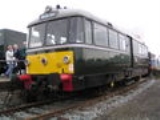
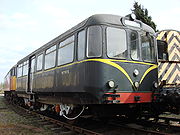
In addition to these Railbuses, BR ordered three for departmental (non-revenue earning) service. The full list of passenger and departmental units is set out below.
 Engines
 British Rail
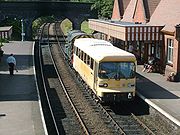
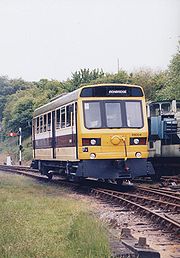
returned to the idea of railbuses from the mid-1970s, and a prototype four wheel vehicle was developed jointly by British Leyland and the British Rail Research Division
. A number of single and two-car Railbuses were built and tested, in co-operation with Leyland (hence the generic term for these vehicles as LEV (Leyland Experimental Vehicle) Railbuses). The first three single car prototypes were essentially Leyland National
bus bodies mounted on a modified HSFV1
four wheeled rail chassis. The prototype two-car Railbus was allocated Class 140
and is dealt with on that page, but the prototype single car Railbuses were not classified and are set out in the table below:
In 1978 tests were carried out with a modified double ended Leyland National bus body placed on an (unpowered) wagon chassis derived from HSFV1
, this was LEV1 (Leyland Experimental Vehicle 1). Whilst in its unpowered state this vehicle never left the Railway Technical Centre
in Derby. In 1979 the powertrain was addded to LEV1 (p54 of A history of engineering research on British Railways Institute of Railway Studies and Transport History by A Gilchrist), the engine being a Leyland 510 diesel, and the transmission a mechanical type with self-changing gears.
Even though some of these vehicles carried numbers in the departmental coach series, they were actually used in ordinary passenger service. LEV1 was tested in passenger service at first in East Anglia, and then elsewhere, before being temporarily exported to the USA in the early 1980s. LEV1 was withdrawn and transferred to the National Railway Museum in 1987 (Railway Magazine April 1987 p252), it is currently at the North Norfolk Railway where it is undergoing restoration. LEV2 was built especially for the USA and following export c1981 was used on an experimental extension of MBTA (Boston) commuter service to Concord, New Hampshire
. When that experiment was ended in 1981 the LEV 2 was sold to Amtrak
for use on the Northeast Corridor
, but it was quickly put out of service after an accident at a crossing. It was subsequently sold to the Steamtown Museum in Scranton, PA for use as a shuttle, but was damaged during repair and sold for scrap. It was bought from the scrap dealer by the Durbin & Greenbrier Valley Railroad, a tourist railroad in West Virginia, and later sold to the Connecticut Trolley Museum
, where it remains to this day. Similarly, R3 was exported to Canada after its testing phase, before being converted to Irish gauge
and sold to Northern Ireland Railways
. R3, also known as RB003, was withdrawn in 1990 and preserved, initially at the Ulster Transport Museum, then in 2001 at the Downpatrick & County Down Railway Museum (Second Generation DMUs p12, author Colin Marsden).
These Railbuses were sent abroad in the hope of gathering export orders, but they never transpired. The hauled railbus coach was tested on various lines in the London Midland region.
In addition, there was an experiment with a loco-hauled Leyland-built vehicle, when a bus-type body was placed on the 63 feet (19.2 m) underframe from Mk1 BCK coach number 21234. This was numbered RDB 977091 and was run in normal service alongside ordinary coaching stock until withdrawn as being unsuitable. It had nothing directly to do with railbuses and is now preserved at the East Kent Railway
.
The result of these tests was that British Rail
ordered a series of two- and three-car Railbuses, which became known as Pacer
s (or Skippers on the Western Region) and were allocated TOPS
Classes 141-144. The next generation of Sprinter
units were based on conventional railway design and bogie mounted bodies.
Additionally, AC Cars railbus 79979 was preserved, as a grounded body, on the Strathspey Railway. It was scrapped by MC Metals, Glasgow, in 1990.
British Rail
British Railways , which from 1965 traded as British Rail, was the operator of most of the rail transport in Great Britain between 1948 and 1997. It was formed from the nationalisation of the "Big Four" British railway companies and lasted until the gradual privatisation of British Rail, in stages...
produced a variety of Railbuses as a means both of building new rolling stock cheaply, and to provide services on lightly used lines economically.
Terminology
Railbuses are a very lightweight type of RailcarRailcar
A railcar, in British English and Australian English, is a self-propelled railway vehicle designed to transport passengers. The term "railcar" is usually used in reference to a train consisting of a single coach , with a driver's cab at one or both ends. Some railways, e.g., the Great Western...
designed for use specifically on little-used railway lines, and as the name suggests share many aspects of their construction with a bus, usually having a bus, or modified bus body, and having four wheels on a fixed base, instead of on bogies. Some, but not all, of the units were equipped for operation as diesel multiple units.
First Generation BR Railbuses
In the late 1950s, British RailBritish Rail
British Railways , which from 1965 traded as British Rail, was the operator of most of the rail transport in Great Britain between 1948 and 1997. It was formed from the nationalisation of the "Big Four" British railway companies and lasted until the gradual privatisation of British Rail, in stages...
tested a series of small Railbuses, produced by a variety of manufacturers. These proved to be very economical, but also somewhat unreliable. The lines they worked on were mainly closed during the Beeching Cuts
Beeching Axe
The Beeching Axe or the Beeching Cuts are informal names for the British Government's attempt in the 1960s to reduce the cost of running British Railways, the nationalised railway system in the United Kingdom. The name is that of the main author of The Reshaping of British Railways, Dr Richard...
and, being non-standard, they were all withdrawn in the mid-1960s, before being allocated TOPS
TOPS
Total Operations Processing System, or TOPS, is a computer system for managing the locomotives and rolling stock owned by a rail system...
classifications.
In addition to these Railbuses, BR ordered three for departmental (non-revenue earning) service. The full list of passenger and departmental units is set out below.
| Number Range | Builder | Introduced | No. Built | Region | Withdrawn |
|---|---|---|---|---|---|
| 79958-59 | Bristol Bristol Commercial Vehicles Bristol Commercial Vehicles was a vehicle manufacturer of in Bristol, England. Most production was of buses but trucks and railbus chassis were also built.... / Eastern Coach Works Eastern Coach Works Eastern Coach Works Ltd was a bus and railbus body building company based in Lowestoft, England.-History:The company can trace its roots back to 1912, when United Automobile Services was founded in the town to run bus services. United began a coach building business at the Lowestoft site in 1920... |
1958 | 2 | Scotland | 1966 |
| 79960-64 | Waggon und Maschinenbau | 1958 | 5 | Eastern Region/London Midland | 1967 |
| 79965-69 | D Wickham & Co | 1958 | 5 | Scotland | 1966 |
| 79970-74 | Park Royal Vehicles Park Royal Vehicles Dating its origins back to 1889, Park Royal Vehicles along with its Leeds-based subsidiary Charles H. Roe was one of Britain's leading coachbuilders and bus manufacturers based at Park Royal, west London, UK.-Associated Commercial Vehicles:... |
1958 | 5 | London Midland / Scotland | 1968 |
| 79975-79 | AC Cars AC Cars AC Cars Group Ltd. formerly known as Auto Carriers Ltd. is a British specialist automobile manufacturer and one of the oldest independent car marques founded in Britain... |
1958 | 5 | Scotland / Western Region | 1968 |
| 999507 Elliot | Wickham | 1958 | 1 | Departmental | 1997 |
| 998900-998901 | Drewry Drewry Car Co. Drewry Car Co, strictly speaking, was a railway locomotive and railcar sales organisation for most of its life. Only at the start and the end of its life did it build its own products, relying on sub-contractors for the rest of its time... |
1950 | 2 | Departmental | 1990 |
- 79958-59, Gardner 6HLW of 112 bhp at 1,700 rpm
- 79960-62, BüssingBüssingBüssing was a German bus and truck manufacturer established by Heinrich Büssing at Braunschweig in 1903. Büssing's first truck was a 2 ton payload machine powered by a 2-cylinder gasoline engine and featuring worm drive...
, 150 bhp at 1,900 rpm - 79963, AEC A220X
- 79964, Büssing, 150 bhp at 1,900 rpm
- 79965-69, MeadowsHenry MeadowsHenry Meadows of Wolverhampton, England were major suppliers of engines and transmissions, to the smaller companies in the British motor industry...
6HDT500 of 105 bhp at 1,800 rpm - 79970-74, AEC, 150 bhp
- 79975-79, AEC, 150 bhp
Second Generation BR Railbuses
British Rail
British Railways , which from 1965 traded as British Rail, was the operator of most of the rail transport in Great Britain between 1948 and 1997. It was formed from the nationalisation of the "Big Four" British railway companies and lasted until the gradual privatisation of British Rail, in stages...
returned to the idea of railbuses from the mid-1970s, and a prototype four wheel vehicle was developed jointly by British Leyland and the British Rail Research Division
British Rail Research Division
The British Rail Research Division came into being in 1964 directly under the control of the British Railways Board, moving into purpose-built premises at the Railway Technical Centre in Derby. The intention was to improve railway reliability and efficiency, while reducing costs and improving revenue...
. A number of single and two-car Railbuses were built and tested, in co-operation with Leyland (hence the generic term for these vehicles as LEV (Leyland Experimental Vehicle) Railbuses). The first three single car prototypes were essentially Leyland National
Leyland National
The Leyland National is a British single-deck bus built in large quantities between 1972 and 1985. It was developed as a joint project between two UK nationalised industries - the National Bus Company and British Leyland. Buses were constructed at a specially built factory at the Lillyhall...
bus bodies mounted on a modified HSFV1
High Speed Freight Vehicle
The High Speed Freight Vehicle was a generic term for a number of prototype 4-wheeled rail vehicles which were fitted with various experimental suspensions developed by the British Rail Research Division in the late 1960s...
four wheeled rail chassis. The prototype two-car Railbus was allocated Class 140
British Rail Class 140
The British Rail Class 140 was the prototype of the Pacer diesel multiple unit. Much of the bodywork was constructed using Leyland National bus components, with the exception of the cabs, in 1980....
and is dealt with on that page, but the prototype single car Railbuses were not classified and are set out in the table below:
| Number | Identity | Builder | Introduced | Withdrawn |
|---|---|---|---|---|
| RDB 975874 | LEV1 | Leyland/BREL Derby | 1978 | 1987 |
| - | LEV2 | Leyland/Wickham | 1980 | 19?? |
| RDB 977020 | R3 | Leyland/BREL Derby | 1981 | 1990 |
| - | RB004 | Leyland/BREL Derby | 1984 | 19?? |
In 1978 tests were carried out with a modified double ended Leyland National bus body placed on an (unpowered) wagon chassis derived from HSFV1
High Speed Freight Vehicle
The High Speed Freight Vehicle was a generic term for a number of prototype 4-wheeled rail vehicles which were fitted with various experimental suspensions developed by the British Rail Research Division in the late 1960s...
, this was LEV1 (Leyland Experimental Vehicle 1). Whilst in its unpowered state this vehicle never left the Railway Technical Centre
Railway Technical Centre
The Railway Technical Centre in London Road, Derby, UK, was built by the British Railways Board in the early 1960s to be its technical headquarters....
in Derby. In 1979 the powertrain was addded to LEV1 (p54 of A history of engineering research on British Railways Institute of Railway Studies and Transport History by A Gilchrist), the engine being a Leyland 510 diesel, and the transmission a mechanical type with self-changing gears.
Even though some of these vehicles carried numbers in the departmental coach series, they were actually used in ordinary passenger service. LEV1 was tested in passenger service at first in East Anglia, and then elsewhere, before being temporarily exported to the USA in the early 1980s. LEV1 was withdrawn and transferred to the National Railway Museum in 1987 (Railway Magazine April 1987 p252), it is currently at the North Norfolk Railway where it is undergoing restoration. LEV2 was built especially for the USA and following export c1981 was used on an experimental extension of MBTA (Boston) commuter service to Concord, New Hampshire
Concord, New Hampshire
The city of Concord is the capital of the state of New Hampshire in the United States. It is also the county seat of Merrimack County. As of the 2010 census, its population was 42,695....
. When that experiment was ended in 1981 the LEV 2 was sold to Amtrak
Amtrak
The National Railroad Passenger Corporation, doing business as Amtrak , is a government-owned corporation that was organized on May 1, 1971, to provide intercity passenger train service in the United States. "Amtrak" is a portmanteau of the words "America" and "track". It is headquartered at Union...
for use on the Northeast Corridor
Northeast Corridor
The Northeast Corridor is a fully electrified railway line owned primarily by Amtrak serving the Northeast megalopolis of the United States from Boston in the north, via New York to Washington, D.C. in the south, with branches serving other cities...
, but it was quickly put out of service after an accident at a crossing. It was subsequently sold to the Steamtown Museum in Scranton, PA for use as a shuttle, but was damaged during repair and sold for scrap. It was bought from the scrap dealer by the Durbin & Greenbrier Valley Railroad, a tourist railroad in West Virginia, and later sold to the Connecticut Trolley Museum
Connecticut Trolley Museum
Founded in 1940, the Connecticut Trolley Museum is the oldest incorporated museum dedicated to electric railroading in the United States.The museum is located in East Windsor, Connecticut, and is open to the public most of the year, featuring static displays and self-guided tours of the state's...
, where it remains to this day. Similarly, R3 was exported to Canada after its testing phase, before being converted to Irish gauge
Irish gauge
Irish gauge railways use a track gauge of . It is used in* Ireland * Australia where it is also known as Victorian Broad Gauge* Brazil where it is also known as Bitola larga no Brasil....
and sold to Northern Ireland Railways
Northern Ireland Railways
NI Railways, also known as Northern Ireland Railways and for a brief period of time, Ulster Transport Railways , is the railway operator in Northern Ireland...
. R3, also known as RB003, was withdrawn in 1990 and preserved, initially at the Ulster Transport Museum, then in 2001 at the Downpatrick & County Down Railway Museum (Second Generation DMUs p12, author Colin Marsden).
These Railbuses were sent abroad in the hope of gathering export orders, but they never transpired. The hauled railbus coach was tested on various lines in the London Midland region.
In addition, there was an experiment with a loco-hauled Leyland-built vehicle, when a bus-type body was placed on the 63 feet (19.2 m) underframe from Mk1 BCK coach number 21234. This was numbered RDB 977091 and was run in normal service alongside ordinary coaching stock until withdrawn as being unsuitable. It had nothing directly to do with railbuses and is now preserved at the East Kent Railway
East Kent Railway
The East Kent Railway was an early railway operating between Strood and the town of Faversham in Kent England, during 1858 and 1859. In the latter year it changed its name to the London, Chatham and Dover Railway to reflect its ambitions to build a rival line from London to Dover via Chatham and...
.
The result of these tests was that British Rail
British Rail
British Railways , which from 1965 traded as British Rail, was the operator of most of the rail transport in Great Britain between 1948 and 1997. It was formed from the nationalisation of the "Big Four" British railway companies and lasted until the gradual privatisation of British Rail, in stages...
ordered a series of two- and three-car Railbuses, which became known as Pacer
Pacer (train)
Pacer is the operational name of the British Rail Classes 140, 141, 142, 143 and 144 diesel multiple unit railbuses, built between 1984 and 1987...
s (or Skippers on the Western Region) and were allocated TOPS
TOPS
Total Operations Processing System, or TOPS, is a computer system for managing the locomotives and rolling stock owned by a rail system...
Classes 141-144. The next generation of Sprinter
British Rail Class 150
The British Rail Class 150 "Sprinter" diesel multiple units were built by BREL from 1984-87. A total of 137 units were built in three main subclasses, replacing many of the earlier first-generation "Heritage" DMUs.- Background :...
units were based on conventional railway design and bogie mounted bodies.
Routes
Lines regularly served by railbuses include:- Cambridge to Mildenhall railwayCambridge to Mildenhall railwayThe Cambridge to Mildenhall railway is a closed railway between Cambridge and Mildenhall in England. The line was built by the Great Eastern Railway and opened from Cambridge to Fordham on 2 June 1884 and then to Mildenhall on 1 April 1885 with a length of ....
- Saffron Walden RailwaySaffron Walden RailwayThe Saffron Walden Railway was a branch of the Great Eastern Railway between Audley End and Bartlow on the Stour Valley Railway between Shelford to Haverhill, a distance of ....
Preservation
A number of the BR Railbuses, both first and second generation examples have survived into preservation, as follows:| Vehicle No. | Builder | Year Built | Location | Comments |
|---|---|---|---|---|
| First Generation Railbuses | ||||
| 79960 | Waggon und Maschinenbau | 1958 | North Norfolk Railway North Norfolk Railway The North Norfolk Railway – also known as the "Poppy Line" – is a heritage steam railway in Norfolk, England, running between the coastal town of Sheringham and Holt, It cuts through the countryside to the east of Weybourne with views of its windmill and passes through the well preserved country... |
- |
| 79962 | Waggon und Maschinenbau | 1958 | Keighley and Worth Valley Railway Keighley and Worth Valley Railway The Keighley and Worth Valley Railway is a long branch line that served mills and villages in the Worth Valley and is now a heritage railway line in West Yorkshire, England. It runs from Keighley to Oxenhope. It connects to the national rail network line at Keighley railway station... |
- |
| 79963 | Waggon und Maschinenbau | 1958 | North Norfolk Railway North Norfolk Railway The North Norfolk Railway – also known as the "Poppy Line" – is a heritage steam railway in Norfolk, England, running between the coastal town of Sheringham and Holt, It cuts through the countryside to the east of Weybourne with views of its windmill and passes through the well preserved country... |
- |
| 79964 | Waggon und Maschinenbau | 1958 | Keighley and Worth Valley Railway Keighley and Worth Valley Railway The Keighley and Worth Valley Railway is a long branch line that served mills and villages in the Worth Valley and is now a heritage railway line in West Yorkshire, England. It runs from Keighley to Oxenhope. It connects to the national rail network line at Keighley railway station... |
- |
| 79976 | AC Cars | 1958 | Great Central Railway Great Central Railway (preserved) The Great Central Railway is a heritage railway split into two adjacent sections, one in Leicestershire and the other Nottinghamshire.The Leicestershire section is currently Britain's only double track mainline heritage railway, with of working double track, period signalling, locomotives and... |
- |
| 79978 | AC Cars | 1958 | Colne Valley Railway Colne Valley Railway The Colne Valley Railway is a heritage railway based at Castle Hedingham Station, near Halstead in Essex, England. The railway consists of a mile-long running line, with a fully reconstructed station, signal box and railway yard... |
- |
| RDB999507 | Wickham | 1958 | Previously Middleton Railway Middleton Railway The Middleton Railway is the world's oldest continuously working railway. It was founded in 1758 and is now a heritage railway run by volunteers from The Middleton Railway Trust Ltd... - moved to Lavender Line Lavender Line The Lavender Line is an informal name for a heritage railway based at Isfield Station, near Uckfield in East Sussex.- History :The Lavender Line formed part of the Lewes to Uckfield Railway when it was opened on the 18 October 1858... 2009 |
Elliot High-speed track-recording unit |
| RDB998901 | Drewry Car Company | 1950 | Middleton Railway Middleton Railway The Middleton Railway is the world's oldest continuously working railway. It was founded in 1758 and is now a heritage railway run by volunteers from The Middleton Railway Trust Ltd... |
Overhead-line inspection car |
| Second Generation Railbuses | ||||
| RDB975874 | Leyland/BREL Derby | 1978 | North Norfolk Railway North Norfolk Railway The North Norfolk Railway – also known as the "Poppy Line" – is a heritage steam railway in Norfolk, England, running between the coastal town of Sheringham and Holt, It cuts through the countryside to the east of Weybourne with views of its windmill and passes through the well preserved country... |
LEV 1 |
| LEV2 | Leyland/BREL Derby | 1980 | Connecticut Trolley Museum Connecticut Trolley Museum Founded in 1940, the Connecticut Trolley Museum is the oldest incorporated museum dedicated to electric railroading in the United States.The museum is located in East Windsor, Connecticut, and is open to the public most of the year, featuring static displays and self-guided tours of the state's... |
There is a project to repatriate LEV2 |
| RDB977020 | Leyland/BREL Derby | 1981 | Downpatrick & County Down Railway Downpatrick & County Down Railway The Downpatrick & County Down Railway is a heritage railway in County Down, Northern Ireland. The project is based at Downpatrick, on part of the former route of the Belfast & County Down Railway.... in Northern Ireland Northern Ireland Northern Ireland is one of the four countries of the United Kingdom. Situated in the north-east of the island of Ireland, it shares a border with the Republic of Ireland to the south and west... |
LEV3 aka RB3. Has been regauged to 5’3” |
| RB002 | Leyland/BREL Derby | 198? | Riverstown Old Corn Railway? near Dundalk, Eire | RB002 aka The Denmark |
| RB004 | Leyland/BREL Derby | 1984 | Currently at the Midland Railway Centre (arrived 19 August 2011) | Owned by Northumbria Rail Ltd. and The Railbus Trust. Moved from Telford Steam Railway Telford Steam Railway The Telford Steam Railway is a heritage railway located at Horsehay, Telford in Shropshire, England, formed in 1976.The railway is operated by volunteers on Sundays and Bank Holidays from Easter to the end of September, and at Christmas... to Llangollen Railway Llangollen Railway The Llangollen Railway is a volunteer-run preserved railway in Denbighshire, Wales, which operates between Llangollen and Carrog; at long, it is the longest preserved standard gauge line in Wales and operates daily in Summer as well as weekends throughout the Winter months using a wide variety of... 20 May 2011 |
Additionally, AC Cars railbus 79979 was preserved, as a grounded body, on the Strathspey Railway. It was scrapped by MC Metals, Glasgow, in 1990.
External links
- EM2 Locomotive Society - owners of Drewry railcar DB998901.
- Old Dalby Test Track site - Pictures of the Drewry car RDB998901 in action at BR's test track
- Wickham Railbus Group - owners of Wickham railbus DB999507.
- Train Testing site - Pictures of the testing and travels of the early railbuses
- departmentals.com
- The Railbus Trust - Working to protect the future of Single Car Railbuses and Second Generation DMU prototypes.