


Mori Terumoto

Encyclopedia
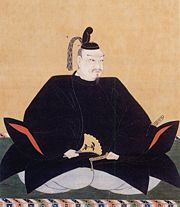
Mori Takamoto
was a daimyo of Aki Province during Japan's Sengoku period. He was the eldest legitimate son of Mōri Motonari.-Life:Born in Tajihi, Aki province, Takamoto was sent at the age of 14 to Suo province as a hostage of Ōuchi Yoshitaka. This was done to ensure his father's loyalties to Ōuchi...
and grandson and successor of the great warlord Mōri Motonari
Mori Motonari
was a prominent daimyō in the west Chūgoku region of Japan during the Sengoku period of the 16th century.-Early years:Mōri Motonari was born under the name Shojumaru in a small domain of Aki province in 1497. He is said to have been born at Suzuo Castle, his mother's homeland...
, fought against Toyotomi Hideyoshi
Toyotomi Hideyoshi
was a daimyo warrior, general and politician of the Sengoku period. He unified the political factions of Japan. He succeeded his former liege lord, Oda Nobunaga, and brought an end to the Sengoku period. The period of his rule is often called the Momoyama period, named after Hideyoshi's castle...
but was eventually overcome, participated in the Kyūshū campaign
Kyushu Campaign
The Kyūshū Campaign of 1586-1587 was part of the campaigns of Toyotomi Hideyoshi who sought to dominate Japan at the end of the Sengoku period...
(1587) on Hideyoshi's side and built Hiroshima Castle
Hiroshima Castle
', sometimes called ' is a castle in Hiroshima, Japan which was the home of the daimyō of the Hiroshima han . Originally constructed in the 1590s, the castle was destroyed in the atomic bombing in 1945...
, thus essentially founding Hiroshima
Hiroshima
is the capital of Hiroshima Prefecture, and the largest city in the Chūgoku region of western Honshu, the largest island of Japan. It became best known as the first city in history to be destroyed by a nuclear weapon when the United States Army Air Forces dropped an atomic bomb on it at 8:15 A.M...
.
Terumoto was a member of the council of Five Elders
Council of Five Elders
The council of five elders, also known as the five Tairō , was formed by Toyotomi Hideyoshi to rule Japan in the place of his son, Hideyori, until such time as he came of age. Hideyoshi chose his five most powerful daimyo: Ukita Hideie, Maeda Toshiie, Uesugi Kagekatsu, Mōri Terumoto, and the...
appointed by Hideyoshi. At the height of his power in late 16th century, Terumoto controlled 1.2 million koku
Koku
The is a Japanese unit of volume, equal to ten cubic shaku. In this definition, 3.5937 koku equal one cubic metre, i.e. 1 koku is approximately 278.3 litres. The koku was originally defined as a quantity of rice, historically defined as enough rice to feed one person for one year...
. This means he could mobilize more than 120,000 men to a battle.
He sided against Tokugawa Ieyasu
Tokugawa Ieyasu
was the founder and first shogun of the Tokugawa shogunate of Japan , which ruled from the Battle of Sekigahara in 1600 until the Meiji Restoration in 1868. Ieyasu seized power in 1600, received appointment as shogun in 1603, abdicated from office in 1605, but...
but was not present at the Battle of Sekigahara
Battle of Sekigahara
The , popularly known as the , was a decisive battle on October 21, 1600 which cleared the path to the Shogunate for Tokugawa Ieyasu...
. Terumoto was in Osaka Castle
Osaka Castle
is a Japanese castle in Chūō-ku, Osaka, Japan.Originally called Ozakajō, it is one of Japan's most famous castles, and played a major role in the unification of Japan during the sixteenth century of the Azuchi-Momoyama period.-Description:...
defending Toyotomi Hideyori
Toyotomi Hideyori
was the son and designated successor of Toyotomi Hideyoshi, the general who first united all of Japan. His mother, Yodo-dono, was the niece of Oda Nobunaga....
at the time and surrendered to Ieyasu soon after Sekigahara. Ieyasu reduced Terumoto's domains, leaving him only Nagato
Nagato Province
, often called , was a province of Japan. It was at the extreme western end of Honshū, in the area that is today Yamaguchi Prefecture. Nagato bordered on Iwami and Suō Provinces....
and Suō Province
Suo Province
was a province of Japan in the area that is today the eastern part of Yamaguchi Prefecture. It was sometimes called . Suō bordered on Aki, Iwami, and Nagato Provinces....
s, worth 369,000 koku in total.
He is believed to having been a below-average general on and off the battle field, having lacked motivation and will. He made little impact in these final years of the Sengoku period
Sengoku period
The or Warring States period in Japanese history was a time of social upheaval, political intrigue, and nearly constant military conflict that lasted roughly from the middle of the 15th century to the beginning of the 17th century. The name "Sengoku" was adopted by Japanese historians in reference...
, often having his subordinates and lesser members of clan fight instead. It is believed that if he had fought at Sekigahara or brought Hideyori to the battlefield, Ieyasu would have been defeated instead. However, he managed his domain well and successfully held the Mōri clan together even when his domain was reduced to a third.
He was succeeded by Mori Hidenari
Mori Hidenari
was a Japanese daimyo of the early Edo Period, who ruled the Chōshū Domain.-References:...
.