

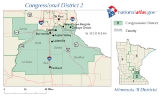
Minnesota's 2nd congressional district

Encyclopedia
Minnesota’s 2nd congressional district covers the south Twin Cities metro area and contains all of Carver
, Scott
, Le Sueur
, Goodhue
and Rice
Counties. It also contains most of Dakota County
and south Washington County
including the cities of Cottage Grove
and the southern part of Woodbury
. Burnsville
and Eagan
are the largest cities in the district.
Three of Minnesota’s most important rivers run through the district, the Mississippi River
, the Minnesota River
, and the St. Croix River
. Interstate highways I-35 E
and I-35 W
merge in the district in addition to the north-south thoroughfares of U.S. Routes 169
, 61
, and 52
and the east-west Route 212
. The suburban areas in the northern part of the district blend into the rural farmland in the south. The district's economy includes agriculture, small businesses, and large corporations.
Some of the largest employers in the district are Thomson North American Legal
, Blue Cross and Blue Shield of Minnesota, Northwest Airlines
, 3M
, Lockheed Martin
, Cambria
, and Red Wing Shoes
. The district includes Pine Bend Refinery
, the largest oil refinery in Minnesota, owned by Koch Industries
.
The 2nd District is also home to two private liberal arts colleges: St. Olaf
and Carleton
, both in Northfield
. Minnesota's largest amusement park, Valleyfair!
, is in Shakopee
, and Le Sueur
, in the southwest part of the district, is the birthplace of the world famous Jolly Green Giant food products.
Two of Minnesota's oldest cities, Hastings
and Red Wing
are in the district. The district hosts heritage festivals and town celebrations, such as Kolacky days in Montgomery
, the Pine Island
Cheese festival, and Shakopee Derby Days.
Minnesota's 2nd Congressional District is currently represented by Republican
John Kline
(Lakeville
), a retired United States Marine Corps
Colonel
. Kline was considered to be the most conservative member of the Minnesota delegation in the 109th Congress
, scoring 100% conservative by a conservative group and 3% progressive
by a liberal group. The district is Republican-leaning with a CPVI of R + 3.
Carver County, Minnesota
As of the census of 2000, there were 70,205 people, 24,356 households, and 18,778 families residing in the county. The population density was 197 people per square mile . There were 24,883 housing units at an average density of 70 per square mile...
, Scott
Scott County, Minnesota
Scott County is a county located in the U.S. state of Minnesota. It was organized in 1853 and named in honor of General Winfield Scott. As of 2010, the population was 129,928. Its county seat is Shakopee...
, Le Sueur
Le Sueur County, Minnesota
As of the census of 2000, there were 25,426 people, 9,630 households, and 6,923 families residing in the county. The population density was 57 people per square mile . There were 10,858 housing units at an average density of 24 per square mile...
, Goodhue
Goodhue County, Minnesota
Goodhue County is a county located in the U.S. state of Minnesota. As of 2010, the population was 46,183. Its county seat is Red Wing. Nearly all of Prairie Island Indian Community is within the county.-History:...
and Rice
Rice County, Minnesota
As of the census of 2000, there were 56,665 people, 18,888 households, and 13,353 families residing in the county. The population density was 114 people per square mile . There were 20,061 housing units at an average density of 40 per square mile...
Counties. It also contains most of Dakota County
Dakota County, Minnesota
Dakota County is the third most populous county in the U.S. state of Minnesota. The county is bordered by the Minnesota and Mississippi Rivers on the north, and the state of Wisconsin on the east. Dakota County comprises the southeast portion of seven-county Minneapolis-St. Paul, the thirteenth...
and south Washington County
Washington County, Minnesota
Washington County is a county established in 1849 in the U.S. state of Minnesota. As of 2010, the population was 238,136. Its county seat is Stillwater.-History:...
including the cities of Cottage Grove
Cottage Grove, Minnesota
As of the census of 2000, there were 30,582 people, 9,932 households, and 8,462 families residing in the city. The population density was 899.9 people per square mile . There were 10,024 housing units at an average density of 295.0 per square mile...
and the southern part of Woodbury
Woodbury, Minnesota
Woodbury is a city in Washington County, Minnesota, United States, and is a suburb of the Twin Cities metropolitan area. It is situated east of Saint Paul along Interstate 94...
. Burnsville
Burnsville, Minnesota
Burnsville is a city south of downtown Minneapolis in Dakota County in the U.S. state of Minnesota. The city lies on the south bank of the Minnesota River, upstream from the confluence with the Mississippi River...
and Eagan
Eagan, Minnesota
Eagan is a city south of Saint Paul in Dakota County in the U.S. state of Minnesota. The city lies on the south bank of the Minnesota River, upstream from the confluence with the Mississippi River. Eagan and nearby suburbs form the southern portion of Minneapolis-St. Paul, the fifteenth largest...
are the largest cities in the district.
Three of Minnesota’s most important rivers run through the district, the Mississippi River
Mississippi River
The Mississippi River is the largest river system in North America. Flowing entirely in the United States, this river rises in western Minnesota and meanders slowly southwards for to the Mississippi River Delta at the Gulf of Mexico. With its many tributaries, the Mississippi's watershed drains...
, the Minnesota River
Minnesota River
The Minnesota River is a tributary of the Mississippi River, approximately 332 miles long, in the U.S. state of Minnesota. It drains a watershed of nearly , in Minnesota and about in South Dakota and Iowa....
, and the St. Croix River
St. Croix River (Wisconsin-Minnesota)
The St. Croix River is a tributary of the Mississippi River, approximately long, in the U.S. states of Wisconsin and Minnesota. The lower of the river form the border between Wisconsin and Minnesota. The river is a National Scenic Riverway under the protection of the National Park Service. A...
. Interstate highways I-35 E
Interstate 35E (Minnesota)
Interstate 35E is an Interstate Highway in the U.S. state of Minnesota, passing through downtown Saint Paul. It is one of two through routes for Interstate 35 through the Twin Cities of Minneapolis and Saint Paul, the other being Interstate 35W through Minneapolis. Thus, both ends of I-35E are...
and I-35 W
Interstate 35W (Minnesota)
Interstate 35W , is an Interstate Highway in the U.S. state of Minnesota, passing through downtown Minneapolis. It is one of two through routes for Interstate 35 through the Twin Cities of Minneapolis and Saint Paul, the other being Interstate 35E through downtown Saint Paul...
merge in the district in addition to the north-south thoroughfares of U.S. Routes 169
U.S. Route 169
U.S. Route 169 currently runs for 966 miles from the city of Virginia, Minnesota to Tulsa, Oklahoma at U.S. Route 64.-Oklahoma:U.S. Highway 169 is a major south–north highway spanning in Oklahoma. The southern terminus for US-169 is Memorial Drive...
, 61
U.S. Route 61
U.S. Route 61 is the official designation for a United States highway that runs from New Orleans, Louisiana, to the city of Wyoming, Minnesota. The highway generally follows the course of the Mississippi River, and is designated the Great River Road for much of its route. As of 2004, the highway's...
, and 52
U.S. Route 52
U.S. Route 52 is a United States highway that runs across the northern, eastern and southeastern regions of the United States. Contrary to most other even-numbered U.S...
and the east-west Route 212
U.S. Route 212
U.S. Route 212 is a spur of U.S. Route 12. Though it currently never intersects U.S. 12, it once had an eastern terminus at U.S. 12 in St. Paul, Minnesota. It runs for 949 miles from Minnesota Highway 62 at Edina, Minnesota to Yellowstone National Park.U.S. 212 passes through the states of...
. The suburban areas in the northern part of the district blend into the rural farmland in the south. The district's economy includes agriculture, small businesses, and large corporations.
Some of the largest employers in the district are Thomson North American Legal
Thomson North American Legal
Thomson Reuters North American Legal is the strategic business unit of The Thomson Corporation that specializes in furnishing information and office solutions to lawyers and other legal professionals in the United States and Canada. Its major business is West...
, Blue Cross and Blue Shield of Minnesota, Northwest Airlines
Northwest Airlines
Northwest Airlines, Inc. was a major United States airline founded in 1926 and absorbed into Delta Air Lines by a merger approved on October 29, 2008, making Delta the largest airline in the world...
, 3M
3M
3M Company , formerly known as the Minnesota Mining and Manufacturing Company, is an American multinational conglomerate corporation based in Maplewood, Minnesota, United States....
, Lockheed Martin
Lockheed Martin
Lockheed Martin is an American global aerospace, defense, security, and advanced technology company with worldwide interests. It was formed by the merger of Lockheed Corporation with Martin Marietta in March 1995. It is headquartered in Bethesda, Maryland, in the Washington Metropolitan Area....
, Cambria
Cambria
Cambria is the classical name for Wales, being the Latinised form of the Welsh name Cymru . The etymology of Cymry "the Welsh", Cimbri, and Cwmry "Cumbria", improbably connected to the Biblical Gomer and the "Cimmerians" by 17th-century celticists, is now known to come from Old Welsh combrog...
, and Red Wing Shoes
Red Wing Shoes
Red Wing Shoes is a footwear company based in Red Wing, Minnesota that was founded by Charles H. Beckman in 1905.Within 10 years of its inception, Red Wing Shoes was producing more than 200,000 pairs of boots per year and was the primary company manufacturing footwear for American soldiers...
. The district includes Pine Bend Refinery
Pine Bend Refinery
The Pine Bend Refinery is the largest oil refinery in Minnesota, located in the Twin Cities suburbs of Rosemount and Inver Grove Heights next to southern split of U.S. Highway 52 and Minnesota State Highway 55. The refinery is notable for being the largest in the United States to be located in a...
, the largest oil refinery in Minnesota, owned by Koch Industries
Koch Industries
Koch Industries, Inc. , is an American private energy conglomerate based in Wichita, Kansas, with subsidiaries involved in manufacturing, trading and investments. Koch also owns Invista, Georgia-Pacific, Flint Hills Resources, Koch Pipeline, Koch Fertilizer, Koch Minerals and Matador Cattle Company...
.
The 2nd District is also home to two private liberal arts colleges: St. Olaf
St. Olaf College
St. Olaf College is a coeducational, residential, four-year, private liberal arts college in Northfield, Minnesota, United States. It was founded in 1874 by a group of Norwegian-American immigrant pastors and farmers, led by Pastor Bernt Julius Muus. The college is named after Olaf II of Norway,...
and Carleton
Carleton College
Carleton College is an independent non-sectarian, coeducational, liberal arts college in Northfield, Minnesota, USA. The college enrolls 1,958 undergraduate students, and employs 198 full-time faculty members. In 2012 U.S...
, both in Northfield
Northfield, Minnesota
As of the census of 2000, there were 17,147 people, 4,909 households, and 3,210 families residing in the city. The population density was 2,452.2 people per square mile . There were 5,119 housing units at an average density of 732.1 per square mile...
. Minnesota's largest amusement park, Valleyfair!
Valleyfair!
Valleyfair, sometimes stylized Valleyfair! is a 125 acre amusement park located in Shakopee, Minnesota, USA and is currently the largest amusement park in the Upper Midwest United States. The park has over 50 rides and water attractions and currently operates 8 roller coasters, one of the most...
, is in Shakopee
Shakopee, Minnesota
Shakopee is a city southwest of downtown Minneapolis in the U.S. state of Minnesota and is the county seat of Scott County. Located on the south bank bend of the Minnesota River, Shakopee and nearby suburbs comprise the southwest portion of Minneapolis-Saint Paul, the thirteenth largest...
, and Le Sueur
Le Sueur, Minnesota
As of the census of 2000, there were 3,922 people, 1,545 households, and 1,025 families residing in the city. The population density was 879.0 people per square mile . There were 1,589 housing units at an average density of 356.1 per square mile...
, in the southwest part of the district, is the birthplace of the world famous Jolly Green Giant food products.
Two of Minnesota's oldest cities, Hastings
Hastings, Minnesota
Hastings is a city in Dakota counties in the U.S. state of Minnesota, near the confluence of the Mississippi and St. Croix Rivers. The population was 22,172 at the 2010 census. It is the county seat of Dakota County. The bulk of Hastings is in Dakota County; only a small part of the city extends...
and Red Wing
Red Wing, Minnesota
Red Wing is a city in Goodhue County, Minnesota, United States, on the Mississippi River. The population was 16,459 at the 2010 census. It is the county seat of Goodhue County....
are in the district. The district hosts heritage festivals and town celebrations, such as Kolacky days in Montgomery
Montgomery, Minnesota
Montgomery is a city in Le Sueur County, Minnesota, in the United States, 45 miles south of Minneapolis. It was named after Richard Montgomery, an Irish-American soldier who served as a major general in the Continental Army during the Revolutionary War. The population was 2,956 at the 2010...
, the Pine Island
Pine Island, Minnesota
Pine Island is a city in Goodhue and Olmsted counties in the U.S. state of Minnesota. The population was 3,263 at the 2010 census. Most of Pine Island is in Goodhue County, but a small part extends into Olmsted County, making it part of the Rochester metropolitan area.The community has a strong...
Cheese festival, and Shakopee Derby Days.
Minnesota's 2nd Congressional District is currently represented by Republican
Republican Party of Minnesota
The Republican Party of Minnesota is the Minnesota branch of the United States Republican Party. Elected by the party’s state central committee in June 2009, its chairman is Tony Sutton, and its deputy-chairman is Michael Brodkorb.-Early history:...
John Kline
John Kline (politician)
John Paul Kline is the U.S. Representative for , serving since 2003. The district includes most of the southern suburbs of the Twin Cities, including Apple Valley, Inver Grove Heights, Burnsville and Eagan. He is a member of the Republican Party.-Early life, education and career:Kline was born...
(Lakeville
Lakeville, Minnesota
As of the census of 2000, there were 43,128 people, 13,609 households, and 11,526 families residing in the city. The population density was 1,192.4 people per square mile . There were 13,799 housing units at an average density of 381.5 per square mile...
), a retired United States Marine Corps
United States Marine Corps
The United States Marine Corps is a branch of the United States Armed Forces responsible for providing power projection from the sea, using the mobility of the United States Navy to deliver combined-arms task forces rapidly. It is one of seven uniformed services of the United States...
Colonel
Colonel (United States)
In the United States Army, Air Force, and Marine Corps, colonel is a senior field grade military officer rank just above the rank of lieutenant colonel and just below the rank of brigadier general...
. Kline was considered to be the most conservative member of the Minnesota delegation in the 109th Congress
109th United States Congress
The One Hundred Ninth United States Congress was the legislative branch of the United States, composed of the United States Senate and the United States House of Representatives, from January 3, 2005 to January 3, 2007, during the fifth and sixth years of George W. Bush's presidency. House members...
, scoring 100% conservative by a conservative group and 3% progressive
Progressivism
Progressivism is an umbrella term for a political ideology advocating or favoring social, political, and economic reform or changes. Progressivism is often viewed by some conservatives, constitutionalists, and libertarians to be in opposition to conservative or reactionary ideologies.The...
by a liberal group. The district is Republican-leaning with a CPVI of R + 3.
List of representatives
| Congress | Representative | Party | Years | Notes | |
|---|---|---|---|---|---|
| District created | March 4, 1861 | ||||
| 37th 37th United States Congress The Thirty-seventh United States Congress was a meeting of the legislative branch of the United States federal government, consisting of the United States Senate and the United States House of Representatives. It met in Washington, D.C. from March 4, 1861 to March 4, 1863, during the first two... |
William Windom William Windom This page is about the former United States politician. William Windom was an American politician from Minnesota. He served as U.S. Representative from 1859 to 1869, and as U.S. Senator from 1870 to January 1871, from March 1871 to March 1881, and from November 1881 to 1883... |
Republican Republican Party (United States) The Republican Party is one of the two major contemporary political parties in the United States, along with the Democratic Party. Founded by anti-slavery expansion activists in 1854, it is often called the GOP . The party's platform generally reflects American conservatism in the U.S... |
March 4, 1861 – March 3, 1863 | Redistricted Redistricting Redistricting is the process of drawing United States electoral district boundaries, often in response to population changes determined by the results of the decennial census. In 36 states, the state legislature has primary responsibility for creating a redistricting plan, in many cases subject to... from the , Redistricted Redistricting Redistricting is the process of drawing United States electoral district boundaries, often in response to population changes determined by the results of the decennial census. In 36 states, the state legislature has primary responsibility for creating a redistricting plan, in many cases subject to... to the |
|
| 38th 38th United States Congress -House of Representatives:Before this Congress, the 1860 United States Census and resulting reapportionment changed the size of the House to 241 members... – 40th 40th United States Congress The Fortieth United States Congress was a meeting of the legislative branch of the United States federal government, consisting of the United States Senate and the United States House of Representatives. It met in Washington, D.C. from March 4, 1867 to March 4, 1869, during the third and fourth... |
Ignatius L. Donnelly | Republican Republican Party (United States) The Republican Party is one of the two major contemporary political parties in the United States, along with the Democratic Party. Founded by anti-slavery expansion activists in 1854, it is often called the GOP . The party's platform generally reflects American conservatism in the U.S... |
March 4, 1863 – March 3, 1869 | ||
| 39th 39th United States Congress The Thirty-ninth United States Congress was a meeting of the legislative branch of the United States federal government, consisting of the United States Senate and the United States House of Representatives. It met in Washington, D.C. from March 4, 1865 to March 4, 1867, during the first month of... |
Eugene McLanahan Wilson Eugene McLanahan Wilson Eugene McLanahan Wilson , was a Representative from Minnesota.-Biography:... |
Democratic Democratic Party (United States) The Democratic Party is one of two major contemporary political parties in the United States, along with the Republican Party. The party's socially liberal and progressive platform is largely considered center-left in the U.S. political spectrum. The party has the lengthiest record of continuous... |
March 4, 1869 – March 3, 1871 | ||
| 42nd 42nd United States Congress The Forty-second United States Congress was a meeting of the legislative branch of the United States federal government, consisting of the United States Senate and the United States House of Representatives. It met in Washington, D.C. from March 4, 1871 to March 3, 1873, during the third and fourth... |
John T. Averill | Republican Republican Party (United States) The Republican Party is one of the two major contemporary political parties in the United States, along with the Democratic Party. Founded by anti-slavery expansion activists in 1854, it is often called the GOP . The party's platform generally reflects American conservatism in the U.S... |
March 4, 1871 – March 3, 1873 | Redistricted Redistricting Redistricting is the process of drawing United States electoral district boundaries, often in response to population changes determined by the results of the decennial census. In 36 states, the state legislature has primary responsibility for creating a redistricting plan, in many cases subject to... to the |
|
| 43rd 43rd United States Congress The Forty-third United States Congress was a meeting of the legislative branch of the United States federal government, consisting of the United States Senate and the United States House of Representatives. It met in Washington, D.C. from March 4, 1873 to March 4, 1875, during the fifth and sixth... – 45th 45th United States Congress -House of Representatives:-Leadership:-Senate:*President: William A. Wheeler *President pro tempore: Thomas W. Ferry -House of Representatives:*Speaker: Samuel J. Randall -Members:This list is arranged by chamber, then by state... |
Horace B. Strait | Republican Republican Party (United States) The Republican Party is one of the two major contemporary political parties in the United States, along with the Democratic Party. Founded by anti-slavery expansion activists in 1854, it is often called the GOP . The party's platform generally reflects American conservatism in the U.S... |
March 4, 1873 – March 3, 1879 | ||
| 46th 46th United States Congress The Forty-sixth United States Congress was a meeting of the legislative branch of the United States federal government, consisting of the United States Senate and the United States House of Representatives. It met in Washington, D.C. from March 4, 1879 to March 4, 1881, during the last two years of... |
Henry Poehler Henry Poehler Henry Poehler, Henry Poehler, Henry Poehler, (August 22, 1833 – July 18, 1912, was Representative from Minnesota; born in Hiddesen, Lippe-Detmold, Germany (now a part of Detmold); attended his father’s academy; immigrated to the United States in April 1848 and settled in Burlington, Iowa,... |
Democratic Democratic Party (United States) The Democratic Party is one of two major contemporary political parties in the United States, along with the Republican Party. The party's socially liberal and progressive platform is largely considered center-left in the U.S. political spectrum. The party has the lengthiest record of continuous... |
March 4, 1879 – March 3, 1881 | ||
| 47th 47th United States Congress The Forty-seventh United States Congress was a meeting of the legislative branch of the United States federal government, consisting of the United States Senate and the United States House of Representatives. It met in Washington, D.C. from March 4, 1881 to March 4, 1883, during the administration... |
Horace B. Strait | Republican Republican Party (United States) The Republican Party is one of the two major contemporary political parties in the United States, along with the Democratic Party. Founded by anti-slavery expansion activists in 1854, it is often called the GOP . The party's platform generally reflects American conservatism in the U.S... |
March 4, 1881 – March 3, 1883 | Redistricted Redistricting Redistricting is the process of drawing United States electoral district boundaries, often in response to population changes determined by the results of the decennial census. In 36 states, the state legislature has primary responsibility for creating a redistricting plan, in many cases subject to... to the |
|
| 48th 48th United States Congress The Forty-eighth United States Congress was a meeting of the legislative branch of the United States federal government, consisting of the United States Senate and the United States House of Representatives. It met in Washington, D.C. from March 4, 1883 to March 4, 1885, during the last two years... – 49th 49th United States Congress The Forty-ninth United States Congress was a meeting of the legislative branch of the United States federal government, consisting of the United States Senate and the United States House of Representatives. It met in Washington, D.C. from March 4, 1885 to March 4, 1887, during the first two years... |
James Wakefield James Wakefield James Beach Wakefield was a United States Representative from Minnesota; born in Winsted, Connecticut; attended the public schools at Westfield, Massachusetts, and Jonesville, New York; was graduated from Trinity College, Hartford, Connecticut in 1846; studied law in Painesville, Lake County,... |
Republican Republican Party (United States) The Republican Party is one of the two major contemporary political parties in the United States, along with the Democratic Party. Founded by anti-slavery expansion activists in 1854, it is often called the GOP . The party's platform generally reflects American conservatism in the U.S... |
March 4, 1883 – March 3, 1887 | ||
| 50th 50th United States Congress The Fiftieth United States Congress was a meeting of the legislative branch of the United States federal government, consisting of the United States Senate and the United States House of Representatives. It met in Washington, D.C. from March 4, 1887 to March 4, 1889, during the third and fourth... -52nd 52nd United States Congress The Fifty-second United States Congress was a meeting of the legislative branch of the United States federal government, consisting of the United States Senate and the United States House of Representatives. It met in Washington, D.C... |
John Lind John Lind (politician) John Lind was an American politician.-Background:Lind was born in Kånna, Kronoberg County in the Swedish province of Småland and emigrated to the United States with his parents when he was thirteen years old. He served in the Spanish-American War in 1898... |
Republican Republican Party (United States) The Republican Party is one of the two major contemporary political parties in the United States, along with the Democratic Party. Founded by anti-slavery expansion activists in 1854, it is often called the GOP . The party's platform generally reflects American conservatism in the U.S... |
March 4, 1887 – March 3, 1893 | ||
| 53rd 53rd United States Congress The Fifty-third United States Congress was a meeting of the legislative branch of the United States federal government, consisting of the United States Senate and the United States House of Representatives. It met in Washington, D.C. from March 4, 1893 to March 4, 1895, during the fifth and sixth... – 59th 59th United States Congress The Fifty-ninth United States Congress was a meeting of the legislative branch of the United States federal government, composed of the United States Senate and the United States House of Representatives. It met in Washington, DC from March 4, 1905 to March 4, 1907, during the fifth and sixth... |
James McCleary James McCleary James Thompson McCleary was a United States Representative from Minnesota. Born in Ingersoll, Ontario, Canada, he was educated at Ingersoll High School and McGill University... |
Republican Republican Party (United States) The Republican Party is one of the two major contemporary political parties in the United States, along with the Democratic Party. Founded by anti-slavery expansion activists in 1854, it is often called the GOP . The party's platform generally reflects American conservatism in the U.S... |
March 4, 1893 – March 3, 1907 | ||
| 60th 60th United States Congress The Sixtieth United States Congress was a meeting of the legislative branch of the United States federal government, composed of the United States Senate and the United States House of Representatives. It met in Washington, DC from March 4, 1907 to March 4, 1909, during the last two years of... – 63rd 63rd United States Congress - House of Representatives:*Democratic : 291 *Republican : 134*Progressive : 9*Independent : 1TOTAL members: 435-Senate:*President of the Senate: Thomas R. Marshall*President pro tempore: James P. Clarke-Senate:... |
Winfield Scott Hammond Winfield Scott Hammond Winfield Scott Hammond was an American politician. He was a Democrat.Born in 1863 in Southborough, Massachusetts, he served from Minnesota in the United States House of Representatives in the 60th,... |
Democratic Democratic Party (United States) The Democratic Party is one of two major contemporary political parties in the United States, along with the Republican Party. The party's socially liberal and progressive platform is largely considered center-left in the U.S. political spectrum. The party has the lengthiest record of continuous... |
March 4, 1907 – January 6, 1915 | Resigned after being elected Governor Governor of Minnesota The Governor of Minnesota is the chief executive of the U.S. state of Minnesota, leading the state's executive branch. Forty different people have been governors of the state, though historically there were also three governors of Minnesota Territory. Alexander Ramsey, the first territorial... |
|
| Vacant | January 6, 1915 – March 4, 1915 | ||||
| 64th 64th United States Congress The Sixty-fourth United States Congress was a meeting of the legislative branch of the United States federal government, composed of the United States Senate and the United States House of Representatives. It met in Washington, DC from March 4, 1915 to March 4, 1917, during the third and fourth... – 66th 66th United States Congress The Sixty-sixth United States Congress was a meeting of the legislative branch of the United States federal government, comprising the United States Senate and the United States House of Representatives. It met in Washington, DC from March 4, 1919 to March 4, 1921, during the last two years of... |
Franklin Ellsworth Franklin Ellsworth Franklin Fowler Ellsworth was a Representative from Minnesota; born in St. James, Watonwan County, Minnesota, July 10, 1879; attended the grade and high schools; enlisted as a private in Company H, Twelfth Regiment, Minnesota Volunteer Infantry, during the Spanish-American War; attended the law... |
Republican Republican Party (United States) The Republican Party is one of the two major contemporary political parties in the United States, along with the Democratic Party. Founded by anti-slavery expansion activists in 1854, it is often called the GOP . The party's platform generally reflects American conservatism in the U.S... |
March 4, 1915 – March 3, 1921 | ||
| 67th 67th United States Congress The Sixty-seventh United States Congress was a meeting of the legislative branch of the United States federal government, consisting of the United States Senate and the United States House of Representatives. It met in Washington, D.C. from March 4, 1921 to March 4, 1923, during the first two years... – 72nd 72nd United States Congress The Seventy-second United States Congress was a meeting of the legislative branch of the United States federal government, consisting of the United States Senate and the United States House of Representatives. It met in Washington, D.C. from March 4, 1931 to March 4, 1933, during the last two years... |
Frank Clague | Republican Republican Party (United States) The Republican Party is one of the two major contemporary political parties in the United States, along with the Democratic Party. Founded by anti-slavery expansion activists in 1854, it is often called the GOP . The party's platform generally reflects American conservatism in the U.S... |
March 4, 1921 – March 3, 1933 | ||
| 73rd 73rd United States Congress The Seventy-third United States Congress was a meeting of the legislative branch of the United States federal government, composed of the United States Senate and the United States House of Representatives. It met in Washington, DC from March 4, 1933 to January 3, 1935, during the first two years... |
March 4, 1933 – January 3, 1935 | District inactive, all representatives elected At-large on a general ticket | |||
| 74th 74th United States Congress -House:Also 2 Delegates, 3 Resident Commissioners-Senate:*President of the Senate: John N. Garner *President pro tempore: Key Pittman -Majority leadership:*Majority leader: Joseph T. Robinson... – 76th 76th United States Congress The Seventy-sixth United States Congress was a meeting of the legislative branch of the United States federal government, composed of the United States Senate and the United States House of Representatives. It met in Washington, DC from January 3, 1939 to January 3, 1941, during the seventh and... |
Elmer Ryan Elmer Ryan Elmer James Ryan was a United States Representative from Minnesota.He was born in Rosemount, Dakota County, Minnesota, May 26, 1907. He attended the public schools, was graduated from the law department of the University of Minnesota at Minneapolis in 1929, was admitted to the bar the same year... |
Democratic Democratic Party (United States) The Democratic Party is one of two major contemporary political parties in the United States, along with the Republican Party. The party's socially liberal and progressive platform is largely considered center-left in the U.S. political spectrum. The party has the lengthiest record of continuous... |
January 3, 1935 – January 3, 1941 | ||
| 77th 77th United States Congress -Major events:* December 7, 1941: Attack on Pearl Harbor* December 8, 1941: Joint Session of Congress met to hear President Roosevelt deliver his "Day of Infamy" speech... – 85th 85th United States Congress The Eighty-fifth United States Congress was a meeting of the legislative branch of the United States federal government, composed of the United States Senate and the United States House of Representatives. It met in Washington, DC from January 3, 1957 to January 3, 1959, during the fifth and sixth... |
Joseph P. O'Hara Joseph P. O'Hara Joseph Patrick O'Hara was a U.S. Representative from Minnesota.-Early life:O'Hara was born in Tipton, Cedar County, Iowa, on January 23, 1895. He attended the public schools and graduated from Spirit Lake, Iowa, High School... |
Republican Republican Party (United States) The Republican Party is one of the two major contemporary political parties in the United States, along with the Democratic Party. Founded by anti-slavery expansion activists in 1854, it is often called the GOP . The party's platform generally reflects American conservatism in the U.S... |
January 3, 1941 – January 3, 1959 | ||
| 86th 86th United States Congress The Eighty-sixth United States Congress was a meeting of the legislative branch of the United States federal government, composed of the United States Senate and the United States House of Representatives. It met in Washington, DC from January 3, 1959 to January 3, 1961, during the last two years... – 93rd 93rd United States Congress The Ninety-third United States Congress was a meeting of the legislative branch of the United States federal government, composed of the United States Senate and the United States House of Representatives. It met in Washington, DC from January 3, 1973 to January 3, 1975, during the end of Richard... |
Ancher Nelsen Ancher Nelsen Ancher Nelsen , was a politician who served as the Lieutenant Governor of the state of Minnesota.-Biography:... |
Republican Republican Party (United States) The Republican Party is one of the two major contemporary political parties in the United States, along with the Democratic Party. Founded by anti-slavery expansion activists in 1854, it is often called the GOP . The party's platform generally reflects American conservatism in the U.S... |
January 3, 1959 – December 31, 1974 | Resigned | |
| Vacant | December 31, 1974 – January 3, 1975 | ||||
| 94th 94th United States Congress The Ninety-fourth United States Congress was a meeting of the legislative branch of the United States federal government, composed of the United States Senate and the United States House of Representatives. It met in Washington, DC from January 3, 1975 to January 3, 1977, during the administration... – 97th 97th United States Congress The Ninety-seventh United States Congress was a meeting of the legislative branch of the United States federal government, composed of the United States Senate and the United States House of Representatives. It met in Washington, DC from January 3, 1981 to January 3, 1983, during the final weeks of... |
Tom Hagedorn Tom Hagedorn Thomas Michael Hagedorn was a Representative from Minnesota; born in Blue Earth, Faribault County, Minnesota, November 27, 1943; graduated from Blue Earth High School, 1961; served in United States Navy, 1961; engaged in grain and livestock farming, Watonwan County, Minnesota; member of the... |
Republican Republican Party (United States) The Republican Party is one of the two major contemporary political parties in the United States, along with the Democratic Party. Founded by anti-slavery expansion activists in 1854, it is often called the GOP . The party's platform generally reflects American conservatism in the U.S... |
January 3, 1975 – January 3, 1983 | ||
| 98th 98th United States Congress The Ninety-eighth United States Congress was a meeting of the legislative branch of the United States federal government, composed of the United States Senate and the United States House of Representatives. It met in Washington, DC from January 3, 1983 to January 3, 1985, during the third and... – 102nd 102nd United States Congress -House of Representatives:- Senate :* President:Dan Quayle * President pro tempore: Robert Byrd - Majority leadership :* Majority Leader: George Mitchell* Majority Whip: Wendell Ford- Minority leadership :... |
Vin Weber Vin Weber John Vincent Weber is a former Republican Congressman from Minnesota. Weber attended the University of Minnesota, Twin Cities from 1970 to 1974. He had been the co-publisher of Murray County newspaper and the president of Weber Publishing Company... |
Republican Republican Party (United States) The Republican Party is one of the two major contemporary political parties in the United States, along with the Democratic Party. Founded by anti-slavery expansion activists in 1854, it is often called the GOP . The party's platform generally reflects American conservatism in the U.S... |
January 3, 1983 – January 3, 1993 | Redistricted Redistricting Redistricting is the process of drawing United States electoral district boundaries, often in response to population changes determined by the results of the decennial census. In 36 states, the state legislature has primary responsibility for creating a redistricting plan, in many cases subject to... from the |
|
| 103rd 103rd United States Congress - House of Representatives :- Leadership :- Senate :* President: Dan Quayle , until January 20, 1993** Al Gore , from January 20, 1993* President pro tempore: Robert Byrd - Majority leadership :* Majority Leader: George Mitchell... – 106th 106th United States Congress The One Hundred Sixth United States Congress was a meeting of the legislative branch of the United States federal government, composed of the United States Senate and the United States House of Representatives. It met in Washington, DC from January 3, 1999 to January 3, 2001, during the last two... |
David Minge David Minge David R. Minge is an American Judge and former political figure. David Minge currently serves as a Judge on the Minnesota Court of Appeals... |
DFL | January 3, 1993 – January 3, 2001 | ||
| 107th 107th United States Congress The One Hundred Seventh United States Congress was a meeting of the legislative branch of the United States federal government, composed of the United States Senate and the United States House of Representatives. It met in Washington, D.C. from January 3, 2001 to January 3, 2003, during the final... |
Mark Kennedy | Republican Republican Party (United States) The Republican Party is one of the two major contemporary political parties in the United States, along with the Democratic Party. Founded by anti-slavery expansion activists in 1854, it is often called the GOP . The party's platform generally reflects American conservatism in the U.S... |
January 3, 2001 – January 3, 2003 | Redistricted Redistricting Redistricting is the process of drawing United States electoral district boundaries, often in response to population changes determined by the results of the decennial census. In 36 states, the state legislature has primary responsibility for creating a redistricting plan, in many cases subject to... to the |
|
| 108th 108th United States Congress The One Hundred Eighth United States Congress was the legislative branch of the United States federal government, composed of the United States Senate and the United States House of Representatives from January 3, 2003 to January 3, 2005, during the third and fourth years of George W. Bush's... – 111th 111th United States Congress The One Hundred Eleventh United States Congress was the meeting of the legislative branch of the United States federal government from January 3, 2009 until January 3, 2011. It began during the last two weeks of the George W. Bush administration, with the remainder spanning the first two years of... |
John Kline John Kline (politician) John Paul Kline is the U.S. Representative for , serving since 2003. The district includes most of the southern suburbs of the Twin Cities, including Apple Valley, Inver Grove Heights, Burnsville and Eagan. He is a member of the Republican Party.-Early life, education and career:Kline was born... |
Republican Republican Party (United States) The Republican Party is one of the two major contemporary political parties in the United States, along with the Democratic Party. Founded by anti-slavery expansion activists in 1854, it is often called the GOP . The party's platform generally reflects American conservatism in the U.S... |
January 3, 2003 – present | Incumbent | |