

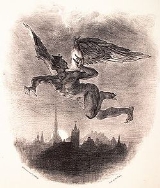
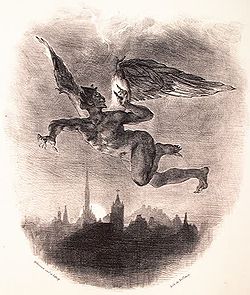
Mephistopheles

Encyclopedia
German folklore
German folklore shares many characteristics with Scandinavian folklore and English folklore due to their origins in a common Germanic mythology. It reflects a similar mix of influences: a pre-Christian pantheon and other beings equivalent to those of Norse mythology; magical characters associated...
. He originally appeared in literature as the demon
Demon
call - 1347 531 7769 for more infoIn Ancient Near Eastern religions as well as in the Abrahamic traditions, including ancient and medieval Christian demonology, a demon is considered an "unclean spirit" which may cause demonic possession, to be addressed with an act of exorcism...
in the Faust
Faust
Faust is the protagonist of a classic German legend; a highly successful scholar, but also dissatisfied with his life, and so makes a deal with the devil, exchanging his soul for unlimited knowledge and worldly pleasures. Faust's tale is the basis for many literary, artistic, cinematic, and musical...
legend, and he has since appeared in other works as a stock character
Stock character
A Stock character is a fictional character based on a common literary or social stereotype. Stock characters rely heavily on cultural types or names for their personality, manner of speech, and other characteristics. In their most general form, stock characters are related to literary archetypes,...
version of the Devil
Devil
The Devil is believed in many religions and cultures to be a powerful, supernatural entity that is the personification of evil and the enemy of God and humankind. The nature of the role varies greatly...
himself.
In the Faust legend
Johann Georg Faust
Dr. Johann Georg Faust , also known in English as John Faustus , was an itinerant alchemist, astrologer, and magician of the German Renaissance...
— who wagers his soul against the Devil.
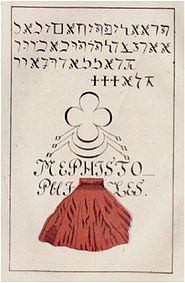
The name appears in the late 16th century Faust chapbooks. In the 1725 version which was read by Goethe, Mephostophiles is a Devil in the form of a greyfriar summoned by Faust in a wood outside Wittenberg
Wittenberg
Wittenberg, officially Lutherstadt Wittenberg, is a city in Germany in the Bundesland Saxony-Anhalt, on the river Elbe. It has a population of about 50,000....
. The name Mephistophiles already appears in the 1527 Praxis Magia Faustiana, printed in Passau
Passau
Passau is a town in Lower Bavaria, Germany. It is also known as the Dreiflüssestadt or "City of Three Rivers," because the Danube is joined at Passau by the Inn from the south and the Ilz from the north....
, alongside pseudo-Hebrew text. It is best explained as a purposely obscure pseudo-Greek
Greek language
Greek is an independent branch of the Indo-European family of languages. Native to the southern Balkans, it has the longest documented history of any Indo-European language, spanning 34 centuries of written records. Its writing system has been the Greek alphabet for the majority of its history;...
or pseudo-Hebrew formation of Renaissance magic
Renaissance magic
Renaissance humanism saw a resurgence in hermeticism and Neo-Platonic varieties of ceremonial magic.The Renaissance and the Industrial Revolution, on the other hand, saw the rise of scientism, in such forms as the substitution of chemistry for alchemy, the dethronement of the Ptolemaic theory of...
.
From the chapbook, the name enters Faustian literature and is also used by authors from Marlowe
Christopher Marlowe
Christopher Marlowe was an English dramatist, poet and translator of the Elizabethan era. As the foremost Elizabethan tragedian, next to William Shakespeare, he is known for his blank verse, his overreaching protagonists, and his mysterious death.A warrant was issued for Marlowe's arrest on 18 May...
down to Goethe. In the 1616 edition of The Tragical History of Doctor Faustus
The Tragical History of Doctor Faustus
The Tragicall History of the Life and Death of Doctor Faustus, commonly referred to simply as Doctor Faustus, is a play by Christopher Marlowe, based on the Faust story, in which a man sells his soul to the devil for power and knowledge...
, Mephostophiles became Mephistophilis.
Greek elements may have played a part in the coining of the name, including Greek mē "not", phōs "light" and philos "lover", suggesting "not a lover of light" in parody of Lucifer
Lucifer
Traditionally, Lucifer is a name that in English generally refers to the devil or Satan before being cast from Heaven, although this is not the original meaning of the term. In Latin, from which the English word is derived, Lucifer means "light-bearer"...
("light-bearer", a common epithet of Satan
Satan
Satan , "the opposer", is the title of various entities, both human and divine, who challenge the faith of humans in the Hebrew Bible...
); in that case, the change from the presumed original mephoto- to mephist- may be due to a suggestion of the Latin
Latin
Latin is an Italic language originally spoken in Latium and Ancient Rome. It, along with most European languages, is a descendant of the ancient Proto-Indo-European language. Although it is considered a dead language, a number of scholars and members of the Christian clergy speak it fluently, and...
mephitis ("a noxious exhalation from the ground; malaria
Malaria
Malaria is a mosquito-borne infectious disease of humans and other animals caused by eukaryotic protists of the genus Plasmodium. The disease results from the multiplication of Plasmodium parasites within red blood cells, causing symptoms that typically include fever and headache, in severe cases...
").
Alternatively, phosto- may be a variation of "Faust," yielding "not Faust-loving." Hamlin suggests a derivation from the Hebrew Mephistoph (perhaps, "meivish tov" "מבאיש טוב"), meaning "destroyer of the good."
Another possibility is a combination of the Hebrew words mephiz ("liar") and tophel ("destroyer").
Another possible origin involves Latin mephitis, treated incorrectly as Greek because it contains '-ph-', plus the Greek superlative
Superlative
In grammar, the superlative is the form of an adjective that indicates that the person or thing modified has the quality of the adjective to a degree greater than that of anything it is being compared to in a given context. English superlatives are typically formed with the suffix -est In...
suffix -ιστος, plus Greek -ωφελης = "help(ful), useful": "he who is the worst or foulest sort of (alleged) help." (Compare Anopheles
Anopheles
Anopheles is a genus of mosquito. There are approximately 460 recognized species: while over 100 can transmit human malaria, only 30–40 commonly transmit parasites of the genus Plasmodium, which cause malaria in humans in endemic areas...
(a malaria mosquito) from Greek α(ν)- = "not", plus -ωφελης, = "no help, the reverse of help.")
Mephistopheles in later treatments of the Faust material frequently figures as a title character: in Meyer Lutz
Meyer Lutz
Wilhelm Meyer Lutz was a German-born English composer and conductor who is best known for light music, musical theatre and burlesques of well-known works....
' Mephistopheles, or Faust and Marguerite (1855), Arrigo Boito
Arrigo Boito
Arrigo Boito , aka Enrico Giuseppe Giovanni Boito, pseudonym Tobia Gorrio, was an Italian poet, journalist, novelist and composer, best known today for his libretti, especially those for Giuseppe Verdi's operas Otello and Falstaff, and his own opera Mefistofele...
's Mefistofele
Mefistofele
Mefistofele is an opera in a prologue, four acts and an epilogue, the only completed opera by the Italian composer-librettist Arrigo Boito.-Composition history:...
(1868), Klaus Mann
Klaus Mann
- Life and work :Born in Munich, Klaus Mann was the son of German writer Thomas Mann and his wife, Katia Pringsheim. His father was baptized as a Lutheran, while his mother was from a family of secular Jews. He began writing short stories in 1924 and the following year became drama critic for a...
's Mephisto
Mephisto (novel)
Mephisto – Novel of a Career is the sixth novel by Klaus Mann, which was published in 1936 whilst he was in exile in Amsterdam. It was published for the first time in Germany in the East Berlin Aufbau-Verlag in 1956...
, and Franz Liszt
Franz Liszt
Franz Liszt ; ), was a 19th-century Hungarian composer, pianist, conductor, and teacher.Liszt became renowned in Europe during the nineteenth century for his virtuosic skill as a pianist. He was said by his contemporaries to have been the most technically advanced pianist of his age...
's Mephisto Waltzes
Mephisto Waltzes
The Mephisto Waltzes are four waltzes composed by Franz Liszt in 1859-62, 1880–81, 1883 and 1885. Nos. 1-2 were composed for orchestra, later arranged for piano, piano duet and two pianos, whereas 3 and 4 were written for piano only...
.
Outside the Faust legend
Shakespeare mentions "Mephistophilus" in the Merry Wives of Windsor (Act1, Sc1, line 128), and by the 17th century, the name had begun to lead an existence independent of the Faust legend. Burton Russell finds, "That the name is a purely modern invention of uncertain origins makes it an elegant symbol of the modern Devil with his many novel and diverse forms."Interpretations of Mephistopheles
Although Mephistopheles appears to Faustus as a devilDevil
The Devil is believed in many religions and cultures to be a powerful, supernatural entity that is the personification of evil and the enemy of God and humankind. The nature of the role varies greatly...
— a worker for Satan — critics claim that he does not search for men to corrupt but comes to serve and ultimately collect the souls of those who are already damned. Farnham explains, "Nor does Mephistophiles first appear to Faustus as a devil who walks up and down in earth to tempt and corrupt any man encountered. He appears because he senses in Faustus’ magical summons that Faustus is already corrupt, that indeed he is already 'in danger to be damned'."
Mephistopheles is already trapped in his own hell
Hell
In many religious traditions, a hell is a place of suffering and punishment in the afterlife. Religions with a linear divine history often depict hells as endless. Religions with a cyclic history often depict a hell as an intermediary period between incarnations...
by serving the Devil. He warns Faustus of the choice he is making by “selling his soul” to the Devil: “Mephistophilis, an agent of Lucifer, appears and at first advises Faust not to forgo the promise of heaven
Heaven
Heaven, the Heavens or Seven Heavens, is a common religious cosmological or metaphysical term for the physical or transcendent place from which heavenly beings originate, are enthroned or inhabit...
to pursue his goals”. Farnham adds to his theory, “…[Faustus] enters an ever-present private hell like that of Mephistophiles”.
Mephistopheles: What kind of angel?
Certain critics have viewed the Faust story as a distortion of ChristianityChristianity
Christianity is a monotheistic religion based on the life and teachings of Jesus as presented in canonical gospels and other New Testament writings...
. Susan Snyder interprets the play by Marlowe as an “inverted Saint’s life”, complete with the “sinful” early life (a student of divinity), “conversion” (to the Devil), reception into the Church (of Lucifer), “temptation” (by the Good Angel) which is overcome by help (of the Bad Angel), miracles and beatific
Beatification
Beatification is a recognition accorded by the Catholic Church of a dead person's entrance into Heaven and capacity to intercede on behalf of individuals who pray in his or her name . Beatification is the third of the four steps in the canonization process...
visions (of the pagan Helen), and the final reception into the house of the Lord (Lucifer).”
However, Mephistophilis does warn Faustus of his regret for losing God and the joys of heaven. He wants Faustus’ soul but also may want to save him from the mistake he made. "Christianity speaks of hell for those who cast it aside. But, says he to Mephistopheles as he delivers to him the agreement to surrender his soul at the end of twenty-four years, 'I think hell’s a fable.' 'Ay,' says Mephistopheles, 'think so still, till experience change thy mind.'"
Mephistopheles' relationship with Faustus
In Doctor Faustus, Mephistopheles acts as a guide to Faustus. Mephistopheles is not only a speaker for the Devil, but he is also seen as a possible lover to the character. In the play, Faustus asks Mephistopheles for a wife and, when he returns, the woman is just a devil in disguise as a woman. According to Hammill, “the wife that [Mephistopheles] brings demonstrates that marriage is not a signifier that can stabilize the genderGender
Gender is a range of characteristics used to distinguish between males and females, particularly in the cases of men and women and the masculine and feminine attributes assigned to them. Depending on the context, the discriminating characteristics vary from sex to social role to gender identity...
. The play... instead replaces this wife with a series of courtesan
Courtesan
A courtesan was originally a female courtier, which means a person who attends the court of a monarch or other powerful person.In feudal society, the court was the centre of government as well as the residence of the monarch, and social and political life were often completely mixed together...
s in an economy of homosocial
Homosocial
In sociology, homosociality describes same-sex relationships that are not of a romantic or sexual nature, such as friendship, mentorship, or others. The opposite of homosocial is heterosocial, preferring non-sexual relations with the opposite sex...
exchange.” Hammill also explains that Mephistopheles brings Faustus a wife who is not actually a woman because he wants to bring up sexual tension between Faustus and himself. This article describes the conversation between the two characters during this scene as “barely legible as male friendship”. The article goes on to explain that the conversation is no longer considered to be friendly because the women whom they are discussing appear to have very masculine features. According to another article, Marlowe was homosexual. Orgel argues that “Marlowe's […] imagination was essentially homosexual”. In “Myth, Psychology, and Marlowe’s Doctor Faustus”, Kenneth Golden explains Mephistopheles' role representing Faustus' alter ego
Alter ego
An alter ego is a second self, which is believe to be distinct from a person's normal or original personality. The term was coined in the early nineteenth century when dissociative identity disorder was first described by psychologists...
constructed from his suppressed feelings.