

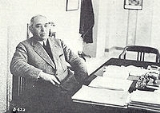
Meir Dizengoff

Encyclopedia
Meir Dizengoff was a Zionist
politician and the first mayor of Tel Aviv
.
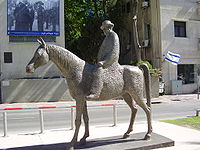 Meir Dizengoff was born in 1861 in the village of Akimovici near Orgeyev, Bessarabia
. In 1878, his family moved to Kishinev
, where he graduated from high school and studied at the polytechnic school. In 1882, he volunteered in the Imperial Russian Army
, serving in Zhitomir (now in the northwestern Ukraine
) until 1884. There he first met Zina Brenner, whom he married in the early 1890s. After his military service, Dizengoff remained in Odessa
, where he became involved in the Narodnaya Volya underground. In 1885, he was arrested for insurgency. In Odessa, he met Leon Pinsker, Ahad Ha’am
and others, and joined the Hovevei Zion
movement. Upon his release from prison, Dizengoff returned to Kishinev and founded the Bessarabian branch of Hovevei Zion, which he represented at the 1887 conference. He left Kishinev in 1889 to study in Paris.
While studying chemical engineering
at the University of Paris
, he met Edmond James de Rothschild
, who sent him to Ottoman
-ruled Palestine
to establish a glass factory
which would supply bottles for Rothschild's wineries. Dizengoff opened the factory in Tantura
in 1882, but it proved unsuccessful due to impurities in the sand, and Dizengoff soon returned to Kishinev. There he met Theodor Herzl
and became his ardent follower, despite having been strongly opposed to the British Uganda Program
promoted by Herzl at the Sixth Zionist Congress
.
. He established the Geulah company, which bought up land in Palestine from Arabs
, and became involved in the import
business, especially machinery and automobiles to replace the horse-drawn carriages that had served as the primary transportation from Jaffa port to Jerusalem and other towns. He also co-founded a boat company that bore his name, and served as the Belgian
consul
.
When Dizengoff learned that residents were organizing to build a new neighborhood, Tel Aviv, he formed a partnership with the Ahuzat Bayit company and bought land on the outskirts of Jaffa, which was parceled out to the early settlers by lot.
, the Ottomans drove out a large part of the population and Dizengoff was the liaison between the exiles and the Ottoman authorities. In this position he dealt with aid sent to the exiles of Tel Aviv and received the nickname Reish Galuta
. He widely circulated and publicised the plight of the exiles, mainly via newspapers, and succeeded in convincing the rulers to agree to a regular supply of food and provisions to the exiles. In 1917, after having received funding from Nili
, Dizengoff refused not only to provide funds to free Nili
member Yosef Lishansky
, but even funds to provide the succor that Dizengoff provided other prisoners and even anti-Zionists, despite having received the money from Nili
.
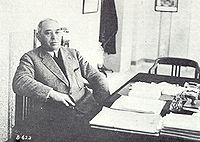 Many committees and associations came into being during Dizengoff's term as mayor. One was the Yerid HaMizrah ("Orient Fair") committee, founded in 1932, which organized its first fair that year. Initially, the fair was held in the south of the city, but after its great success, a fairground with designated buildings was built in north Tel Aviv. A large international fair was held in 1934, followed by a second fair two years later.
Dizengoff was consequently involved with the development of the city, and encouraged its rapid expansion—carrying out daily inspections, and paying attention to details such as entertainment. He was always present at the head of the Adloyada, the annual Purim
carnival. After his wife's death, he donated his house to the city of Tel Aviv, for use as an art museum, and he influenced many important artists to donate their work to improve the museum.
In 1936, with the outbreak of the Arab revolt, the Arabs closed the port of Jaffa with the intention of halting the rapid expansion of Jewish settlements in Israel. Dizengoff pressured the government to give him permission to open a port in his new city of Tel Aviv, and before his death he managed to dedicate the first pier of Tel Aviv's new port. His dedication began with the words: "Ladies and gentlemen, I can still remember the day when Tel Aviv had no port". He died on the September 23, 1936.
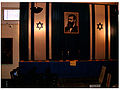 In 1930, after the death of his wife, Dizengoff donated his house to his beloved city of Tel Aviv and requested that it be turned into a museum. The house underwent extensive renovations and became the Tel Aviv Museum of Art
in 1932. The museum moved to its current location in 1971.
On 14 May 1948, David Ben-Gurion
declared the independence of the State of Israel at the Dizengoff residence. The building is now a history museum and known as Independence Hall.
are named after him. His name also lives on in Israeli slang: It was used as a verb - lehizdangeff - which means "to walk down Dizengoff," i.e., go out on the town. Dizengoff Square
, featuring a sculpture by Yaakov Agam, is named after his wife, Zina.
Zionism
Zionism is a Jewish political movement that, in its broadest sense, has supported the self-determination of the Jewish people in a sovereign Jewish national homeland. Since the establishment of the State of Israel, the Zionist movement continues primarily to advocate on behalf of the Jewish state...
politician and the first mayor of Tel Aviv
Tel Aviv
Tel Aviv , officially Tel Aviv-Yafo , is the second most populous city in Israel, with a population of 404,400 on a land area of . The city is located on the Israeli Mediterranean coastline in west-central Israel. It is the largest and most populous city in the metropolitan area of Gush Dan, with...
.
Biography
Bessarabia
Bessarabia is a historical term for the geographic region in Eastern Europe bounded by the Dniester River on the east and the Prut River on the west....
. In 1878, his family moved to Kishinev
Chisinau
Chișinău is the capital and largest municipality of Moldova. It is also its main industrial and commercial centre and is located in the middle of the country, on the river Bîc...
, where he graduated from high school and studied at the polytechnic school. In 1882, he volunteered in the Imperial Russian Army
Imperial Russian Army
The Imperial Russian Army was the land armed force of the Russian Empire, active from around 1721 to the Russian Revolution of 1917. In the early 1850s, the Russian army consisted of around 938,731 regular soldiers and 245,850 irregulars . Until the time of military reform of Dmitry Milyutin in...
, serving in Zhitomir (now in the northwestern Ukraine
Ukraine
Ukraine is a country in Eastern Europe. It has an area of 603,628 km², making it the second largest contiguous country on the European continent, after Russia...
) until 1884. There he first met Zina Brenner, whom he married in the early 1890s. After his military service, Dizengoff remained in Odessa
Odessa
Odessa or Odesa is the administrative center of the Odessa Oblast located in southern Ukraine. The city is a major seaport located on the northwest shore of the Black Sea and the fourth largest city in Ukraine with a population of 1,029,000 .The predecessor of Odessa, a small Tatar settlement,...
, where he became involved in the Narodnaya Volya underground. In 1885, he was arrested for insurgency. In Odessa, he met Leon Pinsker, Ahad Ha’am
Asher Ginsberg
Asher Zvi Hirsch Ginsberg , primarily known by his Hebrew name and pen name, Ahad Ha'am, , was a Hebrew essayist, and one of the foremost pre-state Zionist thinkers. He is known as the founder of Cultural Zionism. With his secular vision of a Jewish "spiritual center" in Palestine he confronted...
and others, and joined the Hovevei Zion
Hovevei Zion
Hovevei Zion , also known as Hibbat Zion , refers to organizations that are now considered the forerunners and foundation-builders of modern Zionism....
movement. Upon his release from prison, Dizengoff returned to Kishinev and founded the Bessarabian branch of Hovevei Zion, which he represented at the 1887 conference. He left Kishinev in 1889 to study in Paris.
While studying chemical engineering
Chemical engineering
Chemical engineering is the branch of engineering that deals with physical science , and life sciences with mathematics and economics, to the process of converting raw materials or chemicals into more useful or valuable forms...
at the University of Paris
University of Paris
The University of Paris was a university located in Paris, France and one of the earliest to be established in Europe. It was founded in the mid 12th century, and officially recognized as a university probably between 1160 and 1250...
, he met Edmond James de Rothschild
Edmond James de Rothschild
Baron Edmond Benjamin James de Rothschild was a French member of the Rothschild banking family. A strong supporter of Zionism, his generous donations lent significant support to the movement during its early years, which helped lead to the establishment of the State of Israel.- Early years :A...
, who sent him to Ottoman
Ottoman Empire
The Ottoman EmpireIt was usually referred to as the "Ottoman Empire", the "Turkish Empire", the "Ottoman Caliphate" or more commonly "Turkey" by its contemporaries...
-ruled Palestine
Palestine
Palestine is a conventional name, among others, used to describe the geographic region between the Mediterranean Sea and the Jordan River, and various adjoining lands....
to establish a glass factory
Glassblowing
Glassblowing is a glassforming technique that involves inflating molten glass into a bubble, or parison, with the aid of a blowpipe, or blow tube...
which would supply bottles for Rothschild's wineries. Dizengoff opened the factory in Tantura
Dor
Tel Dor , is an archeological site located on Israel's Mediterranean coast, about 30 km south of Haifa. Lying on a small headland at the north side of a protected inlet, it is identified with D-jr of Egyptian sources, Biblical Dor, and with Dor/Dora of Greek and Roman sources...
in 1882, but it proved unsuccessful due to impurities in the sand, and Dizengoff soon returned to Kishinev. There he met Theodor Herzl
Theodor Herzl
Theodor Herzl , born Benjamin Ze’ev Herzl was an Ashkenazi Jew Austro-Hungarian journalist and the father of modern political Zionism and in effect the State of Israel.-Early life:...
and became his ardent follower, despite having been strongly opposed to the British Uganda Program
British Uganda Program
The British Uganda Programme was a plan to give a portion of British East Africa to the Jewish people as a homeland.-History:The offer was first made by British Colonial Secretary Joseph Chamberlain to Theodore Herzl's Zionist group in 1903. He offered of the Mau Plateau in what is today Kenya...
promoted by Herzl at the Sixth Zionist Congress
World Zionist Organization
The World Zionist Organization , or WZO, was founded as the Zionist Organization , or ZO, in 1897 at the First Zionist Congress, held from August 29 to August 31 in Basel, Switzerland...
.
Business ventures
In 1905, spurred by his Zionist beliefs, Dizengoff returned to Palestine and settled in JaffaJaffa
Jaffa is an ancient port city believed to be one of the oldest in the world. Jaffa was incorporated with Tel Aviv creating the city of Tel Aviv-Yafo, Israel. Jaffa is famous for its association with the biblical story of the prophet Jonah.-Etymology:...
. He established the Geulah company, which bought up land in Palestine from Arabs
Palestinian people
The Palestinian people, also referred to as Palestinians or Palestinian Arabs , are an Arabic-speaking people with origins in Palestine. Despite various wars and exoduses, roughly one third of the world's Palestinian population continues to reside in the area encompassing the West Bank, the Gaza...
, and became involved in the import
Import
The term import is derived from the conceptual meaning as to bring in the goods and services into the port of a country. The buyer of such goods and services is referred to an "importer" who is based in the country of import whereas the overseas based seller is referred to as an "exporter". Thus...
business, especially machinery and automobiles to replace the horse-drawn carriages that had served as the primary transportation from Jaffa port to Jerusalem and other towns. He also co-founded a boat company that bore his name, and served as the Belgian
Belgium
Belgium , officially the Kingdom of Belgium, is a federal state in Western Europe. It is a founding member of the European Union and hosts the EU's headquarters, and those of several other major international organisations such as NATO.Belgium is also a member of, or affiliated to, many...
consul
Consul (representative)
The political title Consul is used for the official representatives of the government of one state in the territory of another, normally acting to assist and protect the citizens of the consul's own country, and to facilitate trade and friendship between the peoples of the two countries...
.
When Dizengoff learned that residents were organizing to build a new neighborhood, Tel Aviv, he formed a partnership with the Ahuzat Bayit company and bought land on the outskirts of Jaffa, which was parceled out to the early settlers by lot.
Mayor of Tel Aviv
Dizengoff became head of the town planning in 1911, a position that he held until 1922. When Tel Aviv was recognized as a city, Dizengoff was elected mayor. He remained in office until his death, apart from a three-year hiatus in 1925-1928. During World War IWorld War I
World War I , which was predominantly called the World War or the Great War from its occurrence until 1939, and the First World War or World War I thereafter, was a major war centred in Europe that began on 28 July 1914 and lasted until 11 November 1918...
, the Ottomans drove out a large part of the population and Dizengoff was the liaison between the exiles and the Ottoman authorities. In this position he dealt with aid sent to the exiles of Tel Aviv and received the nickname Reish Galuta
Exilarch
Exilarch refers to the leaders of the Diaspora Jewish community in Babylon following the deportation of King Jeconiah and his court into Babylonian exile after the first fall of Jerusalem in 597 BCE and augmented after the further deportations following the destruction...
. He widely circulated and publicised the plight of the exiles, mainly via newspapers, and succeeded in convincing the rulers to agree to a regular supply of food and provisions to the exiles. In 1917, after having received funding from Nili
Nili
Nili of Israel will not lie") was a Jewish espionage network which assisted the United Kingdom in its fight against the Ottoman Empire in Palestine during World War I.-Establishment:...
, Dizengoff refused not only to provide funds to free Nili
Nili
Nili of Israel will not lie") was a Jewish espionage network which assisted the United Kingdom in its fight against the Ottoman Empire in Palestine during World War I.-Establishment:...
member Yosef Lishansky
Yosef Lishansky
Yosef Lishansky was a Jewish paramilitary and a spy for the British in Ottoman Palestine. Upon his arrival in Palestine, Lishansky sought to join HaShomer but, denied membership, he founded a rival organization, HaMagen. Several years later, he joined the Jewish espionage organization, Nili...
, but even funds to provide the succor that Dizengoff provided other prisoners and even anti-Zionists, despite having received the money from Nili
Nili
Nili of Israel will not lie") was a Jewish espionage network which assisted the United Kingdom in its fight against the Ottoman Empire in Palestine during World War I.-Establishment:...
.
Dizengoff was consequently involved with the development of the city, and encouraged its rapid expansion—carrying out daily inspections, and paying attention to details such as entertainment. He was always present at the head of the Adloyada, the annual Purim
Purim
Purim is a Jewish holiday that commemorates the deliverance of the Jewish people in the ancient Persian Empire from destruction in the wake of a plot by Haman, a story recorded in the Biblical Book of Esther .Purim is celebrated annually according to the Hebrew calendar on the 14th...
carnival. After his wife's death, he donated his house to the city of Tel Aviv, for use as an art museum, and he influenced many important artists to donate their work to improve the museum.
In 1936, with the outbreak of the Arab revolt, the Arabs closed the port of Jaffa with the intention of halting the rapid expansion of Jewish settlements in Israel. Dizengoff pressured the government to give him permission to open a port in his new city of Tel Aviv, and before his death he managed to dedicate the first pier of Tel Aviv's new port. His dedication began with the words: "Ladies and gentlemen, I can still remember the day when Tel Aviv had no port". He died on the September 23, 1936.
Dizengoff House
Tel Aviv Museum of Art
The Tel Aviv Museum of Art is an art museum in Tel Aviv, Israel. It was established in 1932 in a building that was the home of Tel Aviv's first mayor, Meir Dizengoff. The Helena Rubinstein Pavilion for Contemporary Art opened in 1959. The museum moved to its current location on King Saul Avenue in...
in 1932. The museum moved to its current location in 1971.
On 14 May 1948, David Ben-Gurion
David Ben-Gurion
' was the first Prime Minister of Israel.Ben-Gurion's passion for Zionism, which began early in life, led him to become a major Zionist leader and Executive Head of the World Zionist Organization in 1946...
declared the independence of the State of Israel at the Dizengoff residence. The building is now a history museum and known as Independence Hall.
Commemoration
Meir Park and Dizengoff streetDizengoff Street
Dizengoff Street is a major street in central Tel Aviv, named after Tel Aviv's first mayor, Meir Dizengoff.The street runs from the corner of Ibn Gabirol Street in its southernmost point to the port area of Tel Aviv in its northwestern point...
are named after him. His name also lives on in Israeli slang: It was used as a verb - lehizdangeff - which means "to walk down Dizengoff," i.e., go out on the town. Dizengoff Square
Dizengoff Square
Dizengoff Square is an iconic public square in Tel Aviv, on the corner of Dizengoff Street, Reines Street and Pinsker Street...
, featuring a sculpture by Yaakov Agam, is named after his wife, Zina.