
All Topics  
McCabe-Thiele method


   Email Print
   Bookmark   Link


McCabe-Thiele method


The graphical approach presented by McCabe and Thiele in 1925, the McCabe-Thiele method is considered the simplest and perhaps most instructive method for analysis of binary distillation
Distillation

Distillation is a method of separation process mixtures based on differences in their Volatility in a boiling liquid mixture. Distillation is a unit operation, or a physical separation process, and not a chemical reaction....
. This method uses the fact that the composition at each theoretical tray
Theoretical plate

A theoretical plate in many separation processes is a hypothetical zone or stage in which two phases, such as the liquid and vapor phases of a substance, establish an Vapor-liquid equilibrium with each other....
 (or equilibrium
Vapor-liquid equilibrium

Vapor-liquid equilibrium, abbreviated as VLE by some, is a condition where a liquid and its vapor are in Chemical equilibrium with each other, a condition or state where the rate of evaporation equals the rate of condensation on a molecular level such that there is no net vapor-liquid interconversion....
 stage) is completely determined by the mole fraction
Mole fraction

In chemistry, mole fraction x'' is a way of expressing the composition of a mixture. The mole fraction of each component i'' is defined as its amount of substance ni'' divided by the total amount of substance in the system, n''...
 of one of the two components.

The McCabe-Thiele method is based on the assumption of constant molar overflow which requires that:


Construction and use of the McCabe-Thiele diagram
Before starting the construction and use of a McCabe-Thiele diagram for the distillation of a binary feed, the vapor-liquid equilibrium (VLE)
Vapor-liquid equilibrium

Vapor-liquid equilibrium, abbreviated as VLE by some, is a condition where a liquid and its vapor are in Chemical equilibrium with each other, a condition or state where the rate of evaporation equals the rate of condensation on a molecular level such that there is no net vapor-liquid interconversion....
 data must be obtained for the lower-boiling component of the feed.

The first step is to draw equal sized vertical and horizontal axes of a graph.


Discussion
Ask a question about 'McCabe-Thiele method'
Start a new discussion about 'McCabe-Thiele method'
Answer questions from other users
Full Discussion Forum


Encyclopedia


The graphical approach presented by McCabe and Thiele in 1925, the McCabe-Thiele method is considered the simplest and perhaps most instructive method for analysis of binary distillation
Distillation

Distillation is a method of separation process mixtures based on differences in their Volatility in a boiling liquid mixture. Distillation is a unit operation, or a physical separation process, and not a chemical reaction....
. This method uses the fact that the composition at each theoretical tray
Theoretical plate

A theoretical plate in many separation processes is a hypothetical zone or stage in which two phases, such as the liquid and vapor phases of a substance, establish an Vapor-liquid equilibrium with each other....
 (or equilibrium
Vapor-liquid equilibrium

Vapor-liquid equilibrium, abbreviated as VLE by some, is a condition where a liquid and its vapor are in Chemical equilibrium with each other, a condition or state where the rate of evaporation equals the rate of condensation on a molecular level such that there is no net vapor-liquid interconversion....
 stage) is completely determined by the mole fraction
Mole fraction

In chemistry, mole fraction x'' is a way of expressing the composition of a mixture. The mole fraction of each component i'' is defined as its amount of substance ni'' divided by the total amount of substance in the system, n''...
 of one of the two components.

The McCabe-Thiele method is based on the assumption of constant molar overflow which requires that:

  • the molal heats of vaporization
    Standard enthalpy change of vaporization

    The enthalpy of vaporization, , also known as the heat of vaporization or heat of evaporation, is the energy required to transform a given quantity of a substance into a gas....
     of the feed components are equal
  • for every mole
    Mole (unit)

    The mole is a Units of measurement of amount of substance: it is an SI base unit, and one of the few units used to measure this physical quantity....
     of liquid vaporized, a mole of vapour is condensed
  • heat effects such as heats of solution
    Enthalpy change of solution

    The enthalpy of solution is the enthalpy change associated with the dissolution ofa substance in a solvent at constant pressure.The heat of solution is one of the three dimensions of solubility analysis....
     and heat transfer
    Heat transfer

    Heat transfer is the transition of thermal energy or simply heat from a hotter object to a cooler object . When an object or fluid is at a different temperature than its thermodynamic system or another object, transfer of thermal energy, also known as heat transfer, or heat exchange, occurs in such a way that the body and the surround...
     to and from the distillation column
    Fractionating column

    A fractionating column or fractionation column is an essential item used in the distillation of liquid mixtures so as to separate the mixture into its component parts, or fractions, based on the differences in their Volatility ....
     are negligible.


Construction and use of the McCabe-Thiele diagram


Before starting the construction and use of a McCabe-Thiele diagram for the distillation of a binary feed, the vapor-liquid equilibrium (VLE)
Vapor-liquid equilibrium

Vapor-liquid equilibrium, abbreviated as VLE by some, is a condition where a liquid and its vapor are in Chemical equilibrium with each other, a condition or state where the rate of evaporation equals the rate of condensation on a molecular level such that there is no net vapor-liquid interconversion....
 data must be obtained for the lower-boiling component of the feed.

The first step is to draw equal sized vertical and horizontal axes of a graph. The horizontal axis will be for the mole fraction (denoted by x) of the lower-boiling feed component in the liquid phase. The vertical axis will be for the mole fraction (denoted by y) of the lower-boiling feed component in the vapor phase.

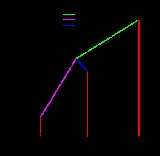
The next step is to draw a straight line from the origin of the graph to the point where x and y both equal 1.0, which is the x = y line in Figure 1. Then draw the equilibrium line using the VLE data points of the lower boiling component, representing the equilibrium vapor phase compositions for each value of liquid phase composition. Also draw vertical lines from the horizontal axis up to the x = y line for the feed and for the desired compositions of the top distillate product and the corresponding bottoms product (shown in red in Figure 1).

The next step is to draw the operating line for the rectifying section (the section above the feed inlet) of the distillation column, (shown in green in Figure 1). Starting at the intersection of the distillate composition line and the x = y line, draw the rectifying operating line at a downward slope (?y/?x) of L / (D + L) where L is the molar flow rate of reflux
Reflux

Reflux is a technique involving the condensation of vapors and the return of this condensate to the system from which it originated. It is used in industrial and laboratory distillations....
 and D is the molar flow rate of the distillate product. For example, in Figure 1, assuming the molar flow rate of the reflux L is 1000 moles per hour and the molar flow rate of the distillate D is 590 moles per hour, then the downward slope of the rectifying operating line is 1000 / (590 + 1000) = 0.63 which means that the y-coordinate of any point on the line decreases 0.63 units for each unit that the x-coordinate decreases.

The next step is to draw the blue q-line (seen in Figure 1) from the x = y line so that it intersects the rectifying operating line.

The parameter q is the mole fraction of liquid in the feed and the slope of the q-line is q / (q - 1). For example, if the feed is a saturated liquid it has no vapor, thus q = 1 and the slope of the q-line is infinite which means the line is vertical. As another example, if the feed is all saturated vapor, q = 0 and the slope of the q-line is 0 which means that the line is horizontal.

Some example q-line slopes are presented in Figure 2. As can be seen now, the typical McCabe-Thiele diagram in Figure 1 uses a q-line representing a partially vaporized feed.

Next, as shown in Figure 1, draw the purple operating line for the stripping section of the distillation column (i.e., the section below the feed inlet). Starting at the intersection of the red bottoms composition line and the x = y line, draw the stripping section operating line up to the point where the blue q-line intersects the green operating line of the rectifying section operating line.

Finally, as exemplified in Figure 1, draw the steps between operating lines and the equilibrium line and then count them. Those steps represent the theoretical plate
Theoretical plate

A theoretical plate in many separation processes is a hypothetical zone or stage in which two phases, such as the liquid and vapor phases of a substance, establish an Vapor-liquid equilibrium with each other....
s (or equilibrium stages). The required number of theoretical plates is 6 for the binary distillation depicted in Figure 1.

Note that using colored lines is not required and only used here to make the methodology easier to describe.

In continuous distillation
Continuous distillation

Continuous distillation, a form of distillation, is an ongoing separation in which a mixture is continuously fed into the process and separated fractions are removed continuously as output streams as time passes during the operation....
 with varying reflux
Reflux

Reflux is a technique involving the condensation of vapors and the return of this condensate to the system from which it originated. It is used in industrial and laboratory distillations....
 ratio, the mole fraction
Mole fraction

In chemistry, mole fraction x'' is a way of expressing the composition of a mixture. The mole fraction of each component i'' is defined as its amount of substance ni'' divided by the total amount of substance in the system, n''...
 of the lighter component in the top part of the distillation column
Fractionating column

A fractionating column or fractionation column is an essential item used in the distillation of liquid mixtures so as to separate the mixture into its component parts, or fractions, based on the differences in their Volatility ....
 will decrease as the reflux
Reflux

Reflux is a technique involving the condensation of vapors and the return of this condensate to the system from which it originated. It is used in industrial and laboratory distillations....
 ratio decreases. Each new reflux
Reflux

Reflux is a technique involving the condensation of vapors and the return of this condensate to the system from which it originated. It is used in industrial and laboratory distillations....
 ratio will alter the slope
Slope

Slope is used to describe the steepness, incline, gradient, or grade of a line . A higher slope value indicates a steeper incline. The slope is defined as the ratio of the "rise" divided by the "run" between two points on a line, or in other words, the ratio of the altitude change to the horizontal distance between any two point...
 of the rectifying section operating line.

When the assumption of constant molar overflow is not valid, the operating lines will not be straight. Using mass and enthalpy balances in addition to vapor-liquid equilibrium data and enthalpy-concentration data, operating lines can be constructed based on Ponchon-Savarit's method.

See also


  • Fenske equation
    Fenske equation

    The Fenske equation in continuous fractional distillation is an equation used for calculating the minimum number of Theoretical plate required for the separation of a binary feed stream by a Fractionating column that is being operated at total reflux ....
  • Fractional distillation
    Fractional distillation

    Fractional distillation is the separation of a mixture into its component parts, or fractions, such as in separating chemical compound by their boiling point by heating them to a temperature at which several fractions of the compound will evaporate....
  • Fractionating column
    Fractionating column

    A fractionating column or fractionation column is an essential item used in the distillation of liquid mixtures so as to separate the mixture into its component parts, or fractions, based on the differences in their Volatility ....
  • Theoretical plate
    Theoretical plate

    A theoretical plate in many separation processes is a hypothetical zone or stage in which two phases, such as the liquid and vapor phases of a substance, establish an Vapor-liquid equilibrium with each other....
  • Vapor-Liquid Equilibrium
    Vapor-liquid equilibrium

    Vapor-liquid equilibrium, abbreviated as VLE by some, is a condition where a liquid and its vapor are in Chemical equilibrium with each other, a condition or state where the rate of evaporation equals the rate of condensation on a molecular level such that there is no net vapor-liquid interconversion....


External links


  • by Tore Haug-Warberg, Norwegian University of Science and Technology, Norway