
Vapor–liquid equilibrium (
VLE) is a condition where a
liquidLiquid is one of the three classical states of matter . Like a gas, a liquid is able to flow and take the shape of a container. Some liquids resist compression, while others can be compressed. Unlike a gas, a liquid does not disperse to fill every space of a container, and maintains a fairly...
and its
vaporA vapor or vapour is a substance in the gas phase at a temperature lower than its critical point....
(gas phase) are in
equilibriumIn a chemical reaction, chemical equilibrium is the state in which the concentrations of the reactants and products have not yet changed with time. It occurs only in reversible reactions, and not in irreversible reactions. Usually, this state results when the forward reaction proceeds at the same...
with each other, a condition or state where the rate of
evaporationEvaporation is a type of vaporization of a liquid that occurs only on the surface of a liquid. The other type of vaporization is boiling, which, instead, occurs on the entire mass of the liquid....
(liquid changing to vapor) equals the rate of
condensationCondensation is the change of the physical state of matter from gaseous phase into liquid phase, and is the reverse of vaporization. When the transition happens from the gaseous phase into the solid phase directly, the change is called deposition....
(vapor changing to liquid) on a molecular level such that there is no net (overall) vapor-liquid interconversion. Although in theory equilibrium takes forever to reach, such an equilibrium is practically reached in a relatively closed location if a liquid and its vapor are allowed to stand in contact with each other long enough with no interference or only gradual interference from the outside.
VLE data introduction
The concentration of a vapor in contact with its liquid, especially at equilibrium, is often in terms of
vapor pressureVapor pressure or equilibrium vapor pressure is the pressure of a vapor in thermodynamic equilibrium with its condensed phases in a closed system. All liquids have a tendency to evaporate, and some solids can sublimate into a gaseous form...
, which could be a
partial pressureIn a mixture of ideal gases, each gas has a partial pressure which is the pressure which the gas would have if it alone occupied the volume. The total pressure of a gas mixture is the sum of the partial pressures of each individual gas in the mixture....
(part of the total gas pressure) if any other gas(es) are present with the vapor. The equilibrium vapor pressure of a liquid is usually very dependent on temperature. At vapor-liquid equilibrium, a liquid with individual components (compounds) in certain concentrations will have an equilibrium vapor in which the concentrations or partial pressures of the vapor components will have certain set values depending on all of the liquid component concentrations and the temperature. This fact is true in reverse also; if a vapor with components at certain concentrations or partial pressures is in vapor-liquid equilibrium with its liquid, then the component concentrations in the liquid will be set dependent on the vapor concentrations, again also depending on the temperature. The equilibrium concentration of each component in the liquid phase is often different from its concentration (or vapor pressure) in the vapor phase, but there is a correlation. Such VLE concentration data is often known or can be determined experimentally for vapor-liquid mixtures with various components. In certain cases such VLE data can be determined or approximated with the help of certain theories such as
Raoult's Law,
Dalton's LawIn chemistry and physics, Dalton's law states that the total pressure exerted by a gaseous mixture is equal to the sum of the partial pressures of each individual component in a gas mixture...
, and/or
Henry's LawIn physics, Henry's law is one of the gas laws formulated by William Henry in 1803. It states that:An equivalent way of stating the law is that the solubility of a gas in a liquid at a particular temperature is proportional to the pressure of that gas above the liquid...
.
Such VLE information is useful in designing
columnsA fractionating column or fractionation column is an essential item used in the distillation of liquid mixtures so as to separate the mixture into its component parts, or fractions, based on the differences in their volatilities...
for
distillationDistillation is a method of separating mixtures based on differences in volatilities of components in a boiling liquid mixture. Distillation is a unit operation, or a physical separation process, and not a chemical reaction....
, especially
fractional distillationFractional distillation is the separation of a mixture into its component parts, or fractions, such as in separating chemical compounds by their boiling point by heating them to a temperature at which several fractions of the compound will evaporate. It is a special type of distillation...
, which is a particular specialty of
chemical engineerIn the field of engineering, a chemical engineer is the profession in which one works principally in the chemical industry to convert basic raw materials into a variety of products, and deals with the design and operation of plants and equipment to perform such work...
s.
Distillation is a process used to separate or partially separate components in a mixture by boiling (vaporization) followed by
condensationCondensation is the change of the physical state of matter from gaseous phase into liquid phase, and is the reverse of vaporization. When the transition happens from the gaseous phase into the solid phase directly, the change is called deposition....
. Distillation takes advantage of differences in concentrations of components in the liquid and vapor phases.
In mixtures containing two or more components where their concentrations are compared in the vapor and liquid phases, concentrations of each component are often expressed as
mole fractions. A mole fraction is number of
molesThe mole is a unit of measurement used in chemistry to express amounts of a chemical substance, defined as an amount of a substance that contains as many elementary entities as there are atoms in 12 grams of pure carbon-12 , the isotope of carbon with atomic weight 12. This corresponds to a value...
of a given component in an amount of mixture in a
phaseIn the physical sciences, a phase is a region of space , throughout which all physical properties of a material are essentially uniform. Examples of physical properties include density, index of refraction, and chemical composition...
(either vapor or liquid phase) divided by the total number of moles of all components in that amount of mixture in that phase.
Binary mixtures are those having two components. Three-component mixtures could be called ternary mixtures. There can be VLE data for mixtures with even more components, but such data becomes copious and is often hard to show graphically. VLE data is often shown at a certain overall pressure, such as 1
atmAn atmosphere is a layer of gases that may surround a material body of sufficient mass, and that is held in place by the gravity of the body. An atmosphere may be retained for a longer duration, if the gravity is high and the atmosphere's temperature is low...
or whatever pressure a process of interest is conducted at. When at a certain temperature, the total of partial pressures of all the components becomes equal to the overall pressure of the system such that vapors generated from the liquid displace any air or other gas which maintained the overall pressure, the mixture is said to
boilBoiling is the rapid vaporization of a liquid, which occurs when a liquid is heated to its boiling point, the temperature at which the vapor pressure of the liquid is equal to the pressure exerted on the liquid by the surrounding environmental pressure. While below the boiling point a liquid...
and the corresponding temperature is the
boiling pointThe boiling point of an element or a substance is the temperature at which the vapor pressure of the liquid equals the environmental pressure surrounding the liquid....
(This assumes excess pressure is relieved by letting out gases to maintain a desired total pressure). A boiling point at an overall pressure of 1 atm is called the
normal boiling point.
Thermodynamic description of vapor-liquid equilibrium
The field of
thermodynamicsThermodynamics is a physical science that studies the effects on material bodies, and on radiation in regions of space, of transfer of heat and of work done on or by the bodies or radiation...
describes when vapor-liquid equilibrium is possible, and its properties. Much of the analysis depends on whether the vapor and liquid consist of a single component, or if they are mixtures.
Pure (single-component) systems
If the liquid and vapor are pure, in that they consist of only one molecular component and no impurities, then the equilibrium state between the two phases is described by the following equations:

;

; and
where

and

are the
pressurePressure is the force per unit area applied in a direction perpendicular to the surface of an object. Gauge pressure is the pressure relative to the local atmospheric or ambient pressure.- Definition :...
s within the liquid and vapor,

and

are the
temperatureTemperature is a physical property of matter that quantitatively expresses the common notions of hot and cold. Objects of low temperature are cold, while various degrees of higher temperatures are referred to as warm or hot...
s within the liquid and vapor, and

and

are the molar
Gibbs free energiesIn thermodynamics, the Gibbs free energy is a thermodynamic potential that measures the "useful" or process-initiating work obtainable from a thermodynamic system at a constant temperature and pressure...
(units of energy per
amount of substanceAmount of substance is a standards-defined quantity that measures the size of an ensemble of elementary entities, such as atoms, molecules, electrons, and other particles. It is sometimes referred to as chemical amount. The International System of Units defines the amount of substance to be...
) within the liquid and vapor, respectively. In other words, the temperature, pressure and molar Gibbs free energy are the same between the two phases when they are at equilibrium.
An equivalent, more common way to express the vapor-liquid equilibrium condition in a pure system is by using the concept of
fugacityIn chemical thermodynamics, the fugacity of a real gas is an effective pressure which replaces the true mechanical pressure in accurate chemical equilibrium calculations. It is equal to the pressure of an ideal gas which has the same chemical potential as the real gas. For example, nitrogen gas ...
. Under this view, equilibrium is described by the following equation:
where

and

are the
fugacitiesIn chemical thermodynamics, the fugacity of a real gas is an effective pressure which replaces the true mechanical pressure in accurate chemical equilibrium calculations. It is equal to the pressure of an ideal gas which has the same chemical potential as the real gas. For example, nitrogen gas ...
of the liquid and vapor, respectively, at the system temperature

and pressure

. Using fugacity is often more convenient for calculation, given that the fugacity of the liquid is, to a good approximation, pressure-independent, and it is often convenient to use the quantity

, the dimensionless
fugacity coefficient, which is 1 for an
ideal gasAn ideal gas is a theoretical gas composed of a set of randomly-moving, non-interacting point particles. The ideal gas concept is useful because it obeys the ideal gas law, a simplified equation of state, and is amenable to analysis under statistical mechanics.At normal conditions such as...
.
Multicomponent systems
In a multicomponent system, where the vapor and liquid consist of more than one type of molecule, describing the equilibrium state is more complicated. For all components

in the system, the equilibrium state between the two phases is described by the following equations:

;

; and
where

and

are the temperature and pressure for each phase, and

and

are the partial molar Gibbs free energy also called
chemical potentialChemical potential, symbolized by μ, is a measure first described by the American engineer, chemist and mathematical physicist Josiah Willard Gibbs. It is the potential that a substance has to produce in order to alter a system...
(units of energy per
amount of substanceAmount of substance is a standards-defined quantity that measures the size of an ensemble of elementary entities, such as atoms, molecules, electrons, and other particles. It is sometimes referred to as chemical amount. The International System of Units defines the amount of substance to be...
) within the liquid and vapor, respectively, for each phase. The partial molar Gibbs free energy is defined by:
where

is the (extensive) Gibbs free energy, and

is the
amount of substanceAmount of substance is a standards-defined quantity that measures the size of an ensemble of elementary entities, such as atoms, molecules, electrons, and other particles. It is sometimes referred to as chemical amount. The International System of Units defines the amount of substance to be...
of component

.
Boiling point diagrams
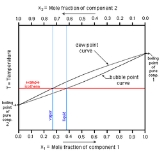
Binary mixture VLE data at a certain overall pressure, such as 1 atm, showing mole fraction vapor and liquid concentrations when boiling at various temperatures can be shown as a two-dimensional
graphGraphics are visual presentations on some surface, such as a wall, canvas, computer screen, paper, or stone to brand, inform, illustrate, or entertain. Examples are photographs, drawings, Line Art, graphs, diagrams, typography, numbers, symbols, geometric designs, maps, engineering drawings,or...
called a
boiling point diagram. The mole fraction of component 1 in the mixture can be represented by the symbol x
1. The mole fraction of component 2, represented by x
2, is related to x
1 in a binary mixture as follows:
x1 + x2 = 1
In multi-component mixtures in general with n components, this becomes:
x1 + x2 + ... + xn = 1
The preceding equations are typically applied for each phase (liquid or vapor) individually. In a binary boiling point diagram, temperature (T) is graphed vs. x
1. At any given temperature where boiling is present, vapor with a certain mole fraction is in equilibrium with liquid with a certain mole fraction, often differing from the vapor. These vapor and liquid mole fractions are both on a horizontal isotherm (constant T) line. When an entire range of boiling temperatures vs. vapor and liquid mole fractions is graphed, two (usually curved) lines are made. The lower one, representing boiling liquid mole fraction at various temperatures, is called a
bubble pointWhen heating a liquid consisting of two or more components, the bubble point is the point where first bubble of vapor is formed. Given that vapor will probably have a different composition than the liquid, the bubble point at different compositions are useful data when designing distillation...
curve. The upper one, representing vapor mole fraction at corresponding temperatures, is called a
dew point curve.
[1]
These two lines (or curves) meet where the mixture becomes purely one component, where x
1 = 0 (and x
2 = 1, pure component 2) or x
1 = 1 (and x
2 = 0, pure component 1). The temperatures at those two points correspond to the boiling points of the two pure components. In certain combinations of components, the two curves may also meet at a point somewhere in between x
1 = 0 and x
1 = 1. That point represents an
azeotropeAn azeotrope is a mixture of two or more liquids in such a ratio that its composition cannot be changed by simple distillation. This occurs because, when an azeotrope is boiled, the resulting vapor has the same ratio of constituents as the original mixture....
in that particular combination of components. That point has an azeotrope temperature and an azeotropic composition often represented as a mole fraction. There can be
maximum-boiling azeotropes, where the azeotrope temperature is at a maximum in the boiling curves, or
minimum-boiling azeotropes, where the azeotrope temperature is at a minimum in the boiling curves.
If one wants to represent a VLE data for a three-component mixture as a boiling point "diagram", a
three-dimensional graph can be used. Two of the dimensions would be used to represent the composition mole fractions, and the third dimension would be the temperature. Using two dimensions, the composition can be represented as an equilateral triangle in which each corner representing one of the pure components. The edges of the triangle represent a mixture of the two components at each end of the edge. Any point inside the triangle represent the composition of a mixture of all three components. The mole fraction of each component would correspond to where a point lies along a line starting at that component's corner and perpendicular to the opposite edge. The
bubble pointWhen heating a liquid consisting of two or more components, the bubble point is the point where first bubble of vapor is formed. Given that vapor will probably have a different composition than the liquid, the bubble point at different compositions are useful data when designing distillation...
and
dew pointThe dew point is the temperature to which a given parcel of humid air must be cooled, at constant barometric pressure, for water vapor to condense into liquid water. The condensed water is called dew when it forms on a solid surface. The dew point is a saturation temperature.The dew point is...
data would become curved surfaces inside a triangular prism, which connect the three boiling points on the vertical temperature "axes". Each face of this triangular prism would represent a two-dimensional boiling point diagram for the corresponding binary mixture. Due to their three-dimensional complexity, such boiling point diagrams are rarely seen. Alternatively, the three-dimensional curved surfaces can be represented on a two-dimensional graph by the use of curved isotherm lines at graduated intervals, similar to iso-altitude lines on a map. Two sets of such isotherm lines are needed on such a two-dimensional graph: one set for the bubble point surface and another set for the dew point surface.
K values and relative volatility values
There can be VLE data for mixtures of four or more components, but such a boiling point diagram is hard to show in either tabular or graphical form. For such multi-component mixtures, as well as binary
mixtures, the vapor-liquid equilibrium data are represented in terms of

values (vapor-liquid distribution ratios) defined by
where y
i and xi are the mole fractions of component i in the phases y and x, respectively.
The values of the ratio Ki are correlated empirically or theoretically in terms of temperature, pressure and phase compositions in the form of equations, tables or graph such as the DePriester charts.
For binary mixtures, the ratio of the
values for the two components is called the relative volatilityRelative volatility is a measure comparing the vapor pressures of the components in a liquid mixture of chemicals. This quantity is widely used in designing large industrial distillation processes. In effect, it indicates the ease or difficulty of using distillation to separate the more volatile...
denoted by 

which is a measure of the relative ease or difficulty of separating the two components. Large-scale industrial distillation is rarely undertaken if the relative volatility is less than 1.05 with the volatile component being
and the less volatile component being
.
values are widely used in the design calculations of continuous distillationContinuous distillation, a form of distillation, is an ongoing separation in which a mixture is continuously fed into the process and separated fractions are removed continuously as output streams. A distillation is the separation or partial separation of a liquid feed mixture into components or...
columns for distilling multicomponent mixtures.
Vapor-Liquid Equilibrium diagrams
For each component in a binary mixture, one could make a vapor-liquid equilibrium diagram. Such a diagram would graph liquid mole fraction on a horizontal axis and vapor mole fraction on a vertical axis. In such VLE diagrams, liquid mole fractions for components 1 and 2 can be represented as x1 and x2 respectively, and vapor mole fractions of the corresponding components are commonly represented as y1 and y2. [2] Similarly for binary mixtures in these VLE diagrams:
x1 + x2 = 1 and y1 + y2 = 1
Such VLE diagrams are square with a diagonal line running from the (x1=0, y1=0) corner to the (x1=1, y1=1) corner for reference.
These types of VLE diagrams are used in the McCabe-Thiele methodThe McCabe-Thiele method was presented by two graduate students at Massachusetts Institute of Technology , Warren L. McCabe and Ernest W. Thiele in 1925. The technique is considered to be the simplest and perhaps most instructive method for analysis of binary distillation...
to determine the number of equilibrium stages (or theoretical plateA theoretical plate in many separation processes is a hypothetical zone or stage in which two phases, such as the liquid and vapor phases of a substance, establish an equilibrium with each other. Such equilibrium stages may also be referred to as an equilibrium stage, ideal stage or a theoretical...
s; same thing) needed to distill a given composition binary feed mixture into one distillate fraction and one bottoms fraction. Corrections can also be made to take into account the incomplete efficiency of each tray in a distillation column when compared to a theoretical plate.
Raoult's Law
At boiling and higher temperatures the sum of the individual component partial pressures becomes equal to the overall pressure, which can symbolized as Ptot.
Under such conditions, Dalton's LawIn chemistry and physics, Dalton's law states that the total pressure exerted by a gaseous mixture is equal to the sum of the partial pressures of each individual component in a gas mixture...
would be in effect as follows:
Ptot = P1 + P2 + ...
Then for each component in the vapor phase:
y1 = P1/Ptot, y2 = P2/Ptot, ... etc.
where P1 = partial pressure of component 1, P2 = partial pressure of component 2, etc.
Raoult's Law is approximately valid for mixtures of components between which there is very little interaction other than the effect of dilution by the other components. Examples of such mixtures includes mixtures of alkaneAlkanes are chemical compounds that consist only of hydrogen and carbon atoms and are bonded exclusively by single bonds without any cycles...
s, which are non-polarIn chemistry, polarity refers to a separation of electric charge leading to a molecule or its chemical groups having an electric dipole or multipole moment. Polar molecules interact through dipole–dipole intermolecular forces and hydrogen bonds. Molecular polarity is dependent on the difference in...
, relatively inert compoundsA chemical compound is a pure chemical substance consisting of two or more different chemical elements that can be separated into simpler substances by chemical reactions. Chemical compounds have a unique and defined chemical structure; they consist of a fixed ratio of atoms that are held together...
in many ways, so there is little attraction or repulsion between the molecules. Raoult's Law states that for components 1, 2, etc. in a mixture:
P1 = x1 P01,
P2 = x2 P02, etc.
where P01, P02, etc. are the vapor pressures of components 1, 2, etc. when they are pure, and x1, x2, etc. are mole fractions of the corresponding component in the liquid.
Recall from the first section that vapor pressures of liquids are very dependent on temperature. Thus the P0pure vapor pressures for each component are a function of temperature ( T ): For example, commonly for a pure liquid component, the Clausius-Clapeyron equation (not shown here) may be used to approximate how the vapor pressure varies as a function of temperature. This makes each of the partial pressures dependent on temperature also regardless of whether Raoult's Law applies or not. When Raoult's Law is valid these expressions become:
P1(T) = x1 P01(T),
P2(T) = x2 P02(T), etc.
At boiling temperatures if Raoult's Law applies, the total pressure becomes:
Ptot = x1 P01(T) +
x2 P02(T) + ...
At a given Ptot such as 1 atm and a given liquid composition, T can be solved for to give the liquid mixture's boiling point or bubble point, although the solution for T may not be mathematically analytical (may require a numerical solution or approximation). For a binary mixture at a given Ptot, bubble point T can become a function of x1 (or x2) and this function can be shown on a two-dimensional graph like a binary boiling point diagram.
At boiling temperatures if Raoult's Law applies, a number of the preceding equations in this section can be combined to give the following expressions for vapor mole fractions as a function of liquid mole fractions and temperature:
y1 = x1 P01(T)/Ptot,
y2 = x2 P02(T)/Ptot, ... etc.
Once the bubble point T's as a function of liquid composition in terms of mole fractions have been determined, these values can be plugged into the above equations to obtain corresponding vapor composition in terms of mole fractions. When this is finished over a complete range of liquid mole fractions and their corresponding temperatures, one effectively obtains a temperature ( T ) function of vapor composition mole fractions. This function effectively acts as the dew point T function of vapor composition.
In the case of a binary mixture: x2 = 1 – x1 and the above equations can be expressed as:
y1 = x1 P01(T)/Ptot and
y2 = (1 – x1) P02(T)/Ptot
For many kinds of mixtures, particularly where there is interaction between components beyond simply the effects of dilution, Raoult's Law does not work well for determining the shapes of the curves in the boiling point or VLE diagrams. Even in such mixtures, there are usually still differences in the vapor and liquid equilibrium concentrations at most points, and distillation is often still useful for separating components at least partially. For such mixtures, empirical data is typically used in determining such boiling point and VLE diagrams. Chemical engineerIn the field of engineering, a chemical engineer is the profession in which one works principally in the chemical industry to convert basic raw materials into a variety of products, and deals with the design and operation of plants and equipment to perform such work...
s have done a significant amount of research trying to develop equations for correlating and/or predicting VLE data for various kinds of mixtures which do not obey Raoult's Law well.
See also
- Continuous distillation
Continuous distillation, a form of distillation, is an ongoing separation in which a mixture is continuously fed into the process and separated fractions are removed continuously as output streams. A distillation is the separation or partial separation of a liquid feed mixture into components or...
- Dortmund Data Bank
The Dortmund Data Bank is a factual data bank for thermodynamic and thermophysical data. Its main usage is the data supply for process simulation where experimental data are the basis for the design, analysis, synthesis, and optimization of chemical processes...
(includes a collection of VLE data)
- Fenske equation
The Fenske equation in continuous fractional distillation is an equation used for calculating the minimum number of theoretical plates required for the separation of a binary feed stream by a fractionation column that is being operated at total reflux .The equation was derived by Merrell Fenske in...
- Flash evaporation
Flash evaporation is the partial vapor that occurs when a saturated liquid stream undergoes a reduction in pressure by passing through a throttling valve or other throttling device. This process is one of the simplest unit operations...
- DECHEMA model
The DECHEMA model is a more general version of Raoult's law and under ideal conditions simplifies to Raoult's law. The DECHEMA model is a model for obtaining K values important in chemical engineering....
- Hand boiler
A hand boiler or love meter is a glass sculpture used as an experimental tool to demonstrate Charles's Law and vapour-liquid equilibrium or as a collector's item to measure love...
- Van Laar equation
The Van Laar equation is an activity model, which was developed by Johannes van Laar in 1910-1913, to describe phase equilibria of liquid mixtures. The equation was derived from the Van der Waals equation. The original van der Waals parameters didn't give good description of vapor-liquid phase...
- Margules activity model
-Introduction:Max Margules introduced in 1895 a simple thermodynamic model for the excess Gibbs free energy of a liquid mixture.After Lewis had introduced the concept of the activity coefficient, the model could be used to derive an expression for the activity coefficients \gamma_iof a compound i...
- Pervaporation
Pervaporation is a membrane technical method for the separation of mixtures of liquids by partial vaporization through a non-porous or porous membrane.-Theory:...
External links