


Mayan Revival

Encyclopedia
Pre-Columbian
The pre-Columbian era incorporates all period subdivisions in the history and prehistory of the Americas before the appearance of significant European influences on the American continents, spanning the time of the original settlement in the Upper Paleolithic period to European colonization during...
Mesoamerica
Mesoamerica
Mesoamerica is a region and culture area in the Americas, extending approximately from central Mexico to Belize, Guatemala, El Salvador, Honduras, Nicaragua, and Costa Rica, within which a number of pre-Columbian societies flourished before the Spanish colonization of the Americas in the 15th and...
n cultures.
Origins
Though the term refers specifically to the Maya civilizationMaya civilization
The Maya is a Mesoamerican civilization, noted for the only known fully developed written language of the pre-Columbian Americas, as well as for its art, architecture, and mathematical and astronomical systems. Initially established during the Pre-Classic period The Maya is a Mesoamerican...
of southern Mexico and Central America
Central America
Central America is the central geographic region of the Americas. It is the southernmost, isthmian portion of the North American continent, which connects with South America on the southeast. When considered part of the unified continental model, it is considered a subcontinent...
, in practice this revivalist style frequently blends Maya architectural
Maya architecture
A unique and spectacular style, Maya architecture spans several thousands of years. Often the most dramatic and easily recognizable as Maya are the stepped pyramids from the Terminal Pre-classic period and beyond. Being based on the general Mesoamerican architectural traditions these pyramids...
and artistic motifs, a "playful pilferings of the architectural and decorative elements" with those of other Mesoamerica
Mesoamerica
Mesoamerica is a region and culture area in the Americas, extending approximately from central Mexico to Belize, Guatemala, El Salvador, Honduras, Nicaragua, and Costa Rica, within which a number of pre-Columbian societies flourished before the Spanish colonization of the Americas in the 15th and...
n cultures, particularly the Central Mexican Aztec architecture
Aztec architecture
Aztec architecture is related to that of older Mesoamerican architecture and sometimes thought of as one of them, usually Maya. Their houses and religious structures were unique, however. Aztec cities often competed to construct the greatest temples in the Aztec empire...
styling from the pre-contact period as exhibited by the Mexica
Mexica
The Mexica were a pre-Columbian people of central Mexico.Mexica may also refer to:*Mexica , a board game designed by Wolfgang Kramer and Michael Kiesling*Mexica , a 2005 novel by Norman Spinrad...
and other Nahua groups. Although there were mutual influences between these original and otherwise distinct and richly varied pre-Columbian artistic traditions, the syncretism
Syncretism
Syncretism is the combining of different beliefs, often while melding practices of various schools of thought. The term means "combining", but see below for the origin of the word...
of these modern reproductions is often an ahistorical one.
Historian Marjorie Ingle traces the history of this style to the Pan American Union Building by Paul Philippe Cret
Paul Philippe Cret
Paul Philippe Cret was a French-American architect and industrial designer. For more than thirty years, he headed the Department of Architecture at the University of Pennsylvania.- Biography :...
, (1908–10) which incorporates numerous motifs drawn from the indigenous traditions of the Americas. Specifically Maya and Mexica elements in the Pan American Union Building include the floor mosaics surrounding a central fountain (most of the motifs are copied directly from sculpture at Copan
Copán
Copán is an archaeological site of the Maya civilization located in the Copán Department of western Honduras, not far from the border with Guatemala. It was the capital city of a major Classic period kingdom from the 5th to 9th centuries AD...
) and figures on lights flanking the entrance to the building. Also, in the Pan American Union Building's Art Museum of the Americas there are numerous stoneware
Stoneware
Stoneware is a vitreous or semi-vitreous ceramic ware with a fine texture. Stoneware is made from clay that is then fired in a kiln, whether by an artisan to make homeware, or in an industrial kiln for mass-produced or specialty products...
architectural details that are copied from Maya
Maya art
Maya art, here taken to mean the visual arts, is the artistic style typical of the Maya civilization, that took shape in the course the Preclassic period , and grew greater during the Classic period Maya art, here taken to mean the visual arts, is the artistic style typical of the Maya...
and Mexica
Mexica
The Mexica were a pre-Columbian people of central Mexico.Mexica may also refer to:*Mexica , a board game designed by Wolfgang Kramer and Michael Kiesling*Mexica , a 2005 novel by Norman Spinrad...
art.
Frank Lloyd Wright
Several prominent architects worked in this style, including Frank Lloyd WrightFrank Lloyd Wright
Frank Lloyd Wright was an American architect, interior designer, writer and educator, who designed more than 1,000 structures and completed 500 works. Wright believed in designing structures which were in harmony with humanity and its environment, a philosophy he called organic architecture...
. Wright's Hollyhock House
Hollyhock House
The Aline Barnsdall Hollyhock House is a building in the East Hollywood neighborhood of Los Angeles, California, originally designed by Frank Lloyd Wright as a residence for oil heiress Aline Barnsdall, built in 1919–1921...
on Olive Hill in Los Angeles
Los Angeles, California
Los Angeles , with a population at the 2010 United States Census of 3,792,621, is the most populous city in California, USA and the second most populous in the United States, after New York City. It has an area of , and is located in Southern California...
copied the shape of temples from Palenque
Palenque
Palenque was a Maya city state in southern Mexico that flourished in the 7th century. The Palenque ruins date back to 100 BC to its fall around 800 AD...
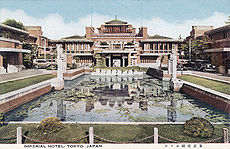
, the Imperial Hotel
Imperial Hotel, Tokyo
The Imperial Hotel, Tokyo, Japan, was created in the late 1880s at the request of the Japanese aristocracy to cater to the increasing number of western visitors to Japan. The hotel site is located just south of the Imperial Palace grounds, next to the previous location of the Palace moat...
in Tokyo
Tokyo
, ; officially , is one of the 47 prefectures of Japan. Tokyo is the capital of Japan, the center of the Greater Tokyo Area, and the largest metropolitan area of Japan. It is the seat of the Japanese government and the Imperial Palace, and the home of the Japanese Imperial Family...
was in the shape of a Mesoamerican pyramid. His Ennis House
Ennis House
The Ennis House is a residential dwelling in the Los Feliz neighborhood of Los Angeles, California, USA, south of Griffith Park. The home was designed by Frank Lloyd Wright for Charles and Mabel Ennis in 1923, and built in 1924....
and Millard House
Millard House
Millard House, also known as La Miniatura, is a textile block house designed by Frank Lloyd Wright and built in 1923 in Pasadena, California. It was listed on the National Register of Historic Places in 1976.-Wright's textile block houses:...
(La Miniatura) in Los Angeles are built in his concrete textile block system, with bas reliefs and modular unit construction evoking the geometric patterning on the façades of Uxmal
Uxmal
Uxmal was dominant from 875 to 900 CE. The site appears to have been the capital of a regional state in the Puuc region from 850-950 CE. The Maya dynasty expanded their dominion over their neighbors. This prominence didn't last long...
buildings.
Wright's son, landscape architect and architect Lloyd Wright
Lloyd Wright
Frank Lloyd Wright, Jr. , commonly known as Lloyd Wright, was an American landscape architect and architect, most active in Los Angeles and Southern California...
, served as construction manager for his father's four textile block houses. He independently designed the iconic Mayan-modernist John Sowden House
John Sowden House
John Sowden House, also known as the "Jaws House", is a residence built in 1926 in the Los Feliz section of Los Angeles, California. Built by Lloyd Wright, the house is noted for its use of ornamented concrete blocks and for its striking facade, resembling either a Mayan temple or the gaping open...
in 1926 in the Los Feliz District
Los Feliz, Los Angeles, California
Los Feliz, also Rancho Los Feliz is an affluent, hilly neighborhood in the Hollywood district of Los Angeles, California, named after its land grantee José Vicente Feliz....
of Hollywood
Greater Hollywood, Los Angeles, California
Greater Hollywood is a region of the City of Los Angeles, United States. It encompases those areas that are a part of the Hollywood, Los Angeles, California district, or are adjacent to it and have similar characteristics. These are listed below....
.
Wright's disciple Arata Endo
Arata Endo
Arata Endo Arata Endo (Japanese: 遠藤 新) Arata Endo (Japanese: 遠藤 新) (January 1, 1889 - June 29, 1951)was a Japanese architect. He was a disciple of Frank Lloyd Wright.One of his most important works was the Kōshien Hotel, the architectural style being heavily influenced by Wright's Imperial Hotel,...
constructed the Kōshien Hotel
Kōshien Hotel
The was a Mayan Revival-style hotel in Nishinomiya, Hyōgo, Japan, constructed by Arata Endo, a disciple of Frank Lloyd Wright. It is now used as a hall forming part of Mukogawa Women's University, and is known as the .-History:The Kōshien Hotel opened in 1930...
in the 1930s, heavily influenced by the architecture of the Imperial Hotel in Tokyo.
Much later, the massive pyramid of Beth Sholom Synagogue
Beth Sholom Synagogue
Beth Sholom Congregation is a Conservative synagogue located in the Philadelphia suburb of Elkins Park, Pennsylvania. It is the only synagogue designed by famed architect Frank Lloyd Wright...
with its geometric roof detailing is perhaps the most direct Wright evocation of Maya form.
Prominent Examples
Robert Stacy-Judd
Robert Stacy-Judd was an English architect and author who designed theaters, hotels, and other commercial buildings in the Mayan Revival architecture Style in Great Britain and the United States...
's Aztec Hotel
Aztec Hotel
The Aztec Hotel is a historical landmark building in Monrovia, in the San Gabriel Valley, California. The Hotel is one of the outstanding examples of Mayan Revival architecture still in existence. It was designed by architect Robert Stacy-Judd, and built on the legendary original U.S. Route 66 in...
of 1924-1925. Its façade, interiors and furniture incorporated abstract patterns inspired by the Maya script
Maya script
The Maya script, also known as Maya glyphs or Maya hieroglyphs, is the writing system of the pre-Columbian Maya civilization of Mesoamerica, presently the only Mesoamerican writing system that has been substantially deciphered...
with Art Deco
Art Deco
Art deco , or deco, is an eclectic artistic and design style that began in Paris in the 1920s and flourished internationally throughout the 1930s, into the World War II era. The style influenced all areas of design, including architecture and interior design, industrial design, fashion and...
influences, and it was built on the original U.S. Route 66
U.S. Route 66
U.S. Route 66 was a highway within the U.S. Highway System. One of the original U.S. highways, Route 66 was established on November 11, 1926 -- with road signs erected the following year...
in Monrovia, California
Monrovia, California
Monrovia is a city located in the foothills of the San Gabriel Mountains in the San Gabriel Valley of Los Angeles County, California, United States. The population was 36,590 at the 2010 census, down from 36,929 at the 2000 census...
. Stacy-Judd was directly influenced by John Lloyd Stephens
John Lloyd Stephens
John Lloyd Stephens was an American explorer, writer, and diplomat. Stephens was a pivotal figure in the rediscovery of Maya civilization throughout Middle America and in the planning of the Panama railroad....
writings, and perhaps even more so by the illustrations by Frederick Catherwood
Frederick Catherwood
Frederick Catherwood was an English artist and architect, best remembered for his meticulously detailed drawings of the ruins of the Maya civilization. He explored Mesoamerica in the mid 19th century with writer John Lloyd Stephens...
as presented in their book Incidents of Travel in Central America, Chiapas and Yucatan, a work that introduced many to the wondrous ruins of Central America. In it Stacy-Judd explains the choice of the name of the hotel.
When the hotel project was first announced, the word Maya was unknown to the layman. The subject of Maya culture was only of archaeological importance, a, at that, concerned but a few exponents. As a word Aztec was fairly well known, I baptized the hotel with that name, although all the decorative motifs are MayaAlthough the buildings use of reinforced concrete to create the intricate designs on the exterior one opinionated observer wrote:
The bizarre Aztec forms may create the atmosphere desired, and will serve the legitimate publicity interests of the establishment, but it would be deplorable if an "Aztec Movement" set in and the style copyists were diverted from noble examples to the forms of a semi-barbaric people.
Other prominent buildings in this style include:
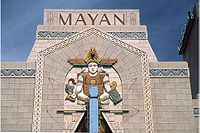
- the Mayan TheaterMayan TheaterThe Mayan Theater at 1014 South Hill Street in Los Angeles, California is a landmark former picture palace.Designed by Stiles O. Clements of Morgan, Walls & Clements and opened in August 1927, the facade of the Mayan includes stylized pre-Columbian patterns and figures designed by sculptor...
in Los Angeles by Stiles O. ClementsStiles O. ClementsStiles Oliver Clements was a Los Angeles architect trained at the École des Beaux-Arts, Paris, and a key figure in the art deco movement of 1920s Los Angeles...
, 1927 - the Petroleum Building, Houston, by the Anglo-American architect Alfred Bossom, a notable proponent of Mayan Revival, 1927
- and the Fisher TheaterFisher BuildingThe Fisher Building is an ornate Art Deco skyscraper located on the corner of West Grand Boulevard and Second Avenue in the heart of the New Center area of Detroit, Michigan. It is constructed of limestone, granite, and several types of marble, and was financed by the Fisher family with proceeds...
by Albert Kahn in Detroit, where the great scholar of the Maya, Sylvanus G. Morley was involved in the design, 1928 - the Guardian BuildingGuardian BuildingThe Guardian Building is a skyscraper at 500 Griswold Street in the downtown of the city of Detroit, in the state of Michigan, in the United States of America. The Guardian is a class-A office building owned by Wayne County, Michigan and serves as its headquarters...
by Wirt C. RowlandWirt C. RowlandWirt Clinton Rowland was an American architect best known for his work in Detroit, Michigan.-Biography:...
of Smith Hinchman & GryllsSmith Hinchman & GryllsSmithGroup ranks as the United States' 7th largest architecture and engineering firm and employs 800. The firm is composed of client industry-focused practices serving Health, Learning, Science & Technology, and Workplace markets...
, 1928–1929 - 450 Sutter Street450 Sutter StreetThe 450 Sutter Medical Building is a 26-floor office tower located in San Francisco, California. It is known for its unique "neo-Mayan" Art Deco design by architect Timothy L. Pflueger...
in San Francisco by Timothy L. PfluegerTimothy L. PfluegerTimothy Ludwig Pflueger was a prominent architect, interior designer and architectural lighting designer in the San Francisco Bay Area in the first half of the 20th century. Together with James R...
, 1929 - the Mayan TheaterMayan TheaterThe Mayan Theater at 1014 South Hill Street in Los Angeles, California is a landmark former picture palace.Designed by Stiles O. Clements of Morgan, Walls & Clements and opened in August 1927, the facade of the Mayan includes stylized pre-Columbian patterns and figures designed by sculptor...
in Denver by Montana Fallis, 1929–1930 - The Lincoln Theater in Marion, Va. 1929
Sources
- Barrett, John. "The Pan American Union: Peace, Friendship, Commerce." Washington, D.C.: Pan American Union. 1911
- Braun, Barbara. Pre-Columbian Art and the Post-Columbian World: Ancient American Sources of Modern Art. New York. Harry N. Abrams. 1993.
- Gebhard, DavidDavid GebhardDavid S. Gebhard was a leading architectural historian, particularly known for his books on the architecture and architects of California. He was a long-time faculty member at the University of California, Santa Barbara, and was dedicated to the preservation of Santa Barbara architecture.Gebhard...
and Peres, Anthony. Robert Stacy-Judd: Maya Architecture and the Creation of a New Style. Capra PressCapra PressCapra Press was a Santa Barbara, California-based independent publishing house which has produced works by authors such as Henry Miller, Anaïs Nin, Raymond Carver, Ray Bradbury, Gretel Ehrlich, Ursula K...
. 1993. - Ingle, Marjorie I. The Mayan Revival Style: Art Deco Mayan Fantasy. University of New Mexico PressUniversity of New Mexico PressThe University of New Mexico Press, founded in 1929, is a university press that is part of the University of New Mexico. Its administrative offices are in the Office of Research , on the campus of UNM in Albuquerque....
. 1989. - ---. Atlantis: Mother of Empires. Los Angeles. De Vorse & Co. 1939
- ---. The Ancient Mayas, Adventures In the Jungles of Yucatan. Los Angeles. Haskell-Travers, Inc. 1934
- ---. A Maya Manuscript. Los Angeles. Philosophical Research SocietyPhilosophical Research SocietyThe Philosophical Research Society is an American nonprofit organization founded in 1934, by the prolific author and scholar Manly Palmer Hall, which provides learning and development of a philosophy of life which embraces conciliation of religion and science and higher understandings of life...
. 1940.
Phillips, Ruth Anne. " 'Pre-Columbian Revival': Defining and Exploring a U.S. Architectural Style, 1910-1940." Ph.D. diss. (New York: City University of New York, 2007).
- Willard, T. A., The City of the Sacred Well, Being a Narrative of the Discoveries and Excavations of Edward Herbert Thompson in the Ancient City of Chi-chen Itza With Some Discourse on the Culture and Development of the Mayan Civilization as Revealed by Their Art and Architecture, Here Set Down and Illustrated From Photographs. New York. Century Co. 1926