
Home      Discussion      Topics      Dictionary      Almanac
Signup       Login
Uxmal

Uxmal

Overview
Uxmal (Yucatec Maya: Óoxmáal) is a large pre-Columbian
Pre-Columbian
The Pre-Columbian era incorporates all period subdivisions in the history and prehistory of the Americas before the appearance of significant European influences on the American continents, spanning the time of the original settlement in the Upper Paleolithic to European colonization during the...

 ruined city of the Maya civilization
Maya civilization
The Maya is a Mesoamerican civilization, noted for the only known fully developed written language of the pre-Columbian Americas, as well as its art, architecture, and mathematical and astronomical systems. Initially established during the Preclassic period , many Maya cities reached their highest...

 in the state of Yucatán
Yucatán
Yucatán is one of the 31 states of Mexico, located on the north of the Yucatán Peninsula. The Yucatan peninsula includes three states: Yucatán, Campeche, and Quintana Roo; all three modern states were formerly part of the larger historic state of Yucatán in the 19th century. The state capital of...

, Mexico
Mexico
The United Mexican States , commonly known as Mexico , is a federal constitutional republic in North America. It is bordered on the north by the United States; on the south and west by the Pacific Ocean; on the southeast by Guatemala, Belize, and the Caribbean Sea; and on the east by the Gulf of...

. It is 78 km south of Mérida, Yucatán
Mérida, Yucatán
Mérida is the capital and largest city of the Mexican state of Yucatán and the Yucatán Peninsula. It is located in the northwest part of the state, about 35 km from the Gulf of Mexico coast, at...

, or 110 km from that city on Highway 261 towards Campeche, Campeche
Campeche, Campeche
Campeche is the capital city of the Mexican state of Campeche, located at,on the shore of the Bay of Campeche of the Gulf of Mexico. The city's population at the 2005 census was 211,671 people...

), 15 km south-southeast of the town of Muna.

Uxmal is pronounced "Oosh-mahl". The place name is Pre-Columbian and it is usually assumed to be an archaic Maya language
Maya language
A Maya language is one of a group of languages spoken by the Maya peoples of Mesoamerica.Maya language may also refer to:* Yucatec Maya language or Maya, a Mayan language spoken in the Yucatán Peninsula...

 phrase meaning "Built Three Times", although some scholars of the Maya language dispute this derivation.


While much work has been done at the popular tourist destination of Uxmal to consolidate and restore buildings, little in the way of serious archeological excavation and research has been done; therefore, the city's dates of occupation are unknown and the estimated population (about 25,000 people) is at present only a very rough guess subject to change upon better data.
Discussion
Ask a question about 'Uxmal'
Start a new discussion about 'Uxmal'
Answer questions from other users
Full Discussion Forum
 
Encyclopedia
Uxmal (Yucatec Maya: Óoxmáal) is a large pre-Columbian
Pre-Columbian
The Pre-Columbian era incorporates all period subdivisions in the history and prehistory of the Americas before the appearance of significant European influences on the American continents, spanning the time of the original settlement in the Upper Paleolithic to European colonization during the...

 ruined city of the Maya civilization
Maya civilization
The Maya is a Mesoamerican civilization, noted for the only known fully developed written language of the pre-Columbian Americas, as well as its art, architecture, and mathematical and astronomical systems. Initially established during the Preclassic period , many Maya cities reached their highest...

 in the state of Yucatán
Yucatán
Yucatán is one of the 31 states of Mexico, located on the north of the Yucatán Peninsula. The Yucatan peninsula includes three states: Yucatán, Campeche, and Quintana Roo; all three modern states were formerly part of the larger historic state of Yucatán in the 19th century. The state capital of...

, Mexico
Mexico
The United Mexican States , commonly known as Mexico , is a federal constitutional republic in North America. It is bordered on the north by the United States; on the south and west by the Pacific Ocean; on the southeast by Guatemala, Belize, and the Caribbean Sea; and on the east by the Gulf of...

. It is 78 km south of Mérida, Yucatán
Mérida, Yucatán
Mérida is the capital and largest city of the Mexican state of Yucatán and the Yucatán Peninsula. It is located in the northwest part of the state, about 35 km from the Gulf of Mexico coast, at...

, or 110 km from that city on Highway 261 towards Campeche, Campeche
Campeche, Campeche
Campeche is the capital city of the Mexican state of Campeche, located at,on the shore of the Bay of Campeche of the Gulf of Mexico. The city's population at the 2005 census was 211,671 people...

), 15 km south-southeast of the town of Muna.

Uxmal is pronounced "Oosh-mahl". The place name is Pre-Columbian and it is usually assumed to be an archaic Maya language
Maya language
A Maya language is one of a group of languages spoken by the Maya peoples of Mesoamerica.Maya language may also refer to:* Yucatec Maya language or Maya, a Mayan language spoken in the Yucatán Peninsula...

 phrase meaning "Built Three Times", although some scholars of the Maya language dispute this derivation.

Ancient history


While much work has been done at the popular tourist destination of Uxmal to consolidate and restore buildings, little in the way of serious archeological excavation and research has been done; therefore, the city's dates of occupation are unknown and the estimated population (about 25,000 people) is at present only a very rough guess subject to change upon better data. Most of the architecture visible today was built between about 700 and 1100.

Maya chronicles say that Uxmal was founded about 500 A.D. by Hun Uitzil Chac Tutul Xiu. For generations Uxmal was ruled over by the Xiu family, was the most powerful site in western Yucatan, and for a while in alliance with Chichen Itza
Chichen Itza
Chichen Itza is a large pre-Columbian archaeological site built by the Maya civilization located in the northern center of the Yucatán Peninsula, in the Yucatán state, present-day Mexico....

 dominated all of the northern Maya area. Sometime after about 1200 no new major construction seems to have been made at Uxmal, possibly related to the fall of Uxmal's ally Chichen Itza and the shift of power in Yucatan to Mayapan
Mayapan
Mayapan , is a Pre-Columbian Maya site a couple of kilometers south of the town of Telchaquillo in the state of Yucatán, Mexico, approximately 40 km south-east of Mérida and 100 km west of Chichen Itza...

. The Xiu moved their capital to Maní
Maní, Yucatán
Maní is a small city, and surrounding municipality of the same name, in the Mexican state of Yucatán. It is about 100 km to the south south-east of Mérida, Yucatán, some 16 km east of Ticul, at....

, and the population of Uxmal declined.

After the Spanish conquest of Yucatán
Spanish conquest of Yucatán
The Spanish conquest of Yucatán was the campaign undertaken by the Spanish conquistadores against the Late Postclassic Maya states and polities, particularly in the northern and central Yucatán Peninsula but also involving the Maya polities of the Guatemalan highlands region...

 (in which the Xiu allied themselves with the Spanish), early colonial documents suggest that Uxmal was still an inhabited place of some importance into the 1550s, but no Spanish town was built here and Uxmal was soon after largely abandoned.

Description of the site


Even before the restoration work Uxmal was in better condition than many other Maya sites thanks to being unusually well built. Much was built with well-cut stones set into a core of concrete not relying on plaster to hold the building together. The Maya architecture here is considered matched only by that of Palenque
Palenque
Palenque was a Maya city state in southern Mexico that flourished in the seventh century CE. After its decline it was absorbed into the jungle, but has been excavated and restored and is now a famous archaeological site attracting thousands of visitors...

 in elegance and beauty. The Puuc
Puuc
Puuc is the name of either a region in the Mexican state of Yucatán or a Maya architectural style prevalent in that region. The word "puuc" is derived from the Maya term for "hill". Since the Yucatán is relatively flat, this term was extended to encompass the large karstic range of hills in the...

 style of Maya architecture predominates. Thanks to its good state of preservation, it is one of the few Maya cities where the casual visitor can get a good idea of how the entire ceremonial center looked in ancient times.

Some of the more noteworthy buildings include:

  • The Governor's Palace, a long low building atop a huge platform, with the longest façades in Pre-Columbian Mesoamerica
    Mesoamerica
    Mesoamerica or Meso-America is a region and culture area in the Americas, extending approximately from central Mexico to Honduras and Nicaragua, within which a number of pre-Columbian societies flourished before the Spanish colonization of the Americas in the 15th and 16th centuries...

    .
  • The Adivino (a.k.a. the Pyramid of the Magician
    Pyramid of the Magician
    The Pyramid of the Magician is a Mesoamerican step pyramid located in the ancient, Pre-Columbian city of Uxmal, Mexico. The structure is also referred to as the Pyramid of the Dwarf, Casa el Adivino, and the Pyramid of the Soothsayer...

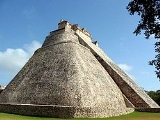
     or the Pyramid of the Dwarf), is a stepped pyramid structure, unusual among Maya structures in that its layers' outlines are oval or elliptical in shape, instead of the more common rectilinear plan. It was a common practice in Mesoamerica to build new temple pyramids atop older ones, but here a newer pyramid was built centered slightly to the east of the older pyramid, so that on the west side the temple atop the old pyramid is preserved, with the newer temple above it. The structure features in one of the best-known tales of Yucatec Maya folklore, "el enano del Uxmal" (the dwarf of Uxmal), which is also the basis for the structure's common name. Multiple versions of this tale are recorded, and the story was further popularised after one of these was recounted by John Lloyd Stephens
    John Lloyd Stephens
    John Lloyd Stephens was an American explorer, writer, and diplomat. Stephens was a pivotal figure in the rediscovery of Maya civilization throughout Middle America and in the planning of the Panama railroad....

     in his influential 1841 book, Incidents of Travel in Central America, Chiapas, and Yucatan. In the version told to Stephens in 1840, the pyramid was magically built overnight during a series of challenges issued to a dwarf by the gobernador (ruler or king) of Uxmal, as part of a competing trial of strength and magic against the king orchestrated by the dwarf's mother (a bruja, or witch).
  • The Nunnery Quadrangle (a nickname given to it by the Spanish; it was a government palace) is the finest of Uxmal's several fine quadrangles of long buildings with elaborately carved façades on both the inside and outside faces.
  • A large Ballcourt for playing the Mesoamerican ballgame
    Mesoamerican ballgame
    The Mesoamerican ballgame was a sport with ritual associations played for over 3000 years by the pre-Columbian peoples of Mesoamerica. The sport had different versions in different places during the millennia, and a modern version of the game, ulama, is still played in a few places by the local...

    , which an inscription there informs us was dedicated in 901 by the ruler Chan Chak K'ak'nal Ajaw
    Chan Chak K'ak'nal Ajaw
    Chan Chak K'ak'nal Ajaw, also known as Lord Chac before the decipherment of his corresponding name glyphs, is identified as a ruler of the pre-Columbian Maya polity at Uxmal in the 10th century....

    , also known as Lord Chac before the decipherment of his corresponding name glyphs.


A number of other temple-pyramids, quadrangles, and other monuments, some of significant size, and in varying states of preservation, are also at Uxmal. These include North Long Building, House of the Birds, House of the Turtles, Grand Pyramid, House of the Doves, and South Temple.

The majority of hieroglyphic inscriptions were on a series of stone stelae unusually grouped together on a single platform. The stelae depict the ancient rulers of the city, and they show signs that they were deliberately broken and toppled in antiquity; some were re-erected and repaired. A further suggestion of possible war or battle is found in the remains of a wall which encircled most of the central ceremonial center.

A large raised stone pedestrian causeway links Uxmal with the site of Kabah, some 18 km to the south. Archaeological research at the small island site of Uaymil
Uaymil
Uaymil is pre-Columbian Maya archaeological site located on the Gulf Coast of northern Campeche. The settlement of Uaymil occupies a small island approximately 2.5 kilometers inland from the coast and 25 km north of Jaina...

, located to the west on the Gulf coast
Gulf Coast of Mexico
The Gulf Coast of Mexico stretches along the Gulf of Mexico from the border with the United states at Matamoros all the way to the tip of the Yucatán Peninsula at Cancún. It includes the coastal regions along the Bay of Campeche. Major cities include Veracruz, Tampico, and Coatzacoalcos....

, may have served as a port
Port
||-||-||-||-||-||-||-||-|}A port is a facility for receiving ships and/or transferring cargo. It is usually found at the edge of an ocean, sea, river, or lake. The best ports have deep water in channels or berths, and protection from the wind and waves...

 for Uxmal and provided the site access to the circum-peninsular trade network.

Modern history of the ruins


The site, located not far from Mérida beside a road to Campeche, has attracted many visitors since the time of Mexico's independence. The first detailed account of the ruins was published by Jean Frederic Waldeck in 1838. John Lloyd Stephens
John Lloyd Stephens
John Lloyd Stephens was an American explorer, writer, and diplomat. Stephens was a pivotal figure in the rediscovery of Maya civilization throughout Middle America and in the planning of the Panama railroad....

 and Frederick Catherwood
Frederick Catherwood
Frederick Catherwood was an English artist of Northern Irish ancestry, and architect, best remembered for his meticulously detailed drawings of the ruins of the Maya civilization. He explored Mesoamerica in the mid 19th century with writer John Lloyd Stephens...

 made two extended visits to Uxmal in the early 1840s, with architect/draftsman Catherwood reportedly making so many plans and drawings that they could be used to construct a duplicate of the ancient city (unfortunately most of the drawings are lost). Désiré Charnay
Désiré Charnay
Claude-Joseph Désiré Charnay was a French traveller and archaeologist notable both for his explorations of Mexico and Central America, and for the pioneering use of photography to document his discoveries....

 took a series of photographs of Uxmal in 1860. Some three years later Empress Carlota of Mexico visited Uxmal; in preparation for her visit local authorities had some statues and architectural elements depicting phallic
Penis
The penis is an external sexual organ of certain biologically male organisms, in both vertebrates and invertebrates....

 themes removed from the ancient façade
Facade
A facade or façade is generally one side of the exterior of a building, especially the front, but also sometimes the sides and rear. The word comes from the French language, literally meaning "frontage" or "face"....

s.

Sylvanus G. Morley made a map of the site in 1909 which included some previously overlooked buildings. The Mexican government's first project to consolidate some of the structures from risk of collapse or further decay came in 1927. In 1930 Frans Blom
Frans Blom
Frans Blom was a Danish explorer and archaeologist....

 led a Tulane University
Tulane University
Tulane University is a private, nonsectarian research university located in New Orleans, Louisiana, United States...

 expedition to the site which included making plaster casts of the façades of the "Nunnery Quadrangle"; using these casts a replica of the Quadrangle was constructed and displayed at the 1933 World's Fair in Chicago, Illinois. Unfortunately, the plaster replicas of the architecture were destroyed following the fair, but some of the plaster casts of Uxmal's monuments are still kept at Tulane's Middle American Research Institute. In 1936 a further Mexican government repair and consolidation program was begun under José Erosa Peniche.

Queen Elizabeth II of the United Kingdom
Elizabeth II of the United Kingdom
Elizabeth II is the queen regnant of sixteen independent states known informally as the Commonwealth realms: the United Kingdom, Canada, Australia, New Zealand, Jamaica, Barbados, the Bahamas, Grenada, Papua New Guinea, the Solomon Islands, Tuvalu, Saint Lucia, Saint Vincent and the Grenadines,...

 visited on 27 February 1975 for the inauguration of the site's sound & light show; when the presentation reached the point where the sound system played the Maya prayer to Chaac
Chaac
Chaac is the name of the Maya rain deity. With his lightning axe, Chaac strikes the clouds and produces thunder and rain. Chaac corresponds to Tlaloc among the Aztecs.-Rain Deities and Rain Makers:...

, a sudden torrential downpour fell upon the gathered dignitaries, despite the fact that it was the middle of the dry season.

Three hotels and a small museum have been built within walking distance of the ancient city.

See also


External links


Uxmal web site at Reed College. Over a thousand 19th - 21st century photographs of Uxmal. http://academic.reed.edu/uxmal/