

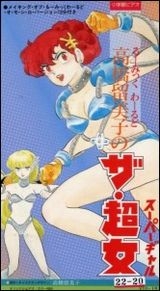
Maris the Chojo

Encyclopedia
, literally translated as "The Supergirl", and originally titled Supergal in U.S. markets, is a one shot
manga
story by Rumiko Takahashi
. It ran in the October 1980 special edition
of Shōnen Sunday
and was later made into an anime
OVA
.
In North America, it was released on VHS
and laserdisc
by Central Park Media
under the "Rumik World
" series (which also included OVAs Laughing Target
, Fire Tripper
, and Mermaid Forest). It was originally released under the title "Supergal", but this was changed for allegedly legal reasons.
is usually the only survivor of Krypton, while the entire population of Thanatos escaped.)
So to keep the destruction her race does to a minimum, Thanatosians are made to wear harnesses that limit their strength. However, Maris accidentally destroys everything she touches and as all damages are docked from her wages, every mission she's assigned to by the Inter-Galactic Space Patrol takes her further in debt. * Note: Maris' obsession with money is demonstrated by her hair ornaments, in the shape of the symbol for Yen (Japanese money).
Traveling with Maris is Murphy, from a kitsune
-like race. He can create nine copies of anything he wants with his tail and is forever teasing Maris.
However, things may be looking up. Koganemaru, the son of an intergalactic billionaire has been kidnapped. This may be the chance that Maris needed to become financially independent, as she figures that he'll be so indebted to her that he might ask for her hand in her marriage.
There's just one tiny (well, large) problem. The kidnapper is Sue, an opponent of Maris from her days as a wrestler, and she's out for revenge. After causing Maris to crash, she heads back to her highly-adored base, where she meets her fellow kidnapper.
When Maris catches up again in an even more broken-down rocketship, she and Sue engage in a wrestling match to the death, made all the more difficult by Maris having a remote-controlled chip on her that prevents her from removing her harness, leaving Maris at Sue's mercy. With Murphy's help, she gets free, and destroys Sue's base.
At the end, it is revealed that Sue's fellow kidnapper is Koganemaru, who was bored and decided to try being evil. Sadly for Maris, he chooses to comfort Sue, and even proposes to her. Naturally, Maris is furious, and the story ends as she is destroying her ship, while being restrained by Murphy.
One shot (comic)
A one-shot is a comic book that is a pilot or a stand-alone story created as a single issue, rather than the more typical series format.-United States:...
manga
Manga
Manga is the Japanese word for "comics" and consists of comics and print cartoons . In the West, the term "manga" has been appropriated to refer specifically to comics created in Japan, or by Japanese authors, in the Japanese language and conforming to the style developed in Japan in the late 19th...
story by Rumiko Takahashi
Rumiko Takahashi
is a Japanese manga artist.Takahashi is one of the wealthiest individuals, and the most affluent manga artists in Japan. The manga she creates are popular worldwide, where they have been translated into a variety of languages...
. It ran in the October 1980 special edition
Special edition
The terms special edition, limited edition and variants such as deluxe edition, collector's edition and others, are used as a marketing incentive for various kinds of products, originally published products related to the arts, such as books, prints or recorded music and films, but now including...
of Shōnen Sunday
Shonen Sunday
, first published on March 17, 1959, is a weekly shōnen manga magazine published in Japan by Shogakukan. Contrary to its title, Weekly Shōnen Sunday issues are released on Wednesdays.- History :...
and was later made into an anime
Anime
is the Japanese abbreviated pronunciation of "animation". The definition sometimes changes depending on the context. In English-speaking countries, the term most commonly refers to Japanese animated cartoons....
OVA
Original video animation
, abbreviated as media , are animated films and series made specially for release in home-video formats. The term originated in relation to Japanese animation...
.
In North America, it was released on VHS
VHS
The Video Home System is a consumer-level analog recording videocassette standard developed by Victor Company of Japan ....
and laserdisc
Laserdisc
LaserDisc was a home video format and the first commercial optical disc storage medium. Initially licensed, sold, and marketed as MCA DiscoVision in North America in 1978, the technology was previously referred to interally as Optical Videodisc System, Reflective Optical Videodisc, Laser Optical...
by Central Park Media
Central Park Media
Central Park Media was an American multimedia entertainment company based in New York City, New York, that was active in the distribution of East Asian cinema, television series, anime, manga and manhwa titles in North America prior to its bankruptcy in 2009...
under the "Rumik World
Rumic World
, later reprinted in Japan as , is a series of short manga stories created by Rumiko Takahashi, mostly created early in her career before Ranma ½. These tend to be comedies....
" series (which also included OVAs Laughing Target
Laughing Target
is an anime OVA released in Japan in 1987. It was licensed for North American release by Central Park Media, but this license has since expired...
, Fire Tripper
Fire Tripper
is an anime OVA based on a manga story by Rumiko Takahashi. In North America, it was released on VHS by Central Park Media under the "Rumik World" series...
, and Mermaid Forest). It was originally released under the title "Supergal", but this was changed for allegedly legal reasons.
Summary
Maris doesn't exactly have the greatest life. Her father's an alcoholic, her mother's an airhead, and to top it off, she's always broke. Why? Maris is a Thanatosian, and Thanatosians have six times the strength of a normal human being. Generally, this would not be a bad thing, except that the planet Thanatos blew up years ago, and the rest of the galaxy is not set up for people who are six times as strong as everyone else. (Thanatos blowing up is similar to Krypton's fate, except that SupermanSuperman
Superman is a fictional comic book superhero appearing in publications by DC Comics, widely considered to be an American cultural icon. Created by American writer Jerry Siegel and Canadian-born American artist Joe Shuster in 1932 while both were living in Cleveland, Ohio, and sold to Detective...
is usually the only survivor of Krypton, while the entire population of Thanatos escaped.)
So to keep the destruction her race does to a minimum, Thanatosians are made to wear harnesses that limit their strength. However, Maris accidentally destroys everything she touches and as all damages are docked from her wages, every mission she's assigned to by the Inter-Galactic Space Patrol takes her further in debt. * Note: Maris' obsession with money is demonstrated by her hair ornaments, in the shape of the symbol for Yen (Japanese money).
Traveling with Maris is Murphy, from a kitsune
Kitsune
is the Japanese word for fox. Foxes are a common subject of Japanese folklore; in English, kitsune refers to them in this context. Stories depict them as intelligent beings and as possessing magical abilities that increase with their age and wisdom. Foremost among these is the ability to assume...
-like race. He can create nine copies of anything he wants with his tail and is forever teasing Maris.
However, things may be looking up. Koganemaru, the son of an intergalactic billionaire has been kidnapped. This may be the chance that Maris needed to become financially independent, as she figures that he'll be so indebted to her that he might ask for her hand in her marriage.
There's just one tiny (well, large) problem. The kidnapper is Sue, an opponent of Maris from her days as a wrestler, and she's out for revenge. After causing Maris to crash, she heads back to her highly-adored base, where she meets her fellow kidnapper.
When Maris catches up again in an even more broken-down rocketship, she and Sue engage in a wrestling match to the death, made all the more difficult by Maris having a remote-controlled chip on her that prevents her from removing her harness, leaving Maris at Sue's mercy. With Murphy's help, she gets free, and destroys Sue's base.
At the end, it is revealed that Sue's fellow kidnapper is Koganemaru, who was bored and decided to try being evil. Sadly for Maris, he chooses to comfort Sue, and even proposes to her. Naturally, Maris is furious, and the story ends as she is destroying her ship, while being restrained by Murphy.
Characters
- ,
- ,
- ,
- ,